Quick Answer: What Are the Core EV Components?
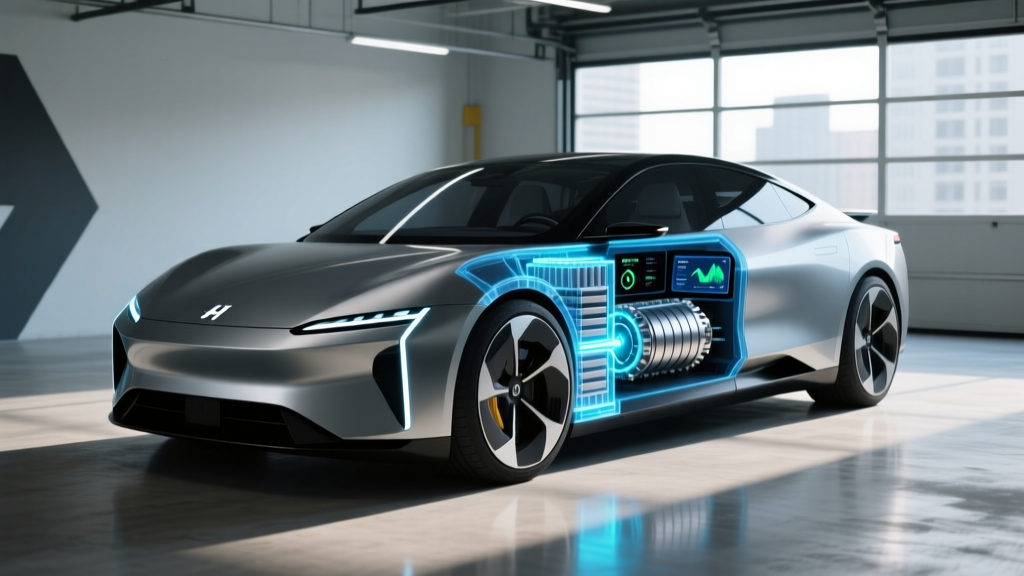
An electric vehicle replaces the engine, transmission, and fuel system of a gas car with four primary EV components: a high-voltage traction battery (typically 50–110 kWh, storing energy), one or more electric motors (converting energy to motion at 85–97% efficiency), a power inverter (converting DC battery power to AC motor power), and an onboard charger (converting AC grid power to DC for the battery). Supporting systems include a thermal management loop, a DC-DC converter, and regenerative braking hardware. Together, these parts contain roughly 20 moving components versus 2,000+ in a conventional internal-combustion drivetrain, which is why EVs require far less routine maintenance.
The Traction Battery: The Most Expensive EV Component
The high-voltage battery pack is the single most costly and consequential part of any electric vehicle. In 2026, most mainstream EVs use either NMC (nickel manganese cobalt) or LFP (lithium iron phosphate) lithium-ion cells. Understanding the difference directly affects your purchase decision, range expectations, and long-term ownership cost.
NMC batteries offer higher energy density — meaning more range per pound — and dominate long-range models. The Hyundai Ioniq 5 Long Range, for example, packs an 84.0 kWh usable NMC battery delivering an EPA-estimated 318 miles of range. LFP batteries, used in the Tesla Model 3 Standard Range and Ford Mustang Mach-E Select, sacrifice roughly 10–15% energy density but gain significantly longer cycle life (3,000+ full cycles versus ~1,500–2,000 for NMC), better thermal stability, and the ability to charge routinely to 100% without accelerated degradation.
| Attribute | NMC (Nickel Manganese Cobalt) | LFP (Lithium Iron Phosphate) |
|---|---|---|
| Energy Density | Higher (~250 Wh/kg cell-level) | Lower (~170 Wh/kg cell-level) |
| Typical Usable Capacity | 75–110 kWh | 50–77 kWh |
| Cycle Life | ~1,500–2,000 full cycles | ~3,000–5,000 full cycles |
| Routine Charging to 100% | Not recommended (80% daily ideal) | Recommended (calibrates BMS) |
| Cold-Weather Performance | Better low-temp conductivity | Greater range loss below 32°F |
| Cost per kWh (2026) | ~$115–$130 | ~$80–$100 |
| Common In | Long-range AWD models | Standard-range / RWD models |
Battery replacement cost remains a top buyer concern. As of 2026, a full pack replacement runs $8,000–$18,000 depending on capacity and vehicle. However, federal regulations mandate that EV batteries carry a warranty of at least 8 years / 100,000 miles (10 years / 150,000 miles in CARB states like California, New York, and Massachusetts), covering capacity retention typically below 70% of original. Real-world degradation data from fleets shows most NMC packs retain 88–92% capacity at 100,000 miles, and LFP packs retain 92–96%.
Electric Motors and the Power Inverter
Where a gas engine produces power through hundreds of controlled explosions per second, an electric motor does it through electromagnetic fields — silently and with far fewer parts. Most 2026 EVs use either a permanent magnet synchronous motor (PMSM) for maximum efficiency or an AC induction motor for durability and reduced rare-earth dependency.
A single-motor EV like the base Tesla Model 3 RWD produces 271 horsepower from one rear PMSM, achieving a 0–60 mph time of 5.8 seconds. Dual-motor AWD configurations, such as the Ioniq 5 Limited AWD (320 hp combined, 0–60 in 4.5 seconds), add a second motor on the opposite axle. High-performance models like the Lucid Air Sapphire use three motors — one front, two rear — to reach 1,234 hp and a 1.89-second 0–60 time.
The power inverter sits between the battery and motor, converting the battery's DC output into the precisely timed AC waveforms the motor requires. Modern inverters increasingly use silicon carbide (SiC) semiconductors rather than traditional silicon IGBTs. SiC inverters switch faster, waste less energy as heat, and improve overall drivetrain efficiency by 2–4% — which translates directly to 5–12 additional miles of real-world range per charge. The Hyundai E-GMP platform and Tesla's current-generation drive units both rely on SiC inverters.
Onboard Charger and DC-DC Converter
The onboard charger (OBC) is the EV component responsible for converting AC electricity from your home outlet or public Level 2 station into DC current the battery can store. Most 2026 EVs include an 11.5 kW onboard charger, meaning a full Level 2 charge at 48 amps adds roughly 32–44 miles of range per hour depending on vehicle efficiency. Some models, like the Ford F-150 Lightning Pro, offer an optional 19.2 kW OBC for faster home replenishment — critical for large-battery trucks that would otherwise take 12+ hours at 11.5 kW.
A secondary but essential component is the DC-DC converter, which steps down the high-voltage pack (400V or 800V) to 12V to power lights, infotainment, power windows, and the vehicle's computers. Unlike a gas car's alternator, the DC-DC converter has no moving parts and operates at 93–96% efficiency. When you see an EV with a dead 12V auxiliary battery — one of the most common roadside-assistance calls — it's typically a 12V battery aging issue, not a failure of the DC-DC converter itself.
EV Components vs Gas Car Equivalents
| Function | EV Component | Gas Car Equivalent | Maintenance Difference |
|---|---|---|---|
| Energy Storage | Traction Battery (50–110 kWh) | Fuel Tank (12–20 gal) | EV: no maintenance; Gas: fuel filter, evap system |
| Propulsion | Electric Motor(s) | Engine + Transmission | EV: no oil, plugs, belts; Gas: regular service |
| Power Conversion | Inverter + OBC | Alternator + ECU | EV: sealed, no service interval |
| Braking | Regen + Friction Brakes | Friction Brakes Only | EV: pads last 100k+ mi; Gas: 30–50k mi |
| Thermal Mgmt | Coolant Loops + Heat Pump | Radiator + Heater Core | Similar coolant service intervals |
Real Costs: EV Components vs Gas Car Ownership
Understanding what EV components do is useful, but the practical question is what they cost you over time. Below is a 5-year total cost of ownership comparison between a representative 2026 EV (Tesla Model 3 Long Range AWD, $42,380 MSRP before incentives) and a comparable gas sedan (Toyota Camry LE, $28,400 MSRP), assuming 15,000 miles/year, home Level 2 charging at $0.14/kWh national average, and gas at $3.40/gallon.
| Cost Category | 2026 Tesla Model 3 LR AWD | 2026 Toyota Camry LE (Gas) |
|---|---|---|
| Purchase Price (MSRP) | $42,380 | $28,400 |
| Federal Tax Credit (§30D) | −$7,500 (if eligible) | $0 |
| Effective Purchase | $34,880 | $28,400 |
| Fuel/Energy (5 yrs) | $3,940 (3,750 kWh/yr × $0.14) | $8,500 (500 gal/yr × $3.40) |
| Maintenance (5 yrs) | $1,200 (cabin filter, fluid top-offs, tires) | $4,500 (oil, filters, brakes, belts) |
| Insurance (5 yrs avg) | $11,500 | $8,750 |
| Estimated Depreciation | $16,200 | $11,800 |
| 5-Year Total | $67,720 | $61,950 |
| Cost Per Mile | $0.90 | $0.83 |
The EV's energy and maintenance savings — roughly $7,860 over five years — partially offset its higher purchase price and insurance premiums. Insurance runs 15–30% higher on EVs due to specialized repair requirements and higher parts costs. If you qualify for the full §30D federal tax credit (subject to income caps of $150K single / $300K joint, MSRP caps of $55K sedans / $80K SUVs/trucks, and battery sourcing requirements), the EV breaks even around year 4 and pulls ahead in year 5 and beyond. Without the credit, the gas car remains cheaper over the same period.
Note: state and local incentives vary significantly by jurisdiction and change frequently. Check your state energy office or the AFDC incentive database for current local rebates, which can add $1,000–$5,000 in states like Colorado, California, and Massachusetts.
Thermal Management and Real-World Range Impact
One EV component buyers routinely underestimate is the thermal management system. Unlike a gas engine that generates abundant waste heat, an EV must actively heat or cool its battery to maintain the optimal 68–95°F operating window. This system includes a liquid coolant loop, a compressor, and — on better-equipped models — a heat pump.
A heat pump extracts ambient heat from outside air (even at temperatures well below freezing) and transfers it into the cabin and battery, using roughly 1 kW of electrical power to produce 3–4 kW of heating. EVs without heat pumps rely on resistive PTC heaters, which consume 3–6 kW directly from the battery — cutting into range substantially.
In real-world cold-weather testing at 20°F, EVs with heat pumps lose approximately 20–30% of their EPA-rated range, while models without heat pumps can lose 35–45%. A Tesla Model Y with heat pump rated at 310 miles EPA might deliver 220–250 miles in sustained 20°F highway driving. The same car in 75°F conditions, driven at 65 mph, typically achieves 280–295 miles. This isn't a defect — it's physics — and it's why understanding thermal management as a core EV component matters for buyers in northern climates.
Common EV Component Misconceptions
| Myth | Fact |
|---|---|
| "EV batteries need replacement every 5 years" | Federal warranty mandates 8 yr/100k mi minimum. Fleet data shows 88–96% capacity retention at 100,000 miles. |
| "Electric motors wear out like gas engines" | EV motors have 2–3 moving parts (rotor, bearings). They routinely outlast 300,000+ miles with zero service. |
| "Regenerative braking eliminates brake service" | Regen handles 80–95% of deceleration, extending pad life to 100k+ miles — but rotors still need inspection and occasional replacement due to corrosion from underuse. |
| "More kW battery = always more range" | kWh (energy capacity) determines range, not kW (power). A 100 kWh battery with a heavy, inefficient vehicle may deliver less range than an 80 kWh pack in a lighter, more aerodynamic one. |
| "All EVs charge at the same speed" | Peak DC charge rates vary from 50 kW (older models) to 350+ kW (800V architectures). A 2026 Ioniq 5 at 240 kW peaks charges 10–80% in ~18 min; a Chevy Equinox EV at 150 kW takes ~30 min. |
What First-Time EV Buyers Should Know About Components
If you're evaluating your first EV, the component landscape can feel overwhelming. Here's a practical decision framework based on your specific situation:
Choose Your EV Based on Your Real Conditions
Choose an LFP battery EV if: You drive under 250 miles daily, have reliable home Level 2 charging, live in a mild climate, and want maximum battery longevity with minimal range-degradation anxiety. Models: Tesla Model 3 RWD, Ford Mustang Mach-E Select, Hyundai Ioniq 5 Standard Range.
Choose an NMC long-range EV if: You regularly drive 300+ miles between charges, take frequent road trips, live in a region with sparse public DC fast charging, or need AWD performance in snow. Models: Tesla Model 3 Long Range, Hyundai Ioniq 5 Long Range AWD, BMW i4 eDrive40.
Prioritize a heat pump if: You live where winter temperatures regularly drop below 35°F. This single component can preserve 50+ additional miles of range on a cold January commute compared to resistive heating. Standard on Tesla Model 3/Y, Hyundai/Kia E-GMP vehicles, and most premium EVs; still absent on some budget models.
Consider an 800V architecture if: You road-trip frequently and value short charging stops. Vehicles on 800V platforms (Hyundai Ioniq 5/6, Kia EV6/EV9, Porsche Taycan, Genesis GV60) sustain higher charge rates longer and achieve 10–80% charges in 18–22 minutes at 250–350 kW stations, versus 30–45 minutes for 400V competitors at 150 kW stalls.
Choose a PHEV instead if: You lack home charging access, regularly exceed 350 miles in a day, or live in a rural charging desert. A plug-in hybrid like the Toyota RAV4 Prime (42 miles EV-only, 38 MPG combined after depletion) eliminates range anxiety while still providing electric daily commuting. The trade-off: you maintain both an electric and a combustion drivetrain, doubling the systems that can require service.
Charging Access Is the Real Component Question
The most important "component" isn't under the hood — it's whether you can charge at home. Roughly 80% of EV charging happens at home on Level 2 (240V) equipment. If you have a garage or driveway with access to a 240V circuit (or can install one for $500–$2,000 including electrician, panel assessment, and permit), EV ownership is seamless. A typical 48-amp Level 2 station delivers 11.5 kW, adding 30–44 miles per hour of charging — enough to fully replenish any EV overnight.
If you cannot charge at home — apartment living, street parking, no electrical access — you'll rely on public Level 2 and DC fast charging. This adds 2–4 hours per week of dedicated charging time and costs roughly 2–3× more per mile than home charging ($0.30–$0.50/kWh at public DC stations versus $0.10–$0.18/kWh at home). This is the single biggest lifestyle variable that separates satisfied EV owners from frustrated ones.
Frequently Asked Questions
How many moving parts does an EV drivetrain have compared to a gas car?
An EV drivetrain contains roughly 20 moving parts — primarily the motor rotor, bearings, and reduction gear. A conventional internal-combustion drivetrain has over 2,000 moving parts across the engine, transmission, differential, and associated systems. This is the primary reason EVs eliminate oil changes, spark plug replacements, timing belt service, and transmission fluid flushes.
Do EV components require any regular maintenance?
Yes, but far less than gas vehicles. Expect to replace the cabin air filter ($30–$60 every 2 years), rotate tires every 6,000–8,000 miles (EVs are heavier and wear tires 20–30% faster due to instant torque), top off windshield washer fluid, and have the brake fluid checked every 2–3 years. Coolant loops for the battery and power electronics typically require a flush at 100,000–150,000 miles per manufacturer schedules.
What happens if the inverter or onboard charger fails?
These are sealed, solid-state components with no moving parts and failure rates well below 1% in the first 100,000 miles. If they do fail, they're covered under the power electronics warranty (typically 5 yr/60,000 mi for general components, 8 yr/100,000 mi for emissions-related electronics in CARB states). Out-of-warranty inverter replacement runs $2,000–$5,000; onboard charger replacement runs $1,500–$3,000.
Is the 12V battery in an EV the same as a gas car battery?
Functionally similar, yes — it powers the computers, lights, and accessories when the high-voltage system is off. Most 2026 EVs use either a traditional lead-acid 12V battery (lasting 3–5 years, $150–$250 to replace) or increasingly a lithium-ion 12V battery (lasting 6–8 years, $300–$500). A dead 12V battery will prevent an EV from starting even if the main traction pack is fully charged, which is why many EVs now include 12V battery monitoring in their apps.
Can I upgrade EV components after purchase — like adding a bigger battery?
No. Unlike a gas car where you might swap an engine or add a supercharger, EV battery packs, motors, and inverters are deeply integrated into the vehicle's structural and software architecture. You cannot upgrade a 60 kWh pack to a 90 kWh pack after purchase. This makes choosing the right battery capacity at the time of purchase critically important — buy for the longest trip you'll take regularly, not just your daily commute.