The Short Answer: EV Cold-Weather Range Loss
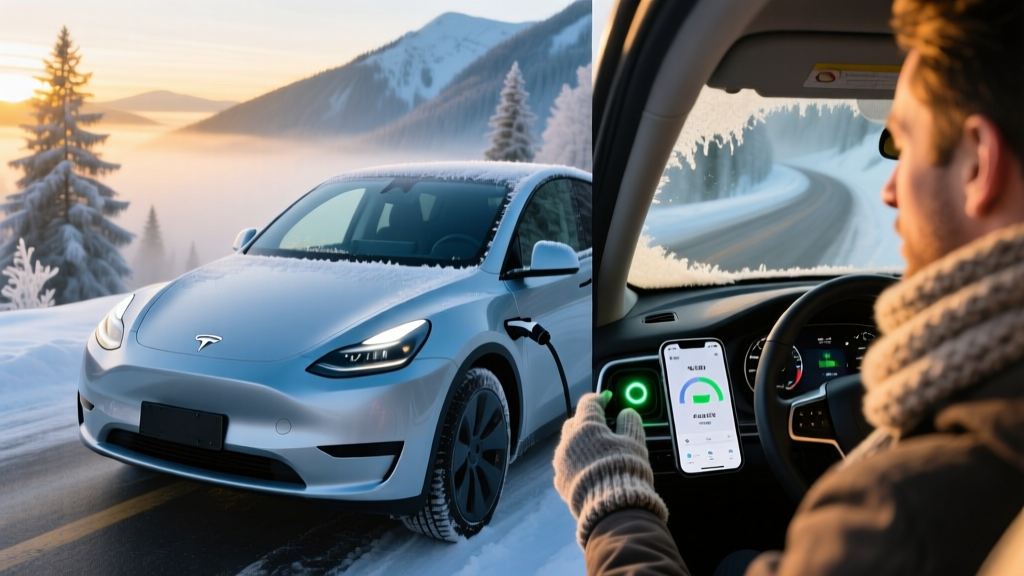
An EV in cold weather typically loses 20% to 40% of its EPA-rated range when temperatures drop below freezing (32°F / 0°C), depending on whether the vehicle uses a heat pump, battery preconditioning, and cabin heating demands. A 300-mile EPA-rated EV may deliver only 180–240 real-world miles at 20°F. However, modern EVs with heat pumps (like the Hyundai Ioniq 5, Tesla Model Y, and BMW iX) limit losses to roughly 15–25%. Cold also slows DC fast charging by 10–30 minutes unless the battery is preconditioned. For context, gas cars also lose efficiency in winter—about 10–20% lower MPG per fueleconomy.gov—but EVs have no cold-start issues and can be "refueled" in a warm garage every morning.
Why Cold Weather Hits EVs Harder Than Gas Cars
Electric vehicles face two distinct cold-weather penalties that gas cars don't experience in the same way:
- Battery chemistry slowdown: Lithium-ion cells (whether NMC or LFP) experience increased internal resistance at low temperatures. Ions move more sluggishly through the electrolyte, reducing the battery's ability to deliver and accept energy. This is a physical chemistry limitation, not a defect.
- Cabin heating load: A gas car generates massive waste heat from its engine—free warmth that gets piped into the cabin. An EV's electric motor is roughly 90% efficient, meaning very little waste heat exists. The vehicle must generate cabin heat from the battery, consuming 2–6 kW continuously depending on outside temperature and desired cabin warmth.
The combined effect is substantial. AAA testing found that at 20°F with HVAC on, EVs lost an average of 41% of range compared to mild-weather driving. Without cabin heat, the loss was closer to 12%—proving that heating is the dominant factor, not just battery chemistry.
Real-World Range Loss by Vehicle: What the Data Shows
Not all EVs suffer equally. The presence of a heat pump—a device that moves ambient heat rather than generating it from resistance elements—can cut heating energy consumption by 50–70%. Here's how popular 2025–2026 models perform in freezing conditions based on owner-reported data and independent testing:
| Vehicle | EPA Range | Heat Pump? | Est. Winter Range (20°F) | Range Loss % |
|---|---|---|---|---|
| Tesla Model Y LR (2025) | 320 mi | Yes | ~250–270 mi | 15–22% |
| Hyundai Ioniq 5 LR AWD | 290 mi | Yes | ~220–240 mi | 17–24% |
| Ford Mustang Mach-E ER AWD | 290 mi | Yes (2025+) | ~225–245 mi | 16–22% |
| Chevrolet Equinox EV 3RS | 319 mi | Yes | ~240–260 mi | 18–25% |
| Nissan Leaf SV Plus | 212 mi | No (resistance) | ~135–160 mi | 25–36% |
| BMW iX xDrive50 | 324 mi | Yes | ~260–280 mi | 14–20% |
Key insight: The Nissan Leaf's lack of a heat pump makes it one of the worst cold-weather EVs on the market. If you live where winters regularly drop below 30°F, prioritize a vehicle with a heat pump. It's the single biggest hardware factor in winter range retention.
Cold-Weather Charging: What Changes and How to Adapt
Cold batteries don't just lose range—they charge more slowly. Lithium-ion cells cannot safely accept high charge rates when cold, so the battery management system (BMS) restricts current to protect cell health. This has real consequences at DC fast chargers:
| Scenario | Peak Charge Rate | 10–80% Time | Notes |
|---|---|---|---|
| Warm battery (70°F+), preconditioned | 240 kW (Ioniq 5) | ~18 min | Optimal conditions |
| Cold battery (20°F), NO preconditioning | 40–80 kW | 45–60+ min | BMS throttles to protect cells |
| Cold battery (20°F), WITH preconditioning | 180–220 kW | ~22–28 min | Navigation to charger triggers warming |
Preconditioning is the process of warming the battery pack before a fast-charge session. Most modern EVs (Tesla, Hyundai/Kia, BMW, Ford, Rivian) do this automatically when you navigate to a DC fast charger using the built-in navigation. The battery's thermal management system uses energy from the pack to heat the cells to roughly 70–90°F, enabling near-peak charge rates.
Practical charging tips for winter:
- Always navigate to the charger using the car's built-in nav, even if you know the route. This triggers preconditioning.
- Charge at home before leaving. A battery that's been charging at Level 2 (7–11 kW) in a garage is already warm and ready for fast charging later.
- Expect the charge curve to taper earlier in cold weather. Even preconditioned, you may see peak rates sustained for a shorter window before tapering above 60–70% SoC.
- Level 2 home charging is largely unaffected by cold. Overnight charging at 7–11 kW generates enough gentle heat to keep the pack healthy, and you start every morning with a full battery regardless of temperature.
EV vs Gas Car in Winter: Cost and Efficiency Comparison
A common misconception is that gas cars are unaffected by cold. They aren't—though the impact is different. Here's a data-driven comparison for a 1,000-mile winter month in a region averaging 25°F:
| Factor | EV (e.g., Ioniq 5 AWD) | Gas Car (e.g., Toyota RAV4 AWD) |
|---|---|---|
| Baseline efficiency | 3.0 mi/kWh (100 MPGe combined) | 28 MPG combined |
| Winter efficiency (25°F avg) | ~2.2 mi/kWh (30% loss) | ~24 MPG (14% loss) |
| Energy for 1,000 mi | ~455 kWh | ~41.7 gallons |
| Cost (home charging $0.14/kWh) | $63.70 | — |
| Cost (gasoline $3.20/gal) | — | $133.44 |
| Cold-start reliability | No issues (no engine) | Battery/alternator strain, thickened oil |
| Morning "refuel" convenience | Full battery every AM (home L2) | Trip to gas station required |
| Idling to warm up | Zero cost (heat from grid) | Wastes fuel, emissions |
Even with a 30% range hit, the EV's winter fuel cost is roughly half that of a comparable gas crossover. And if your utility offers off-peak winter rates (common in the Midwest and Northeast), that $63.70 could drop to $40–45. According to the IRS §30D clean vehicle credit, qualifying new EVs can still receive up to $7,500 in federal tax credits (subject to MSRP caps, buyer income limits, and battery sourcing requirements), which partially offsets the higher upfront purchase price.
Winter Ownership Costs: The Full Picture
Beyond fuel, here's what a first-time EV buyer in a cold climate should budget for across a 5-year ownership period:
| Cost Category | EV (Ioniq 5 SEL, ~$47,500) | Gas (RAV4 XLE AWD, ~$33,500) |
|---|---|---|
| Purchase price (after $7,500 credit) | ~$40,000 | $33,500 |
| Home Level 2 charger install | $500–$1,500 | $0 |
| Fuel/energy (5 yrs, 12k mi/yr) | $3,200–$4,000 | $7,500–$8,500 |
| Maintenance (5 yrs) | $800–$1,200 | $2,500–$3,500 |
| Insurance (5 yrs) | $7,500–$9,500 | $5,500–$7,000 |
| Tires (winter set recommended) | $1,200–$1,800 | $1,200–$1,800 |
| 5-Year Total Cost | ~$53,200–$58,000 | ~$50,200–$54,300 |
The EV's higher insurance premiums (typically 15–30% above gas equivalents per industry data) and charger installation partially erase the fuel and maintenance savings. Over 5 years, the total cost gap narrows to roughly $2,000–4,000, with the EV breaking even around year 6–7. In states with additional EV rebates or HOV-lane access, the math tilts further in the EV's favor.
Common Cold-Weather EV Myths vs Facts
| Myth | Fact |
|---|---|
| "EVs can't handle winter—batteries die in the cold" | Norway, where EVs make up over 80% of new car sales, has harsh winters averaging 20°F. EVs work fine with planning. Range drops, but doesn't disappear. |
| "You'll get stranded with no warning" | Modern EVs provide accurate range estimates that adjust for temperature and driving style. The guess-o-meter is reliable when preconditioned and driven consistently. |
| "Charging doesn't work in the cold" | DC fast charging works, but slower without preconditioning. With navigation-triggered preconditioning, 10–80% takes only ~5–10 minutes longer than summer. |
| "EV batteries degrade faster in cold climates" | Cold actually slows degradation chemistry. The bigger degradation risk is heat. Tesla's fleet data shows under 12% degradation at 200,000 miles regardless of climate. Battery warranties cover 8 years/100,000 miles with a 70% capacity retention guarantee. |
| "You need to idle an EV to warm it up" | EVs can precondition the cabin and battery while plugged in, using grid power at zero battery cost. Schedule departure preconditioning via the app—walk out to a warm car with a full battery every morning. |
| "All EVs are equally bad in winter" | Heat pump-equipped EVs (Tesla, Hyundai/Kia E-GMP platform, BMW iX/i4) lose 15–25% range. Resistance-heater EVs (older Leaf, some base trims) lose 25–40%. The hardware matters enormously. |
Decision Framework: Should You Buy an EV in a Cold Climate?
Choose an EV for cold-weather ownership IF:
- You have access to home Level 2 charging (garage or covered driveway)—this is the single biggest winter advantage, giving you a full "tank" every morning without visiting a station
- Your daily round-trip commute is under 80 miles (leaving ample buffer even with 30% range loss)
- You select a model with a heat pump and battery preconditioning capability
- You're willing to plan longer road trips with an extra charging stop or two in winter
- You value lower operating costs and don't mind a slightly higher purchase price
Consider a PHEV or hybrid instead IF:
- You lack reliable home charging access (apartment, street parking, shared driveway)
- You regularly drive 200+ miles in sub-freezing temps without time for mid-route charging
- You live in a region with sparse DC fast-charging infrastructure (rural Great Plains, parts of the Mountain West)
- Your budget doesn't accommodate the $35,000+ entry point for a cold-capable EV
- You want zero range compromise in extreme cold—a PHEV like the Toyota RAV4 Prime (42 mi electric-only, then gas hybrid) eliminates the anxiety entirely
10 Practical Tips for Maximizing EV Range in Winter
- Precondition while plugged in. Schedule departure heating so the cabin and battery warm using grid power, not battery energy.
- Use seat heaters and steering wheel heater instead of cranking cabin air. Heated seats draw ~100W vs. 2,000–5,000W for cabin air heating.
- Set cabin temperature to 65–68°F instead of 72°F. Every degree below 70 saves roughly 1–2% range in sub-freezing conditions.
- Keep the battery between 20–80% SoC for daily use, but charge to 100% before long winter road trips (set the limit back to 80% after).
- Navigate to every DC fast charger using the car's built-in nav to trigger battery preconditioning.
- Drive 65 mph instead of 75 mph on the highway. Aerodynamic drag increases with the square of speed, and cold dense air makes it worse. This alone can recover 10–15% range.
- Use regenerative braking on moderate settings. Max regen on icy roads can cause rear-wheel slip. Many EVs auto-reduce regen in cold temps for safety.
- Install winter tires. They don't directly affect range significantly (1–3% more rolling resistance), but they dramatically improve traction and safety on snow and ice.
- Garage your EV if possible. A 40°F garage vs. a 15°F driveway means less energy spent warming the battery and cabin each morning.
- Plan for 30% range loss on winter road trips and add a buffer. If your route requires 200 miles, make sure your EV's EPA rating is at least 285 miles, or plan a charge stop.
Frequently Asked Questions
Do EVs lose range permanently from cold weather?
No. Range loss from cold is temporary and fully recovers when temperatures rise. The battery isn't damaged—it's just operating less efficiently due to electrochemistry. Once the pack warms up (through driving, preconditioning, or charging), full capacity returns.
Which EV is best for cold weather in 2025–2026?
Top cold-weather performers include the Tesla Model Y Long Range (heat pump, excellent preconditioning, Supercharger network), Hyundai Ioniq 5 (heat pump, fast preconditioned charging at 240 kW peak), BMW iX (heat pump, strong range retention), and Rivian R1T/R1S (heat pump, robust thermal management). All offer over 280 miles EPA with roughly 20% or less winter loss.
How much does home Level 2 charging cost to install?
A typical Level 2 (240V, 32–48 amp) home charger installation costs $500–$1,500 if your electrical panel has sufficient capacity (a 200-amp panel is standard in most homes built after 2000). If you need a panel upgrade from 100A to 200A, expect $1,500–$3,000 additional. The charger hardware itself runs $300–$700 for quality units like the ChargePoint Home Flex, Emporia Vue, or Tesla Wall Connector. Check with a licensed electrician for your specific situation.
Does the federal tax credit apply to EVs bought in cold-weather states?
The IRS §30D clean vehicle credit applies nationwide regardless of climate. For 2025–2026, qualifying new EVs can receive up to $7,500, but eligibility depends on MSRP caps ($55,000 for cars, $80,000 for SUVs/trucks), buyer income limits ($150,000 single / $300,000 joint AGI), and battery component/critical mineral sourcing requirements. The credit can now be transferred to the dealer as a point-of-sale discount. Consult a tax professional to confirm your eligibility, as rules are subject to change.
Can I use a DC fast charger in sub-zero temperatures?
Yes, but expect significantly slower charging unless the battery is preconditioned. At 0°F without preconditioning, peak charge rates may be limited to 30–50 kW, making a 10–80% charge take 60+ minutes. With proper preconditioning (triggered by navigating to the charger), expect near-normal speeds with only a 5–10 minute penalty. Never force high-rate charging on a cold-soaked battery—the BMS prevents this anyway to protect cell health.
Is a PHEV better than a BEV for extreme cold climates?
For drivers who regularly face sub-zero temperatures, drive 200+ miles daily, or lack home charging, a PHEV like the Toyota RAV4 Prime or Jeep Wrangler 4xe offers a practical middle ground: 35–42 miles of electric-only range for daily commuting, plus a gas engine for long winter trips with zero range anxiety. If you have home charging and a sub-80-mile commute, a BEV with a heat pump is more cost-effective over 5 years.