The Short Answer on EV Cold Weather Range
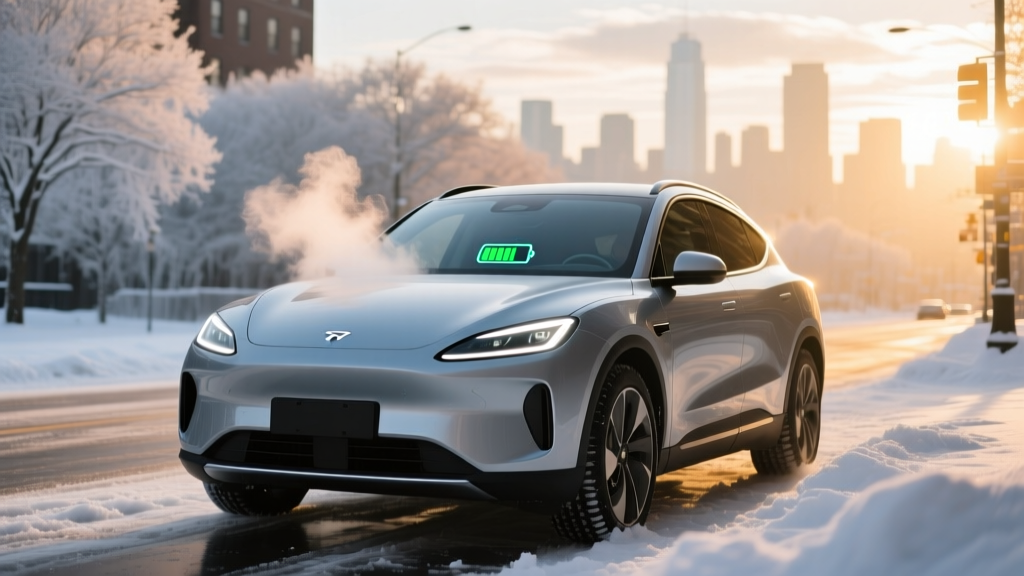
When temperatures drop below freezing (32°F / 0°C), expect your EV's real-world range to fall 20% to 30% below its EPA sticker estimate. At 0°F (-18°C), losses can reach 35% to 40% depending on whether you use cabin heat. This happens because lithium-ion batteries lose efficiency in cold temperatures, and unlike gas engines, EVs have no waste heat to warm the cabin — they must generate heat electrically, drawing directly from the battery. A 300-mile EPA-rated EV typically delivers 210–240 real-world miles at 20°F with the heater running. Models equipped with a heat pump (standard on most 2025–2026 Hyundai, Kia, Tesla, and BMW EVs) recover roughly 5–10% of that lost range by extracting ambient heat more efficiently than resistive heating elements.
Why Cold Temperatures Slash EV Range
Three distinct physics problems stack up when the mercury drops:
1. Battery electrochemistry slows down. Lithium-ion cells rely on lithium ions shuttling between the anode and cathode through a liquid electrolyte. Below roughly 40°F, the electrolyte becomes more viscous, internal resistance rises, and the battery management system (BMS) restricts power flow to protect the cells. This means less usable energy (kWh) and slower charging.
2. Cabin and battery heating consume energy. A gasoline engine dumps roughly 60–70% of its fuel energy as waste heat — free cabin warmth. An EV motor is ~90% efficient, meaning very little waste heat exists. The vehicle must power a resistive heater (typically 3–6 kW draw) or a heat pump (1–3 kW draw) to keep the cabin at 70°F. Over a 2-hour winter commute, resistive heating alone can consume 6–12 kWh — the equivalent of 20–40 miles of range in a mid-size SUV.
3. Regenerative braking is limited. When the battery is cold, the BMS reduces regen braking power to prevent lithium plating on the anode. You'll notice the friction brakes engage more often on cold mornings, losing the energy recapture that boosts efficiency in warmer weather.
Real-World EV Cold Weather Range Data by Temperature
The figures below represent aggregated findings from owner reports, fueleconomy.gov data, and controlled testing by organizations like Recurrent Auto and the Norwegian Automobile Federation (NAF). They assume mixed driving with cabin heat set to 70°F.
| Outside Temp | Avg. Range Retained | 300-mi EPA EV Delivers | Primary Loss Factors |
|---|---|---|---|
| 70°F (21°C) | ~95–100% | 285–300 mi | Minimal — near-ideal conditions |
| 40°F (4°C) | ~88–93% | 264–279 mi | Mild cabin heat, slight battery resistance |
| 20°F (-7°C) | ~75–82% | 225–246 mi | Cabin heat draw, reduced regen, battery inefficiency |
| 0°F (-18°C) | ~62–72% | 186–216 mi | Heavy heating load, significant battery restriction |
| -20°F (-29°C) | ~55–65% | 165–195 mi | Maximum heating draw, severe battery limitations |
Key caveat: Highway driving at 70+ mph compounds these losses. Aerodynamic drag increases with air density (colder air is denser), and sustained high speeds prevent the battery from self-warming through use. Expect an additional 5–10% loss on highway trips versus city driving in cold weather.
Heat Pump vs. Resistive Heater: The Winter Efficiency Gap
Not all EVs handle cold equally. The single biggest hardware differentiator for winter driving is whether your vehicle uses a heat pump or a resistive (PTC) heater.
| Feature | Resistive (PTC) Heater | Heat Pump |
|---|---|---|
| How it works | Passes current through a heating element (like a toaster) | Extracts heat from outside air and compressor waste heat, transfers it to cabin |
| Power draw (cabin heat) | 3–6 kW continuous | 1–3 kW continuous (varies with outdoor temp) |
| Efficiency at 20°F | COP ~1.0 (1 kW electricity = 1 kW heat) | COP ~2.0–3.0 (1 kW electricity = 2–3 kW heat) |
| Efficiency at 0°F | COP ~1.0 | COP ~1.5–2.0 (diminishes but still outperforms PTC) |
| Range impact (20°F, 1-hr drive) | ~15–25 miles lost to heating | ~8–15 miles lost to heating |
| Cost to manufacturer | Low (~$200–400) | Higher (~$800–1,500) |
As of the 2026 model year, heat pumps are standard on most Tesla vehicles (Model 3, Model Y, Cybertruck), all Hyundai/Kia E-GMP vehicles (Ioniq 5, Ioniq 6, EV6, EV9), BMW iX/i4/i7, Rivian R1T/R1S (2025+), and the Ford F-150 Lightning (2024+). Many base-trim EVs from legacy automakers — including some Chevrolet, Nissan, and Subaru models — still use resistive heaters. Always verify before purchasing if you live in a cold climate.
EV vs. Gas Car in Winter: Honest Comparison
Gas cars also lose efficiency in cold weather — the U.S. Department of Energy estimates a 12% to 22% fuel economy drop for gasoline vehicles at 20°F compared to 77°F, due to cold-engine enrichment, thicker fluids, and increased aerodynamic drag. However, gas cars have one major winter advantage: the engine produces abundant waste heat for the cabin at zero additional fuel cost.
| Metric | EV (with heat pump) | EV (resistive heat) | Gas Car |
|---|---|---|---|
| Range/MPG loss at 20°F | 20–28% | 28–38% | 12–22% |
| Range/MPG loss at 0°F | 30–38% | 38–45% | 18–28% |
| Cabin heat energy source | Battery (costs range) | Battery (costs range) | Engine waste heat (free) |
| Cold-start impact | No warm-up needed; instant torque | No warm-up needed | Rich fuel mixture for 1–5 min; higher emissions |
| Idling to stay warm (1 hr) | ~2–4 kWh used (~8–15 mi range) | ~3–6 kWh used (~12–22 mi range) | ~0.2–0.4 gal gas (~$0.70–$1.40) |
| Block heater needed? | No (but preconditioning helps) | No | Recommended below -20°F |
The bottom line: Gas cars lose less range in cold weather, primarily because cabin heat is "free." But EVs still win on cold-start reliability (no cranking a frozen engine), instant cabin warmth (heat pumps produce warm air within 30–60 seconds vs. minutes for a cold gas engine), and zero tailpipe emissions during idle warm-up.
Cold Weather DC Fast Charging: What Changes
Cold batteries charge slower — this is non-negotiable physics. If you pull up to a 350 kW DC fast charger with a battery at 20°F, the BMS will limit charge rate to protect the cells from lithium plating (permanent damage). Expect peak charge rates to be 30% to 60% lower until the battery warms up to roughly 60–80°F internally.
Here's what that looks like in practice for a typical 77 kWh NMC battery (e.g., Hyundai Ioniq 5 / Kia EV6 class):
| Battery Temp at Arrival | Peak Charge Rate | 10–80% Time | Notes |
|---|---|---|---|
| Warm (preconditioned, ~75°F) | ~230–240 kW | ~18 minutes | Ideal — full charge curve available |
| Moderate (~50°F) | ~140–170 kW | ~28–35 minutes | BMS ramps slowly, then opens up |
| Cold (~30°F) | ~70–100 kW | ~45–55 minutes | Significant taper; BMS heats battery during charge |
| Very cold (~10°F) | ~40–70 kW | ~60–75 minutes | Most energy goes to battery heating initially |
Preconditioning is the fix. If your EV supports navigation-based battery preconditioning (Tesla, Hyundai/Kia E-GMP, BMW iX/i4, Ford Mustang Mach-E 2025+, Rivian), setting the charger as your navigation destination triggers the thermal management system to warm the battery en route. This can cut your 10–80% charge time in half on a cold day. Always precondition before fast charging in winter — it's the single most impactful thing you can do.
Myths vs. Facts About EVs in Cold Climates
| Myth | Fact (with data) |
|---|---|
| "EVs can't handle winter — they'll strand you." | Norway, where EVs make up over 80% of new car sales, has harsh winters averaging 20–30°F. The average Norwegian EV driver commutes daily without issue. A 300-mile EPA EV still delivers ~210+ real-world winter miles — more than enough for 95% of daily driving. (fueleconomy.gov) |
| "You can't charge an EV in freezing temperatures." | You can. The BMS manages battery heating during charging. It's slower when cold, but it works. Level 2 home charging is largely unaffected by cold because charging overnight generates some internal warmth and charge rates are low enough that the BMS doesn't need to restrict current. |
| "Cold weather destroys EV batteries permanently." | Cold weather reduces range temporarily — it does not cause permanent degradation. In fact, cold temperatures slow the chemical aging process. The bigger degradation risk is heat, not cold. Batteries in cold climates often show better long-term State of Health (SoH) than those in hot climates like Arizona or Texas. |
| "EVs are dangerous in snow because they're heavy." | EVs are heavier than comparable gas cars (typically 500–1,000 lbs more due to the battery), but that weight is low in the chassis (skateboard platform), giving them a lower center of gravity. Traction in snow depends on tires, not weight. AWD EVs with winter tires outperform most gas cars in snow. The instant torque control of electric motors also provides precise traction management. |
| "You need a garage to own an EV in a cold climate." | A garage helps (the car stays warmer, charging is faster, range loss is reduced), but it's not required. Thousands of EV owners in Minnesota, Canada, and Scandinavia charge outdoors. The key requirement is access to a Level 2 (240V) charger — whether at home, work, or a public station — so you can start each morning with a full battery. |
Winter EV Ownership Costs: The Real Numbers
Cold weather affects your wallet beyond range. Here's a realistic annual cost comparison for a driver in a cold climate (e.g., Minneapolis, Chicago, Boston) covering 12,000 miles/year, comparing a 2026 mid-size EV SUV (e.g., Hyundai Ioniq 5 AWD, $50,000 MSRP) to a comparable gas SUV (e.g., Toyota RAV4 AWD, $33,000 MSRP).
| Cost Category | EV (Ioniq 5 AWD class) | Gas SUV (RAV4 AWD class) | Notes |
|---|---|---|---|
| Fuel / Energy | $540–$780/yr | $1,560–$1,920/yr | EV: $0.14/kWh avg home rate, 3.5 mi/kWh winter. Gas: $3.30/gal, 25 MPG winter combined. |
| Maintenance | $150–$300/yr | $500–$800/yr | EV: cabin filter, wiper fluid, tire rotation, brake fluid check. Gas: oil changes, filters, spark plugs, transmission fluid. |
| Tires (winter set) | $200–$350/yr (amortized) | $200–$350/yr (amortized) | EVs are heavier and may wear tires ~10–15% faster; EV-specific tires (e.g., Michelin CrossClimate 2 EV) help. |
| Insurance | $1,800–$2,400/yr | $1,400–$1,800/yr | EVs cost 15–25% more to insure on average due to higher repair costs and parts pricing. |
| Depreciation (year 1–3 avg) | $5,500–$7,500/yr | $3,500–$5,000/yr | EVs currently depreciate faster; market is stabilizing but cold-climate resale is strong for AWD models. |
| Total Annual Cost | $8,190–$11,330 | $7,160–$9,870 | EV wins on fuel/maintenance; loses on insurance/depreciation. Tax credits narrow the gap. |
Federal tax credit context: Under current IRS §30D rules, qualifying new EVs can receive up to $7,500 — available as a point-of-sale rebate at the dealer. Eligibility depends on MSRP caps ($55,000 for sedans, $80,000 for SUVs/trucks), buyer income limits ($150K single / $300K joint), and battery critical-mineral and component sourcing requirements that tighten each year. Always verify current-year eligibility at the IRS link above or with a tax professional.
Actionable Decision Framework: Is an EV Right for Your Cold Climate?
Choose an EV for cold-weather driving IF:
- You have access to Level 2 home charging (240V, 32–48A) — starting every morning with a full battery eliminates most winter range concerns.
- Your typical daily driving is under 80 miles round-trip — even with 30% range loss, a 300-mile EPA EV covers this easily.
- You can select a model with a heat pump and navigation-based battery preconditioning.
- You're willing to invest in a set of winter tires ($600–$1,200 for a set of four, mounted).
- You value instant cabin heat, no cold-start struggles, and $800–$1,200/year fuel savings.
Consider a PHEV or stick with gas IF:
- You regularly drive 200+ miles in a single day in sub-zero temperatures with limited DC fast charging along your route.
- You have no access to home or workplace charging and rely entirely on public infrastructure.
- You live in a charging desert (rural areas of the Dakotas, Montana, northern Maine) where stations are 80+ miles apart.
- Your budget can't absorb the higher insurance premiums and you don't qualify for the §30D credit.
Consider a PHEV (plug-in hybrid) as the middle ground IF:
- You want electric commuting (30–40 miles EV range) but gas-engine backup for long winter road trips.
- You're not ready to fully commit to BEV ownership in extreme cold.
- Models like the Toyota RAV4 Prime (42 mi EV range, 38 MPG combined on gas) or Hyundai Tucson PHEV (33 mi EV range) offer flexibility without range anxiety.
7 Practical Tips to Maximize EV Range in Cold Weather
- Precondition while plugged in. Set your departure time in the EV's app. The car will warm the battery and cabin using grid power, not battery energy. You leave with a warm car and 100% charge.
- Use seat heaters and steering wheel heaters instead of cranking cabin heat. Heated seats draw ~50–100 watts vs. 3,000–5,000 watts for cabin air heating. Set cabin temp to 65°F and let the seat heaters keep your body warm.
- Precondition the battery before DC fast charging. Navigate to the charger using the car's built-in nav to trigger battery preheating. This alone can cut your charge time in half on a cold day.
- Keep your State of Charge (SoC) between 20–80% for daily use, but charge to 100% before long winter trips. LFP batteries (Tesla Model 3 RWD, some base-trim models) can and should be charged to 100% regularly — check your owner's manual for chemistry-specific guidance.
- Install winter tires. They improve traction and safety. While they slightly increase rolling resistance (~2–4% range penalty), the safety benefit far outweighs the cost.
- Drive 60–65 mph on the highway instead of 75. Aerodynamic drag increases with the square of speed, and cold air is ~10% denser than warm air. Dropping from 75 to 65 mph can recover 15–25 miles of range on a long trip.
- Park in a garage or use a car cover. Even an unheated garage keeps the car 10–20°F warmer than outside, reducing the energy needed to precondition.
Frequently Asked Questions
Do EVs lose range permanently after a cold winter?
No. Cold-weather range loss is temporary and fully reversible when temperatures rise. Your battery's long-term State of Health (SoH) is actually better preserved in cold climates than in hot ones. Data from Recurrent Auto shows that EVs in cooler northern U.S. states degrade ~1–2% less over 5 years than identical models in hot southern states. Permanent degradation is caused by heat exposure, high SoC storage, and frequent DC fast charging — not cold temperatures.
Can I charge my EV outdoors in sub-zero temperatures?
Yes. The vehicle's BMS will manage battery heating during the charge session. Level 2 charging (240V, 7–11 kW) generates enough internal current to gradually warm the pack. Expect the first 30–60 minutes of a cold-soak charge to be slower as the BMS directs energy to heating. Charging will accelerate as the pack warms. Use a weather-rated outdoor Level 2 charger (e.g., ChargePoint Home Flex, Emporia Vue) rated for -40°F operation.
Which EVs perform best in cold weather for 2026?
The top cold-weather EVs share three traits: a heat pump, AWD, and navigation-based battery preconditioning. Strong performers include the Tesla Model Y Long Range AWD (320 mi EPA, heat pump standard), Hyundai Ioniq 5 AWD (290 mi EPA, heat pump + preconditioning), BMW iX xDrive50 (324 mi EPA, heat pump), and Rivian R1T/R1S Dual-Motor (352 mi EPA, heat pump from 2025+). Always choose AWD for snow traction and verify the heat pump is included on your specific trim — some base trims omit it.
Does cold weather affect EV battery warranty?
No. Federal law requires EV battery warranties to cover at least 8 years / 100,000 miles (in CARB states, 10 years / 150,000 miles) for capacity retention below a specified threshold (typically 70% of original capacity). Cold weather does not void this warranty. However, damage from improper charging (e.g., using non-certified equipment) or modifications could. Always follow the manufacturer's cold-weather charging guidelines.
How much does it cost to precondition an EV in winter?
Preconditioning typically draws 2–5 kWh from the grid (at $0.14/kWh average U.S. residential rate), costing roughly $0.28–$0.70 per session. Over a 150-day winter heating season, that's $42–$105 total — a fraction of the fuel cost for warming up a gas car (which idles at ~0.2–0.4 gal/hour, or $100–$200 for the same season). The preconditioning energy is an investment: it preserves 15–30 miles of range per trip and protects battery health.