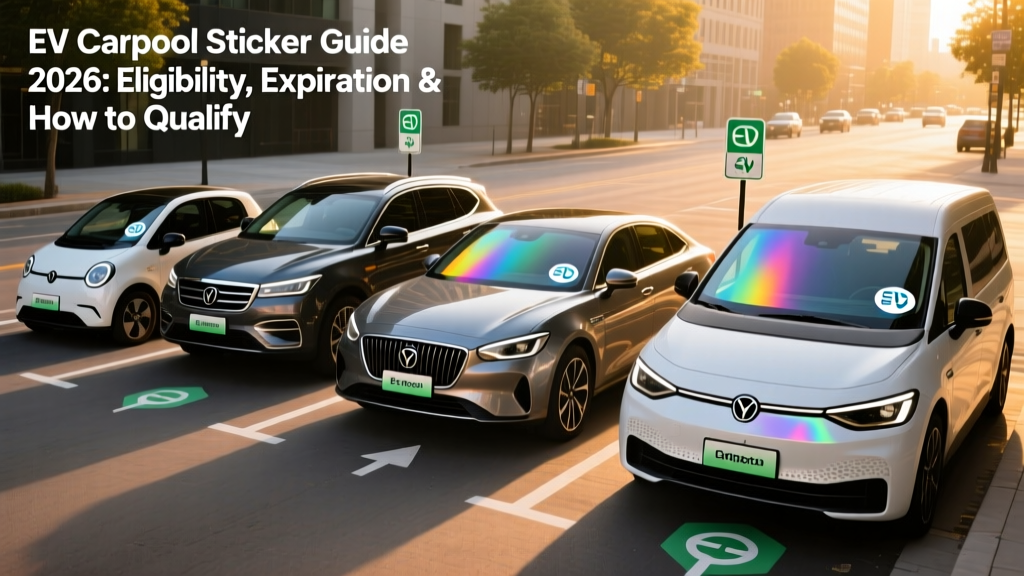
If you're searching for an EV carpool sticker, you're likely in California — the only state that has offered HOV lane access decals specifically tied to zero-emission and plug-in hybrid vehicle purchases. Here's the direct answer: California's Clean Air Vehicle (CAV) decal program is phasing out. As of January 1, 2025, the DMV stopped issuing new HOV lane stickers for vehicles that hadn't already received one. Vehicles with existing decals can retain them through their expiration date, but no new applications are being accepted. This means buying an EV in 2026 does not grant you carpool lane access in California unless you purchase a vehicle that already holds a transferable, unexpired decal — a scenario that applies to very few used EVs.
What Is the EV Carpool Sticker and Why Does It Matter?
The EV carpool sticker — officially known as the California Clean Air Vehicle (CAV) decal — allowed qualifying zero-emission vehicles (ZEVs) and plug-in hybrids (PHEVs) to use High Occupancy Vehicle (HOV/carpool) lanes with only a single occupant. For commuters in metro areas like Los Angeles, the Bay Area, and San Diego, this translated to saving 30-90 minutes per day on congested freeways like the I-405, I-10, and US-101.
The program was designed as a purchase incentive: buy a qualifying EV, get HOV access, and enjoy both environmental and time benefits. But the program was always temporary by design — California's legislature set sunset dates to encourage early adoption without permanently degrading carpool lane throughput.
Quick Answer: Can I Get an EV Carpool Sticker in 2026?
No. California stopped issuing new CAV decals on January 1, 2025. If you buy a new or used EV in 2026, you will not receive HOV lane access through this program. Existing decals issued before the cutoff remain valid through their printed expiration date (typically 4 years from issuance). Some other states offer HOV perks for EVs — details below.
Program Timeline: How the EV Carpool Sticker Program Ended
Understanding the timeline helps clarify why the program is no longer available and what options existed at each phase:
| Period | Program Status | Eligible Vehicles |
|---|---|---|
| 2005–2011 | Original program (white decals) | ZEVs and partial-ZEVs (early Prius, Honda Insight) |
| 2012–2018 | Renewed with green decals | BEVs, FCEVs, qualifying PHEVs |
| 2019–2024 | Final extension (red/purple decals) | BEVs, FCEVs, PHEVs with 15+ mi electric range |
| Jan 1, 2025 | Program sunset — no new decals issued | N/A |
| 2026–2028 | Existing decals expire per original dates | Legacy holders only |
Decals issued in 2022 expire in 2026. Those issued in 2023 expire in 2027. Decals issued in 2024 — the final year — expire in 2028. After that, no CAV decals will exist on California roads.
Which Vehicles Qualified for the EV Carpool Sticker?
During its active years, the program required vehicles to meet specific criteria. For the final phase (2019–2024), eligibility required:
- Battery Electric Vehicles (BEVs): All qualifying models — Tesla Model 3/Y/S/X, Hyundai Ioniq 5/6, Ford Mustang Mach-E, Chevrolet Bolt EV/EUV, Kia EV6/EV9, BMW i4/iX, Rivian R1T/R1S, Lucid Air, and others
- Fuel Cell Electric Vehicles (FCEVs): Toyota Mirai, Hyundai Nexo
- Plug-in Hybrids (PHEVs): Required a minimum of 15 miles EPA-rated electric-only range — vehicles like the Toyota RAV4 Prime (42 mi), Jeep Wrangler 4xe (22 mi), and Chrysler Pacifica PHEV (32 mi) qualified
The MSRP cap was another factor. Starting in 2024, vehicles with an MSRP above $80,000 (SUVs/pickups) or $45,000 (sedans) were excluded from new decal eligibility — aligning with the federal IRS §30D tax credit caps. This excluded higher-trim Lucid Air, Tesla Model S/X, and some fully-loaded configurations.
EV Carpool Sticker vs. Gas Car: Real Commute Savings
For those who held a decal, the commute-time savings were substantial. Here's a comparison based on typical Southern California freeway commuting data:
| Metric | EV with CAV Decal (HOV Lane) | Gas Car (General Lanes) | EV without Decal (General Lanes) |
|---|---|---|---|
| Avg. commute time (20-mi one way) | 22 minutes | 48 minutes | 48 minutes |
| Weekly time saved | 4.3 hours | 0 | 0 |
| Annual time saved | ~224 hours | 0 | 0 |
| Fuel/energy cost (20-mi commute, round trip) | $1.80 (home charging at $0.18/kWh) | $5.40 (gas at $4.80/gal, 28 MPG) | $1.80 |
| Annual fuel/energy cost (250 commute days) | $450 | $1,350 | $450 |
The HOV lane access alone saved decal holders an estimated 224 hours per year — roughly 9 full days of reclaimed time. Combined with EV fueling savings of roughly $900/year versus a 28 MPG gas car, the total annual benefit exceeded $3,500 when valuing time at $15/hour. For a 4-year decal, that's $14,000+ in combined value.
Without the decal, the EV still saves on fuel costs, but the commute-time advantage disappears. This is the critical calculation for 2026 buyers: an EV's financial case must stand on its own without the HOV lane perk.
Does Any Other State Offer EV Carpool Lane Access in 2026?
A handful of states maintain HOV lane exemptions or toll discounts for EVs, though none match California's former program in scale:
- Virginia: EVs qualify for HOV lane access on I-66 inside the Beltway during restricted hours, plus reduced E-ZPass toll rates. This program remains active in 2026.
- Colorado: Some Express Lanes offer discounted tolls for EVs via the state's Clean Vehicle program.
- Georgia: The state's former HOV access for EVs expired in 2018 and has not been renewed.
- Maryland: EVs receive a 50% discount on E-ZPass tolls in express lanes (I-95, I-495).
- Utah: No active HOV exemption program for EVs as of 2026.
If HOV lane access is a key part of your EV purchase decision, check your state DOT's current program — these change frequently with legislative sessions.
EV Ownership Costs in 2026 Without the Carpool Sticker
With the decal program gone, does buying an EV still make financial sense? Here's a 5-year ownership cost comparison for a typical mid-size crossover:
| Cost Category | 2026 Hyundai Ioniq 5 SEL (BEV) | 2026 Toyota RAV4 XLE (Gas) | 2026 Toyota RAV4 Prime SE (PHEV) |
|---|---|---|---|
| MSRP | $43,750 | $33,425 | $44,590 |
| Federal tax credit (§30D) | Up to $7,500* | $0 | Up to $7,500* |
| Effective purchase price | $36,250 | $33,425 | $37,090 |
| 5-year fuel/energy cost (12,000 mi/yr) | $3,600 (home L2, $0.18/kWh) | $9,600 ($4.00/gal, 30 MPG) | $4,200 (mix of electric + gas) |
| 5-year maintenance | $1,200 | $3,800 | $2,900 |
| 5-year insurance (avg) | $9,500 | $7,200 | $8,400 |
| Estimated 5-year depreciation | $18,000 | $14,500 | $17,200 |
| Total 5-year cost | $68,550 | $68,525 | $69,790 |
*Federal tax credit eligibility depends on MSRP caps ($55,000 sedans, $80,000 SUVs/pickups), buyer income limits ($150K single / $300K joint), and battery component/critical mineral sourcing requirements. Verify current eligibility at IRS.gov and confirm with a tax professional. Point-of-sale transfer is available at participating dealers.
The numbers show near-parity between the Ioniq 5 BEV and the gas RAV4 over five years — even without the HOV lane decal. The BEV's higher insurance and depreciation are offset by dramatically lower fuel and maintenance costs. The PHEV sits slightly higher due to its dual powertrain maintenance needs, but offers flexibility for drivers without reliable home charging.
Decision Framework: Should You Buy an EV in 2026 Without HOV Lane Access?
If-Then Buying Guide
Choose a BEV if: You have home Level 2 charging (240V, 32-48A circuit), your daily commute is under 80 miles round-trip, you want the lowest per-mile operating cost (~$0.04/mi on home electricity), and you plan to keep the vehicle 5+ years to absorb the higher upfront cost.
Choose a PHEV if: You lack reliable home charging but can install a 120V outlet for overnight trickle charging, you take frequent road trips beyond 300 miles where DC fast-charging infrastructure is sparse, or you want HOV-like flexibility without range planning.
Stick with gas/HEV if: You live in an apartment without any charging access, public DC fast-charging in your area is unreliable or expensive (>$0.45/kWh), your annual mileage is under 8,000 (reducing fuel savings), or the $10,000+ price premium of an electrified vehicle doesn't pencil out over your ownership horizon.
Common Misconceptions About the EV Carpool Sticker
| Myth | Fact |
|---|---|
| "I can still apply for a carpool sticker if I buy an EV in 2026." | California stopped issuing new CAV decals on Jan 1, 2025. No exceptions for 2026 purchases. |
| "If I buy a used EV that had a sticker, I inherit HOV access." | CAV decals were non-transferable upon sale. When the original owner sold the vehicle, the decal expired. The new owner cannot reapply. |
| "The federal government offers HOV lane access for EVs." | HOV lane policy is set by individual states, not the federal government. The federal incentive is the §30D tax credit, not lane access. |
| "All EVs qualified for the sticker." | Only BEVs, FCEVs, and PHEVs with 15+ miles of electric range qualified. Standard hybrids (HEVs) like the regular Toyota Prius did not qualify in the final program phase. |
| "The sticker gave free toll road access." | CAV decals provided HOV lane access only. Toll roads and express lanes still required payment unless a separate toll-discount program applied. |
What First-Time EV Buyers Should Know in 2026
With the carpool sticker no longer available, your EV purchase decision should be grounded in practical ownership factors:
Home charging is non-negotiable for most buyers. A Level 2 home charger (240V, 40A circuit, delivering ~9.6 kW) adds roughly 30-35 miles of range per hour of charging — enough to fully replenish any EV overnight. Installation costs range from $500-$2,500 depending on panel capacity and run length. If your electrical panel needs a 200A upgrade, budget an additional $1,500-$3,000. Get a quote from a licensed electrician before purchasing the vehicle.
Real-world range is 15-30% below the EPA sticker. The Hyundai Ioniq 5's EPA rating of 303 miles (Long Range RWD) typically delivers 240-260 miles in highway driving at 70+ mph. In cold weather (below 35°F), expect 200-220 miles due to battery chemistry limitations and cabin heating demand. Plan road trips around 200-mile segments to maintain a comfortable buffer.
DC fast charging peaks briefly, then tapers. The Ioniq 5's 800V architecture supports a peak charge rate of 240 kW, but that peak sustains for only roughly 5-8 minutes before tapering. A realistic 10-80% session takes 18-22 minutes at a functioning 350 kW charger. At older 50-150 kW stations, expect 35-50 minutes for the same 10-80% session.
Insurance costs 15-30% more for EVs. Higher repair costs (specialized body shops, battery replacement risk, and aluminum construction) drive premiums up. Get quotes from at least three insurers before purchasing — some, like Geico and Progressive, have narrowed their EV coverage in certain states.
The §30D tax credit is not guaranteed. Battery sourcing requirements (critical minerals and component manufacturing) disqualify some trims and model years. Always verify eligibility on fueleconomy.gov and the IRS's official list before signing a purchase agreement.
Frequently Asked Questions
Is there any way to get HOV lane access with an EV in California in 2026?
No. The Clean Air Vehicle decal program ended on January 1, 2025. California's HOV lanes now require the posted minimum number of occupants (typically 2 or 3) regardless of vehicle type. The only remaining single-occupant HOV access is for motorcycles and certain transit vehicles.
Did the EV carpool sticker transfer to a new owner when selling the car?
No. CAV decals were tied to the original purchaser and the specific vehicle. Upon transfer of ownership, the decal became invalid. The new owner could not reapply for a replacement decal after the program sunset.
What replaced the EV carpool sticker as a purchase incentive?
The primary remaining incentives are the federal §30D tax credit (up to $7,500 for new EVs, up to $4,000 for used EVs under §25E), state rebates (California's CVRP has been replaced by point-of-sale rebates targeting lower-income buyers), and utility company charging incentives (many California utilities offer $500-$1,500 rebates for home charger installation).
Do any 2026 EVs still offer HOV lane perks outside California?
Yes, in limited form. Virginia allows EVs in HOV lanes on I-66 inside the Beltway. Maryland offers 50% toll discounts on express lanes. Colorado provides EV discounts on some Express Lanes. These programs vary and can change annually — check your state's DOT website for current rules.
How much was the EV carpool sticker worth in time savings?
Based on Caltrans commute data for major Southern California corridors, HOV lane access saved an average of 20-30 minutes per one-way trip during peak hours. For a daily commuter, this translated to roughly 200-250 hours saved annually — worth an estimated $3,000-$5,000 per year depending on how you value your time.
Should I delay an EV purchase hoping a new HOV program launches?
Unlikely. California's legislative trend is toward direct financial incentives (rebates, tax credits) rather than lane-access perks, which were found to increase solo driving and reduce carpool formation. No pending legislation as of early 2026 would reinstate the CAV decal program.