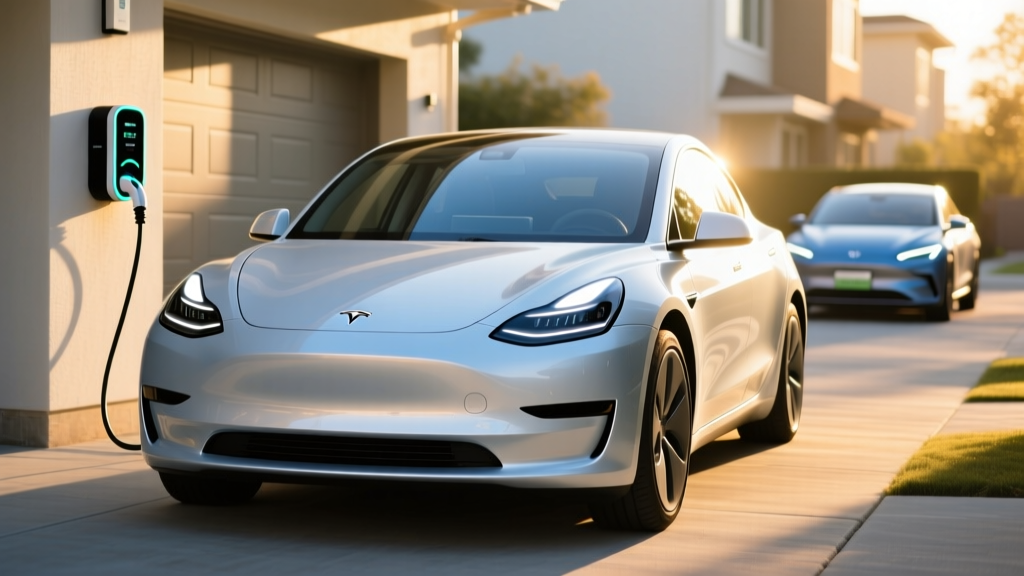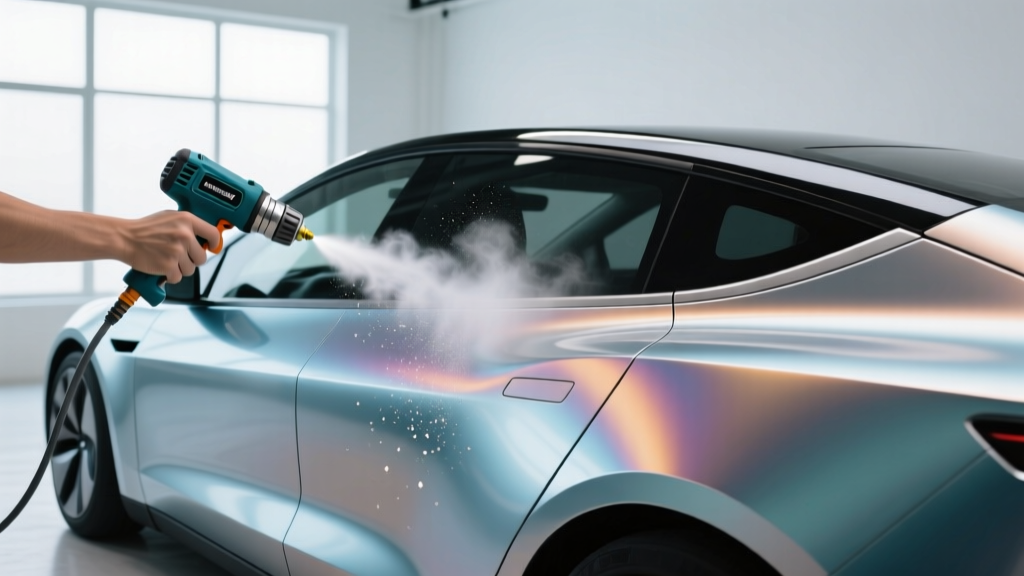
If you own an electric vehicle and are considering a DIY paint job using a car paint electric spray gun, here is the direct, practical answer: yes, you can repaint or touch up an EV with an electric spray gun, but EVs introduce complications that gas-car owners rarely think about. Modern EVs are wrapped in cameras, ultrasonic sensors, radar-transparent panels, and specialized thermal-management coatings. A careless paint application—especially over sensor zones or high-voltage warning labels—can degrade ADAS functionality, void portions of your warranty, or interfere with thermal dissipation on battery-adjacent panels. Before you plug in that spray gun, you need a plan that accounts for EV-specific body architecture, not just standard automotive refinishing.
Why EV Owners Reach for a Car Paint Electric Spray Gun
EV paint damage follows different patterns than gas-car wear. Without a front-mounted internal combustion engine, EVs lack the large grille openings that shield paint from road debris. The result? Hood and front-bumper chips are more common on models like the Tesla Model Y, Hyundai Ioniq 5, and Ford Mustang Mach-E. Combine that with the typical EV curb weight (4,000–5,500 lbs due to battery packs) and the higher tire torque at low speeds, and you get more gravel kick-up along rocker panels and rear quarter panels.
A car paint electric spray gun—typically a 1.3mm or 1.4mm HVLP (high-volume, low-pressure) gun powered by a dedicated turbine or compressor—offers a middle ground between $50 rattle-can touch-ups and $3,000–$7,000 professional body-shop resprays. For a single-panel repair (hood, fender, or bumper cover), a quality electric spray gun setup costs between $150 and $450 for the equipment, plus $80–$200 in basecoat, clearcoat, primer, and sanding supplies. A professional shop charges $600–$1,500 per panel, depending on your metro area and the paint code complexity.
EV-Specific Risks Before You Spray
Here is where electrification changes the calculus. Every EV sold in the US for the 2025–2026 model years integrates exterior sensors into the body panels. Understanding their locations is non-negotiable before masking and spraying:
- Front radar: Typically behind the front emblem or lower bumper fascia (e.g., Hyundai Ioniq 5's front-center radar, Ford Mach-E's lower grille sensor). Paint thickness exceeding factory spec—usually 4–6 mils total—can attenuate radar signals and trigger ADAS fault codes.
- Ultrasonic parking sensors: Small circular flush-mounted units on front and rear bumpers. Masking tape over these is mandatory; paint buildup on the sensor face degrades close-range object detection.
- Camera housings: Side-mirror cameras, front windshield header cameras (for Autopilot/FSD, Toyota Safety Sense, Honda Sensing), and rear-view cameras. Paint overspray on camera lenses or housings requires careful polishing to avoid optical distortion.
- Thermal-management coatings: Some EVs use specialized heat-reflective or insulative coatings on panels adjacent to the battery enclosure (underbody and rocker areas). Replacing these with standard automotive clearcoat is not recommended without OEM guidance.
- High-voltage warning labels: Orange-bordered labels under the hood and along door jambs identify HV routing. Paint must never obscure these; they are required for first-responder safety per NHTSA guidance.
Common EV Paint Myths vs. Reality
| Myth | Fact |
|---|---|
| "Painting my EV voids the battery warranty." | Exterior paint work does not void the 8-year/100,000-mile battery warranty under federal law (Magnuson-Moss), unless you can be shown to have caused battery damage—which body paint does not. |
| "Any spray gun works on EVs." | EVs use the same OEM basecoat/clearcoat systems as gas cars. The spray gun is fine; the issue is sensor zones and paint thickness over radar-transparent panels. |
| "EV paint is special and can't be matched." | OEM paint codes for EVs (e.g., Tesla's Midnight Cherry Red, Hyundai's Gravity Matte Gold) are available from standard automotive paint suppliers. Matte finishes require specific clearcoat chemistry. |
| "I don't need to worry about ADAS after repainting." | If you repaint a bumper housing front radar, your forward collision warning and adaptive cruise may malfunction. Some shops require post-paint ADAS calibration ($150–$400). |
Cost Breakdown: DIY Spray Gun vs. Body Shop vs. Wrap
Let's compare the real numbers for a single-panel repair (e.g., a chipped hood on a 2026 Tesla Model Y or a scuffed rear bumper on a Chevrolet Equinox EV). Costs reflect 2026 pricing for materials and average labor rates:
| Method | Equipment/Material | Labor | ADAS Calibration | Total (1 Panel) | Finish Quality |
|---|---|---|---|---|---|
| DIY electric spray gun (HVLP) | $230–$650 | Your time (6–10 hrs) | $0–$400 (if radar panel) | $230–$1,050 | 70–90% of OEM with practice |
| Professional body shop | Included | $400–$1,100 | $150–$400 | $600–$1,500+ | OEM spec |
| Vinyl wrap (single panel) | $150–$300 material | $200–$500 | $0 (non-paint) | $350–$800 | Good; not permanent |
| Rattle-can touch-up | $30–$60 | Your time (1–2 hrs) | $0 | $30–$60 | Visible repair; not seamless |
For full-body resprays, the math shifts dramatically. A DIY full respray with an electric spray gun requires $800–$1,500 in materials and 40–80 hours of skilled labor, plus a dust-controlled environment. A professional full respray runs $4,000–$10,000. Most EV owners are better served by panel-by-panel repair or a vinyl wrap for color change, which avoids sensor-thickness issues entirely.
Step-by-Step: Using a Car Paint Electric Spray Gun on an EV
If you have decided to proceed, here is the EV-aware workflow. This assumes an HVLP electric spray gun with a 1.3mm tip for basecoat and 1.4mm for clearcoat:
- Identify sensor zones. Consult your owner's manual or OEM service documentation for radar, ultrasonic, and camera locations on your specific model year. Mark these with painter's tape before any work begins.
- Mask aggressively. Use automotive-grade masking film (not newspaper) to cover all cameras, sensors, emblems, glass, and trim. EV sensor housings are often flush with the panel, so mask to the edge—not over—the sensor face.
- Remove panels where possible. Bumper covers on most 2025–2026 EVs remove with 6–10 fasteners. Spraying a bumper off the car eliminates overspray into radar housings and allows proper back-side coverage.
- Prep to 600-grit. Sand the repair area with 400-grit, apply 2K urethane primer, then block-sand with 600-grit. EV panels are typically steel, aluminum, or composite—adjust primer chemistry accordingly (aluminum requires self-etching primer).
- Mix paint to OEM code. Your EV's paint code is on the driver's door jamb sticker or in the frunk. Order basecoat from a supplier like AutomotiveTouchUp or your local PPG distributor. Matte finishes (e.g., Hyundai's Gravity Matte Gold) require a matte clearcoat—do not use standard gloss clear.
- Apply in controlled conditions. 65–75°F, below 50% humidity, with ventilation. Electric spray guns are quieter and produce less overspray than compressed-air guns, making them more suitable for residential garages—but you still need a particulate respirator (NIOSH-approved, not a dust mask).
- Measure paint thickness. After curing, use a mil-thickness gauge ($30–$60 on Amazon) on radar-transparent panels. If total film build exceeds 7–8 mils over a front radar zone, ADAS calibration may be required or the panel may need to be stripped and redone.
- Calibrate ADAS if needed. If you repainted a radar or camera housing, visit a dealer or an ADAS calibration specialist. Costs range from $150 to $400 depending on the system (Tesla's vision-only system requires a different calibration procedure than Ford's BlueCruise radar-fusion setup).
EV vs. Gas Car: How Ownership Context Affects Your Paint Decision
The decision to DIY paint repair is partly economic—and EV ownership economics differ from gas-car ownership in ways that matter here. EV owners typically spend less on routine maintenance (no oil changes, fewer brake jobs due to regenerative braking) but more on insurance and upfront purchase price. According to fueleconomy.gov, a 2026 EV owner charging at home at $0.14/kWh spends roughly $550–$700 per year on electricity for 12,000 miles of driving, compared to $1,400–$1,800 on gasoline for a comparable 28-MPG gas car. That $700–$1,100 annual fuel savings can offset a professional paint repair in a single year.
However, EV insurance premiums run 15–25% higher than equivalent gas cars (per the Insurance Information Institute), and collision repairs on EVs average 20–30% more due to battery-safety protocols and ADAS recalibration requirements. If your paint damage resulted from a collision, file a claim—the insurance will cover the bodywork plus any required sensor recalibration. If it is cosmetic gravel damage or clear-coat failure, DIY with a car paint electric spray gun makes more financial sense, especially given the fuel savings you are already banking.
Should You DIY or Go to a Shop? Decision Framework
- Choose DIY electric spray gun if: the damage is cosmetic (gravel chips, clear-coat peel, minor scratches), the panel has no embedded radar or camera, you have a ventilated workspace, and you can invest 6–10 hours per panel.
- Choose a professional body shop if: the damage is on a radar-equipped bumper or camera-housing panel, the paint is a complex tri-coat or matte finish, your insurance is covering the repair, or you lack a dust-controlled environment.
- Choose vinyl wrap if: you want a color change without risking sensor-thickness issues, you plan to sell the EV within 2–3 years (wrap preserves OEM paint underneath), or the damage spans multiple panels and a full respray is cost-prohibitive.
Maintenance and Longevity: Protecting Your EV's Paint Post-Repair
Once you have completed a spray-gun repair, EV-specific maintenance practices help the new paint last. EVs accumulate highway miles differently—many owners use ADAS features like Tesla's Autopilot or GM's Super Cruise for long commutes, which means more sustained highway driving and more bug/road-film accumulation on front surfaces. A ceramic coating ($400–$800 professional application, or $60–$120 DIY kit) over your repaired panel provides UV protection and makes cleaning easier without adding meaningful thickness to sensor zones (ceramic coatings measure in microns, not mils).
For EVs with matte or satin finishes, avoid automatic car washes with abrasive brushes—these are the leading cause of matte-clearcoat marring. Touchless washes or hand washing with a pH-neutral automotive soap preserve the finish. If you applied a matte clearcoat with your electric spray gun, use only matte-specific detail sprays; gloss enhancers will create uneven sheen.
Frequently Asked Questions
Does repainting an EV panel void the battery or powertrain warranty?
No. Under the Magnuson-Moss Warranty Act, exterior paint work cannot void your 8-year/100,000-mile battery warranty or 5-year/60,000-mile powertrain warranty unless the manufacturer can prove the paint work directly caused a powertrain failure—which is effectively impossible for exterior refinishing. However, if you damage a sensor during paint prep and the dealer traces an ADAS fault to your work, that specific repair may not be covered.
Can I use a standard HVLP electric spray gun on aluminum EV panels?
Yes, but the primer chemistry matters more than the gun. Many EVs (Tesla Model Y, Ford F-150 Lightning, Rivian R1T) use aluminum hood, door, or bed panels. Aluminum requires a self-etching primer or an epoxy primer designed for non-ferrous metals. Standard steel-body primer will not adhere properly and will peel within months. Your spray gun settings (1.3mm tip, 25–30 PSI at the gun for HVLP) remain the same.
How do I find my EV's exact paint code?
Check the manufacturer's label on the driver's side door jamb—it lists the paint code alongside the VIN. Tesla owners can also find the code in the service menu on the touchscreen (tap Vehicle → Software → Additional Vehicle Information). For 2025–2026 models, OEM touch-up paint is available directly from the manufacturer's parts store or from licensed suppliers using the code. Always order a test card and compare in natural light before mixing a full batch.
Will painting over a Tesla Autopilot camera housing cause problems?
Potentially, yes. Tesla's vision-only Autopilot system (no radar on 2023+ models) relies on eight cameras, including the windshield header unit and fender-mounted side repeaters. Paint overspray on the camera lens or housing edge can cause optical distortion, triggering phantom braking or lane-departure errors. If you must repaint near a camera housing, remove the camera (requires a Torx driver and careful connector handling) or mask with extreme precision. Post-paint, Tesla recommends a camera recalibration via Service Mode on the touchscreen.
What is the best electric spray gun for a first-time EV owner doing a single-panel repair?
For a single-panel repair, a mid-range HVLP gravity-feed gun with a 1.3mm tip (for basecoat) and interchangeable 1.4mm tip (for clearcoat) is ideal. Brands like DeVilbiss FLG-5, Iwata W-400, or the more budget-friendly Master Airbrush G22 kit ($80–$150) deliver acceptable results for non-professionals. You need a compressor delivering at least 6 CFM at 40 PSI, or a dedicated turbine unit. Total entry cost for a functional setup: $200–$450 including gun, compressor, hose, and regulator.
Repainting an EV with a car paint electric spray gun is a viable cost-saving strategy for cosmetic damage, provided you respect the sensor architecture and OEM paint specifications that distinguish modern electric vehicles from their gas-powered predecessors. The tools are the same; the preparation discipline is higher.