What Is an EV Car Kit — And What Do You Actually Need?
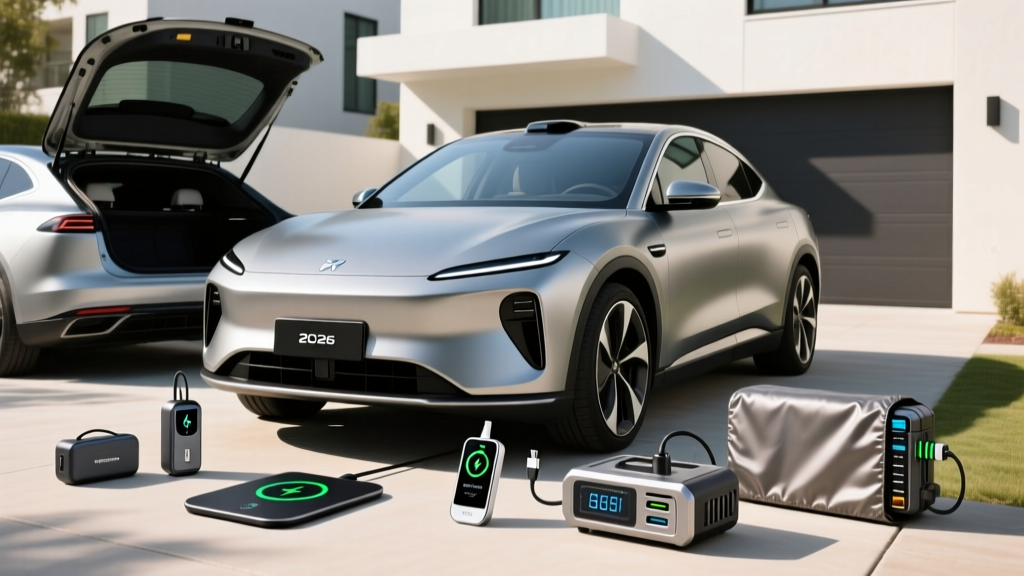
An EV car kit is a curated set of charging adapters, emergency tools, and accessories that keeps an electric vehicle owner prepared for road trips, charging-network gaps, and roadside scenarios unique to battery-electric driving. Unlike a gas-car emergency kit, an EV-specific kit prioritizes charging adaptability (J1772-to-NACS, CCS-to-Tesla, CHAdeMO adapters), portable Level 1/Level 2 EVSE units, tire repair supplies rated for heavier EV curb weights, and 12V auxiliary battery maintenance — because a dead 12V battery, not the traction pack, is the #1 reason EVs get towed.
A well-built EV car kit costs between $350 and $1,200 depending on adapter count and portable charger quality. Below is a data-driven breakdown of what to pack, what each item costs, and why it matters for real-world ownership in 2026.
The Core EV Car Kit: Itemized Cost Breakdown
Every EV owner — whether driving a 2026 Tesla Model Y, Hyundai Ioniq 5, Ford F-150 Lightning, or Chevrolet Equinox EV — should start with this baseline kit. Prices reflect current 2026 retail averages from major EV accessory suppliers.
| Item | Purpose | Avg. Cost | Priority |
|---|---|---|---|
| NACS-to-CCS1 adapter (or CCS-to-NACS) | Access non-native DC fast-charging networks | $175–$300 | Essential |
| J1772-to-NACS adapter (Level 2) | Charge at legacy public L2 stations (non-Tesla) | $95–$160 | Essential (Tesla owners) |
| Portable Level 1/2 EVSE (120V/240V, 16–40A) | Emergency or destination charging from any outlet | $200–$550 | Essential |
| 25-ft heavy-duty 10-gauge extension cord (L1 backup) | Reach a distant 120V outlet at a rental or relative's home | $45–$75 | Recommended |
| NACS or CCS plug holster / cable organizer | Protect adapter pins and keep trunk organized | $25–$50 | Nice-to-have |
| Tire inflator with EV-rated pressure (42–50 PSI) | EVs run higher tire pressures; many cheap inflators max at 35 PSI | $40–$80 | Essential |
| Tire plug kit + sealant (EV-weight rated) | EVs are 15–30% heavier than gas equivalents — more puncture stress | $25–$45 | Essential |
| 12V lithium jump-starter pack | Dead 12V battery = car won't start, even with full traction pack | $60–$120 | Essential |
| Reflective triangles / LED road flares | Safety during roadside stops (same as gas cars) | $20–$40 | Essential |
| Microfiber towels + screen cleaner | EV touchscreens collect fingerprints; camera lenses need cleaning for ADAS | $10–$20 | Nice-to-have |
| Portable 12V air compressor (dual-purpose) | Adjust tire pressure for efficiency or load changes | $35–$60 | Recommended |
Total baseline kit cost: $725–$1,500 — but most owners can build a practical kit for $400–$700 by prioritizing essentials and skipping nice-to-haves.
Charging Adapters: The Heart of Any EV Car Kit
The single biggest difference between an EV emergency kit and a gas-car kit is charging adapter strategy. North America's charging infrastructure in 2026 is in a transitional period: Tesla's NACS connector has become the de facto standard (adopted by Ford, GM, Rivian, Volvo, and others starting in 2024–2025), but thousands of CCS1 and CHAdeMO public chargers remain operational.
Adapter Compatibility by Vehicle Brand (2026 Models)
| Vehicle Brand | Native Connector | Adapter Needed For | Typical Adapter Cost |
|---|---|---|---|
| Tesla (Model 3/Y/S/X) | NACS | CCS1 chargers (Electrify America, some EVgo) | $175–$250 |
| Ford (2025+ F-150 Lightning, Mustang Mach-E) | NACS | Legacy CCS1 stations still in service | $175–$250 |
| GM (2025+ Ultium models) | NACS | Legacy CCS1 stations | $175–$250 |
| Hyundai / Kia (Ioniq 5/6, EV6, EV9) | CCS1 | Tesla Superchargers (NACS) | $200–$300 |
| Rivian (R1T, R1S 2025+) | NACS | Legacy CCS1 stations | $175–$250 |
| VW (ID.4, ID.7) | CCS1 | Tesla Superchargers (NACS) | $200–$300 |
| Nissan (Leaf, Ariya) | CHAdeMO (Leaf) / CCS1 (Ariya) | CHAdeMO-to-CCS adapters are rare; plan routes around native network | $300+ (limited availability) |
Key insight: If you drive a CCS1-equipped vehicle (most non-Tesla EVs built before 2025), a NACS adapter unlocks Tesla Supercharger access — which, as of 2026, represents over 25,000 stalls in North America. This is the highest-value adapter you can carry.
If you drive a 2025+ NACS-native vehicle, you still want a CCS1 adapter because Electrify America and some regional networks still use CCS1 connectors at many stations. Until full NACS migration completes (expected 2027–2028), carrying both directions of adapter is the safest road-trip strategy.
EV vs. Gas Car Emergency Kit: What Changes and What Stays the Same
A common misconception is that EVs need radically different emergency gear. In reality, about 60% of a traditional roadside kit transfers directly. Here's the precise comparison:
| Kit Item | Gas Car | EV | Why It Differs |
|---|---|---|---|
| Jumper cables / jump pack | Yes (12V) | Yes (12V) — equally critical | EVs still have a 12V auxiliary battery that powers computers, door locks, and the contactor that connects the traction pack. Dead 12V = stranded. |
| Spare tire / inflator | Yes | Inflator preferred — most EVs omit spares | EV weight (4,500–6,500 lbs) accelerates tire wear; no spare saves cargo space and weight for range. |
| Gas can / fuel funnel | Yes | Not applicable | No liquid fuel to carry. Portable EVSE replaces the gas can as the "range recovery" tool. |
| Charging adapters | Not applicable | Essential | Fragmented connector standards require adapter strategy. |
| Portable charger (EVSE) | Not applicable | Essential | Enables charging from any 120V or 240V outlet — your "gas can" equivalent. |
| Coolant / oil | Yes | No (EVs have no engine oil) | EV thermal management uses sealed coolant loops — not a roadside item. |
| Reflective triangles / flares | Yes | Yes | Universal safety requirement. |
| First-aid kit | Yes | Yes | Universal. |
The takeaway: EVs eliminate the gas can and engine fluids but add charging adapters and a portable EVSE — items that cost roughly the same as a quality gas can and funnel set ($200–$400 total).
Real-World Ownership Scenarios: When Your EV Car Kit Pays for Itself
Scenario 1: The Dead 12V Battery (Most Common EV Tow Reason)
According to AAA and multiple EV-owner surveys, the 12V auxiliary battery is the single most common reason an EV requires a tow — not the high-voltage traction battery. When the 12V dies, the car's computers can't boot, the contactor stays open, and the vehicle is effectively bricked even with 80% state of charge in the main pack.
A $70 lithium jump-starter in your EV car kit resolves this in 2 minutes. Without it, you're waiting for a tow truck — and many tow operators still lack EV-specific training, risking damage from improper flatbed loading.
Scenario 2: The Charging Desert Road Trip
Even in 2026, stretches of I-70 through Kansas, US-50 through Nevada, and parts of rural Montana remain DC fast-charging deserts with 80–120 miles between reliable stations. A portable Level 1 EVSE (plugging into a standard 120V outlet) adds roughly 3–5 miles of range per hour of charging. That sounds slow — but if you're stuck overnight at a hotel or relative's house, 12 hours on a 120V outlet adds 36–60 miles, enough to reach the next fast charger.
Scenario 3: Cold-Weather Range Loss
EVs lose 20–40% of EPA-rated range in sub-freezing temperatures, per testing by fueleconomy.gov and independent reviewers. A 300-mile EPA-rated EV might deliver only 180–240 miles at 20°F on the highway. Your kit's tire inflator matters here: cold air drops tire pressure, and under-inflated tires increase rolling resistance, compounding range loss. Checking and adjusting tire pressure at every charging stop recovers 2–5% efficiency.
Common EV Kit Misconceptions — Myth vs. Fact
| Myth | Fact |
|---|---|
| "I don't need adapters — my car's native network is enough." | In 2026, no single network covers 100% of routes. Tesla Superchargers are the most reliable, but NACS-native non-Tesla vehicles still need CCS adapters for Electrify America. CCS-native vehicles need NACS adapters for Supercharger access. |
| "EVs don't need jumper cables — they don't have a 12V battery." | Every EV sold in the US still has a 12V auxiliary battery. It powers the ECU, lights, locks, and the high-voltage contactor. If it dies, the car won't start. |
| "A portable charger is useless — it's too slow." | At 120V/12A (Level 1), you get ~3–5 mi/hr. At 240V/32A (portable Level 2 with a NEMA 14-50 plug), you get ~25–35 mi/hr. An overnight charge at a rental cabin or relative's house on a dryer outlet can recover 150–200+ miles. |
| "EV tires are the same as gas-car tires — any inflator works." | EV-specific tires (e.g., Michelin Pilot Sport EV, Hankook iON) often require 42–50 PSI. Many budget inflators max out at 35 PSI. Buy one rated for at least 60 PSI. |
| "I'll just use the mobile app to find chargers — I don't need physical adapters." | Apps show charger locations, not connector availability. Broken CCS stalls, occupied NACS posts, and adapter-incompatible stations are common. Carrying the right adapter gives you options the app can't provide. |
Cost Breakdown: Building Your Kit on a Budget vs. Fully Loaded
| Kit Tier | Items Included | Total Cost | Best For |
|---|---|---|---|
| Budget ($250–$400) | 12V jump-starter, tire inflator (EV-rated), tire plug kit, reflective triangles, one charging adapter (NACS or CCS depending on vehicle) | $250–$400 | City drivers with reliable home charging who take occasional road trips |
| Standard ($500–$750) | All budget items + portable Level 1/2 EVSE + both NACS and CCS adapters + 25-ft extension cord + cable organizer | $500–$750 | Regular road-trippers and renters who may lack consistent home charging |
| Fully Loaded ($900–$1,500) | All standard items + premium portable EVSE (40A, 240V capable) + CHAdeMO adapter (if applicable) + dedicated EV first-aid and tool roll + tire pressure monitoring system (TPMS) reader | $900–$1,500 | Cross-country travelers, overlanders (Rivian R1T, F-150 Lightning owners), and single-vehicle households |
Decision Framework: What to Pack Based on Your Driving Profile
If you charge at home every night and drive <50 miles daily: Budget kit. Focus on the 12V jump-starter and tire inflator. You'll rarely need adapters or a portable EVSE.
If you take 3+ road trips per year (>200 miles each): Standard kit. Both NACS and CCS adapters are non-negotiable. Add the portable EVSE for hotel and destination charging.
If you live in a cold-weather state (average winter temps below 32°F): Prioritize the EV-rated tire inflator and a TPMS reader. Cold drops tire pressure ~1 PSI per 10°F, directly impacting range. Also budget for a cabin-12V-battery maintainer if your EV sits for days in extreme cold.
If you rent or lack dedicated home charging: The portable Level 2 EVSE (240V, NEMA 14-50 plug) is your most important purchase — it turns any dryer outlet into a home charger delivering 25–35 miles of range per hour. Pair it with a qualified electrician consultation if you want a dedicated 240V outlet installed (typically $500–$1,500 including panel assessment).
If you drive a pre-2025 CCS1 vehicle: The NACS adapter is your #1 priority purchase. Tesla Supercharger access dramatically expands your route options, especially in the Mountain West and rural South where CCS infrastructure lags.
What NOT to Pack: Dead Weight in Your EV Car Kit
Equally important to what you include is what you leave out. EVs don't need:
- Gas cans or siphon kits — no liquid fuel to transfer
- Engine oil, transmission fluid, or coolant jugs — EVs use sealed thermal management loops serviced by dealers
- Serpentine belt or spark plug tools — no internal combustion engine
- Traditional heavy-duty jumper cables (20-ft copper) — a compact lithium jump-starter is lighter, safer, and sufficient for the 12V system
- Full-size spare tire — EVs are heavy (adding a 50-lb spare and jack reduces range by 2–4%); a plug kit and inflator handle 90% of punctures
Frequently Asked Questions
Do I need an EV car kit if I only drive locally?
Yes, at minimum a 12V jump-starter and tire inflator. The 12V battery failure scenario is location-independent and is the leading cause of EV tows. A tire inflator rated for 50+ PSI addresses EV-specific tire pressures that gas-station air pumps often can't reach.
How much does a NACS-to-CCS adapter cost in 2026?
Between $175 and $300 depending on brand and amperage rating. Tesla sells an official CCS adapter for ~$250. Third-party options from Lectron and A2Z are typically $175–$225. Always verify the adapter supports your vehicle's peak DC charge rate — some budget adapters cap at 150 kW even if your car can accept 250+ kW.
Can I use any extension cord with my portable EVSE?
No. For Level 1 (120V) charging, use a 10-gauge or thicker extension cord rated for outdoor use, maximum 25 feet. Thinner cords (14- or 16-gauge) overheat and can trip the EVSE's safety cutoff or, worse, cause a fire. Never daisy-chain extension cords. For Level 2 (240V), do not use an extension cord at all — plug the EVSE directly into the NEMA 14-50 outlet.
Will my EV car kit items qualify for any tax credits?
No. The federal §30D clean vehicle credit applies to the vehicle purchase, not accessories. However, some state and utility programs offer rebates for home EVSE installation (the Alternative Fuels Data Center tracks state incentives). Your portable EVSE generally does not qualify since it's not a permanent installation.
How often should I check the items in my EV car kit?
Every 6 months. Specifically: verify the 12V jump-starter holds charge (most lithium packs have an LED indicator), check tire sealant expiration dates (typically 2–4 years), inspect adapter pins for corrosion or damage, and test the portable EVSE by plugging it in and initiating a charge session. Store adapters in a dry, padded case to prevent pin damage.
My EV has a tire repair kit from the factory — do I need anything extra?
Factory tire-inflation kits (sealant + compressor) are single-use and often rated for lighter vehicles. EVs weigh 4,500–6,500 lbs, putting more stress on sealant patches. Carry a dedicated tire plug kit ($15–$25) as a backup — plug repairs are more durable than sealant for heavy vehicles and can be performed multiple times.