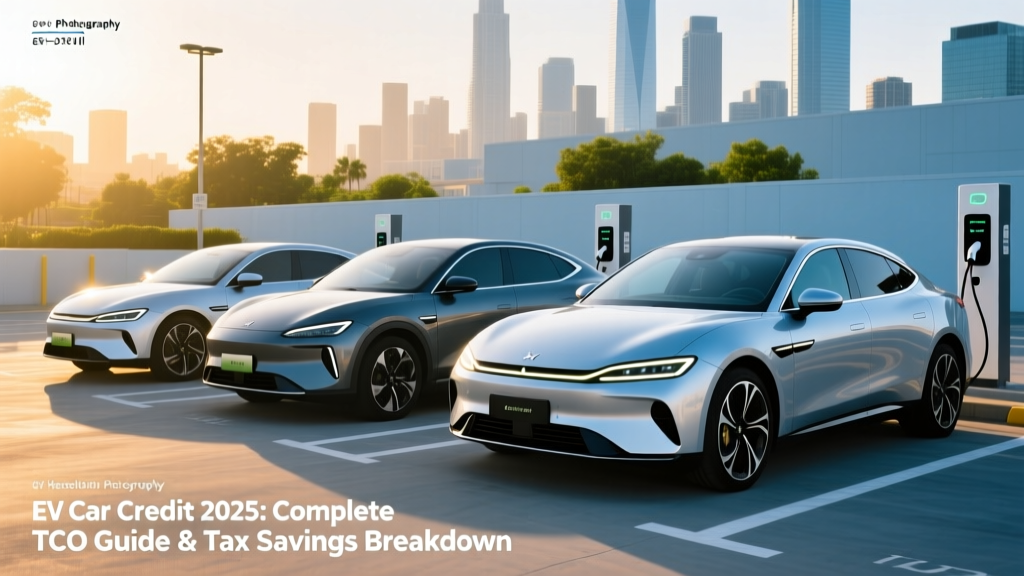
Buying an electric vehicle involves a complex calculation of upfront incentives against long-term operational costs. While the EV car credit 2025 remains a primary driver for adoption, the actual financial benefit depends heavily on your specific tax situation, the vehicle's battery sourcing, and your regional utility rates. For the 2025 and 2026 model years, the IRS §30D credit is more accessible at the point of sale, but the eligibility hurdles for the vehicles themselves have become stricter.
Federal Tax Credit Eligibility: The $7,500 Question
The federal tax credit is no longer a simple 'per manufacturer' rebate. Under current IRS guidelines, a vehicle must meet critical mineral and battery component sourcing requirements to qualify for the full $7,500. If it meets only one of the two requirements, it qualifies for $3,750.
IRS §30D Requirements Checklist
- MSRP Caps: Vans, SUVs, and pickup trucks must be under $80,000; sedans and other vehicles under $55,000.
- Income Limits: Modified AGI must not exceed $300k (joint), $225k (head of household), or $150k (individual).
- Assembly: Final assembly must occur in North America.
- Transferability: As of 2024/2025, you can transfer the credit to the dealer for an immediate down payment reduction, even if you have no tax liability.
5-Year Total Cost of Ownership (TCO) Analysis
To understand the real value of an EV, we compare a 2025 Tesla Model 3 Long Range (AWD) against a 2025 Toyota Camry (ICE Hybrid). The EV starts at a higher MSRP but benefits from the $7,500 credit and significantly lower per-mile energy costs.
| Category | 2025 Tesla Model 3 LR (EV) | 2025 Toyota Camry LE (Hybrid) |
|---|---|---|
| Purchase Price (MSRP) | $47,740 | $28,855 |
| Federal Tax Credit | -$7,500 | $0 |
| Estimated Energy (75k miles) | $4,125 ($0.15/kWh) | $8,250 (3.30/gal @ 50 MPG) |
| Maintenance (5 Years) | $1,200 | $3,500 |
| Insurance (5 Years) | $11,500 | $8,200 |
| Depreciation (Est.) | $18,000 | $11,000 |
| Net 5-Year Cost | $75,065 | $49,805 |
Charging vs. Gas: The Math Behind the Miles
The cost-per-mile advantage is the strongest argument for EV ownership, but it requires home charging. Public DC fast charging (averaging $0.48/kWh) can make an EV more expensive to run than a 50 MPG hybrid. Based on EPA efficiency ratings:
- EV Efficiency: 25 kWh/100 miles. At $0.16/kWh (national home average), cost is $0.04 per mile.
- Gas Hybrid Efficiency: 2.0 gallons/100 miles (50 MPG). At $3.30/gallon, cost is $0.066 per mile.
Over 15,000 miles annually, the home-charging EV saves approximately $390 per year in fuel. However, if you rely exclusively on public fast-charging networks, that cost can jump to $0.12 per mile, eliminating the savings.
Maintenance Savings: Fewer Moving Parts
EVs eliminate oil changes, spark plugs, and transmission fluid. More importantly, regenerative braking significantly reduces wear on friction brake pads. According to fueleconomy.gov, EV maintenance costs are roughly 30-40% lower than ICE vehicles over the life of the car.
| Service Item | EV Interval/Cost | ICE Interval/Cost |
|---|---|---|
| Oil Change | Never | Every 5k-10k miles ($60-$120) |
| Brake Pads | 100k+ miles (rarely) | 30k-50k miles ($300-$600) |
| Tire Rotation | Every 6k miles ($40) | Every 6k miles ($40) |
| Cabin Air Filter | Every 20k miles ($30) | Every 15k miles ($25) |
The Insurance Reality Check
Insurance premiums for EVs are typically 15-25% higher than comparable gas cars. This is due to higher repair costs, specialized labor requirements, and the price of replacement battery packs. While some insurers offer 'green vehicle' discounts, the higher base MSRP and total-loss risk often outweigh them. Always run a quote from your provider before purchasing.
Depreciation and Resale Value Trends
Historically, EVs suffered from steep depreciation. However, as battery health data (SoH) becomes more transparent and the used market expands, models like the Tesla Model 3 and Hyundai Ioniq 5 are holding value better. The primary risk remains the expiration of the used EV tax credit (up to $4,000), which can shift demand in the secondary market.
State and Utility Incentives
Federal credits are only the baseline. Many states and utilities offer additional rebates:
- California (CVRP): Up to $7,000 for income-qualified buyers.
- Colorado: Innovative Motor Vehicle Credit (up to $5,000).
- Utility Rebates: Many providers offer $500-$1,000 for home charger installation or off-peak charging credits.
Frequently Asked Questions
Can I get the credit if I don't owe taxes?
Yes. Under the transferability provision, you can transfer the credit to a registered dealer who will reduce your purchase price by the credit amount, effectively making it a down payment.
Do all 2025 EVs qualify for the credit?
No. The list of eligible vehicles changes frequently as manufacturers adjust supply chains to meet FEOC (Foreign Entity of Concern) battery sourcing rules. Always check the IRS 'Clean Vehicle Provisions' list before signing.
Is it cheaper to own an EV if I live in an apartment?
If you must rely on public DC fast charging (which is 2-3x more expensive than home charging), the fuel savings are minimal. In those cases, a high-MPG hybrid may be the more economical choice.