Quick Answer: What EV Cable Do You Actually Need?
Every EV sold in the US since 2025 ships with a NACS (Tesla-style) or CCS1 charge port. Your vehicle will include a basic Level 1 (120V) mobile cable that adds roughly 3–5 miles of range per hour. For practical daily ownership, you'll want a Level 2 cable and home charger (240V, 32–48 amps) that adds 25–44 miles per hour and costs $400–$700 for the equipment alone. You do not need a separate DC fast-charging cable — those are permanently attached at public stations.
The Three Types of EV Cables (and Which Ones Matter)
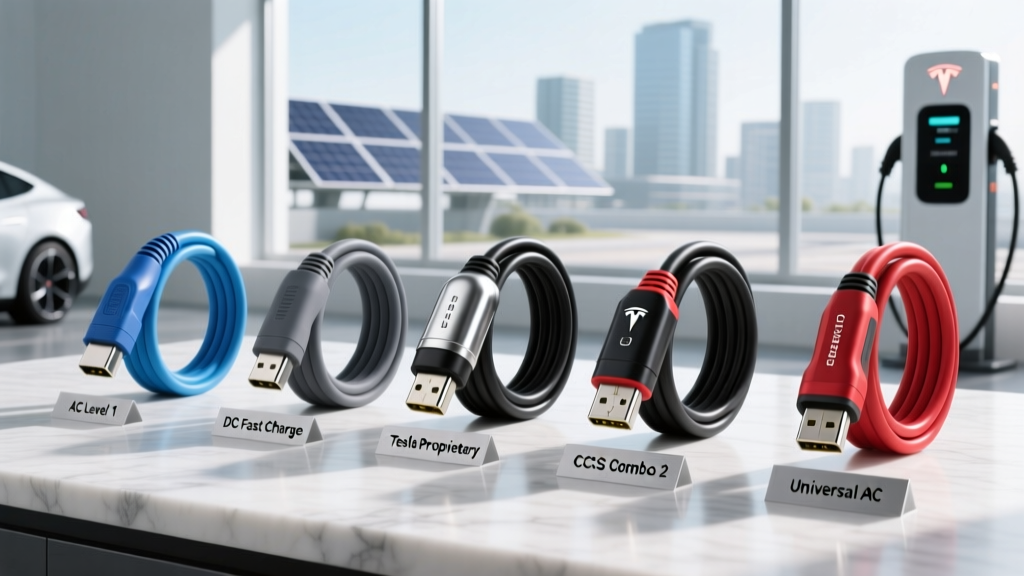
EV cables fall into three categories based on the charging level they support. Understanding the difference between kW (power — how fast energy flows) and kWh (energy — how much your battery stores) is essential here. A higher-kW cable delivers energy faster, but your car's onboard charger sets the ceiling for AC charging speeds.
Level 1 Cable (120V AC — Included with Your EV)
This is the portable cord that comes in the trunk or frunk. It plugs into a standard household NEMA 5-15 outlet and delivers 1.0–1.4 kW. That translates to roughly 3–5 miles of range per hour of charging. For a vehicle with a 75 kWh battery (like the Tesla Model Y Long Range or Hyundai Ioniq 5), a full 0–100% charge on Level 1 takes 50–75 hours.
Level 1 is adequate if you drive under 30 miles per day and can plug in overnight. It requires zero installation cost. However, it's painfully slow for road-trip recovery or larger-battery trucks like the Ford F-150 Lightning (extended-range 131 kWh pack — that's 90+ hours on Level 1).
Level 2 Cable (240V AC — The Home Charging Standard)
A Level 2 cable connects your EV to a 240V source — the same voltage as your electric dryer. These cables use either a J1772 connector (pre-2025 non-Tesla EVs, still common on older models) or the NACS connector (now standard on Tesla, Ford, GM, Rivian, Hyundai, Kia, and most 2025+ models).
Level 2 cables deliver 6.6–11.5 kW depending on amperage (28–48 amps). At 48 amps / 11.5 kW, you'll add roughly 40–44 miles of range per hour. A 75 kWh battery charges from empty to full in 7–11 hours — ideal for overnight replenishment.
Most Level 2 home chargers (the wall unit that the cable plugs into) include a permanently attached 18–25 foot cable. If you need a replacement or extension, a quality 25-foot Level 2 cable rated at 48 amps costs $150–$300 from brands like Emporia, ChargePoint, or Lectron.
DC Fast-Charging Cable (Attached at Public Stations)
You'll never buy or own a DC fast-charging cable. These heavy, liquid-cooled cables are permanently attached to public chargers (Electrify America, EVgo, Tesla Superchargers, Ionity). They deliver 50–350 kW directly to your battery, bypassing the onboard charger. A 350 kW station can add 10–80% in roughly 18–25 minutes on compatible vehicles like the Hyundai Ioniq 5 (peak 240 kW) or Porsche Taycan (peak 320 kW).
EV Cables vs. Gas Car Fueling: The Real Cost Comparison
One of the most common first-time buyer questions: how does charging at home with your own EV cable compare to paying for gasoline? Here's a concrete breakdown using 2026 national averages.
| Factor | EV (Home Level 2) | Gas Car (30 MPG) |
|---|---|---|
| Energy source | Electricity ($0.16/kWh avg) | Gasoline ($3.40/gal avg) |
| Efficiency | 3.5 miles/kWh (114 MPGe) | 30 miles/gallon |
| Energy used per year | 4,286 kWh | 500 gallons |
| Annual cost | $686 | $1,700 |
| 5-year fueling cost | $3,430 | $8,500 |
| Annual savings (EV) | $1,014/year | |
Source: US average residential electricity rate and gasoline price per EIA. Efficiency based on EPA combined ratings from fueleconomy.gov.
The EV cable pays for itself in fuel savings within the first 5–7 months of ownership compared to the cost of a quality Level 2 home charger and cable setup.
Connector Types in 2026: NACS, CCS, and J1772
The connector landscape has consolidated dramatically. Here's what you need to know before buying any EV cable or adapter:
| Connector | Used For | Compatible Brands (2026) |
|---|---|---|
| NACS (Tesla-style) | AC Level 1/2 + DC fast | Tesla, Ford, GM, Rivian, Hyundai, Kia, Volvo, Polestar, Nissan, BMW, most 2025+ models |
| CCS1 | AC Level 2 + DC fast | Legacy: 2020–2024 VW ID.4, older BMW i4, some Stellantis models |
| J1772 | AC Level 1/2 only | All pre-2025 non-Tesla EVs (requires adapter for DC fast charging on NACS stations) |
| CHAdeMO | DC fast only | Nissan Leaf (discontinued after 2025); legacy only |
Key takeaway for 2026 buyers: If you're purchasing a new EV, it almost certainly has a NACS port. Your Level 2 home cable should be NACS. If you own an older CCS1 or J1772 vehicle, you can use a CCS-to-NACS adapter ($150–$250) to access Tesla Superchargers, which now number over 25,000 stalls open to non-Tesla EVs.
Real Costs: EV Cable and Home Charging Setup
Here's the full financial picture for getting your home charging infrastructure in place, including the cable, charger, and electrical work.
| Item | Cost Range | Notes |
|---|---|---|
| Level 2 home charger (wall unit with cable) | $400–$700 | ChargePoint Home Flex, Emporia Vue, Wallbox Pulsar Plus |
| Replacement/standalone Level 2 cable (25 ft) | $150–$300 | 48-amp rated, NACS or J1772 |
| Electrician labor (240V outlet install) | $500–$2,000 | Depends on panel proximity; NEMA 14-50 or hardwire |
| Electrical panel upgrade (if needed) | $1,500–$3,500 | Required if your panel is 100A or maxed out |
| Permit and inspection | $50–$200 | Varies by municipality |
| Total typical install | $950–$2,900 | Without panel upgrade; $2,500–$6,400 with upgrade |
The federal Alternative Fuel Vehicle Refueling Property Credit (IRS Form 8911) covers up to 30% of home charger equipment and installation costs, capped at $1,000, for installations in eligible census tracts. Check the IRS site for current eligibility — this credit has location-based requirements that disqualify some addresses.
Common EV Cable Misconceptions — Myth vs. Fact
| Myth | Fact |
|---|---|
| "I need to buy a separate fast-charging cable for road trips." | DC fast-charging cables are permanently attached at public stations. You just plug in — no cable to carry. |
| "Any extension cord works for Level 1 charging." | Using an undersized extension cord (below 12-gauge) creates a fire hazard. EV manufacturers explicitly warn against extension cords. If you must use one, it should be a heavy-duty 10-gauge, 25-foot maximum cord rated for outdoor use. |
| "A longer Level 2 cable charges slower." | Cable length has negligible effect on charging speed within normal lengths (up to 25 ft). Voltage drop becomes a factor only beyond 50+ feet or with undersized wire gauge. |
| "I can use my old J1772 cable on a new NACS car." | Physically incompatible. You'd need a J1772-to-NACS adapter (~$150–$200) for AC charging. For DC fast charging, CCS-to-NACS adapters are available for legacy CCS vehicles. |
| "Leaving my EV plugged in overnight damages the cable or battery." | Modern EVs manage charging automatically. Once the battery reaches your set limit (e.g., 80%), charging stops. The cable simply sits idle. No degradation to cable or battery occurs from being plugged in. |
Decision Framework: Which EV Cable Setup Is Right for You?
If-This-Then-That: Your EV Cable Decision
- If you drive under 30 miles/day and have a standard 120V outlet near your parking spot: Stick with the included Level 1 cable. Cost: $0 additional. Expect 3–5 miles of range per hour — enough to recover a day's driving overnight.
- If you drive 30–80 miles/day or want full-battery recovery overnight: Install a Level 2 home charger with an included 18–25 ft cable. Budget $950–$2,900 total (equipment + electrician). This is the setup 80%+ of EV owners use as their primary charging method.
- If you rent and can't install a 240V outlet: Use the Level 1 cable daily and rely on workplace charging or public Level 2/DC stations for longer trips. Consider a portable Level 2 cable ($200–$350) that works with NEMA 14-50 outlets at RV parks or friends' homes.
- If you own a pre-2025 CCS1 or J1772 EV: Keep your existing cable for home use. Purchase a CCS-to-NACS or J1772-to-NACS adapter ($150–$250) to unlock access to the Tesla Supercharger network for road trips.
- If you live in an apartment without charging access: Advocate for building-level chargers, use public networks (Electrify America, EVgo, ChargePoint), and check whether your workplace offers Level 2 charging. DC fast charging your EV to 80% takes 18–30 minutes at a 150+ kW station — feasible as a weekly routine but more expensive ($0.35–$0.55/kWh vs. $0.16 at home).
Real-World Ownership: What First-Time EV Buyers Should Know About Cables
Beyond the hardware itself, here are the practical realities that experienced EV owners learn the hard way:
Cold weather slows everything down. Below 32°F, your EV's battery management system may limit charging speed to protect the cells. A Level 2 cable that delivers 11.5 kW in July might effectively deliver 6–8 kW in January until the battery warms. Preconditioning your battery (a feature on most 2025+ EVs) mitigates this, but expect 20–30% longer charge times in winter.
Cable management matters. A 25-foot Level 2 cable weighs 8–12 pounds and is stiff in cold weather. Wall-mounted cable organizers ($20–$50) prevent tripping hazards and protect the connector from ground moisture. Never let the connector sit in standing water or snow.
Public charging cable etiquette. At public Level 2 stations, the cable is attached to the charger. Don't unplug another EV — even if it's finished charging — unless the lot has explicit signage permitting it. Many stations now have "plug-share" apps showing real-time availability.
Your cable's amp rating must match your charger. If your home charger outputs 48 amps but your cable is rated for only 32 amps, the system will default to the lower rate. Always match or exceed your charger's maximum output. A 48-amp rated cable is the safest universal choice for modern Level 2 installations.
Warranty coverage. Quality Level 2 cables carry 2–3 year warranties. The charge port on your EV is covered under the vehicle's battery/electrical warranty — typically 8 years/100,000 miles per federal mandate. If a port or cable fails within warranty, replacement is covered.
Frequently Asked Questions
Can I use a Tesla cable on a non-Tesla EV?
Yes — if your non-Tesla EV has a NACS charge port (standard on most 2025+ models from Ford, GM, Hyundai, Kia, Rivian, and others). The NACS connector is now the industry standard. Tesla's Mobile Connector and Wall Connector cables work natively with any NACS-equipped vehicle.
Do I need to buy an EV cable separately, or is one included?
Every new EV sold in the US includes a Level 1 mobile charging cable in the box. Some manufacturers (Tesla, Ford) also include a NACS-to-J1772 adapter. A dedicated Level 2 home charger with its own attached cable is a separate purchase.
How much does it cost to replace a damaged EV charging cable?
A replacement Level 1 mobile cable from the manufacturer costs $200–$350. A standalone Level 2 cable (without the wall unit) costs $150–$300. Third-party cables from reputable brands like Lectron or Emporia are typically 20–30% cheaper than OEM equivalents.
Is it safe to charge my EV in the rain with an outdoor cable?
Yes. EV charging cables and connectors are rated IP55 or higher, meaning they're protected against water jets from any direction. The connector only energizes after a secure handshake with the vehicle's charge port. Charging in rain, snow, or humidity is safe when using undamaged, UL-listed equipment.
What's the difference between a 32-amp and 48-amp Level 2 cable?
A 32-amp cable delivers up to 7.7 kW (roughly 28 miles of range per hour). A 48-amp cable delivers up to 11.5 kW (roughly 44 miles per hour). The 48-amp option charges about 50% faster but requires a 60-amp dedicated circuit, which may increase electrician costs by $100–$300. For most EVs with batteries under 80 kWh, the 48-amp cable provides a meaningfully faster overnight charge.