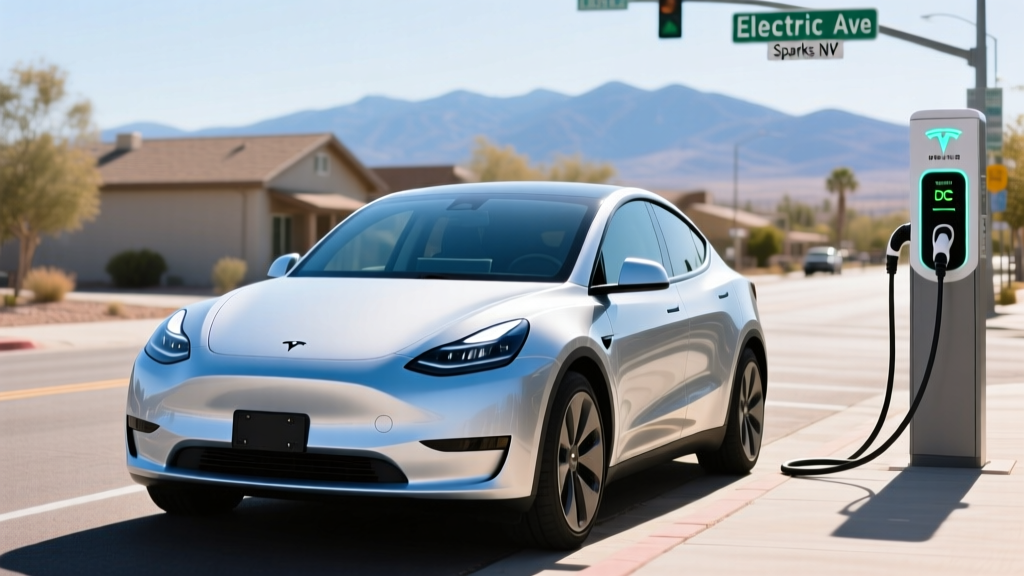
If you're researching electric vehicles near 1 Electric Ave, Sparks, NV 89434 — whether you live in the Sparks/Reno corridor, commute to Tahoe, or drive I-80 east toward Elko — the short answer is: a battery-electric vehicle (BEV) can work well in Northern Nevada, but only if you secure reliable home Level 2 charging and choose a model with enough EPA range to handle cold-weather losses and high-desert highway driving. Expect real-world range to drop 15–30% in winter temperatures below freezing, and plan for sparse DC fast charging east of Reno on I-80. A plug-in hybrid (PHEV) is the safer bet if you lack home charging or regularly drive beyond the Reno-Sparks-Carson City triangle.
Quick Answer: Should You Buy an EV in Sparks, NV?
Buy a BEV if: You can install a Level 2 home charger (240V, 40A+ circuit), your daily driving is under 80 miles, and you choose a model with 300+ miles EPA range to absorb winter losses.
Buy a PHEV if: You lack home charging access, frequently drive I-80 east or US-395 south where DC chargers are sparse, or need guaranteed range in sub-zero mountain passes.
Stick with gas/hybrid if: You live in an apartment without charging access and cannot install a workplace or public-charging routine.
What Northern Nevada EV Buyers Need to Know in 2026
Sparks sits at roughly 4,500 feet elevation in the high desert, with winter lows routinely dipping into the teens and single digits. That matters for EVs because cold temperatures reduce battery efficiency and increase cabin heating demand. A vehicle rated at 310 miles EPA may deliver only 220–260 miles of real-world range on a 25°F morning commute along I-80 or I-580.
The Reno-Sparks metro has improved its public charging infrastructure significantly. As of early 2026, there are multiple Tesla Supercharger and Electrify America stations along I-80 through Sparks and Reno, plus ChargePoint and EVgo Level 2 chargers at shopping centers like Victorian Square and the Outlets at Legends. But heading east on I-80 toward Winnemucca or Elko, DC fast chargers remain spaced 80–120 miles apart — tight for a cold-weather BEV with a smaller battery.
Nevada does not currently offer a state-level EV purchase incentive on top of the federal §30D Clean Vehicle Credit, but Nevada's relatively low electricity rates (NV Energy's residential rate averages around $0.12–0.14/kWh) make home charging significantly cheaper than gasoline on a per-mile basis.
Real Costs: EV vs. Gas in the Sparks/Reno Area
Let's compare a popular midsize electric SUV against a comparable gasoline crossover for a Sparks-based driver covering 12,000 miles per year, with a mix of local commuting and periodic I-80 highway trips.
| Cost Factor | 2026 Hyundai Ioniq 5 (SEL AWD, BEV) | 2026 Toyota RAV4 (LE AWD, Gas) |
|---|---|---|
| Base MSRP | $47,400 | $32,350 |
| Federal Tax Credit (§30D) | Up to $7,500 (eligibility varies) | $0 |
| Effective Purchase Price | ~$39,900 | $32,350 |
| Energy/Fuel Cost per Year | ~$540 (home L2, $0.13/kWh, 3.5 mi/kWh) | ~$1,714 (28 MPG combined, $4.00/gal) |
| Annual Maintenance | ~$300 (cabin filter, tire rotation, fluid top-offs) | ~$700 (oil changes, filters, brakes) |
| 5-Year Energy/Fuel Total | ~$2,700 | ~$8,570 |
| 5-Year Maintenance Total | ~$1,500 | ~$3,500 |
| Estimated Insurance (Annual) | ~$1,900 | ~$1,500 |
| 5-Year Total Cost of Ownership | ~$55,100 | ~$53,420 |
Note: Federal §30D eligibility depends on MSRP caps ($55,000 for SUVs), buyer income limits ($150K single / $300K joint), and battery mineral sourcing requirements. The Ioniq 5 SEL AWD qualifies for the full $7,500 as of early 2026 based on IRS guidance, but always verify at purchase. Point-of-sale transfer is available, reducing your dealer price directly.
The EV's higher insurance premiums (typically 15–25% more than equivalent gas vehicles) and higher upfront price narrow the savings gap. However, the Ioniq 5 pulls ahead in year 6 and beyond, and the gap widens if gas prices rise above $4/gallon — common in Northern Nevada during summer travel season.
Charging at Home: What Sparks Homeowners Should Budget
Home charging is the backbone of practical EV ownership. Most Sparks residences are single-family homes with garages or carports, which simplifies Level 2 installation. Here's what to expect:
| Component | Typical Cost Range | Notes |
|---|---|---|
| Level 2 Charger (40A–48A hardwired) | $400–$700 | ChargePoint Home Flex, Wallbox Pulsar Plus, Emporia Vue |
| Electrician Labor (240V/50A circuit) | $800–$2,000 | Varies by panel proximity; longer runs cost more |
| Electrical Panel Upgrade (if needed) | $1,500–$3,500 | Required if panel is 100A or near capacity |
| Permit (City of Sparks) | $75–$200 | Required for new 240V circuits |
| Total (No Panel Upgrade) | $1,275–$2,900 | Most common scenario |
| Total (With Panel Upgrade) | $2,775–$6,400 | Older homes or high-load panels |
A 48A Level 2 charger on a 240V circuit delivers roughly 11.5 kW of power. For the Ioniq 5's 77.4 kWh (usable) battery, that means a full 10–100% charge in about 7 hours — easily overnight. You'll add roughly 30–35 miles of range per hour of Level 2 charging.
Panel upgrade gotcha: Many homes built in the 1980s–1990s in Sparks have 100A or 125A panels. If you already run central AC, an electric dryer, and an electric range, adding a 50A EV circuit may push you over capacity. Have a licensed electrician perform a load calculation before committing. NV Energy may also require a service upgrade request for larger panels.
EV vs. Gas vs. Hybrid: Which Powertrain Fits Your Driving Pattern?
Not every Northern Nevada driver is a candidate for a full BEV. Here's a decision framework based on common Sparks-area driving patterns:
Decision Framework: Choose Your Powertrain
- Choose a BEV (e.g., Ioniq 5, Tesla Model Y, Chevy Equinox EV) if: You have home Level 2 charging, drive under 80 miles/day locally, and your longest regular trip is Reno-Tahoe (~60 miles one way) or Reno-Sacramento (~130 miles, well-served by I-80 chargers).
- Choose a PHEV (e.g., Toyota RAV4 Prime, Hyundai Tucson PHEV) if: You want 30–42 miles of electric-only commuting but need gas flexibility for I-80 trips to Elko (300 miles, sparse charging) or US-395 to Bishop (200+ miles, limited DC infrastructure).
- Choose a standard hybrid (e.g., RAV4 Hybrid, Honda CR-V Hybrid) if: You have no home charging access, live in an apartment, or drive routes where cold weather + highway + charging gaps make BEV ownership stressful.
- Stick with gas if: You drive very low annual miles (<5,000), the fuel savings won't offset higher EV purchase prices, or you tow heavy loads regularly (trailers, boats to Pyramid Lake).
| Attribute | BEV (Ioniq 5 AWD) | PHEV (RAV4 Prime AWD) | Gas (RAV4 AWD) |
|---|---|---|---|
| EPA Range / MPG | 290 mi (EPA) | 42 mi EV + 38 MPG gas | 28 MPG combined |
| Real-World Winter Range | ~200–240 mi (20°F) | ~30 mi EV + 34 MPG gas | ~25 MPG (cold, short trips) |
| Home Charging Required? | Essential | Strongly recommended | No |
| Base MSRP | $47,400 | $44,500 | $32,350 |
| Federal Tax Credit | Up to $7,500 | Up to $7,500 | $0 |
| Annual Fuel/Energy | ~$540 | ~$900 (mixed EV/gas) | ~$1,714 |
| Best For | Daily commuters with home charging | Mixed commuters who road-trip | Low-mileage or no-charging drivers |
Real-World Range in Northern Nevada: Cold Weather and Highway Reality
EPA range estimates are measured under controlled conditions that don't reflect Sparks winters or sustained 75 mph I-80 cruising. Here's what to actually expect:
Real-World Range Expectations (300-mi EPA BEV)
Spring/Fall, city driving (50–65°F): ~280–310 miles (near or slightly above EPA)
Summer, highway 75 mph (95°F): ~250–270 miles (A/C load + aero drag)
Winter, highway 75 mph (25°F): ~200–230 miles (cabin heat + battery resistance + cold aero)
Winter, city (30°F): ~230–260 miles (regen limited, heat pump helps if equipped)
Key insight: Vehicles equipped with a heat pump (standard on the Ioniq 5, Tesla Model Y, and most 2025+ Korean/Japanese BEVs) lose less range in cold weather than those relying on resistive cabin heaters. If you're shopping for an EV in Sparks, prioritize models with heat pumps — they can save 10–15% of winter range.
For Tahoe commuters: the climb from Sparks to Tahoe Summit via I-580 and US-50 gains roughly 2,000 feet of elevation. That ascent consumes energy at roughly 1.5x the normal rate. However, regenerative braking on the descent recovers a meaningful portion. Plan your range budget for the uphill leg, not the round trip average.
Common EV Myths — Addressed with Facts
| Myth | Fact |
|---|---|
| "EV batteries need replacing every 5 years." | Modern NMC and LFP batteries are warrantied for 8 years/100,000 miles (10 years/150,000 miles in CARB states including California; Nevada is not a CARB state). DOE data shows average degradation of 10–15% over 8 years. Full replacement costs $8,000–$18,000 but is rarely needed within the first 10 years. |
| "You can't drive an EV in cold weather." | You can, but expect 15–30% range loss below freezing. Preconditioning the battery while plugged in (a feature on most 2024+ BEVs) mitigates this by warming the pack before departure. Norwegians — who face far harsher winters than Sparks — have one of the highest EV adoption rates in the world. |
| "Everyone gets the $7,500 tax credit." | The §30D credit has strict requirements: vehicle MSRP caps ($55K for SUVs, $50K for sedans), buyer income limits ($150K single / $300K joint AGI), and battery sourcing rules that disqualify some models. Always check the IRS qualifying vehicle list before purchasing. |
| "EVs cost more to insure." | Generally true — EV insurance premiums run 15–25% higher due to higher repair costs and battery replacement risk. Shop quotes from GEICO, State Farm, and EV-specialty insurers before buying. The annual premium difference ($300–$600) partially offsets fuel savings. |
| "Public charging is always broken." | Reliability varies by network. Tesla Superchargers consistently report 98%+ uptime. Electrify America and EVgo have improved but still experience occasional connector or payment failures. In the Reno-Sparks area, Tesla and EA stations along I-80 are generally reliable. Always have a backup charging plan for road trips. |
Public Charging Near Sparks: What's Available in 2026
The Sparks/Reno corridor has a reasonable mix of DC fast charging and Level 2 public infrastructure:
- Tesla Supercharger (Sparks, I-80 & Nugget): 150–250 kW stalls, open to NACS-equipped vehicles. Non-Tesla EVs with NACS adapters (Ford, Rivian, GM 2025+) can access these.
- Electrify America (Reno, near Meadowood Mall): 150–350 kW CCS chargers. Suitable for Hyundai, Kia, BMW, VW, and other CCS-equipped vehicles.
- ChargePoint / EVgo Level 2 (multiple locations): 7–19 kW chargers at shopping centers, hotels, and parking garages. Good for topping up during errands, not for full charges.
- I-80 corridor east of Sparks: DC fast chargers in Lovelock (~35 mi), Winnemucca (~130 mi), and Elko (~300 mi). Winnemucca has both Tesla and CCS options. Plan carefully in winter — a 300-mile EPA vehicle may arrive in Winnemucca with minimal buffer if driving 75 mph in 25°F weather.
NACS vs. CCS in 2026: The North American Charging Standard (NACS), originally Tesla's connector, has been adopted by Ford, GM, Rivian, Volvo, and others starting in 2025. Hyundai/Kia and some others still use CCS1 but have announced NACS transitions for 2026–2027 model years. If you're buying a new EV in 2026, confirm which connector it uses and whether you'll need a CCS-to-NACS adapter for Supercharger access.
First-Time EV Buyer Checklist for Northern Nevada
- Verify home charging feasibility: Get an electrician quote for a 240V/50A circuit before you buy. Budget $1,300–$3,000 (more if panel upgrade needed).
- Calculate your real-world range need: Take your longest regular one-way trip, add 30% for cold weather, then add a 20-mile buffer. If the result exceeds 250 miles, choose a 300+ mile EPA-rated BEV or consider a PHEV.
- Check §30D tax credit eligibility: Confirm the specific model and trim qualifies. Use the IRS VIN-check tool at purchase. Consider the point-of-sale transfer option to reduce your upfront cost.
- Get insurance quotes before signing: Use the exact VIN. Compare to your current gas car premium. Factor the difference into your cost-of-ownership math.
- Test cold-weather charging: If possible, test-charge the vehicle at a DC fast charger in cold conditions. Some models precondition the battery automatically when you navigate to a charger (Tesla, Hyundai/Kia with updated software); others require manual preconditioning or don't offer it, resulting in painfully slow winter charging speeds.
- Understand your warranty: Federal law mandates a minimum 8-year/100,000-mile battery warranty. The warranty typically covers capacity loss below 70% of original. Read the specific terms — some manufacturers are more generous than others.
- Plan your road-trip charging: Use apps like A Better Routeplanner (ABRP) or PlugShare to map chargers on your most common long routes. For Sparks residents, test-plan a trip to Elko, Sacramento, and Lake Tahoe to see if the infrastructure meets your needs.
Frequently Asked Questions
Is an EV practical for Sparks, NV winters?
Yes, with preparation. Expect 15–30% range loss in sub-freezing temperatures. Choose a vehicle with a heat pump, precondition the battery while plugged in at home, and budget your range for the worst-case winter scenario, not the EPA sticker. Garage parking helps significantly — even an unheated garage keeps the battery warmer than outdoor parking in single-digit nights.
How much will I save on fuel switching to an EV in Nevada?
At NV Energy's residential rate of ~$0.13/kWh and a vehicle efficiency of 3.5 miles per kWh, you'll pay roughly $0.037 per mile on electricity. A gas car getting 28 MPG at $4.00/gallon costs $0.143 per mile. Over 12,000 miles annually, that's roughly $1,170 in annual fuel savings. Over 5 years: ~$5,850 saved on energy.
Do I qualify for the $7,500 federal EV tax credit?
It depends on three factors: (1) the vehicle must be on the IRS qualifying list and meet MSRP caps ($55K SUVs, $50K sedans); (2) your adjusted gross income must be under $150K (single) or $300K (joint); (3) the battery must meet critical mineral and component sourcing requirements, which change annually. As of 2026, several popular models (Ioniq 5, Model Y, Equinox EV) qualify for the full credit, but always verify before purchase. The credit can be transferred to the dealer at point of sale, reducing your purchase price directly.
What if I live in an apartment in Sparks without a garage?
Apartment charging is the biggest barrier to EV ownership. Check if your complex has or plans to install Level 2 chargers. Some Sparks workplaces offer charging. If neither is available, rely on public DC fast charging — but this is more expensive ($0.30–$0.50/kWh at DC stations vs. $0.13 at home) and adds time to your week. A PHEV is often the better choice for apartment dwellers, as you can still benefit from electric-only commuting when you find a charger, but you're never stranded without one.
How long do EV batteries last, and what does replacement cost?
Based on data from fueleconomy.gov and manufacturer warranty terms, modern EV batteries (NMC or LFP chemistry) typically retain 85–90% of original capacity after 8 years and 100,000 miles. Full battery replacement costs $8,000–$18,000 depending on the vehicle, but is rarely needed within the first 10–12 years. LFP batteries (used in some Tesla Model 3/Y Standard Range and Ford Mustang Mach-E Select trims) degrade more slowly and tolerate regular 100% charging, making them a strong choice for high-mileage drivers.
Can I tow with an EV from Sparks?
Some EVs can tow — the F-150 Lightning is rated for 7,700–10,000 lbs, and the Rivian R1T for 11,000 lbs. However, towing dramatically reduces range (often by 40–50%). If you regularly tow a boat to Pyramid Lake or a camper to the Sierras, a PHEV truck or a gas/diesel vehicle may be more practical for those specific trips, even if you drive an EV daily.