Quick Answer: Is an EV BMW Worth It in 2026?
BMW's current EV lineup — the i4, i5, i7, and iX — delivers between 250 and 320 miles of EPA range, peaks at up to 205 kW DC fast charging, and starts from roughly $52,200 (i4 eDrive35) to over $120,000 (i7 M70). Compared to a gas BMW 3/5/7 Series, you'll save an estimated $1,200–$1,800 annually on fuel and maintenance if you charge at home, but you'll pay $5,000–$15,000 more upfront. Federal §30D tax credit eligibility varies by model, battery sourcing, and your income — most BMW EVs currently face partial or full ineligibility due to critical-mineral sourcing rules. If you have Level 2 home charging and drive under 250 miles daily, a BMW EV is a practical luxury choice. If you rely solely on public charging or regularly drive 400+ mile routes in cold climates, a BMW plug-in hybrid (like the 550e xDrive) may serve you better.
BMW's 2026 EV Lineup: Specs at a Glance
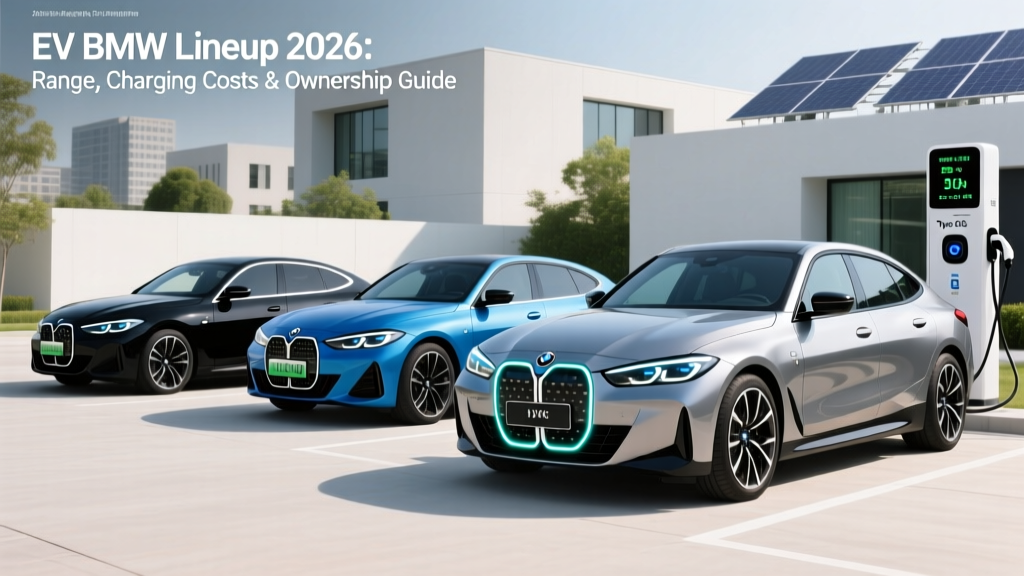
BMW sells four fully electric models in the US for the 2026 model year, all built on the flexible CLAR platform shared with their gas counterparts. Here's how they stack up on the numbers that matter:
| Model | EPA Range | Battery (kWh usable) | Chemistry | Peak DC kW | 10–80% Time | 0–60 mph | HP | Base MSRP |
|---|---|---|---|---|---|---|---|---|
| i4 eDrive35 | 263 mi | 66.5 | NMC | 180 kW | ~31 min | 5.8s | 281 | $52,200 |
| i4 M50 | 245 mi | 81.5 | NMC | 205 kW | ~31 min | 3.7s | 536 | $67,900 |
| i5 eDrive40 | 295 mi | 84.3 | NMC | 205 kW | ~30 min | 5.7s | 335 | $70,200 |
| i5 M60 | 270 mi | 84.3 | NMC | 205 kW | ~30 min | 3.7s | 593 | $84,300 |
| i7 eDrive50 | 318 mi | 101.7 | NMC | 195 kW | ~34 min | 4.5s | 449 | $97,300 |
| i7 M70 | 291 mi | 101.7 | NMC | 195 kW | ~34 min | 3.5s | 650 | $125,300 |
| iX xDrive50 | 324 mi | 111.5 | NMC | 195 kW | ~35 min | 4.4s | 516 | $87,250 |
| iX M60 | 296 mi | 111.5 | NMC | 195 kW | ~35 min | 3.6s | 610 | $108,900 |
Source: fueleconomy.gov and BMW USA 2026 model-year specifications.
Real-World Range Reality Check
EPA estimates are measured under controlled conditions. In real-world ownership, expect the following adjustments:
- Highway driving (75+ mph): Subtract 15–20% from EPA. An i5 eDrive40 rated at 295 mi EPA will deliver roughly 240–255 mi on sustained highway trips.
- Cold weather (below 32°F): Subtract 20–30%. The i4 eDrive35 (263 mi EPA) may drop to 185–210 mi in freezing conditions without preconditioning.
- Combined daily driving with preconditioning: Expect within 5–10% of EPA — so an iX xDrive50 realistically delivers 290–310 mi in moderate weather.
All BMW EVs use NMC (nickel manganese cobalt) battery chemistry, which offers higher energy density than LFP but requires more careful thermal management. BMW's liquid-cooled thermal system and standard heat pump help mitigate cold-weather losses, but physics still applies.
Charging an EV BMW: Home vs. Public Costs
Charging cost is the single largest variable in EV ownership economics. Here's how it breaks down for BMW's lineup:
| Charging Level | Power (kW) | Miles Added/Hour | Typical Cost per kWh | Cost to Add 200 mi (i5 eDrive40) |
|---|---|---|---|---|
| Level 1 (120V household) | 1.4 kW | ~4 mi/hr | $0.13–$0.18 (home) | ~$9.50 |
| Level 2 (240V home wallbox) | 7.4–11 kW | ~22–34 mi/hr | $0.13–$0.18 (home) | ~$9.50 |
| DC Fast (public, 50–150 kW) | 50–150 kW | ~150–350 mi/hr | $0.35–$0.55 | ~$22–$34 |
| DC Fast (public, 150–205 kW) | 150–205 kW | ~350–500 mi/hr | $0.35–$0.55 | ~$22–$34 |
Key insight: The BMW i5 eDrive40 consumes roughly 32 kWh per 100 miles (combined EPA). At the national average home electricity rate of ~$0.16/kWh, charging 200 miles of range at home costs about $10.24. The same 200 miles on a DC fast charger at $0.48/kWh costs $30.72. Home charging is essential to making the economics work.
BMW Charging Curve Reality
BMW advertises peak charge rates of 180–205 kW, but peak is not sustained. In real-world DC fast charging sessions, BMW EVs typically sustain peak rate from approximately 10% to 35% SoC, then taper progressively. Expect a 10–80% session to average roughly 110–140 kW on the i5/i7/iX, meaning the advertised 30–35 minute 10–80% time is achievable under ideal conditions (battery preconditioned, ambient temperature 60–80°F) but can stretch to 40–50 minutes in cold weather without preconditioning. Always use the BMW app or iDrive system to precondition the battery before arriving at a fast charger.
EV BMW vs. Gas BMW: 5-Year Cost Comparison
The sticker price tells only part of the story. Here's a 5-year total cost of ownership (TCO) comparison between the i5 eDrive40 and its closest gas counterpart, the 530i xDrive, assuming 12,000 miles/year, $3.80/gallon regular, and $0.16/kWh home electricity:
| Cost Category | i5 eDrive40 (EV) | 530i xDrive (Gas) |
|---|---|---|
| Base MSRP | $70,200 | $60,900 |
| Federal tax credit (§30D) | $0–$3,750* | $0 |
| Fuel/Energy (5 years) | $3,840 (home charging) | $11,400 |
| Maintenance (5 years) | ~$1,800 | ~$3,500 |
| Insurance (5 years avg) | ~$14,400 | ~$11,400 |
| Estimated depreciation | ~$28,000 | ~$22,000 |
| 5-Year Total (approx.) | $90,240–$93,990 | $87,200 |
*BMW's §30D eligibility is limited by battery critical-mineral sourcing requirements. As of 2026, most BMW EVs qualify for $0–$3,750 depending on the specific trim's battery component sourcing. Verify current eligibility at irs.gov before purchasing.
The gas 530i still edges out the i5 on total 5-year cost by $3,000–$7,000, primarily due to higher upfront price, steeper EV depreciation, and pricier insurance. However, the i5 wins on driving smoothness, instant torque, lower tailpipe emissions, and the convenience of home charging. The gap narrows if you qualify for the full $3,750 credit, if your state offers additional rebates, or if gas prices rise above $4.50/gallon in your area.
Federal Tax Credit: What BMW EV Buyers Need to Know
§30D Tax Credit Requirements (2026)
- MSRP cap: Vans, SUVs (iX): up to $80,000. Sedans (i4, i5, i7): up to $55,000. This eliminates the i7 and most i5 trims.
- Buyer income cap: $150,000 single / $225,000 head of household / $300,000 joint (modified AGI).
- Battery components: Must be manufactured or assembled in North America (phased percentage thresholds increase annually). $3,750 credit portion.
- Critical minerals: Must be sourced from the US or FTA partners. $3,750 credit portion.
- Point-of-sale transfer: You can transfer the credit to the dealer at purchase for an immediate price reduction, or claim it on your tax return.
Practical reality: BMW sources battery cells primarily from CATL (China) and Samsung SDI (South Korea). Due to critical-mineral and battery-component sourcing rules, most 2026 BMW EVs qualify for $0 to $3,750 of the $7,500 maximum — not the full amount. The i4 eDrive35, with an MSRP of $52,200, falls under the $55,000 sedan cap and is the most credit-eligible model. The iX xDrive50 at $87,250 exceeds the $80,000 SUV cap entirely and is ineligible. Always confirm eligibility with your dealer and a tax professional before finalizing a purchase. Rules are subject to change — check the IRS clean vehicle credits page for current status.
Common EV BMW Misconceptions — Fact-Checked
| Myth | Fact |
|---|---|
| "BMW EV batteries degrade quickly and cost $25,000 to replace." | BMW guarantees 70% battery capacity retention for 8 years/100,000 miles. Real-world data from early i4/iX owners shows approximately 5–8% degradation at 50,000 miles. Full battery replacement cost is $15,000–$22,000 out of warranty, but most owners will never need one within typical ownership periods. |
| "You can't road-trip an EV BMW — charging takes too long." | A 10–80% DC fast charge takes 30–35 minutes on the i5/i7/iX. On a 500-mile trip with one stop, total added time is roughly 40 minutes (including getting in/out). The BMW navigation system automatically routes through compatible chargers and preconditions the battery. |
| "EV BMWs aren't reliable — they're too new." | BMW's EVs share the proven CLAR platform with gas models. The electric powertrain has fewer moving parts than an ICE engine. Early reliability data (Consumer Reports, JD Power) rates the i4 and iX at average to above-average for the luxury EV segment. |
| "Home charging installation is prohibitively expensive." | A basic Level 2 (240V/48A) home wallbox installation typically costs $1,200–$2,800 including equipment, electrician labor, and permit — assuming your electrical panel has capacity. A panel upgrade (200A service) adds $2,000–$4,500. Many BMW dealers offer discounted ChargePoint or BMW Wallbox installations. |
| "The i4 is just a gas 4 Series with a battery — it's compromised." | The i4 shares the 4 Series Gran Coupe body but was designed from the start to accommodate batteries. Cargo space is 35.7 cu ft (vs. 46.8 in the gas 4 Series), a modest reduction. The low battery floor gives a lower center of gravity, and the instant torque makes the i4 M50 quicker than any gas M440i. |
Who Should Buy an EV BMW — Decision Framework
Choose a BMW EV (i4, i5, i7, or iX) if:
- You have access to Level 2 home charging (garage or driveway with 240V outlet).
- Your daily driving is under 250 miles round-trip.
- You value smooth, silent acceleration and low running costs over maximum highway range.
- You want a luxury EV that drives like a BMW — balanced chassis, precise steering, iDrive tech.
- You live in a region with reliable DC fast charging networks (Electrify America, Tesla Supercharger with NACS adapter, EVgo) for road trips.
Choose a BMW Plug-in Hybrid (e.g., 550e xDrive, X5 xDrive50e) instead if:
- You lack reliable home charging access (apartment/condo without charging options).
- You regularly drive 350+ miles in a single day or frequently tow heavy loads.
- You live in an area with extreme cold (sustained sub-zero temperatures) and limited charging infrastructure.
- You want electric-only commuting (30–40 mi EV range on PHEV models) with gas flexibility for long trips.
- The §30D tax credit ineligibility makes a BMW EV financially unattractive compared to a PHEV with lower upfront cost.
Choose a non-BMW EV (Tesla, Hyundai, Rivian) if:
- Maximum tax credit ($7,500) is a priority — Tesla Model Y, Ford F-150 Lightning, and select Hyundai/Kia models currently qualify for more of the credit.
- You want the largest Supercharger network without adapter dependency (Tesla NACS native).
- You need 400+ miles of real-world range (Lucid Air, Tesla Model S).
First-Time BMW EV Buyer Checklist
If you're transitioning from a gas BMW to an electric one, here's what to prepare before signing:
- Audit your home electrical panel. Determine if you have 200A service and available breaker slots for a 48A–60A Level 2 circuit. Get a quote from a licensed electrician — do not assume your panel can handle it without checking.
- Test your daily route range. Use BMW's online range calculator for your specific commute, factoring in climate, terrain, and speed. If your round-trip exceeds 200 miles in winter, consider the i5 eDrive40 or iX xDrive50 over the i4 eDrive35.
- Map public charging near your frequent destinations. Use PlugShare or the BMW app to verify DC fast charger availability along your road-trip routes. Electrify America has the broadest non-Tesla coverage; BMW EVs use CCS1 connectors natively but can access Tesla Superchargers with a BMW-approved NACS adapter (available for 2025+ models).
- Get insurance quotes before purchasing. BMW EVs typically cost 15–25% more to insure than gas equivalents due to higher repair costs and MSRP. Shop at least three carriers.
- Confirm §30D eligibility in writing. Ask the dealer for the specific VIN's credit qualification. Cross-reference with the IRS clean vehicle credit lookup tool.
- Understand the warranty. BMW covers the high-voltage battery for 8 years/100,000 miles (70% capacity retention threshold) and the powertrain for 4 years/50,000 miles. Complimentary maintenance covers 3 years/36,000 miles.
EV BMW Ownership FAQ
What is the cheapest BMW EV available in 2026?
The i4 eDrive35 starts at $52,200 MSRP (before destination). It offers 263 miles EPA range, 281 HP, and 180 kW peak DC charging. It's the only BMW EV that falls under the §30D sedan MSRP cap of $55,000, making it the most tax-credit-eligible model.
Does BMW use NACS or CCS for charging?
BMW EVs sold in the US through 2024 use CCS1 connectors natively. Starting with 2025 model-year vehicles, BMW is transitioning to NACS (the Tesla connector). For 2026 models, check the specific trim — most will include NACS, and BMW offers a CCS-to-NACS adapter for compatibility with Electrify America and other CCS networks. Tesla Supercharger access is available via BMW's adapter program.
How much does it cost to charge a BMW i5 at home per month?
If you drive 1,000 miles per month in the i5 eDrive40 (consuming ~32 kWh/100 mi), you'll use about 320 kWh monthly. At $0.16/kWh (national average), that's approximately $51/month — compared to roughly $190/month for gas in a 530i xDrive at 28 MPG combined and $3.80/gallon.
Is BMW's warranty competitive for EVs?
BMW's 8-year/100,000-mile battery warranty (70% retention) is standard for the luxury segment — matching Mercedes and Audi. Hyundai/Kia offer 10-year/100,000-mile coverage, and Tesla offers 8 years with varying mileage limits (120,000–150,000 depending on model). BMW's warranty is adequate but not class-leading.
Can I tow with a BMW EV?
The iX xDrive50 is rated to tow up to 4,400 lbs. The i5 is not rated for towing in the US market. Towing significantly reduces range — expect a 30–50% reduction depending on trailer weight and speed. If you tow regularly, the iX is the practical choice.
Do BMW EVs qualify for any state incentives?
State incentives vary widely and change frequently. California's CVRP, Colorado's innovative motor vehicle credit, and various utility rebates may apply. Check your state's energy office and your local utility for current programs — these can stack with (or substitute for) the federal credit. Consult your state's official incentive database for exact amounts.