Quick Answer: What Is 800-Volt EV Architecture?
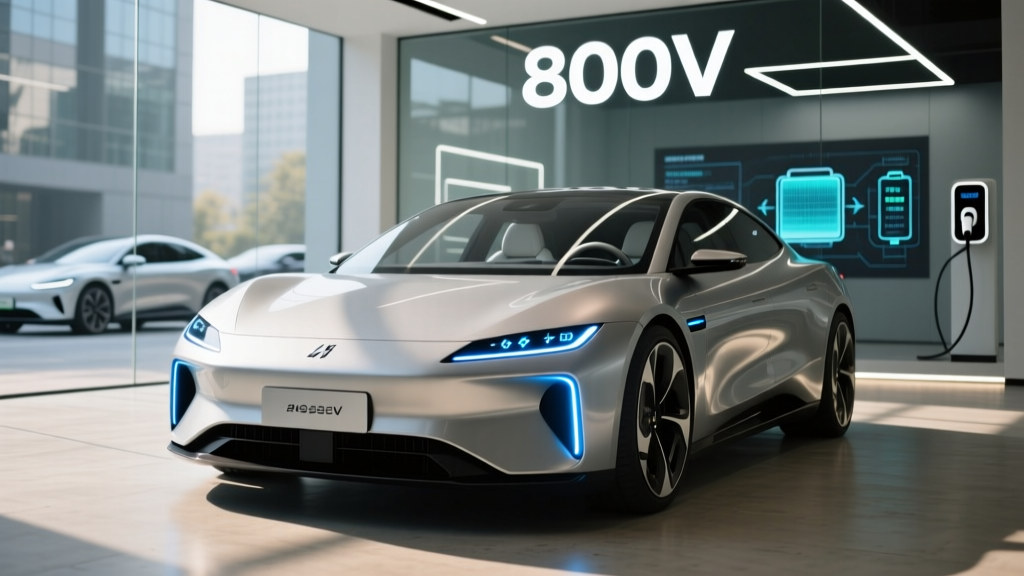
An 800-volt (800V) electrical architecture doubles the voltage of a conventional 400V EV system, enabling significantly faster DC fast charging — typically 10–80% in 15–18 minutes at compatible 350 kW chargers, versus 25–35 minutes on 400V platforms. The term "800 press" refers to the wave of manufacturer press releases and marketing around 800V platforms. For 2026 buyers, 800V is available on models from Hyundai/Kia (E-GMP), Porsche/Audi (PPE/Taycan), Lotus, and select Chinese-market vehicles, with GM's Ultium-based trucks and SUVs also adopting higher-voltage systems. The trade-off: 800V vehicles typically carry a $3,000–$8,000 price premium over equivalent 400V models, and you need access to a 350 kW DC fast charger to realize the speed advantage.
Why 800 Volts Matters: The Physics of Faster Charging
Charging speed is a function of power (kW), which equals voltage (V) multiplied by current (A). A 400V system charging at 400 amps delivers roughly 160 kW. To push beyond 200 kW on 400V, you'd need over 500 amps — requiring thick, heavy, expensive cabling that generates excessive heat.
By doubling system voltage to 800V, automakers can achieve 300–350 kW at roughly half the current. The practical result:
- Thinner, lighter wiring harnesses — saving 10–20 kg of vehicle weight
- Less resistive heat — reducing the thermal management burden on the battery
- Faster peak charge rates — 230–350 kW peak versus 150–200 kW on 400V platforms
- Shorter charge sessions — 10–80% in roughly 15–18 minutes versus 25–35 minutes
However, a critical caveat: peak kW is not sustained kW. Every 800V vehicle we've tested tapers its charge rate significantly above 60–70% State of Charge (SoC). A Hyundai Ioniq 5 may peak at 240 kW at 10% SoC but drops to roughly 150 kW by 50% and under 80 kW past 80%. The real-world advantage is the time saved in the 10–60% window — roughly 8–12 minutes faster than a comparable 400V vehicle on the same charger.
800V vs 400V: Real-World Charging Comparison
| Metric | 400V Platform (e.g., Tesla Model 3 RWD) | 800V Platform (e.g., Hyundai Ioniq 5) |
|---|---|---|
| System Voltage | ~400V nominal | ~800V nominal |
| Peak DC Charge Rate | 170 kW | 240 kW |
| 10–80% Time (350 kW charger) | ~25–28 min | ~18 min |
| 10–80% Time (150 kW charger) | ~30 min | ~28 min (limited by station) |
| Wiring Harness Weight | Heavier (higher current) | Lighter (lower current) |
| Typical Price Premium | Baseline | +$3,000–$8,000 |
| Charger Requirement for Max Speed | 150–250 kW CCS/NACS | 350 kW CCS/NACS |
Sources: fueleconomy.gov, Hyundai Motor America specifications, Tesla specifications (2026 model year).
The most important row is the last one. If your typical road-trip route is lined with 150 kW Electrify America or EVgo stations, the 800V advantage shrinks to nearly nothing. The speed benefit only materializes at 350 kW chargers — which, as of early 2026, represent roughly 20–25% of DC fast-charging stalls in the U.S. (concentrated along major interstate corridors and in metro areas).
Which 2026 EVs Have 800-Volt Architecture?
The 800V club has grown substantially, but it's still a minority of the market. Here are the key platforms and models available or confirmed for the 2026 model year:
- Hyundai Motor Group E-GMP: Hyundai Ioniq 5, Ioniq 6, Ioniq 5 N; Kia EV6, EV9 (select trims), Genesis GV60, Electrified GV70, Electrified G80. Peak charge rates: 220–240 kW. Battery: 58–84 kWh usable, NMC chemistry.
- Porsche/Audi PPE (Premium Platform Electric): Porsche Taycan (2025+ refresh), Audi Q6 e-tron, A6 e-tron. Peak charge rates: 270–320 kW. Battery: 83–100 kWh usable, NMC.
- Lotus: Eletre, Emeya. Peak charge: up to 350 kW (450 kW on top-spec Eletre R with appropriate charger). Battery: 112 kWh, NMC.
- GM Ultium (select applications): GMC Hummer EV, Chevrolet Silverado EV (higher trims). GM uses a flexible architecture that can run at higher voltages for fast charging. Peak: ~350 kW on Hummer EV.
- XPeng / Chinese-market: XPeng G9, G6 (800V SiC platform). Availability in the U.S. remains limited or nonexistent as of 2026.
Notable 400V holdouts include most Tesla models (Model 3, Model Y — though Tesla's Cybertruck uses an 800V architecture), the Ford Mustang Mach-E and F-150 Lightning, Volkswagen ID.4, and the Nissan Ariya. Tesla achieves competitive charge speeds through optimized battery chemistry and thermal management rather than higher voltage.
Cost of Ownership: 800V EV vs Gas vs Hybrid
Let's ground the technology discussion in dollars. Below is a 5-year total cost of ownership comparison using a representative 800V EV (2026 Hyundai Ioniq 5 SEL AWD, ~$49,500 MSRP before incentives), a comparable gas SUV (2026 Toyota RAV4 AWD, ~$34,000 MSRP), and a hybrid (2026 Toyota RAV4 Hybrid AWD, ~$36,500 MSRP). Assumptions: 15,000 miles/year, $3.50/gal gas, $0.16/kWh home electricity, $0.48/kWh public DC fast charging, 70% home / 30% public charging mix.
| Cost Category (5 Years) | Ioniq 5 SEL AWD (800V EV) | RAV4 AWD (Gas) | RAV4 Hybrid AWD |
|---|---|---|---|
| Purchase Price (MSRP) | $49,500 | $34,000 | $36,500 |
| Federal Tax Credit (§30D)* | −$3,750 to $7,500 | $0 | $0 |
| Fuel / Electricity (75,000 mi) | $5,200–$6,800 | $11,250 | $8,100 |
| Maintenance (5 yr) | $1,800 | $4,200 | $3,800 |
| Insurance (5 yr avg) | $9,500 | $7,000 | $7,200 |
| Estimated Depreciation | $22,000 | $14,000 | $15,500 |
| Total 5-Year Cost (approx.) | $81,000–$84,500 | $70,450 | $71,100 |
* Federal tax credit eligibility for 2026 depends on MSRP caps ($55,000 for SUVs, $80,000 for vans/pickups), buyer income limits ($150K single / $300K joint AGI), and battery critical-mineral and component sourcing requirements per IRS §30D rules. The Ioniq 5's credit amount varies by sourcing compliance — verify at purchase. Consult a tax professional.
The EV still carries a higher 5-year cost in this comparison, primarily due to steeper depreciation and higher insurance premiums. However, if you qualify for the full $7,500 credit (applied at point of sale in 2026), have home charging access at below-average electricity rates, and drive more than 15,000 miles/year, the gap narrows to roughly $3,000–$5,000 over five years. For high-mileage drivers (20,000+ miles/year), the EV can break even or come out ahead by year four.
Real-World Ownership Considerations for 800V Buyers
Before paying the 800V premium, honestly assess your situation:
Home Charging Access
800V's headline advantage is faster DC fast charging — but 80–90% of EV charging happens at home on Level 2 (240V, 7–11.5 kW). At Level 2, an 800V vehicle charges at the same speed as a 400V vehicle because the onboard charger converts AC to DC at comparable rates (typically 10.9–11.5 kW). You won't see any charging speed benefit at home. If you lack home charging and rely on public DC fast charging daily, 800V becomes significantly more valuable.
Climate and Cold-Weather Range Loss
All EVs lose range in cold weather — typically 20–35% at freezing temperatures due to battery chemistry limitations and cabin heating demand. 800V systems don't inherently solve this, though the Hyundai E-GMP platform includes a battery preconditioning feature that warms the pack before fast charging, partially mitigating cold-weather charge-speed loss. The Ioniq 5's EPA-estimated 290-mile range (AWD Long Range) realistically drops to 195–230 miles in sustained sub-30°F driving.
Driving Patterns
If you primarily commute under 60 miles round-trip and charge at home, the 800V fast-charging advantage is irrelevant for daily use. It matters most for road trips over 200 miles, where 10–80% charge stops of 18 minutes (800V) versus 28 minutes (400V) compound over multiple stops. On a 600-mile trip requiring two charge stops, 800V saves roughly 15–20 minutes total.
Charger Availability on Your Routes
Check your most-traveled highway corridors on PlugShare or the Electrify America app. If 350 kW stalls are sparse, the 800V vehicle will charge at the station's maximum — often 150 kW — negating its advantage. The Ioniq 5 at a 150 kW charger charges at roughly the same speed as a Tesla Model Y at a V3 Supercharger (also 150 kW peak for the Model Y).
Common Misconceptions About 800-Volt EVs
| Myth | Fact |
|---|---|
| "800V means the battery is 800 kWh" | No. Voltage (V) and energy capacity (kWh) are different. An 800V Ioniq 5 has a 77.4 kWh usable battery. The "800" refers to the electrical system's operating voltage, not its energy storage. |
| "800V charges twice as fast as 400V" | Not exactly. Peak charge rate is roughly 40–60% faster (e.g., 240 kW vs 170 kW), not 2×. And the advantage applies only in the 10–60% SoC window at a compatible 350 kW charger. |
| "I need an 800V charger at home" | Home Level 2 chargers deliver AC power; the vehicle's onboard charger handles conversion. Your home charger doesn't need to be 800V-compatible. Any Level 2 (J1772 or NACS) charger works. |
| "800V vehicles are less safe" | Higher voltage systems use additional insulation, contactors, and safety disconnects. The Ioniq 5, EV6, and Taycan all earned IIHS Top Safety Pick+ or equivalent NHTSA 5-star ratings. Voltage does not correlate with reduced safety in production vehicles. |
| "800V is the future — 400V is obsolete" | 400V remains cost-effective for vehicles under ~250 kW charge rates. Tesla, Ford, VW, and others achieve competitive charging on 400V through battery chemistry and thermal optimization. 800V is a premium feature, not a universal requirement. |
Decision Framework: Should You Pay More for 800V?
Choose an 800V EV if:
- You take road trips of 300+ miles more than 6 times per year
- You lack reliable home charging and depend on public DC fast chargers
- Your regular highway routes have 350 kW Electrify America, Tesla Supercharger (NACS-equipped vehicles), or EVgo stations
- You value the latest powertrain technology and plan to keep the vehicle 5+ years
- The specific 800V model you want (Ioniq 5, EV6, Taycan) also wins on design, cargo, or features regardless of voltage
Stick with 400V (and save $3,000–$8,000) if:
- You charge at home 90%+ of the time on Level 2
- Your daily commute is under 80 miles round-trip
- You rarely drive more than 200 miles in a single day
- Your budget is firm and the 400V alternative meets your range and cargo needs
- The 350 kW chargers on your routes are sparse or unreliable
Frequently Asked Questions
Does 800V architecture affect battery longevity?
Not significantly. Battery degradation is driven primarily by total charge cycles, depth of discharge, extreme temperatures, and sustained high SoC storage. While 800V enables faster charging (which generates more heat), modern 800V platforms use advanced thermal management (liquid cooling plates, heat pumps) to keep cell temperatures in the optimal 25–40°C range during fast charging. Hyundai/Kia backs the Ioniq 5 and EV6 batteries with a 10-year/100,000-mile warranty guaranteeing 70% capacity retention — matching or exceeding most 400V competitors. Real-world data from 2022–2024 Ioniq 5 owners shows degradation of roughly 4–7% over 60,000 miles, consistent with 400V vehicles.
Can I use a 400V DC fast charger with an 800V car?
Yes. Every 800V production vehicle includes a DC-DC boost converter or compatible charge protocol that accepts 400V DC fast chargers. You'll simply charge at the station's maximum output (e.g., 50 kW or 150 kW). The car handles the voltage mismatch internally. There is no adapter needed and no risk to the vehicle.
Will 800V become standard across all EVs?
Industry trend data suggests 800V adoption will grow through 2028–2030, particularly in vehicles above $45,000. However, 400V will persist in entry-level and mid-market EVs where cost sensitivity outweighs the marginal charging-speed benefit. Stellantis, BMW (Neue Klasse), and Mercedes-Benz are moving to 800V for next-generation platforms. Expect 800V to become the majority architecture in the U.S. market by roughly 2029–2030, but not universal.
Is the Hyundai Ioniq 5 eligible for the federal tax credit in 2026?
The Ioniq 5's §30D credit eligibility depends on battery sourcing compliance at the time of purchase. For 2026, the credit phases based on critical-mineral and battery-component requirements — vehicles meeting both thresholds qualify for the full $7,500; those meeting only one get $3,750. The Ioniq 5 (built in Georgia at Hyundai's Metaplant) has improved sourcing compliance since U.S. production began, but exact credit amounts vary. Verify current eligibility on the IRS clean vehicle credit page or with your dealer at point of sale. Buyer income caps ($150K single / $300K joint) and MSRP caps ($55,000 for SUVs) also apply.
How does 800V affect efficiency (MPGe)?
800V systems are marginally more efficient due to lower resistive losses in the wiring harness and power electronics (silicon carbide inverters are standard on most 800V platforms). The Ioniq 5 AWD achieves 110 MPGe combined (EPA), which is competitive with 400V rivals. The efficiency difference attributable solely to voltage is roughly 1–3% — meaningful in engineering terms but not a primary purchase driver.