The Europe Cybertruck Ban Explained: Why Tesla's Pickup Can't Cross the Atlantic
If you've been following Tesla's polarizing Cybertruck since its late-2023 launch, you may have encountered a frustrating reality: the Europe Cybertruck ban is very real, and as of 2026, Tesla's stainless-steel electric pickup remains illegal for consumer sale across the European Union, the United Kingdom, and most of the European Economic Area. Unlike the Model 3 and Model Y — which dominate European EV sales charts — the Cybertruck has never received Whole Vehicle Type Approval (WVTA) from European regulators, effectively locking it out of one of the world's largest EV markets.
This isn't a temporary paperwork delay. The Europe Cybertruck ban stems from fundamental design and regulatory incompatibilities between Tesla's angular pickup and decades of European vehicle safety legislation. For US-based shoppers researching the Cybertruck, understanding these restrictions provides critical context on the truck's safety profile, design trade-offs, and how it stacks up against domestically available competitors like the Ford F-150 Lightning, Rivian R1T, and Chevrolet Silverado EV.
Why European Regulators Won't Approve the Cybertruck
The European Union enforces some of the world's strictest vehicle safety standards, particularly regarding pedestrian protection. Under EU Regulation 78/2009 and subsequent updates, all new passenger vehicles and light commercial vehicles sold in the EU must pass rigorous pedestrian impact tests. These tests simulate a collision with an adult pedestrian at 40 km/h (25 mph), measuring head, pelvis, and leg injury criteria.
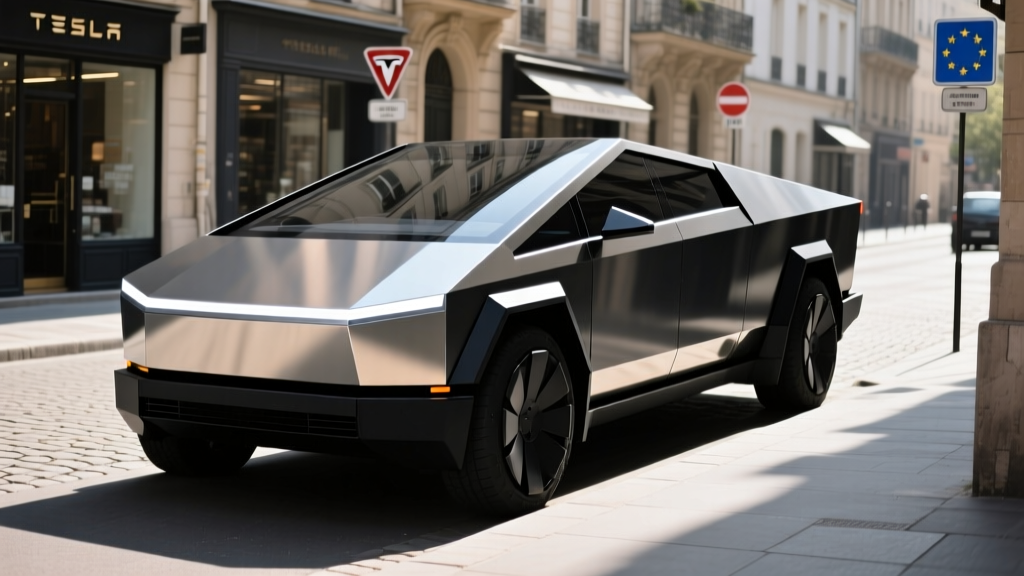
The Cybertruck's defining feature — its ultra-hard 30X cold-rolled stainless-steel exoskeleton — is precisely what disqualifies it. European crash-test engineers have indicated that the truck's flat, unyielding front fascia and sharp angular geometry would fail pedestrian head-impact and leg-impact requirements by a wide margin. Traditional vehicles use deformable bumper structures, hood crumple zones, and rounded edges to absorb impact energy and reduce pedestrian injury severity. The Cybertruck's stainless-steel panels simply don't deform.
Additional regulatory hurdles include:
- Sharp exterior edges: EU standards prohibit external protrusions and sharp edges that could lacerate pedestrians or cyclists in a collision. The Cybertruck's geometric folds and panel gaps present compliance challenges.
- Mass and size classification: At over 6,600 lbs (curb weight for the Cyberbeast), the Cybertruck exceeds the 3,500 kg (7,716 lbs) Gross Vehicle Weight threshold for standard European passenger vehicle type approval in some configurations, potentially requiring commercial-vehicle certification pathways.
- Lighting and mirror regulations: EU lighting standards (ECE regulations) differ from US FMVSS requirements, and the Cybertruck's light-bar configuration would need redesign for European homologation.
- Side-impact and rollover standards: European NCAP and regulatory side-impact testing protocols differ from NHTSA's, and the Cybertruck has not been submitted for Euro NCAP evaluation.
Tesla CEO Elon Musk acknowledged in 2023 that making the Cybertruck road-legal in Europe would be "very difficult" — a statement that has proven accurate. As of early 2026, Tesla has not submitted the Cybertruck for WVTA testing, nor announced plans to develop a Europe-compliant variant.
Cybertruck US Specs: What American Buyers Actually Get
Since the Cybertruck is only available in North America, let's break down the exact specifications US buyers can purchase in the 2026 model year. These figures are sourced from Tesla's official specifications and fueleconomy.gov EPA data.
| Specification | AWD (Dual-Motor) | Cyberbeast (Tri-Motor) |
|---|---|---|
| Base MSRP | $79,990 | $99,990 |
| EPA Range | 340 miles | 320 miles |
| Battery (usable) | ~123 kWh (NMC) | ~123 kWh (NMC) |
| Horsepower | 600 hp | 845 hp |
| 0-60 mph | 3.9 seconds | 2.6 seconds |
| Drivetrain | Dual-motor AWD | Tri-motor AWD |
| Max DC Fast Charge | 250 kW | 250 kW |
| 10-80% DC Charge | ~28 minutes | ~28 minutes |
| Level 2 Home Charging | 11.5 kW (~37 mi/hr) | 11.5 kW (~37 mi/hr) |
| EPA Efficiency | 65 MPGe (51 kWh/100mi) | 62 MPGe (54 kWh/100mi) |
| Towing Capacity | 11,000 lbs | 11,000 lbs |
| Payload Capacity | 2,500 lbs | 2,500 lbs |
| Cargo Bed Length | 6 ft (72 in) | 6 ft (72 in) |
| Frunk Volume | 7.1 cu ft | 7.1 cu ft |
| Battery/Drive Warranty | 8 yr / 120,000 mi | 8 yr / 120,000 mi |
Note: Tesla discontinued the originally announced rear-wheel-drive $60,990 base variant. The current lineup starts at $79,990 for the AWD dual-motor. Tesla previously offered a "Range Extender" battery pack option targeting 470+ miles, but availability and delivery timelines have been inconsistent — check Tesla's configurator for current status.
Real-World Range: What the EPA Sticker Doesn't Tell You
EPA Estimated Range: 340 miles (AWD) / 320 miles (Cyberbeast)
Real-World Expectation: In mixed driving at moderate temperatures (60-80°F), expect 280-310 miles from the AWD and 260-290 miles from the Cyberbeast. At sustained highway speeds of 75+ mph, range drops to approximately 240-270 miles due to the Cybertruck's poor aerodynamic drag coefficient (estimated Cd ~0.38-0.40 — high for an EV). In cold weather (below 32°F), reduce these figures by an additional 15-25%, yielding as little as 190-220 miles on winter highway trips.
The Cybertruck's large frontal area and angular profile work against it aerodynamically. While Tesla's heat pump and thermal management system mitigate cold-weather battery losses better than many competitors, physics is physics — pushing a 6,600+ lb stainless-steel wedge through cold, dense air at 75 mph consumes energy rapidly. Independent real-world highway range tests have consistently shown the Cybertruck falling 15-20% short of its EPA sticker at 70 mph cruise speeds.
For context, the Ford F-150 Lightning Extended Range (320 miles EPA) achieves similar real-world highway results, while the Rivian R1T with the Max Pack (410 miles EPA) offers a meaningful buffer for road-trippers willing to pay the premium.
Charging Speed and Infrastructure
| Charging Level | Power (kW) | Miles Added per Hour | Notes |
|---|---|---|---|
| Level 1 (120V household) | 1.4 kW | ~3-4 mi/hr | Emergency/trickle only; full charge takes days |
| Level 2 (240V home, 48A) | 11.5 kW | ~37 mi/hr | Full charge in ~11-12 hours; ideal for overnight |
| DC Fast Charge (peak) | 250 kW | ~750 mi/hr (peak) | Peak rate only; tapers significantly above 50% SoC |
| DC Fast Charge (10-80%) | ~150 kW avg | — | 10-80% in ~28 min at a V3 Supercharger |
The Cybertruck uses the NACS (North American Charging Standard) connector natively, giving it seamless access to Tesla's Supercharger network — the most reliable DC fast-charging infrastructure in North America. At a V3 Supercharger (250 kW capable), the Cybertruck peaks near 250 kW at low states of charge but tapers aggressively. Independent testing shows the charge curve drops below 100 kW once the battery passes approximately 55% SoC, and drops below 50 kW above 80%.
This tapering is typical for large NMC battery packs, which require careful thermal management during high-rate charging to prevent accelerated degradation. For road trips, plan charging stops around the 10-80% window — pushing to 100% at a DC fast charger adds minimal range while costing significant time. On a 300-mile highway trip with cold-weather headwinds, expect two charging stops of roughly 25-30 minutes each.
For home charging, a 48-amp Level 2 wall connector on a 60-amp circuit delivers the full 11.5 kW, replenishing roughly 370 miles overnight — more than enough for daily use. Installation costs for a dedicated 240V/60A circuit typically range from $800 to $2,500 depending on panel capacity and run length (source: HomeAdvisor national averages).
Federal Tax Credit Eligibility (§30D) for 2026
Does the Cybertruck qualify for the $7,500 federal EV tax credit? It depends on your income, and the rules are strict.
| §30D Requirement | Threshold | Cybertruck Status |
|---|---|---|
| Vehicle MSRP Cap (trucks) | ≤ $80,000 | AWD ($79,990): ✅ Qualifies | Cyberbeast ($99,990): ❌ Over cap |
| Buyer AGI Cap (married filing jointly) | ≤ $300,000 | Varies by buyer |
| Buyer AGI Cap (head of household) | ≤ $225,000 | Varies by buyer |
| Buyer AGI Cap (single) | ≤ $150,000 | Varies by buyer |
| Battery Component Sourcing (N. America) | Phase-in % per IRS | Check current IRS battery sourcing list |
| Critical Minerals Sourcing | Phase-in % per IRS | Check current IRS minerals list |
| Point-of-Sale Transfer | Available | Apply credit at purchase if eligible |
Source: IRS §30D Clean Vehicle Credit. Battery sourcing and critical mineral requirements tighten annually. Always verify current-year eligibility with a tax professional before purchase.
The key takeaway: the AWD dual-motor Cybertruck at $79,990 squeaks under the $80,000 truck MSRP cap, making it potentially eligible for the full $7,500 credit — bringing the effective price to roughly $72,490 for qualifying buyers. The Cyberbeast at $99,990 is categorically ineligible due to the MSRP cap. Battery-sourcing and critical-mineral requirements continue to tighten under the Inflation Reduction Act, and Tesla's supply chain compliance can shift quarter to quarter. Always check the fueleconomy.gov tax credit lookup tool for the specific model year and build date before committing.
How the Cybertruck Compares to Rivals US Buyers Can Actually Get
Since the Europe Cybertruck ban means European buyers must look elsewhere, and even US buyers should weigh alternatives, here's how the Cybertruck stacks up against the electric pickups you can buy in 2026:
| Spec | Tesla Cybertruck AWD | Ford F-150 Lightning Ext. Range | Rivian R1T Max Pack | Chevy Silverado EV 4WT |
|---|---|---|---|---|
| Base MSRP | $79,990 | $76,995 | $99,000 | $74,800 |
| EPA Range | 340 mi | 320 mi | 410 mi | 380 mi |
| Battery (usable) | ~123 kWh | ~131 kWh | ~149 kWh | ~200 kWh |
| 0-60 mph | 3.9 sec | 4.5 sec | 3.5 sec | 4.5 sec |
| Max DC Charge | 250 kW | 150 kW | 220 kW | 350 kW |
| Towing | 11,000 lbs | 10,000 lbs | 11,000 lbs | 12,000 lbs |
| Tax Credit Eligible | AWD only (MSRP cap) | Yes (MSRP under cap) | No (MSRP over cap) | Yes (MSRP under cap) |
The Cybertruck's advantages are straight-line acceleration, Tesla's Supercharger network access, and its unmistakable design. Its disadvantages include real-world range that lags the Rivian and Silverado EV, limited bed utility compared to a traditional full-size truck bed, and the polarizing aesthetic that isn't for everyone. The F-150 Lightning remains the pragmatic choice for traditional truck buyers who want familiar proportions and broad dealer support, while the Silverado EV's massive battery and 350 kW charging capability make it the road-trip range king — if you can stomach the size.
Pros and Cons
Pros
- Tri-motor Cyberbeast delivers supercar-level 2.6-second 0-60 in a pickup
- Native NACS connector with full Tesla Supercharger network access
- Stainless-steel exoskeleton is extremely dent- and corrosion-resistant
- 11,000-lb towing capacity with integrated trailer brake controller
- 6-ft bed with powered tonneau cover and 7.1 cu ft frunk
- Over-the-air updates continuously add features
- 8-year/120,000-mile battery and drive unit warranty
Cons
- Europe Cybertruck ban means zero availability outside North America
- Real-world highway range significantly below EPA estimates (~15-20% short)
- Cold-weather range loss compounds aerodynamic inefficiency
- DC fast-charge taper is aggressive above 55% SoC
- Cyberbeast trim ($99,990) is ineligible for §30D federal tax credit
- Visibility compromised by thick A-pillars and small rear window
- No traditional truck bed width between wheel wells (narrower than F-150)
- Panel gap and build quality inconsistencies reported by early owners
Who Should Buy the Cybertruck (and Who Shouldn't)
Buy the Cybertruck if: You want a fast, attention-grabbing electric pickup for daily driving and light-to-moderate towing. You live in an area with robust Supercharger coverage. You prioritize acceleration and tech over traditional truck utility. You qualify for the §30D credit on the AWD trim and want to get in under the $80,000 MSRP cap.
Skip the Cybertruck if: You need maximum real-world range for frequent long-distance towing (the Silverado EV or Rivian R1T Max Pack are better suited). You live in a cold climate where the aerodynamic penalties compound range loss. You need a full-width truck bed for standard 4x8 plywood sheets (the Cybertruck's bed is narrower between the wheel wells). You need a vehicle that's road-legal outside North America — the Europe Cybertruck ban is not going away soon.
Frequently Asked Questions
Why is the Cybertruck banned in Europe?
The Cybertruck fails to meet EU pedestrian safety regulations (Regulation 78/2009) due to its rigid stainless-steel exoskeleton, flat front fascia, and sharp angular edges. These design features would cause excessive injury to pedestrians in a collision compared to vehicles with deformable crumple zones and rounded surfaces. Tesla has not pursued European Whole Vehicle Type Approval for the Cybertruck.
Will Tesla ever make a Europe-legal Cybertruck?
As of 2026, Tesla has not announced plans for a Europe-compliant variant. Redesigning the front structure to meet pedestrian impact standards would fundamentally alter the Cybertruck's design identity. Elon Musk has previously suggested it would be "very difficult" to homologate for Europe. A European version, if it ever comes, would likely require significant structural changes including deformable front-end structures and reshaped body panels.
What is the Cybertruck's real-world range on the highway?
Expect approximately 240-270 miles at sustained 75 mph highway speeds in moderate temperatures — roughly 15-20% below the EPA's 340-mile estimate for the AWD trim. In cold weather (below freezing), highway range can drop to 190-220 miles. The Cybertruck's large frontal area and estimated 0.38-0.40 drag coefficient are the primary factors.
Does the Cybertruck qualify for the $7,500 federal tax credit?
The AWD dual-motor trim at $79,990 is under the $80,000 MSRP cap for trucks and may qualify, pending buyer income limits and current battery-sourcing compliance. The Cyberbeast at $99,990 exceeds the MSRP cap and is ineligible. Always verify on fueleconomy.gov and consult a tax professional before purchasing, as sourcing rules change.
How does the Cybertruck compare to the Ford F-150 Lightning?
The Cybertruck is faster (3.9s vs 4.5s 0-60), offers slightly more EPA range (340 vs 320 mi), and has access to the Supercharger network natively. The F-150 Lightning offers a more traditional truck bed, broader dealer service network, and a lower starting price. Real-world range is comparable between the two. The Lightning is also more likely to be eligible for the full $7,500 tax credit.
Is the Cybertruck safe?
The Cybertruck has not been crash-tested by NHTSA or IIHS as of early 2026, so there are no official US safety ratings to reference. Tesla claims the stainless-steel exoskeleton provides exceptional occupant protection, but the same rigidity raises pedestrian-safety concerns — which is exactly why Europe won't approve it. Without independent crash-test data, buyers are relying on Tesla's internal testing claims.