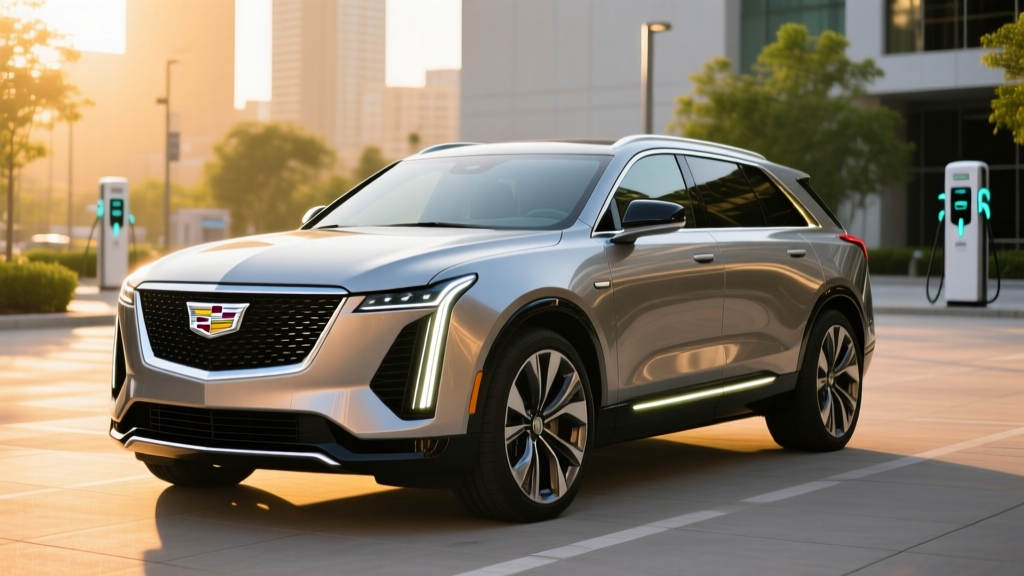
Quick Answer: The 2025 Cadillac Escalade IQ is a full-size luxury electric SUV with an EPA-estimated 460 miles of range, a massive 200+ kWh Ultium battery, and a starting MSRP of $129,990. It charges at up to 350 kW on DC fast chargers (10–80% in approximately 30 minutes) and delivers 750 horsepower in Velocity mode. Buyers should budget for higher insurance premiums, plan home Level 2 charging (essential for a battery this large), and note that the Escalade IQ does not qualify for the federal §30D tax credit due to its MSRP exceeding the $80,000 SUV cap.
Range and Efficiency: 460 Miles on Paper, What About Reality?
The Escalade IQ's headline number is its EPA-estimated 460 miles of range, achieved on the Luxury trim with 24-inch wheels. That figure comes from an enormous Ultium-platform battery pack with over 200 kWh of usable capacity — one of the largest ever fitted to a production passenger vehicle. The battery uses GM's NCMA (nickel-cobalt-manganese-aluminum) chemistry, optimized for energy density to support this heavy, full-size SUV.
EPA Range vs. Real-World Expectations
EPA sticker: 460 miles (Luxury trim, 24" wheels)
Highway driving (70–80 mph): Expect approximately 360–390 miles. Large SUVs face significant aerodynamic drag at speed.
Cold weather (below 32°F): Plan for 320–370 miles. The Escalade IQ's heat pump helps, but a 200+ kWh battery still loses meaningful capacity in freezing temps.
Mixed real-world driving: 390–430 miles is realistic for moderate climates and combined city/highway use.
Efficiency lands around 58–62 MPGe combined depending on trim, according to fueleconomy.gov. That translates to roughly 54–58 kWh per 100 miles — thirsty by EV standards, but expected for a 7,500+ pound vehicle. For comparison, the Tesla Model X achieves about 101 MPGe combined, but it's significantly smaller and lighter.
| Trim | EPA Range | Battery (usable) | Efficiency (MPGe) | kWh/100mi |
|---|---|---|---|---|
| Luxury 2WD | 460 mi | ~200 kWh | ~62 MPGe | ~54 |
| Sport 2WD | ~440 mi | ~200 kWh | ~58 MPGe | ~58 |
| Luxury AWD | ~430 mi | ~200 kWh | ~56 MPGe | ~60 |
| Sport AWD | ~410 mi | ~200 kWh | ~54 MPGe | ~62 |
Charging: 350 kW Peak, But Plan Your Home Setup Carefully
The Escalade IQ supports DC fast charging at up to 350 kW via its CCS connector (with NACS adapter support for Tesla Supercharger access). At peak rate, GM estimates a 10–80% charge in approximately 30 minutes. However, as with every large battery EV, the charge curve tapers significantly above 80% — a full 10–100% session will take closer to 50–55 minutes.
Here's the practical reality: a 200 kWh battery charging at a sustained average of 250 kW (realistic accounting for taper) still requires significant energy transfer. Peak 350 kW rates only hold in the 10–30% state-of-charge window before stepping down.
| Level | Power | Miles Added/Hour | Full Charge Time | Best For |
|---|---|---|---|---|
| Level 1 (120V) | ~1.4 kW | ~3 mi/hr | ~140+ hours | Emergency trickle only |
| Level 2 (240V, 48A) | 11.5 kW | ~20 mi/hr | ~18–20 hours | Daily home charging |
| Level 2 (240V, 80A) | 19.2 kW | ~34 mi/hr | ~10–12 hours | Optimal home setup |
| DC Fast (350 kW peak) | Up to 350 kW | ~600+ mi/hr (peak) | 10–80% in ~30 min | Road trips |
Home charging is non-negotiable for this vehicle. With a 200 kWh battery, Level 1 charging is essentially useless — it would take nearly a full week to charge from empty. A 48-amp Level 2 circuit (requiring a 60-amp breaker) adds about 20 miles per hour of charging, which works if you drive under 80 miles daily and plug in every night. For heavier use or faster turnaround, an 80-amp circuit (100-amp breaker) delivering 19.2 kW is strongly recommended. This may require a 200-amp electrical panel upgrade, adding $1,500–$3,000 to your installation cost.
Expect to pay $2,500–$5,500 total for a professional Level 2 home installation with the Escalade IQ, including the charger unit ($500–$800 for a quality 48A–80A unit), electrician labor, permit fees, and potential panel work. Consult a licensed electrician for your specific situation.
Escalade IQ vs. Gas Escalade: The Real Cost Comparison
The most common buyer question: does going electric save money on a six-figure luxury SUV? Let's break it down with concrete numbers over a 5-year ownership period, assuming 12,000 miles driven annually.
| Cost Category | Escalade IQ (Electric) | 2025 Escalade Gas (Premium 4WD) |
|---|---|---|
| Base MSRP | $129,990 | $89,590 |
| Federal Tax Credit (§30D) | $0 (exceeds $80K cap) | $0 |
| Fuel/Energy (5 yrs) | $7,200–$9,600* | $21,000–$24,000** |
| Maintenance (5 yrs) | $2,500–$3,500 | $6,000–$8,000 |
| Insurance (5 yrs, est.) | $18,000–$24,000 | $14,000–$18,000 |
| Estimated Depreciation | $52,000–$65,000 | $36,000–$45,000 |
| 5-Year Total (approx.) | $160,000–$190,000 | $130,000–$155,000 |
*Based on $0.12–$0.16/kWh average home charging; public DC fast charging costs more.
**Based on $4.50/gallon premium, 16 MPG combined (EPA for gas Escalade 4WD).
The verdict: the Escalade IQ saves significantly on fuel and maintenance — roughly $12,000–$16,000 over five years. But the $40,000 higher purchase price, steeper depreciation on a first-year EV platform, and higher insurance premiums mean the gas Escalade remains cheaper to own in total. This is a luxury and technology purchase, not a cost-savings play.
Performance, Interior, and Technology
The Escalade IQ delivers 680 horsepower in normal driving and 750 hp in Velocity mode, with a 0–60 mph time of under 5.0 seconds — remarkable for a vehicle with a curb weight approaching 8,000 pounds. The dual-motor AWD system provides precise torque vectoring, and GM's magnetic ride control adapts to road conditions in real time.
Inside, Cadillac has gone maximalist: a 55-inch total LED display span across the dashboard, executive second-row seating with massage and recline functions, a 40-speaker AKG Studio Reference audio system, and Super Cruise hands-free driving on compatible highways. Super Cruise is an SAE Level 2 driver-assistance system — the driver must remain attentive and hands-free does not mean eyes-free or self-driving. The system monitors driver attention via an infrared camera.
Automation Level: Super Cruise is SAE Level 2 — partial automation. The driver must continuously supervise the system and be prepared to take over immediately. This is not autonomous driving. Only Level 4 services like Waymo operate without a human driver.
Cargo space is generous: approximately 23 cubic feet behind the third row, expanding to over 130 cubic feet with all rear seats folded. The IQ also adds a front trunk (frunk) with roughly 10–12 cubic feet of additional sealed storage — useful for charging cables or groceries.
Tax Credits, Incentives, and Purchase Considerations
A critical point for buyers: the 2025 Escalade IQ does not qualify for the federal §30D clean vehicle tax credit. Under current IRS rules, SUVs must have an MSRP at or below $80,000 to be eligible. At $129,990, the Escalade IQ far exceeds this cap. State-level incentives vary — some states offer rebates regardless of MSRP, while others follow federal rules. Check your state's energy office or DMV for specifics.
§30D Federal Tax Credit Checklist (2025–2026 Rules):
- Vehicle MSRP cap: $80,000 for SUVs/pickups/vans, $55,000 for sedans — Escalade IQ does NOT qualify
- Buyer income cap: $300K joint / $225K head of household / $150K individual
- Battery critical minerals and component sourcing requirements apply
- Credit can be transferred to dealer at point of sale for eligible vehicles
- Consult a tax professional for your specific eligibility
Common Misconceptions About the Escalade IQ
| Myth | Fact |
|---|---|
| "It qualifies for the $7,500 federal tax credit" | It does not. MSRP far exceeds the $80,000 SUV cap under §30D. |
| "460 miles means I'll get 460 miles in all conditions" | Expect 320–390 miles in cold weather or sustained highway driving. EPA tests are conducted in moderate conditions. |
| "I can charge it overnight on a standard outlet" | Level 1 adds only ~3 miles per hour. A 200 kWh battery needs Level 2 (240V) for practical daily charging. |
| "Super Cruise means the car drives itself" | Super Cruise is SAE Level 2. You must remain attentive. It's an advanced cruise control and lane-keeping system, not a self-driving car. |
| "Electric means cheaper to own" | Fuel and maintenance savings are real (~$14K over 5 yrs), but higher purchase price, insurance, and depreciation mean total cost is higher than the gas Escalade. |
| "The battery will need replacing in a few years" | GM warranties the Ultium battery for 8 years/100,000 miles against defects and capacity loss below 70%. Modern EV batteries typically last 15–20 years with gradual degradation. |
Decision Framework: Is the Escalade IQ Right for You?
Choose the Escalade IQ if:
- You have reliable home Level 2 charging (or can install it) and rarely drive more than 300 miles in a single day without overnight stops
- You want a full-size three-row luxury SUV with the quietest, smoothest ride possible — EV powertrains eliminate engine vibration and noise entirely
- You value instant torque, 750-hp acceleration, and cutting-edge in-cabin technology
- You drive primarily in urban or suburban areas where regenerative braking maximizes efficiency
- You want to reduce your carbon footprint and your electricity comes from renewable or low-carbon sources
Stick with the gas Escalade (or wait) if:
- You regularly tow heavy loads over long distances — towing can cut EV range by 30–50%, and the IQ's real-world tow range is unproven
- You live in an apartment or lack home charging access — relying solely on public DC fast charging for a 200 kWh battery is expensive and time-consuming
- Total cost of ownership is a primary concern — the gas Escalade is $40K cheaper upfront and depreciates less in absolute dollars
- You frequently drive in extreme cold (below 0°F) in areas with sparse charging infrastructure
- You want to wait for second-generation refinements, NACS native port integration, or potential price reductions
Frequently Asked Questions
What is the real-world range of the 2025 Escalade IQ?
The EPA rates it at 460 miles for the Luxury 2WD trim. In real-world mixed driving, expect 390–430 miles. Sustained highway driving at 75+ mph drops that to roughly 360–390 miles, and cold weather (below freezing) can reduce range to 320–370 miles. The massive 200+ kWh battery provides a large buffer, but physics still applies — aerodynamic drag and temperature affect every EV.
How long does it take to charge the Escalade IQ at home?
On a 48-amp Level 2 charger (11.5 kW), a full charge from near-empty takes approximately 18–20 hours. On an 80-amp circuit (19.2 kW), it takes about 10–12 hours. Most owners who plug in nightly will only need to replenish 40–80 kWh (a day's driving), which takes 4–7 hours on a 48A charger.
Does the Escalade IQ use NACS or CCS?
The 2025 Escalade IQ ships with a CCS1 charge port. Cadillac has confirmed NACS adapter compatibility for access to Tesla Superchargers, and future model years are expected to adopt the native NACS port. For now, CCS gives you access to Electrify America, EVgo, and most non-Tesla DC fast-charging networks.
Can I tow with the Escalade IQ?
GM rates the Escalade IQ for up to 8,000 pounds of towing capacity. However, towing significantly impacts range — expect a 30–50% reduction depending on trailer weight, speed, and terrain. A 460-mile EPA range could drop to 230–320 miles while towing near maximum capacity. Plan charging stops accordingly.
What is the battery warranty?
GM covers the Ultium battery pack for 8 years or 100,000 miles (whichever comes first) against defects and capacity degradation below 70% of original capacity. The broader vehicle limited warranty is 4 years/50,000 miles. The powertrain (motors, electronics) is covered for 6 years/70,000 miles. See Cadillac's official site for full warranty details.
How does insurance cost compare to the gas Escalade?
Expect insurance premiums on the Escalade IQ to be 20–40% higher than the gas Escalade, primarily due to the higher MSRP, expensive battery replacement costs, and limited repair data on the new Ultium platform. Budget $3,600–$4,800 annually depending on your location, driving record, and coverage level. Get quotes before purchasing.
Is the Escalade IQ a good first EV?
It can be, if you have home charging and your daily driving is predictable. The 460-mile range eliminates range anxiety for most trips, and the size and comfort make it an easy transition from a gas Escalade or similar large SUV. However, the $129,990+ price and lack of federal tax credit make it a high-stakes first EV. Many first-time EV buyers start with a more affordable model to learn charging habits before moving to a flagship.
Sources: EPA fueleconomy.gov, Cadillac official specifications, IRS Clean Vehicle Tax Credits. Pricing and specifications reflect 2025 model year as published. Verify current figures with your local Cadillac dealer.