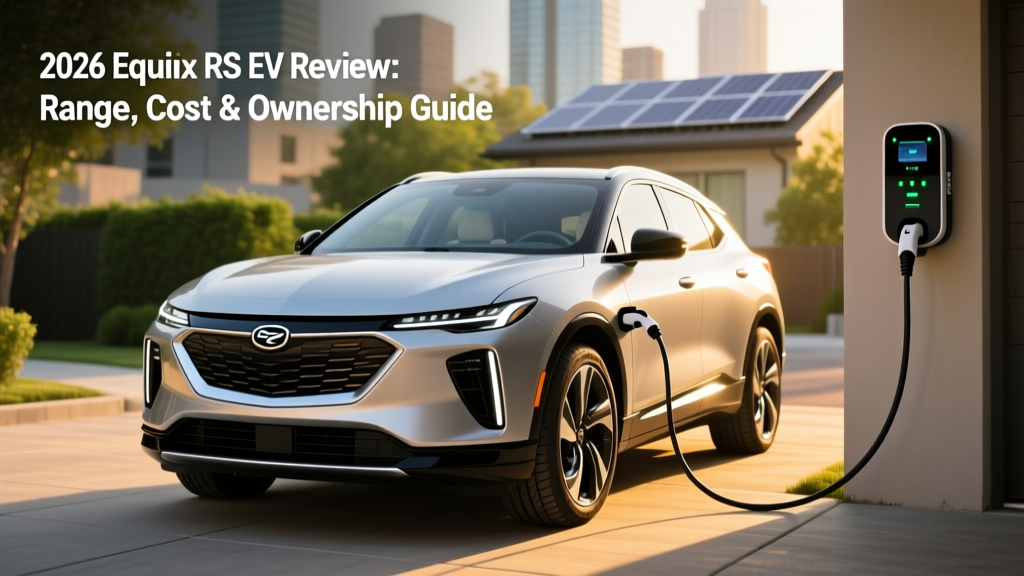
Quick Answer: The 2026 Chevrolet Equinox RS EV is a front-wheel-drive electric crossover with an EPA-estimated 319 miles of range from its 85 kWh (usable) Ultium battery, starting at $44,600 before incentives. It charges at up to 150 kW on DC fast chargers (10–80% in roughly 30 minutes) and delivers 213 horsepower. For buyers with home Level 2 charging, it can save $1,200–$1,800 annually over a comparable gas Equinox, but apartment dwellers without charging access should consider the gas or hybrid Equinox instead.
Range, Battery, and Real-World Efficiency
The Equinox RS EV rides on GM's Ultium platform with a front-mounted permanent-magnet motor producing 213 hp and 236 lb-ft of torque. Its 85 kWh usable battery pack (NMC chemistry) delivers an EPA-estimated 319 miles in FWD form — one of the highest figures in the compact electric crossover segment.
EPA vs. Real-World Range: The 319-mile EPA figure assumes a mix of city and highway driving at moderate temperatures. Expect approximately 260–285 miles on sustained highway trips at 70+ mph, and 220–250 miles in sub-freezing winter conditions (cold reduces battery efficiency and increases cabin heating load). The Equinox RS EV includes a heat pump, which mitigates but does not eliminate cold-weather range loss.
| Spec | Value |
|---|---|
| EPA Range (FWD) | 319 miles |
| Battery (Usable) | 85 kWh, NMC (Ultium) |
| Motor | Single FWD, 213 hp / 236 lb-ft |
| 0–60 mph | ~8.3 seconds |
| DC Fast Charge (Peak) | 150 kW (10–80% in ~30 min) |
| Level 2 Charge Rate | 11.5 kW (~34 mi/hr) |
| MPGe (Combined) | ~97 MPGe |
| Base MSRP (RS 2LT) | $44,600 |
| Battery/Powertrain Warranty | 8 years / 100,000 miles |
Efficiency lands around 3.0–3.3 kWh/mile depending on conditions, translating to roughly 97 MPGe combined. That's competitive with the Hyundai Ioniq 5 (303 mi EPA, 114 MPGe) and slightly behind the Tesla Model Y Long Range (320 mi EPA, 122 MPGe) in energy efficiency per mile.
Charging Speeds and Home Setup Costs
Understanding the difference between kW (power, or charge rate) and kWh (energy, or battery capacity) is critical. The Equinox RS EV's 85 kWh battery holds energy; the 150 kW peak charge rate determines how fast you refill it.
| Level | Power | Miles Added/Hour | Typical Use |
|---|---|---|---|
| Level 1 (120V) | ~1.4 kW | ~4 mi/hr | Overnight trickle; emergency top-ups |
| Level 2 (240V) | 11.5 kW | ~34 mi/hr | Home daily charging; full charge in ~8 hrs |
| DC Fast Charge | Up to 150 kW | ~170 mi in 20 min | Road trips; 10–80% in ~30 min |
Charging curve reality: The 150 kW peak only applies between roughly 10–40% state of charge. Above 60%, the rate tapers significantly — expect 50–70 kW from 60–80%, and below 25 kW past 80%. This is normal battery-protection behavior, not a defect. Plan road-trip stops to charge from 10% to 80% and move on rather than waiting for 100%.
The Equinox RS EV uses the NACS (Tesla-style) connector as standard for 2026, granting native access to Tesla Supercharger stations (now open to non-Tesla EVs via NACS) as well as Electrify America and other networks through adapters where needed.
Home Level 2 Installation Cost Breakdown
| Item | Cost Range |
|---|---|
| Level 2 charger (hardwired, 48A) | $400–$700 |
| Electrician labor (240V/50A circuit) | $600–$1,500 |
| Permit and inspection | $100–$300 |
| Electrical panel upgrade (if needed) | $1,500–$3,500 |
| Total (no panel upgrade) | $1,100–$2,500 |
| Total (with panel upgrade) | $2,600–$6,000 |
If your home has a 200-amp panel with spare capacity, expect the lower end. Homes with older 100-amp panels may require an upgrade — get a quote from a licensed electrician before purchasing the vehicle. A final spec should always come from a licensed professional evaluating your specific panel and wiring.
Equinox RS EV vs. Gas Equinox: Cost and Efficiency
The most common buyer question is whether the EV version saves money compared to the gasoline Equinox. The answer depends heavily on your driving volume, electricity rate, and charging access.
| Category | Equinox RS EV | Gas Equinox RS (AWD) |
|---|---|---|
| Base MSRP | $44,600 | $34,900 |
| Est. Federal Tax Credit (§30D) | Up to $7,500* | $0 |
| Effective Purchase Price | ~$37,100 | $34,900 |
| Fuel/Energy (5 yrs, 75k mi) | ~$3,750** | ~$9,750*** |
| Maintenance (5 yrs) | ~$1,200 | ~$3,200 |
| Insurance (5 yrs, est.) | ~$9,500 | ~$7,800 |
| 5-Year Total | ~$51,550 | ~$55,650 |
* §30D credit eligibility depends on buyer income caps ($150K single / $300K joint), MSRP caps ($80K for SUVs), battery sourcing, and critical mineral requirements. Verify current-year rules at IRS.gov. Credit may be applied at point of sale.
** Based on $0.14/kWh national average and 3.1 kWh/mile.
*** Based on $3.50/gallon and 26 MPG combined.
The EV breaks even or pulls ahead within 3–4 years for most owners with home charging. The gap widens if your electricity rate is below $0.12/kWh or if you drive more than 15,000 miles annually. However, EV insurance premiums run 15–25% higher on average — get quotes before committing.
What First-Time EV Buyers Must Know
Transitioning from a gas car to the Equinox RS EV involves a few non-obvious adjustments:
- Home charging is the backbone. Over 80% of EV charging happens at home. If you can install a Level 2 charger, you'll wake up to a "full tank" every morning and rarely visit public chargers except on road trips.
- Public charging is improving but inconsistent. NACS access to Tesla Superchargers is a significant advantage for the Equinox RS EV. Still, plan road trips using apps like PlugShare or the Tesla app and expect occasional offline stalls.
- Regenerative braking changes driving feel. The Equinox RS EV offers one-pedal driving mode, where lifting off the accelerator slows the car substantially and recovers energy. Most owners adapt within a week and prefer it.
- Preconditioning matters. Use the MyChevy app to warm or cool the cabin and battery while still plugged in. This preserves range and improves DC fast-charge speed in cold weather.
- Tire wear increases. EVs are heavier and deliver instant torque. Expect tire replacement 10,000–15,000 miles sooner than on a gas equivalent. Budget for EV-rated tires (~$200–$280 each).
Common Misconceptions — Myth vs. Fact
| Myth | Fact |
|---|---|
| "The battery will need replacing in 5 years." | GM warrants the Ultium battery for 8 years/100,000 miles against capacity loss below 60%. Industry data shows NMC packs retaining 85–90% capacity at 100K miles. Replacement, if needed out of warranty, costs $10,000–$16,000 — but is rare. |
| "319 miles means I'll always get 319 miles." | EPA estimates use a specific test cycle. Highway driving at 75 mph, cold weather, and mountain grades reduce range 15–30%. Plan for ~260–285 real-world highway miles. |
| "The $7,500 tax credit applies to everyone." | The §30D credit has income caps, MSRP caps, and battery-sourcing requirements that change annually. Some buyers qualify for $0, others for $3,750, and some for the full $7,500. Always verify at IRS.gov or with a tax professional. |
| "I can charge on any public charger." | The Equinox RS EV uses NACS natively. Most new public chargers now offer NACS, but older CCS-only stations require an adapter (GM provides one). CHAdeMO stations are largely incompatible. |
| "EVs are worse in winter." | Range drops 15–30% in freezing temps, but EVs start reliably (no cold-cranking), and the heat pump plus preconditioning keep cabins warm. Many cold-climate owners prefer EVs once they adapt. |
Decision Framework: Is the Equinox RS EV Right for You?
Choose the Equinox RS EV if:
- You have (or can install) home Level 2 charging
- Your daily commute is under 100 miles round-trip
- You drive 12,000+ miles per year (higher volume = faster payback)
- You qualify for at least a partial §30D federal tax credit
- You take 2–4 road trips per year and can plan around DC fast chargers
- You want a quiet, low-maintenance daily driver with strong cargo space (26.4 cu ft rear, 57.1 cu ft folded)
Stick with the gas Equinox or a PHEV alternative if:
- You live in an apartment or condo without charging access
- Your area has sparse public DC fast-charging infrastructure
- You regularly tow more than 1,500 lbs (the EV is rated for 1,500 lbs vs. gas Equinox at 3,500 lbs)
- Your budget is strictly under $35,000 and you don't qualify for incentives
- You drive in extreme cold (below –20°F) for extended periods where range loss compounds
Frequently Asked Questions
Does the 2026 Equinox RS EV qualify for the $7,500 federal tax credit?
It may, depending on your income, the vehicle's battery-sourcing compliance for the current tax year, and MSRP limits. The Equinox RS EV's $44,600 base price is well under the $80,000 SUV cap. Income limits are $150,000 (single) or $300,000 (joint) modified AGI. Critical-mineral and battery-component sourcing rules tighten annually — check the IRS §30D page or consult a tax professional for your specific situation. The credit can be transferred to the dealer at point of sale as a purchase-price reduction.
How long does it take to charge the Equinox RS EV at home?
On a Level 2 (240V) home charger at 11.5 kW, a full charge from near-empty takes approximately 8 hours. Most owners charge from 20–80% daily, which takes about 4.5 hours — easily accomplished overnight. Level 1 (standard 120V outlet) adds roughly 4 miles per hour and is only practical for low-mileage days or trickle maintenance.
What is the real-world highway range?
Expect 260–285 miles at sustained highway speeds (70–75 mph) in moderate temperatures (50–80°F). In winter conditions (20–35°F), plan for 220–250 miles. These figures assume no extreme elevation changes. Use the vehicle's navigation-based range estimator on road trips — it factors in terrain, temperature, and speed more accurately than the dashboard guess-o-meter.
Is the Equinox RS EV available with all-wheel drive?
The RS trim for 2026 is offered in FWD (319-mile EPA) and available AWD (estimated 290-mile EPA, dual-motor, ~288 hp). AWD adds approximately $3,000 to the MSRP and reduces range by roughly 30 miles due to the additional motor and weight. AWD is worth it if you regularly drive on snow or unpaved roads; FWD suffices for most paved-road commuters.
How does the Equinox RS EV compare to the Tesla Model Y?
The Model Y Long Range AWD offers 320 EPA miles, faster DC charging (250 kW peak, 10–80% in ~20 min), and a more extensive Supercharger network experience. The Equinox RS EV counters with a lower starting price ($44,600 vs. ~$48,000 for Model Y), traditional dealer service, and a more conventional interior layout. If charging speed and road-trip convenience are top priorities, the Model Y has an edge. If value, dealer support, and a familiar crossover experience matter more, the Equinox RS EV is compelling.
What maintenance does the Equinox RS EV require?
Minimal compared to gas vehicles. There are no oil changes, spark plugs, or transmission fluid. Expect cabin air filter replacement ($30–$60 annually), brake fluid flush every 2 years, tire rotation every 7,500 miles, and windshield washer fluid. Brake pads last significantly longer due to regenerative braking — many EV owners report original pads at 80,000+ miles. Budget roughly $200–$350 per year in routine maintenance.