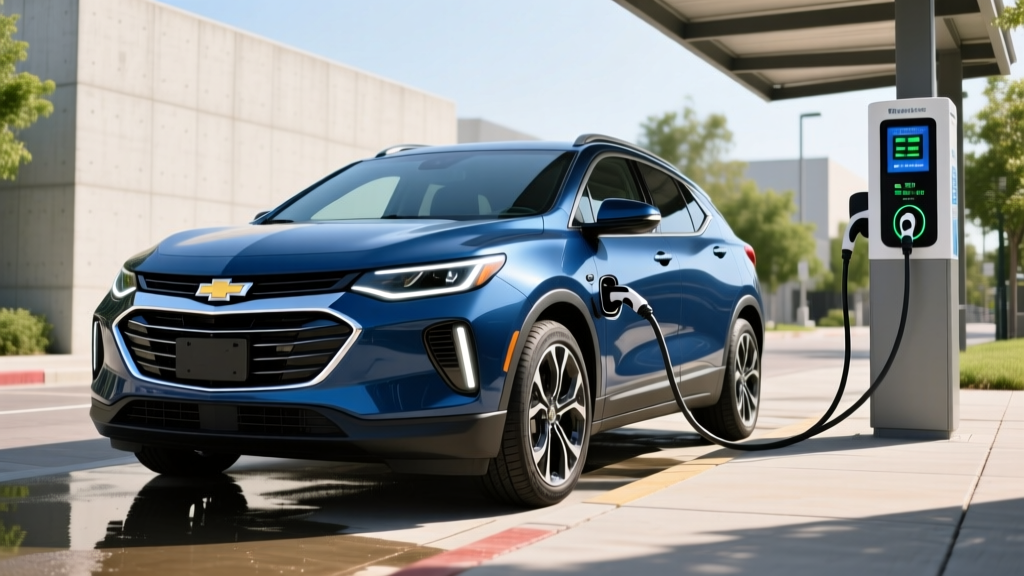
The Chevrolet Equinox EV occupies a critical space in the electric vehicle market: an affordable, practical crossover that doesn't force buyers into luxury pricing or sub-250-mile range figures. For 2026, Chevy continues to refine the Ultium-based platform with updated software, expanded Advanced Pedestrian Alert system capabilities, and continued eligibility for the full $7,500 federal tax credit. But beyond the spec sheet, how does this EV actually perform in daily driving, and what should buyers know about its acoustic safety features, real-world range, and charging behavior?
In this review, we break down the 2026 Equinox EV with the precision EV buyers demand — exact range figures, charging curve realities, battery chemistry, and a deep look at the pedestrian sound system that's become a search priority for safety-conscious shoppers.
2026 Equinox EV Quick Specs at a Glance
| Specification | 2026 Equinox EV (LT / RS) |
|---|---|
| EPA Range | 319 miles (FWD) / 285 miles (AWD) |
| Battery (usable) | 85 kWh, NMC (nickel manganese cobalt) |
| Max DC Fast Charge | 150 kW peak |
| 10–80% DC Charge Time | ~42 minutes |
| Level 2 Home Charging | 11.5 kW (up to 51 mi/hr) |
| 0–60 mph | 8.3 sec (FWD) / 7.8 sec (AWD) |
| Horsepower | 213 hp (FWD) / 288 hp (AWD) |
| Efficiency | 113 MPGe combined / 30 kWh/100 mi |
| Cargo Volume | 26.4 cu ft (rear up) / 57.2 cu ft (rear folded) |
| Base MSRP | $33,600 (2LT FWD) |
| Battery Warranty | 8 years / 100,000 miles |
Range, Efficiency & Real-World Expectations
The front-wheel-drive Equinox EV earns an EPA-estimated 319 miles of range, placing it among the top contenders in the affordable electric crossover segment. The all-wheel-drive variant drops to 285 miles — still competitive, but worth factoring into your decision if you live in a climate where AWD is essential.
EPA 319 miles (FWD). In real-world highway driving at 70–75 mph, expect approximately 260–280 miles before needing a charge. In cold weather (below 30°F), range can drop an additional 15–25%, bringing effective winter highway range to roughly 210–240 miles. City driving with regenerative braking recovers closer to the EPA sticker, often exceeding 300 miles in mild conditions.
The 85 kWh usable battery uses NMC (nickel manganese cobalt) chemistry, which offers higher energy density than LFP alternatives. This means more range in a lighter package, though NMC cells benefit from avoiding consistent 100% charges — Chevy recommends daily charging to 80–90% for optimal longevity, with 100% reserved for road trips.
Efficiency comes in at 113 MPGe combined (30 kWh per 100 miles) for the FWD model, according to fueleconomy.gov. That's competitive with the Hyundai Ioniq 5 and slightly behind the Tesla Model Y, but the Equinox EV's lower starting price helps offset the efficiency gap in total cost of ownership.
Charging Speed: DC Fast, Level 2 & the Curve Reality
The Equinox EV's Ultium platform supports a peak DC fast-charge rate of 150 kW. In practice, that translates to a 10–80% session in approximately 42 minutes on a capable 150+ kW station like those found on the Electrify America or EVgo networks.
However, the charging curve matters more than the peak number. The Equinox EV sustains close to its peak rate between roughly 10–50% State of Charge, then tapers progressively. From 80–100%, expect charging to slow dramatically — adding that final 20% can take as long as the first 70%. This is typical for NMC batteries and is managed by the vehicle's thermal system to protect long-term cell health.
| Charging Level | Power / Rate | Speed (Miles Added) |
|---|---|---|
| Level 1 (120V outlet) | ~1.4 kW | ~4 miles per hour |
| Level 2 (240V home) | 11.5 kW max | ~51 miles per hour (full in ~8.5 hrs) |
| DC Fast Charge | 150 kW peak | ~190 miles in 30 min; 10–80% in ~42 min |
For home charging, the Equinox EV's onboard charger accepts up to 11.5 kW on Level 2, meaning a full 0–100% charge takes about 8.5 hours on a properly installed 48-amp Level 2 station. Most owners will plug in overnight and wake to a full battery — the most convenient and cost-effective way to own an EV.
One important note: the Equinox EV uses the NACS (North American Charging Standard) connector for 2026, giving it native access to Tesla's Supercharger network — a significant advantage over CCS-equipped competitors that still require adapters.
The Equinox EV Pedestrian Sound System Explained
One of the most-searched features on this vehicle is the Equinox EV pedestrian sound system — officially called the Advanced Pedestrian Alert System. Because electric vehicles produce virtually no engine noise at low speeds, federal regulations (FMVSS 141, enforced by NHTSA) require EVs to emit an audible warning sound at speeds below approximately 18.6 mph (30 km/h) to alert pedestrians, cyclists, and visually impaired individuals.
Chevy's implementation on the Equinox EV produces a low-frequency, futuristic hum that increases in pitch and volume as vehicle speed increases from 0 to 18 mph. Above that threshold, tire and wind noise become sufficient for pedestrian awareness, and the system deactivates automatically.
Key details about the Equinox EV pedestrian sound system:
- Active below ~18.6 mph — both forward and in reverse
- Reverse tone is distinct — a different pattern to signal the vehicle is backing up
- Cannot be permanently disabled — federal compliance requires it to remain active, though some model years allow temporary cabin-toggle (resets on next start)
- Volume is speed-proportional — quieter at creep speeds, louder approaching 18 mph
- Exterior speakers only — the sound is projected forward and to the sides from bumper-mounted speakers, not audible inside the cabin at normal levels
Owners frequently ask whether the sound is intrusive or noticeable from the driver's seat. In our experience, it's barely perceptible inside the cabin with windows up — a non-issue for daily driving. Externally, the tone is distinctive without being grating, comparable to the approach sounds used on the Bolt EUV and newer Blazer EV.
Performance, Drivetrain & Daily Driving
The 2026 Equinox EV offers two powertrain configurations. The base front-wheel-drive model produces 213 horsepower and 236 lb-ft of torque, reaching 60 mph in approximately 8.3 seconds. That's adequate for commuting and highway merging, though not thrilling.
Step up to the all-wheel-drive dual-motor setup and output rises to 288 horsepower and 343 lb-ft of torque, dropping the 0–60 time to 7.8 seconds. The AWD system also improves traction in rain and snow, making it the recommended choice for buyers in northern climates — even with the 34-mile range trade-off.
Ride quality is tuned for comfort over sportiness. The suspension soaks up potholes and highway imperfections well, and cabin noise levels are impressively low at speed — a benefit of the electric powertrain and acoustic glass on higher trims. Regenerative braking offers two modes: a mild setting that mimics a traditional automatic transmission coast, and a stronger setting that enables near one-pedal driving in city traffic.
Interior Space, Cargo & Technology
The Equinox EV's cabin is where Chevy's value proposition really lands. The flat-floor Ultium architecture creates generous interior volume:
- Front legroom: 43.2 inches
- Rear legroom: 37.8 inches
- Cargo behind rear seats: 26.4 cubic feet
- Cargo with rear seats folded: 57.2 cubic feet
That cargo space beats the Tesla Model Y's rear compartment and rivals mid-size SUVs costing significantly more. A small front trunk (frunk) adds roughly 1.5 cubic feet for charging cables or a small bag.
The centerpiece of the dashboard is a 17.7-inch diagonal infotainment touchscreen running Google Built-In — meaning Google Maps, Google Assistant, and the Play Store are native to the vehicle. Wireless Apple CarPlay and Android Auto are standard. A 11-inch digital driver display sits behind the steering wheel, configurable with range, navigation, and driver-assist readouts.
On the driver-assist front, Chevy Super Cruise is available on RS and higher trims, enabling hands-free driving on over 400,000 miles of mapped highways in the US and Canada.
Pricing, Tax Credit & Ownership Cost
The 2026 Equinox EV starts at $33,600 MSRP for the 2LT FWD trim, climbing to approximately $41,900 for a fully equipped RS AWD with Super Cruise. Here's how the pricing and credit landscape breaks down:
| Trim | MSRP | Est. After §30D Credit |
|---|---|---|
| 2LT FWD | $33,600 | ~$26,100* |
| 3LT FWD | $36,400 | ~$28,900* |
| RS FWD | $38,200 | ~$30,700* |
| RS AWD | $41,900 | ~$34,400* |
*Assumes full $7,500 federal tax credit eligibility. Actual credit depends on individual tax situation, income caps, and battery sourcing compliance.
The Equinox EV continues to qualify for the full $7,500 federal EV tax credit under IRS §30D for 2026, and it can be applied as a point-of-sale price reduction at participating dealers — meaning you don't have to wait until tax filing to benefit. However, eligibility has conditions:
- MSRP cap: Vehicle must be under $80,000 (SUVs/crossovers) — Equinox EV qualifies easily
- Buyer income cap: AGI must not exceed $150,000 (single), $225,000 (head of household), or $300,000 (joint)
- Battery sourcing: Critical minerals and battery components must meet phased-in sourcing requirements — Chevy has confirmed 2026 Equinox EV compliance
- Tax liability: If taken as a traditional credit (not point-of-sale), you must owe at least $7,500 in federal taxes
For full details on eligibility, consult the IRS Clean Vehicle Tax Credits page and speak with a tax professional.
How the Equinox EV Compares to Key Rivals
The Equinox EV doesn't exist in a vacuum. Its main competitors include the Tesla Model Y, Hyundai Ioniq 5, and Ford Mustang Mach-E. Here's how they stack up on the metrics buyers care about most:
| Metric | Equinox EV FWD | Model Y LR | Ioniq 5 (Std RWD) | Mach-E (Std RWD) |
|---|---|---|---|---|
| EPA Range | 319 mi | 320 mi | 303 mi | 250 mi |
| Base MSRP | $33,600 | $44,990 | $42,600 | $42,995 |
| DC Fast Peak | 150 kW | 250 kW | 350 kW | 150 kW |
| 10–80% Time | ~42 min | ~27 min | ~18 min | ~40 min |
| Federal Credit | $7,500 | $7,500 | $7,500 | $3,750 |
| NACS Native | Yes | Yes | No (adapter) | No (adapter) |
The Equinox EV's biggest advantage is price after credit — at roughly $26,100 after the federal incentive, no competitor comes close on value. Its trade-off is charging speed: the 150 kW peak means longer road-trip stops compared to the Ioniq 5's blistering 350 kW capability or the Model Y's 250 kW.
- Class-leading value after $7,500 credit
- 319-mile EPA range (FWD)
- Spacious interior with 57.2 cu ft cargo
- Native NACS / Supercharger access
- Standard Google Built-In infotainment
- Available Super Cruise hands-free driving
- 150 kW DC charging lags rivals
- FWD acceleration is merely adequate
- No front trunk (frunk) of meaningful size
- AWD range drops to 285 miles
- Super Cruise locked to higher trims
- Some interior materials feel budget-grade
Who Should Buy the 2026 Equinox EV?
The Equinox EV is best suited for value-oriented buyers who want maximum range per dollar, primarily commute and drive in suburban or urban environments, and can charge at home overnight. It's an excellent first EV for households transitioning from a gas crossover, and the 319-mile range eliminates daily range anxiety entirely.
It's less ideal for frequent long-distance road trippers who prioritize the fastest possible charging stops — the Ioniq 5 or Model Y serve that use case better. And if you need serious towing capacity or off-road capability, this isn't the platform for you.
For the family commuter, the school-run driver, or the cost-conscious buyer who wants a modern, well-equipped electric crossover without stretching to $45,000+, the 2026 Equinox EV makes a compelling — and financially rational — case.
Frequently Asked Questions
What does the Equinox EV pedestrian sound actually sound like?
It's a low, futuristic hum — similar to a soft turbine spool — that increases in pitch with speed. It's designed to be noticeable to nearby pedestrians without being annoying. Inside the cabin, it's essentially inaudible with windows up.
Can I turn off the pedestrian alert sound?
Not permanently. Federal safety regulations (FMVSS 141) require the system to activate every time the vehicle starts. Some Chevy models have allowed a temporary cabin toggle, but it resets on the next ignition cycle.
What is the real-world highway range of the Equinox EV?
Expect approximately 260–280 miles at highway speeds (70–75 mph) in mild weather. In cold conditions below 30°F, that drops to roughly 210–240 miles. City driving with regen braking recovers closer to the 319-mile EPA figure.
Does the Equinox EV qualify for the full $7,500 federal tax credit?
Yes, the 2026 Equinox EV qualifies for the full $7,500 credit under IRS §30D, and it can be applied at the point of sale. Buyer income caps apply ($150K single / $300K joint), and you should verify current-year eligibility with your dealer and tax professional.
How long does home charging take?
On a 48-amp Level 2 home charger (11.5 kW), a full 0–100% charge takes approximately 8.5 hours. Most owners charge from 20–80% overnight, which takes about 5 hours and provides roughly 250 miles of range.
Is the Equinox EV better than the Tesla Model Y?
It depends on your priorities. The Equinox EV is significantly cheaper after the tax credit (~$26K vs ~$37K) and offers nearly identical EPA range. The Model Y charges faster (250 kW vs 150 kW), has a more established Supercharger network advantage (though the gap is closing with NACS adoption), and offers slightly more performance. For budget-first buyers, the Equinox EV wins on value.