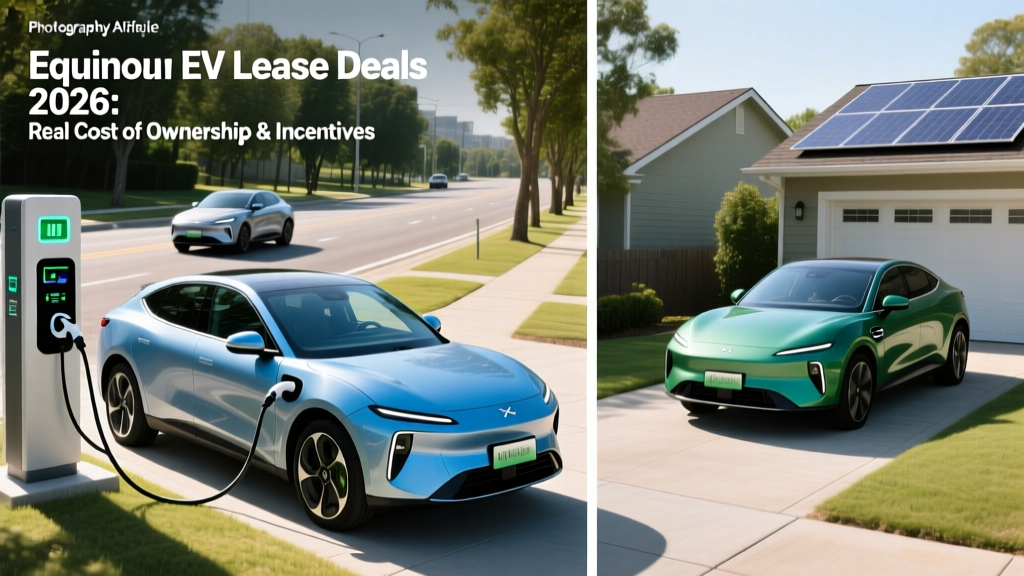
Why the 2026 Chevrolet Equinox EV Is Dominating Lease Searches
The 2026 Chevrolet Equinox EV has become one of the most searched electric crossovers in the compact segment, and for good reason: aggressive lease pricing, federal tax credit eligibility, and a 315-mile EPA range make it a compelling entry point into battery-electric ownership. But before you sign on the dotted line for one of those eye-catching Equinox EV lease deals, the math behind the monthly payment is only part of the picture.
This guide breaks down the full 5-year cost of owning or leasing the 2026 Equinox EV — including the real value of the IRS §30D federal tax credit, how much you'll save on fuel and maintenance, why your insurance premium might sting, and what to expect when it's time to sell or return the vehicle.
| Spec | LT (Base) | RS / Activ |
|---|---|---|
| MSRP (before incentives) | ~$33,600 | ~$43,400–$46,300 |
| EPA Range | 315 mi (FWD) | 285–315 mi (FWD/AWD) |
| Battery (usable) | ~85 kWh, NMC lithium-ion | |
| Peak DC Fast Charge | 150 kW (10–80% in ~30 min) | |
| Level 2 Charge Rate | 11.5 kW (~34 mi/hr) | |
| Horsepower | 213 hp (FWD) | 288 hp (AWD RS) |
| 0–60 mph | ~8.0 sec | ~6.5 sec (AWD) |
| MPGe (combined) | 109 MPGe | 95–105 MPGe |
| Battery Warranty | 8 years / 100,000 miles | |
| NACS Connector | Standard (Supercharger access) | |
5-Year Total Cost of Ownership: The Full Picture
The monthly lease payment is the easy number. What separates a smart EV purchase from buyer's remorse is understanding total cost of ownership (TCO). Below is a realistic 5-year / 75,000-mile breakdown for the Equinox EV LT (FWD) compared against a similarly priced gas compact SUV averaging 28 MPG combined.
| Category | Equinox EV LT | Gas Compact SUV (28 MPG) |
|---|---|---|
| Purchase / Lease (after incentives) | ~$26,100* | ~$31,000 |
| Fuel / Electricity | ~$3,200 | ~$9,400 |
| Maintenance | ~$1,800 | ~$3,600 |
| Insurance (5-year total) | ~$10,500 | ~$8,500 |
| Depreciation (est.) | ~$13,000 | ~$14,200 |
| Total (approx.) | ~$54,600 | ~$66,700 |
*Assumes $7,500 federal tax credit applied at point of sale. Actual purchase price depends on trim, dealer fees, and credit eligibility. See IRS §30D section below.
The Equinox EV can save roughly $12,000 over five years compared to a gas alternative — but those savings are not evenly distributed. Fuel and maintenance are where EVs shine. Insurance and upfront pricing can eat into the gap. Let's unpack each line item.
Federal Tax Credit: Do You Qualify for §30D?
The federal EV tax credit under IRS §30D can reduce your effective purchase price by up to $7,500 — and since 2024, it can be transferred to the dealer as a point-of-sale rebate, meaning you don't need to wait until tax day to benefit. For lease deals, the credit typically goes to the lessor (the financing company), who may pass the savings through as a lower capitalized cost or reduced monthly payment. Always confirm this with the dealer.
The 2026 Equinox EV LT (MSRP ~$33,600) falls well under the $80,000 MSRP cap for SUVs and is assembled in Mexico with GM's Ultium battery platform. Battery sourcing and critical-mineral requirements continue to tighten annually under the Inflation Reduction Act. As of 2026, verify the specific VIN's eligibility using the IRS's online tool before committing.
- MSRP Cap: Vehicle must be under $80,000 for SUVs, vans, and pickups; $55,000 for sedans. The Equinox EV qualifies.
- Buyer Income Limits: Modified AGI must not exceed $300,000 (joint filers), $225,000 (head of household), or $150,000 (single). Check your prior-year or current-year tax return.
- Battery Component Sourcing: Increasing percentages of battery components must be manufactured or assembled in North America. This threshold rises each year — confirm the specific model year qualifies.
- Critical Minerals: A growing percentage of critical minerals must be sourced from the U.S. or a free-trade-agreement partner. This requirement also tightens annually.
- Foreign Entity of Concern (FEOC): Vehicles with battery components or critical minerals from a FEOC (e.g., certain Chinese suppliers) may be disqualified. GM's Ultium platform has worked to reduce FEOC exposure, but verify per VIN.
- Point-of-Sale Transfer: You can elect to transfer the credit to the dealer for an immediate price reduction rather than claiming it on your tax return.
Tax credit rules are subject to legislative change. Always verify current eligibility at IRS.gov and consult a tax professional for your specific situation.
State, Local, and Utility Incentives
Beyond the federal credit, many buyers can stack additional savings. These vary dramatically by zip code:
- California (CVRP): Up to $2,000 rebate for income-qualified buyers; additional $2,000 for low-income applicants.
- Colorado: State tax credit of up to $5,000 for new EV purchases (income and price caps apply).
- Utility Rebates: Many electric utilities offer $250–$1,500 rebates for home Level 2 charger installation or off-peak charging enrollment. Check with your local provider.
- HOV Lane Access: Several states grant EVs carpool-lane privileges — a non-monetary perk with real commute-time value.
State and utility incentives change frequently. Check AFDC's incentive database for your specific location.
Charging vs. Gas: Cost Per Mile in Real Dollars
The single biggest ongoing savings from owning an Equinox EV comes at the "pump." But the actual cost per mile depends heavily on how and where you charge.
| Scenario | Cost per Mile | Annual Cost (15,000 mi) |
|---|---|---|
| Home charging (Level 2, $0.14/kWh national avg) | $0.039 | $585 |
| Home charging (off-peak rate, $0.08/kWh) | $0.022 | $336 |
| Public DC fast charging ($0.40/kWh avg) | $0.111 | $1,665 |
| Gas SUV (28 MPG, $3.50/gal) | $0.125 | $1,875 |
The Equinox EV averages roughly 2.8 miles per kWh (≈36 kWh/100 mi) based on its 109 MPGe combined rating per fueleconomy.gov.
If you charge predominantly at home on a standard residential rate, you'll spend roughly $600/year on electricity versus nearly $1,900 on gasoline. That's a ~$1,300 annual fuel savings. However, if you rely exclusively on public DC fast charging at $0.35–$0.50/kWh, the savings shrink dramatically — in some cases to near parity with gas. Home charging access is the single biggest variable in EV operating cost.
Maintenance Savings: Where the EV Advantage Is Undeniable
Battery-electric vehicles eliminate the most routine and costly maintenance items that gas car owners take for granted. The Equinox EV has no engine oil, no transmission fluid, no spark plugs, no timing belt, and no exhaust system. Regenerative braking also dramatically extends brake pad and rotor life.
| Service Item | Equinox EV | Gas Compact SUV |
|---|---|---|
| Oil changes (every 5,000–7,500 mi) | $0 | ~$900–$1,200 |
| Brake pads/rotors | ~$200–$400 (regen extends life 2–3x) | ~$800–$1,400 |
| Transmission fluid/service | $0 | ~$300–$500 |
| Cabin air filter | ~$150 | ~$150 |
| Tire rotation/replacement | ~$1,200 (EVs wear tires ~15% faster) | ~$1,000 |
| Coolant / misc. fluids | ~$100 | ~$300 |
| Total (est.) | ~$1,800 | ~$3,600 |
The net maintenance savings over five years is roughly $1,800. The one area where EVs cost slightly more is tires — the instant torque and heavier curb weight of an EV (the Equinox EV weighs ~4,700 lbs) accelerate tread wear. Budget for a tire replacement around 35,000–45,000 miles.
Insurance Costs: The Uncomfortable Truth
Here's where the EV cost advantage narrows. Insurance premiums for the Equinox EV typically run 15–25% higher than a comparable gas-powered compact SUV. The reasons are structural, not a conspiracy:
- Higher repair costs: EV battery packs and high-voltage components are expensive to replace after collision damage. Even minor rear-end impacts can trigger battery safety inspections.
- Specialized labor: Fewer body shops have high-voltage-certified technicians, which drives up labor rates for EV repairs.
- Parts availability: EV-specific parts (battery modules, power electronics) often have longer lead times and higher costs than widely available ICE components.
- Vehicle value: The higher purchase price of an EV means higher comprehensive and collision coverage costs.
Expect to pay roughly $2,000–$2,400/year for full coverage on an Equinox EV, compared to $1,600–$1,900 for a gas equivalent. Over five years, that's an additional $2,000–$3,000 in insurance costs. Always get quotes from at least three insurers before purchase — EV insurance rates vary enormously by carrier, and some (like Progressive and Tesla Insurance in eligible states) offer usage-based discounts.
Depreciation and Resale Value: What to Expect
EV depreciation has been one of the most volatile areas of ownership over the past several years. After a sharp correction in 2023–2024 — driven by Tesla's aggressive price cuts, an influx of new models, and early-adopter trade-ins — EV residual values have begun to stabilize.
For the Equinox EV specifically:
- 5-year depreciation estimate: 45–55% of original purchase price, which is now closer to the industry average for compact SUVs (gas or electric).
- Lease advantage: Leasing transfers depreciation risk to the lessor. If residual values drop further, it's the leasing company's problem, not yours. This makes Equinox EV lease deals especially attractive if you're concerned about long-term value retention.
- Battery health factor: GM's 8-year/100,000-mile battery warranty (covering capacity below ~70%) provides a floor for used-vehicle value. A documented healthy battery at trade-in time supports resale price.
- Market headwinds: Rapid battery technology improvements and falling new-EV prices continue to pressure used EV values. Buying a 2026 model means competing with 2028–2029 models that may offer more range or faster charging at similar prices.
If you plan to keep the Equinox EV for the full 8-year battery warranty period, depreciation matters less. If you trade in every 3–4 years, leasing is the lower-risk strategy.
Equinox EV Lease vs. Buy: A Decision Framework
- You want the lowest monthly payment with the point-of-sale tax credit passed through by the lessor.
- You're uncertain about long-term EV resale values and want to transfer depreciation risk.
- You plan to upgrade in 3 years to take advantage of improving battery tech and charging infrastructure.
- You drive fewer than 15,000 miles/year (most leases cap at 10K–15K miles).
- You qualify for the full $7,500 federal tax credit and can apply it at point of sale.
- You plan to keep the vehicle 5+ years, maximizing the fuel and maintenance savings.
- You drive more than 15,000 miles/year (lease overage penalties of $0.20–$0.30/mile add up fast).
- You want to build equity and avoid perpetual car payments.
Frequently Asked Questions
How much does it really cost to own a 2026 Equinox EV over 5 years?
Our analysis estimates approximately $54,600 over 5 years and 75,000 miles for the Equinox EV LT (including purchase after the $7,500 federal credit, electricity, maintenance, insurance, and depreciation). That's roughly $12,000 less than a comparable 28 MPG gas compact SUV over the same period. Your actual cost depends on local electricity rates, insurance premiums, and whether you charge at home or rely on public chargers.
Do I qualify for the $7,500 federal tax credit on the Equinox EV?
Eligibility depends on three factors: your modified adjusted gross income (must be under $300K joint / $150K single), the vehicle's MSRP (must be under $80K for SUVs — the Equinox EV qualifies), and battery sourcing requirements that tighten each year. The 2026 Equinox EV has generally qualified for the full credit, but you must verify using the VIN-specific tool on IRS.gov before purchase. The credit can now be transferred to the dealer at point of sale for an immediate price reduction.
How much do I actually save on fuel and maintenance?
With home charging at the national average rate of $0.14/kWh, you'll spend roughly $585/year on electricity versus ~$1,875/year on gasoline for a 28 MPG compact SUV — a savings of about $1,300/year. Maintenance savings add another ~$360/year (no oil changes, less brake wear). Combined, that's roughly $1,660/year or $8,300 over five years in operational savings.
Are EVs more expensive to insure than gas cars?
Yes, typically 15–25% more. For the Equinox EV, expect $2,000–$2,400/year for full coverage versus $1,600–$1,900 for a gas equivalent. Higher repair costs, specialized labor, and expensive battery components drive the premium. Shop at least three insurers — rates vary widely, and some carriers offer EV-specific discounts.
How well does the Equinox EV hold its value?
Expect 45–55% depreciation over 5 years, which is now closer to the compact SUV average after the 2023–2024 EV value correction. GM's 8-year/100,000-mile battery warranty provides residual-value support. If resale value is a primary concern, leasing transfers that risk to the lessor and is the financially safer option for 3-year ownership horizons.
Can I charge the Equinox EV at Tesla Superchargers?
Yes. The 2026 Equinox EV comes standard with the NACS (North American Charging Standard) connector, providing native access to Tesla's Supercharger network — now the largest and most reliable DC fast-charging network in North America. You'll see peak charging speeds of up to 150 kW at V3 Superchargers, adding roughly 150 miles in about 20 minutes under ideal conditions.