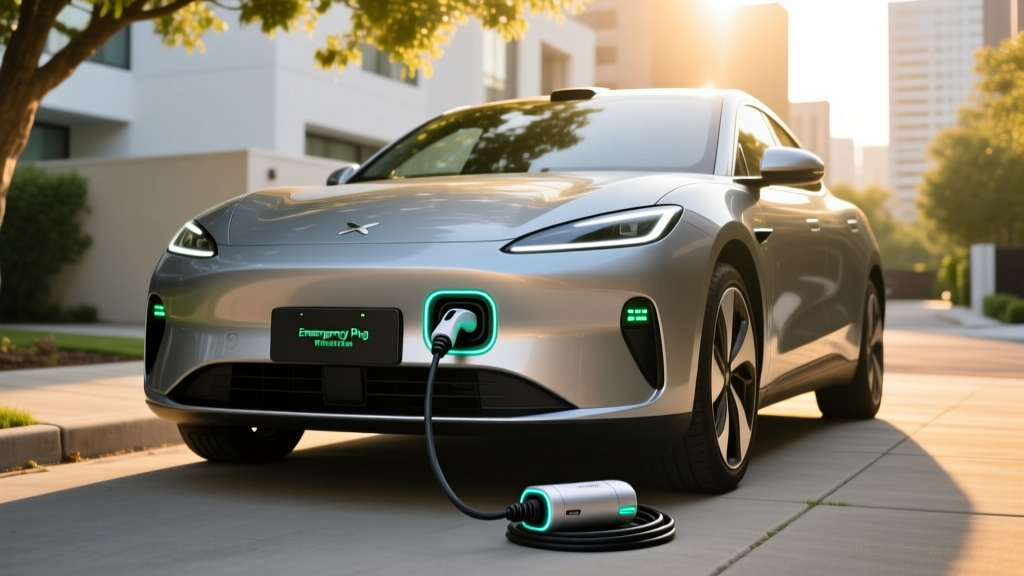
If you've seen the term "emergency plug for electric vehicles" circulating on EV forums and social media, here's the direct answer: an emergency plug is a small, portable adapter (typically $30–$100) that connects a standard 120V household outlet to your EV's charge port, allowing trickle charging at roughly 1.0–1.4 kW. It adds approximately 3–5 miles of range per hour of charging. It is not a replacement for a Level 2 home charger or DC fast charging—it's a slow, last-resort backup for situations where you're stranded with a low battery and have access to a standard outlet.
For context, plugging in overnight (10 hours) at 1.2 kW yields roughly 30–45 miles of range. That's enough to reach a nearby DC fast charger in many cases, but it won't fill a depleted 75 kWh battery in any reasonable timeframe. Think of it as the EV equivalent of a gas can—useful insurance, not a daily solution.
What Exactly Is an Emergency Plug and How Does It Work?
The term "emergency plug" refers broadly to any portable Level 1 charging adapter that bridges a standard NEMA 5-15 household outlet (120V, 15A circuit) to your EV's J1772 (or NACS) charge port. These devices typically include:
- A NEMA 5-15 plug on one end (standard household 3-prong)
- An inline control box (the EVSE—Electric Vehicle Supply Equipment) that manages communication, ground-fault protection, and current limiting
- A J1772 or NACS connector on the other end that plugs into your vehicle
The inline EVSE limits draw to 12 amps (1.44 kW maximum on a 15A circuit, following the NEC 80% continuous-load rule). Some units allow switching between 8A, 10A, and 12A settings to avoid tripping breakers on older circuits.
Here's what that power translates to in real-world range recovery, depending on vehicle efficiency:
| Vehicle (2026 Model Year) | Efficiency (kWh/100mi) | Miles Added/Hour at 1.2 kW | Miles After 10-Hour Overnight |
|---|---|---|---|
| Tesla Model 3 RWD (26 kWh/100mi) | 26 | ~4.6 | ~46 |
| Hyundai Ioniq 5 SEL (30 kWh/100mi) | 30 | ~4.0 | ~40 |
| Ford F-150 Lightning (48 kWh/100mi) | 48 | ~2.5 | ~25 |
| Chevrolet Equinox EV (32 kWh/100mi) | 32 | ~3.8 | ~38 |
The key takeaway: efficiency matters enormously. A lightweight sedan like the Model 3 recovers nearly twice the range per hour compared to a heavy electric truck. Always check your vehicle's kWh/100mi figure on fueleconomy.gov to estimate your own recovery rate.
Emergency Plug vs. the Mobile Connector That Came With Your EV
Here's the nuance most emergency-plug discussions miss: most 2026 EVs already ship with a mobile connector (sometimes called a "Gen 2 Mobile Connector" or "portable charge cord") that does exactly what a standalone emergency plug does—and often more.
For example, Tesla's Mobile Connector ($200) includes interchangeable adapter plugs for NEMA 5-15 (120V), NEMA 14-50 (240V, up to 32A/7.7 kW), and NACS output. Hyundai, Kia, and Ford include similar multi-voltage mobile connectors with their 2026 Ioniq 5, EV6, and Mustang Mach-E models, respectively. These OEM mobile connectors typically retail for $175–$300 as replacements.
A third-party emergency plug (brands like Emporia, Lectron, or EVoCharge) costs $30–$100 and is usually limited to 120V only. The advantage is price and portability—they're compact enough to keep permanently in the trunk. The disadvantage is they lack the 240V upgrade path.
Real-World Scenarios: When an Emergency Plug Actually Saves You
An emergency plug earns its keep in specific situations. Here are the scenarios where owners report genuine value, based on EV community data and real-world testing:
Scenario 1: Stranded at a relative's house with no Level 2 charger. You drove 180 miles to visit family, arrived with 15% battery, and the nearest DC fast charger is 25 miles away. Plugging into their garage 120V outlet overnight gives you ~35–45 miles—enough to reach the charger comfortably.
Scenario 2: Workplace outlet charging. Your office parking garage has standard 120V outlets. Even at 1.2 kW, an 8-hour workday adds ~32–40 miles—potentially covering your entire commute without ever using a public charger.
Scenario 3: Rural travel in a charging desert. On routes like US-50 through Nevada or sections of rural Montana where DC fast chargers are 80+ miles apart, a hotel room 120V outlet can recover enough range overnight to bridge the gap.
Scenario 4: Apartment dwellers without charging access. If your apartment complex lacks EV infrastructure but you have access to a standard outdoor outlet (with permission), Level 1 can sustain a short daily commute of 15–25 miles. It's slow—you'll need 12–16 hours plugged in to recover a typical day's driving—but it's viable for low-mileage drivers.
The Honest Cost Breakdown: Emergency Plug vs. Alternatives
Let's put the emergency plug in context against other charging options, with real 2026 pricing:
| Method | Equipment Cost | Power | Miles/Hour | Cost per Mile* |
|---|---|---|---|---|
| Emergency plug (120V, 12A) | $30–$100 | 1.2–1.4 kW | 3–5 | $0.04–$0.06 |
| OEM Mobile Connector (120V) | Included or $175–$300 | 1.2–1.4 kW | 3–5 | $0.04–$0.06 |
| Home Level 2 (240V, 48A) | $350–$700 + $500–$2,000 install | 11.5 kW | 30–44 | $0.04–$0.06 |
| DC Fast Charger (public, 150+ kW) | $0 (pay per use) | 50–350 kW | 180–1,200+ | $0.10–$0.20 |
| Gas car (30 MPG, $3.40/gal avg) | N/A | N/A | N/A | $0.11 |
*Cost per mile based on $0.16/kWh national average electricity rate (2026) and 30 kWh/100mi average efficiency. Gas comparison at 30 MPG combined.
The emergency plug's cost per mile is identical to any other home Level 1 or Level 2 charging—because electricity pricing is the same. The only difference is time. You're paying the same rate; you're just waiting much longer for the energy to transfer.
Common Misconceptions About Emergency Plugs
| Myth | Fact |
|---|---|
| "An emergency plug can fully charge my EV overnight." | At 1.2 kW, fully charging a 75 kWh battery takes 62+ hours. Overnight (10 hours) adds roughly 12 kWh—about 35–45 miles of range in an efficient sedan. |
| "I need a special emergency plug for my EV brand." | Any J1772-compatible Level 1 EVSE works with any J1772-port EV. NACS-equipped Teslas and 2025+ Ford/GM/Rivian vehicles need a NACS adapter or a NACS-native unit. The 120V side is universal. |
| "Using a 120V outlet will damage my EV battery." | Level 1 charging is actually gentle on batteries due to the low charge rate. Slow charging generates minimal heat, which is better for long-term battery health than frequent DC fast charging. |
| "I should buy a cheap Amazon emergency plug to save money." | UL-listed or ETL-certified units are critical. Uncertified EVSEs lack proper ground-fault and overcurrent protection—a real shock and fire hazard. Stick to UL/ETL-listed brands (Lectron, Emporia, ChargePoint). |
| "Emergency plugs are the same as portable generators for EVs." | An emergency plug is a charging cable, not a power source. It requires access to a grid-connected 120V outlet. It cannot generate electricity independently. |
EV vs. Gas: What Happens When You Run Low?
The emergency-plug conversation is fundamentally about the "what if I run out" fear. Let's compare the recovery options directly:
| Factor | Electric Vehicle | Gas Vehicle |
|---|---|---|
| Emergency fuel/energy source | 120V outlet (emergency plug) | Portable gas can (1–5 gal) |
| Recovery range in 1 hour | 3–5 miles | 30–150 miles (2 gal at 15–75 MPG) |
| Recovery after overnight (10 hrs) | 30–50 miles | Full tank (300–500 mi) in 5 min |
| Infrastructure ubiquity | 120V outlets nearly everywhere | Gas stations every 10–30 miles |
| Roadside assistance tow | Required if no outlet accessible | Rarely needed (gas delivery available) |
| Cost of emergency recovery | $0.50–$1.50 (electricity) | $7–$17 (gas can fuel) |
The honest assessment: gas vehicles recover from "empty" far faster. An EV's advantage is that 120V electricity is available virtually everywhere people live and work—homes, hotels, workplaces, campgrounds—while gas requires a fueling station. The emergency plug converts that ubiquity into usable range, slowly but reliably.
For practical comparison, the AAA EV roadside assistance program reports that EV-specific tow calls remain a small fraction of total dispatches, and most are resolved by mobile DC charging trucks or flatbed tows to the nearest fast charger—not by emergency plugs.
Decision Framework: Do You Need an Emergency Plug?
- You regularly drive routes with 60+ mile gaps between DC fast chargers (rural road trips, national parks)
- You don't have a Level 2 home charger and rely on public charging, but have access to a 120V outlet at home or work
- Your EV did not come with a mobile connector (some 2026 models have dropped the included cord to cut costs)
- You want a compact, $50 backup that lives permanently in your trunk for peace of mind
- You visit family or friends in areas with limited public charging infrastructure
❌ Skip It If:
- Your EV already came with a mobile connector that includes a NEMA 5-15 adapter (most do—check your trunk)
- You have reliable Level 2 home charging and rarely drive beyond your battery's range
- Your daily driving is under 40 miles round-trip and you charge at home every night
- You're primarily concerned about apartment living without any outlet access (you need a different solution—portable power stations or advocacy for building chargers)
What First-Time EV Buyers Should Know About Emergency Charging
If you're new to EV ownership, the emergency plug is one small piece of a larger charging strategy. Here's the hierarchy of what actually matters:
- Home Level 2 charger (240V): This is the single most important EV ownership decision. A 48A Level 2 unit adds 30–44 miles per hour. Installation costs $500–$2,000 (equipment + electrician + permit), but it eliminates 95% of charging anxiety. Budget $850–$2,700 total.
- Know your DC fast charging network: Download the PlugShare or A Better Routeplanner app before any road trip. Know where 150+ kW chargers are along your route. In 2026, the Tesla Supercharger network (now open to NACS-equipped Fords, GMs, Rivians, and others) and Electrify America's CCS stations cover most interstate corridors.
- Keep your OEM mobile connector in the car: If your EV came with a portable charging cord, leave it in the trunk. It's your emergency plug—no separate purchase needed.
- Precondition your battery: When navigating to a DC fast charger, most 2026 EVs automatically warm the battery for optimal charge speed. This can cut a 10–80% session from 35 minutes to 18 minutes. Always use the car's built-in navigation to chargers when possible.
- Understand your real-world range: The EPA sticker is an estimate. Highway driving at 75 mph typically reduces range by 10–15%. Cold weather (below 30°F) can reduce it by 20–35%. Plan trips using 75–80% of your EPA range as your practical limit.
On the cost side, the federal §30D clean vehicle credit offers up to $7,500 for qualifying new EVs in 2026, subject to MSRP caps ($55,000 for cars, $80,000 for SUVs/trucks), buyer income limits ($150K single / $300K joint AGI), and battery critical-mineral sourcing requirements. This credit can now be transferred to the dealer at point of sale as an immediate price reduction. The credit does not apply to charging equipment separately, but some utilities offer $250–$500 rebates for Level 2 home charger installation.
Frequently Asked Questions
Can I use a regular extension cord with an emergency plug?
Technically yes, but it's risky. If you must, use only a heavy-duty 12-gauge or 10-gauge cord rated for outdoor use, and keep it under 25 feet. Longer or thinner cords cause voltage drop, which reduces charging speed and generates heat at the connections. The safest approach is to plug the emergency plug directly into the outlet.
Will Level 1 charging degrade my battery faster than Level 2?
No—the opposite is true. Slower charge rates produce less heat in the battery cells, which is better for long-term health. Battery degradation is primarily driven by heat, high state-of-charge storage (sitting at 100%), and DC fast charging frequency. Level 1 at 1.2 kW is among the gentlest ways to charge. The trade-off is purely time, not battery wear.
How do I find a 120V outlet when I'm stranded?
Look for: hotel exterior outlets, campground pedestal outlets (many have 120V alongside 240V), auto repair shops, and residential garages (with permission). Many commercial buildings have exterior GFCI outlets for maintenance use. The PlugShare app allows filtering for Level 1 (120V) locations, though these are less commonly listed than Level 2 and DC stations.
Is it worth buying a 240V-capable portable charger instead?
Yes, if your budget allows. A portable Level 2 unit like the Emporia Level 2 Portable ($250–$350) can connect to NEMA 14-50 outlets (common at RV parks, campgrounds, and some homes) and deliver up to 7.7 kW—roughly 25–30 miles of range per hour. This is dramatically faster than 120V and covers both emergency and routine use cases. The trade-off is higher cost and slightly more bulk.
Do all 2026 EVs come with a mobile connector?
Not all. Tesla includes the Mobile Connector with most trims. Hyundai, Kia, Ford, and GM generally include a portable charge cord. However, some manufacturers have begun omitting them to reduce vehicle cost—BMW and Mercedes-Benz have made the portable charger a dealer accessory on certain 2026 models. Always verify what's included before delivery, and budget $175–$300 for a replacement or aftermarket unit if needed.