Quick Answer: Is Now the Right Time to Go Electric?
The "electrification of everything" — the broad shift from fossil-fuel vehicles, appliances, and heating systems to electric alternatives — has reached a decisive inflection point for car buyers in 2026. The average new EV now delivers 270–340 miles of EPA range, charges from 10–80% in 18–25 minutes at a DC fast charger, and costs roughly $0.04–$0.06 per mile to fuel at home versus $0.12–$0.16 per mile for a comparable gas car. But the math only works if you have reliable home charging, your daily driving fits within realistic (not EPA-sticker) range, and you account for higher insurance premiums and upfront purchase prices. For drivers without home charging access or those in extreme cold climates, a plug-in hybrid (PHEV) often delivers 70–80% of the savings with none of the range anxiety.
What "Electrification of Everything" Actually Means for Car Buyers
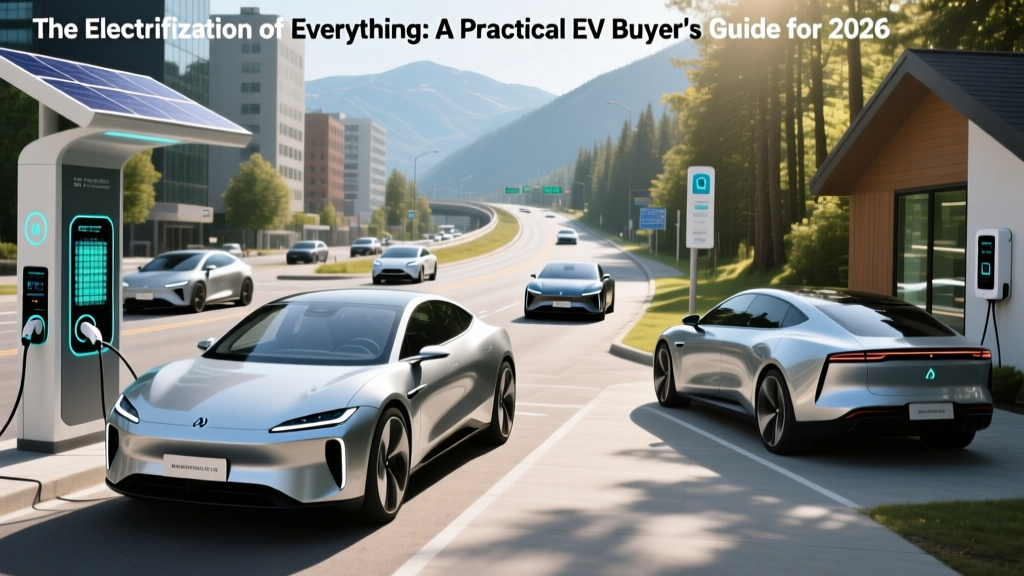
The phrase "electrification of everything" describes the macro trend of replacing combustion-based energy use — in transportation, home heating, cooking, and industry — with electricity, ideally sourced from increasingly renewable grids. For auto buyers, this translates to a market where battery-electric vehicles (BEVs), plug-in hybrids (PHEVs), and conventional hybrids (HEVs) now span nearly every vehicle category: compact sedans, three-row SUVs, pickup trucks, and luxury performance cars.
As of the 2026 model year, over 120 electrified models are available in the U.S. market. Battery costs have fallen below $110/kWh at the pack level according to BloombergNEF data, enabling longer-range vehicles at lower prices than even two years ago. But the transition is uneven: public charging infrastructure remains inconsistent in rural areas, apartment dwellers still face significant barriers to home charging, and the federal §30D tax credit has complex sourcing and income requirements that disqualify many buyers and vehicles alike.
This guide cuts through the noise. We'll give you the exact numbers — costs, ranges, charging times, and trade-offs — so you can decide whether a BEV, PHEV, HEV, or gas vehicle is the right call for your specific situation.
EV vs. Gas vs. Hybrid: The Numbers Side by Side
Let's compare three representative 2026 vehicles across the powertrain spectrum: the Hyundai Ioniq 6 SE (BEV), Toyota RAV4 Prime XSE (PHEV), and Toyota Camry LE (gas HEV). This cross-section covers the key metrics buyers actually need.
| Metric | Hyundai Ioniq 6 SE (BEV) | Toyota RAV4 Prime XSE (PHEV) | Toyota Camry LE (HEV) |
|---|---|---|---|
| Base MSRP | $39,250 | $44,590 | $29,990 |
| EPA Range / Electric-Only | 361 mi (EPA) | 42 mi electric + 540 mi total | N/A (644 mi total range) |
| Efficiency | 140 MPGe / 24 kWh/100mi | 94 MPGe (elec) / 38 MPG (gas) | 51 MPG combined |
| Battery Capacity | 77.4 kWh usable (NMC) | 18.1 kWh usable (NMC) | 1.6 kWh (HEV buffer) |
| DC Fast Charge (10–80%) | ~18 min at 240 kW peak | ~35 min at 50 kW peak | N/A |
| Level 2 Charge (0–100%) | ~7.5 hrs at 10.9 kW | ~2.5 hrs at 6.6 kW | N/A |
| 0–60 mph | 5.1 sec (RWD) | 5.7 sec (AWD) | 7.2 sec |
| Horsepower | 225 hp | 302 hp combined | 225 hp combined |
| Federal Tax Credit (§30D) | Up to $7,500 (varies by sourcing) | Up to $7,500 (varies by sourcing) | None |
| Powertrain Warranty | 10 yr / 100,000 mi | 10 yr / 150,000 mi (hybrid components) | 10 yr / 150,000 mi (hybrid components) |
Key takeaway: The BEV wins on running cost and performance per dollar. The PHEV offers electric commuting with gas-trip flexibility. The HEV requires zero behavioral change and still delivers strong fuel economy. Your choice depends on charging access, trip patterns, and budget — not ideology.
The Real Cost of Ownership: 5-Year Breakdown
Sticker price is only the starting point. Here's a 5-year / 75,000-mile total cost of ownership (TCO) comparison for the three vehicles above, assuming 15,000 miles/year, $0.14/kWh home electricity (national average), $3.50/gallon gas, and mid-tier insurance rates.
| Cost Category | Ioniq 6 SE (BEV) | RAV4 Prime XSE (PHEV) | Camry LE (HEV) |
|---|---|---|---|
| Purchase Price (after est. credit) | $31,750* | $37,090* | $29,990 |
| Fuel / Energy (5 years) | $3,150 | $4,800 | $7,200 |
| Maintenance (5 years) | $1,800 | $3,200 | $3,400 |
| Insurance (5 years) | $8,500 | $7,800 | $6,900 |
| Estimated Depreciation | $14,200 | $16,500 | $12,800 |
| Total 5-Year TCO | $59,400 | $69,390 | $60,290 |
| Cost Per Mile | $0.79 | $0.93 | $0.80 |
*Tax credit assumes full §30D eligibility. Verify your personal qualification at IRS.gov. Point-of-sale transfer is available through participating dealers.
The BEV's advantage is clearest in fuel and maintenance savings — no oil changes, no transmission fluid, fewer brake replacements thanks to regenerative braking. But EV insurance premiums run 15–25% higher on average (per AAA and NerdWallet data), and EV depreciation has been steeper than gas cars in recent years due to price wars and rapid tech obsolescence. The PHEV splits the difference. The HEV remains the low-risk, predictable-cost option.
What First-Time EV Buyers Must Know Before Signing
If you're considering your first EV, these are the ownership realities that no showroom brochure will volunteer:
Home Charging Is the Make-or-Break Factor
Over 80% of EV charging happens at home. A Level 2 home charger (240V, typically 32–48 amps / 7.7–11.5 kW) adds 25–40 miles of range per hour and costs $500–$1,500 for equipment plus $800–$2,500 for electrician installation, depending on whether your panel needs an upgrade. If you live in an apartment without charging access or park on the street, public charging becomes your primary fueling method — and at $0.30–$0.55/kWh at DC fast chargers (per Electrify America and EVgo pricing), your per-mile cost nearly doubles versus home charging.
EPA Range ≠ Real-World Range
The EPA range sticker is a blended estimate. In real-world highway driving at 70–80 mph, expect 85–90% of EPA range in mild weather. In freezing temperatures (below 32°F), cabin heating and battery thermal losses can reduce range by 20–35%. An EV rated at 300 miles EPA may deliver 200–240 miles in a Midwestern winter. If your commute or road-trip route demands the full EPA number, you need a larger buffer.
Charging Speed Is a Curve, Not a Constant
When a manufacturer advertises "240 kW DC fast charging," that's the peak rate — typically sustained only between 10–40% State of Charge (SoC). Above 60%, the rate tapers significantly to protect battery health. A "10–80% in 18 minutes" claim assumes optimal battery preconditioning and a charger capable of delivering the full rate. In practice, plan for 25–35 minutes per fast-charge stop on a road trip.
The §30D Tax Credit Is Not Guaranteed
The federal clean vehicle credit offers up to $7,500, but eligibility depends on:
- Your income: AGI must not exceed $150,000 (single), $225,000 (head of household), or $300,000 (joint).
- Vehicle MSRP caps: $55,000 for sedans; $80,000 for SUVs, vans, and trucks.
- Battery sourcing: Increasingly strict critical-mineral and battery-component requirements, with foreign-entity-of-concern (FEOC) restrictions phasing in through 2027.
- Point-of-sale transfer: You can apply the credit as a down-payment reduction at a participating dealer, rather than waiting for tax filing.
Always verify current eligibility on IRS.gov or consult a tax professional before committing.
Common EV Myths — Addressed with Data
| Myth | Fact |
|---|---|
| "EV batteries need replacing every few years." | Modern NMC and LFP packs are warrantied for 8 years / 100,000 miles at 70%+ capacity retention. Real-world data from fueleconomy.gov and fleet studies show average degradation of 1.5–2.3% per year. Most packs outlast 150,000+ miles before dropping below 80% State of Health. |
| "EVs are worse in cold weather." | Range drops 20–35% in sub-freezing temps, but EVs start reliably (no cold-crank issues), and preconditioning while plugged in mitigates range loss. Heat-pump-equipped models (Hyundai, Tesla, BMW) reduce cabin-heating energy draw by 30–50%. |
| "The grid can't handle mass EV adoption." | Most EV charging occurs overnight during off-peak hours. A single EV adds roughly 1,000–1,500 kWh/year to household consumption — equivalent to adding a refrigerator. Managed charging and V2G (vehicle-to-grid) systems are actively being deployed to balance load. |
| "EVs are more expensive to own, period." | Higher purchase price and insurance, yes. But lower fuel and maintenance costs typically offset this within 3–5 years for drivers covering 12,000+ miles annually with home charging. TCO parity varies by state electricity rates and local incentives. |
| "I'll be stranded by a dead battery." | With 270+ mile EPA ranges on mainstream models and over 190,000 public charging ports in the U.S. (per AFDC data), range stranding is increasingly rare — but still a real risk in rural corridors. Trip planning via A Better Routeplanner or built-in nav eliminates most uncertainty. |
Your Decision Framework: EV, PHEV, Hybrid, or Gas?
Use this if-then guide to find your ideal powertrain:
Choose a BEV (full electric) if:
- You can install a Level 2 charger at home (garage or driveway with 240V access)
- Your daily driving is under 100 miles round-trip
- You take road trips 1–3 times per year and can plan charging stops
- You want the lowest per-mile operating cost and minimal maintenance
- You qualify for the §30D credit or your state offers additional incentives
Choose a PHEV (plug-in hybrid) if:
- Your commute is under 40 miles round-trip (covering most PHEV electric-only ranges)
- You have home charging but also take frequent long road trips
- You want electric daily driving without any range anxiety
- You live in an area with sparse DC fast-charging infrastructure
- You need AWD capability and towing (e.g., RAV4 Prime: 302 hp, 2,500 lb towing)
Choose an HEV (conventional hybrid) if:
- You cannot install a home charger (apartment, street parking)
- You want better fuel economy without changing your fueling habits
- Your budget is under $35,000 and you want maximum reliability track record
- You drive in extreme cold climates where EV range loss is most severe
Stick with gas (for now) if:
- You drive fewer than 6,000 miles per year (fuel savings won't offset EV premium)
- You tow heavy loads regularly (8,000+ lbs) in remote areas without charging
- You need the lowest possible upfront cost and plan to keep the vehicle 10+ years
The Electrification of Everything: Beyond the Car
The broader "electrification of everything" trend extends beyond vehicles. Heat pumps are replacing gas furnaces, induction cooktops are replacing gas ranges, and residential solar-plus-storage is reducing grid dependence. For EV owners, this convergence creates compounding benefits: a home with solar panels, a Level 2 charger, and a heat pump can slash total household energy costs by 40–60% versus fossil-fuel equivalents, according to Department of Energy analyses.
Vehicle-to-home (V2H) technology — available on the Ford F-150 Lightning and Hyundai Ioniq 5 with compatible bidirectional chargers — lets your EV's battery back up your home during outages, effectively turning your car into a 77–131 kWh rolling power bank. This integration is where the electrification narrative moves from transportation to whole-home energy resilience.
But the ecosystem is still maturing. Bidirectional chargers cost $3,000–$7,000 installed, utility interconnection agreements vary by state, and not all EVs support V2H or V2G. The vision is compelling; the execution requires careful, localized planning.
Frequently Asked Questions
How long do EV batteries actually last?
Most 2026 EV batteries are warrantied for 8 years or 100,000 miles, with a capacity-retention threshold of 70%. Real-world fleet data suggests average annual degradation of 1.5–2.3% for liquid-cooled NMC packs and 1.0–1.5% for LFP chemistry. At these rates, a battery should retain 80–85% of original capacity after 10 years. Full replacement costs range from $8,000 to $18,000 depending on pack size and chemistry, but complete failure before 150,000 miles is uncommon.
Is it cheaper to charge an EV at home or use gas?
At the national average electricity rate of ~$0.14/kWh and an EV efficiency of 3–4 miles/kWh, home charging costs roughly $0.035–$0.047 per mile. A gas car averaging 28 MPG at $3.50/gallon costs $0.125 per mile. That's a savings of $0.08–$0.09 per mile — or about $1,200–$1,350 per year at 15,000 miles. However, public DC fast charging at $0.35–$0.55/kWh narrows the gap to near parity with gas.
Do I need a 200-amp electrical panel for a home charger?
Not always. A 48-amp Level 2 charger (the most powerful common residential unit) draws about 11.5 kW and requires a 60-amp dedicated circuit. Many homes with 100-amp panels can support this if total simultaneous load is low. However, older homes or those already running electric dryers, ovens, and HVAC on a 100-amp panel may need a $1,500–$3,500 panel upgrade. A licensed electrician should perform a load calculation before installation.
Can I get the $7,500 federal tax credit on any EV?
No. Under current IRS §30D rules, eligibility depends on your adjusted gross income (caps apply), the vehicle's MSRP (sedans ≤$55,000; SUVs/trucks ≤$80,000), and battery-component and critical-mineral sourcing requirements that tighten annually. Some popular models qualify for the full $7,500; others qualify for $3,750 or nothing. Always check the IRS qualified vehicle list before purchasing.
What happens if I can't charge at home?
Exclusive reliance on public charging is feasible but more expensive and less convenient. Budget $0.30–$0.55/kWh at DC fast chargers, plan 20–35 minute stops every 200–250 miles on road trips, and account for charger downtime (5–10% of public chargers may be out of service at any given time, per J.D. Power studies). For apartment dwellers, workplace charging or community charging programs can partially bridge the gap. If none of these are available, a PHEV or HEV is likely the more practical choice.