The Quick Answer: Are Electric Work Vans Worth It in 2026?
Yes — but only if your routes fit the battery. Today's leading electric work vans deliver 120–205 miles of EPA-estimated range, handle 2,000–3,300 lb payloads, and can cut per-mile energy costs by 50–70% versus gas equivalents when depot-charged overnight. The upfront premium ($8,000–$20,000 over a gas van) is offset within 3–6 years for fleets averaging 60–150 miles/day with Level 2 depot charging. If your daily routes exceed 180 miles, involve heavy towing, or operate in sub-20°F climates without garage parking, a gas or hybrid van remains the safer bet.
The commercial electric work van market in 2026 is no longer experimental. Three platforms dominate: the Ford E-Transit, the BrightDrop Zevo 600 (backed by GM), and the Mercedes-Benz eSprinter. Each targets a different duty cycle, from last-mile urban delivery to longer suburban routes. Let's break down the numbers that actually matter to fleet managers and owner-operators.
Spec Comparison: 2026 Electric Work Vans Side by Side
| Spec | Ford E-Transit (2026) | BrightDrop Zevo 600 | Mercedes-Benz eSprinter |
|---|---|---|---|
| EPA Range | 126 mi (low-roof cargo) | ~205 mi (est.) | ~200 mi (150 kWh, high-roof) |
| Battery (usable) | 68 kWh (NMC) | ~110 kWh (NMC, Ultium) | 113 kWh (NMC) / 150 kWh option |
| Max DC Fast Charge | 115 kW | 120 kW | 115 kW |
| 10–80% DC Charge | ~45 min | ~55 min | ~50 min (113 kWh) |
| Level 2 Rate | 10.5 kW (AC) | 11.5 kW (AC) | 9.6 kW (AC) |
| Horsepower / Torque | 266 hp / 317 lb-ft | 300 hp / 348 lb-ft | 201 hp / 332 lb-ft |
| Max Payload | 3,332 lb | ~2,500 lb | ~2,624 lb |
| Cargo Volume (max) | 487.3 cu ft | 615 cu ft | 532.6 cu ft |
| Base MSRP (cargo van) | ~$47,500 | ~$55,000 (est.) | ~$58,000 (113 kWh) |
| Battery Warranty | 8 yr / 100,000 mi | 8 yr / 60,000 mi | 8 yr / 100,000 mi |
Sources: Ford Commercial, fueleconomy.gov, Mercedes-Benz USA. BrightDrop specs are manufacturer-estimated for the 2026 model year.
EV vs. Gas Van: The Real Cost of Ownership
The sticker price of an electric work van is undeniably higher. A 2026 Ford Transit T-250 cargo van with the 3.5L V6 starts around $43,000, while the E-Transit begins near $47,500. The Mercedes gulf is wider: a gas Sprinter 2500 starts around $48,000 versus the eSprinter's ~$58,000. But purchase price is only one line item. The real story is total cost of ownership (TCO) over five years and 75,000 miles.
| Cost Factor (5 yr / 75k mi) | Ford E-Transit | Ford Transit 3.5L Gas | Difference |
|---|---|---|---|
| Purchase Price (base) | $47,500 | $43,000 | +$4,500 |
| Federal §45W Commercial Credit | –$7,500 | $0 | –$7,500 |
| Fuel / Electricity | $3,200 (depot L2 @ $0.13/kWh) | $10,500 (gas @ $3.50/gal, 14 MPG) | –$7,300 |
| Maintenance (brakes, fluids, filters) | $1,800 | $4,200 | –$2,400 |
| Insurance (avg.) | $7,500 | $6,800 | +$700 |
| Net 5-Year Cost | $52,500 | $64,500 | –$12,000 |
The E-Transit wins by roughly $12,000 over five years, primarily through fuel and maintenance savings. Regenerative braking dramatically extends brake pad life — many fleet operators report brake jobs at 120,000+ miles on electric vans versus 40,000–60,000 miles on gas equivalents. There's no transmission fluid, no oil changes, no spark plugs, and no emissions system to service.
Important tax credit note: The §30D consumer credit does not apply to commercial fleet purchases. Instead, the IRS §45W Commercial Clean Vehicle Credit provides up to $7,500 for vehicles under 14,000 lb GVWR. Eligibility depends on battery component and critical-mineral sourcing requirements that tighten annually. Consult a tax professional to confirm your fleet's eligibility.
Real-World Range: What the EPA Sticker Doesn't Tell You
EPA vs. Reality for Electric Work Vans:
- EPA 126 mi (E-Transit): Expect ~100–110 mi on mixed suburban routes with cargo; ~80–95 mi at sustained 70 mph highway speeds; ~70–85 mi in sub-25°F weather with cabin heat.
- EPA ~200 mi (eSprinter 150 kWh): Expect ~160–175 mi loaded in moderate temps; ~120–140 mi in winter highway driving.
- EPA ~205 mi (Zevo 600): Expect ~165–180 mi in typical delivery use; cold-weather loss of 20–30% applies.
Range loss in electric work vans is driven by four factors that rarely appear in marketing brochures:
- Payload weight: A fully loaded van (2,500+ lb of cargo) increases energy consumption by 10–18%. The E-Transit's 2.0 kWh/mi efficiency can climb to 2.4 kWh/mi at max payload.
- Cold weather: Lithium-ion batteries lose 15–30% of usable capacity below 25°F. Cabin heating draws 3–5 kW continuously — the equivalent of running a space heater on your battery. Vans with heat pump systems (standard on the eSprinter) mitigate this by ~30% compared to resistive heaters.
- Highway speeds: Aerodynamic drag is brutal on tall cargo vans. Efficiency drops 20–25% at 70 mph versus 45 mph city driving. These vehicles are optimized for 25–45 mph urban routes.
- Accessory loads: Refrigeration units, lift gates, and aftermarket shelving with lighting all draw from the traction battery unless separately powered.
For fleets running predictable urban routes under 120 miles with overnight depot charging, range is a non-issue. For longer rural routes or winter operations in northern states, you need to spec the larger battery option or plan mid-day DC fast charging — which brings us to infrastructure.
Charging Infrastructure: Depot, Public, and the Install Bill
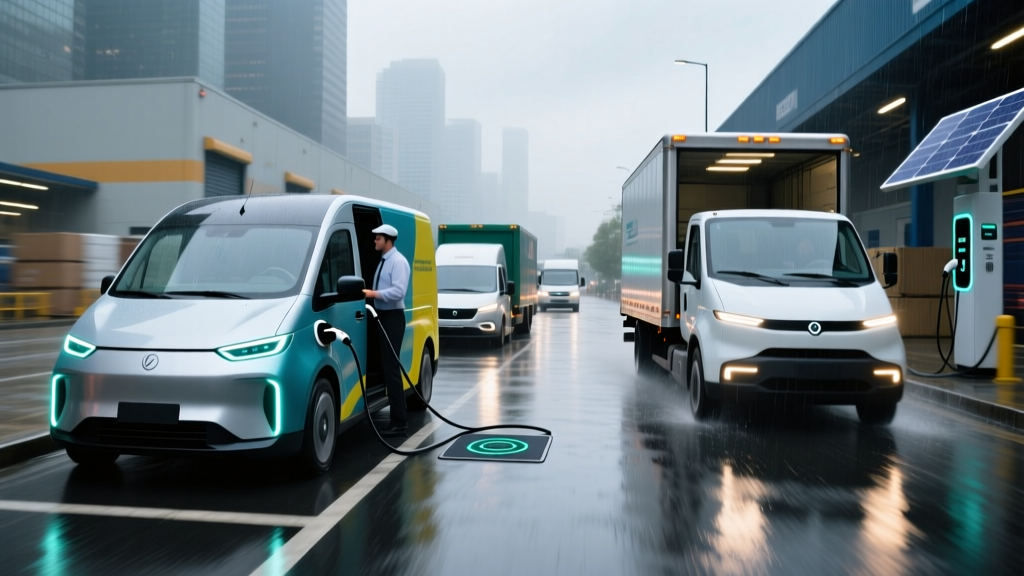
Commercial van charging almost always happens at the depot. Here's what that looks like in practice:
| Level | Power (kW) | Miles Added/Hour | Best For |
|---|---|---|---|
| Level 1 (120V) | 1.4 kW | ~4–5 mi/hr | Emergency top-up only |
| Level 2 (240V, 40A) | 9.6 kW | ~28–35 mi/hr | Overnight depot charging |
| Level 2 (240V, 48A) | 11.5 kW | ~35–42 mi/hr | Faster overnight, larger batteries |
| DC Fast (50 kW) | 50 kW | ~150 mi/hr | Mid-day top-up |
| DC Fast (115 kW peak) | 115 kW | ~300+ mi/hr | Rapid turnaround (tapers above 80%) |
A typical depot installation for 5 vans with Level 2 chargers runs $15,000–$40,000 depending on electrical panel capacity, trenching, and local utility demand-charge structures. Here's a realistic breakdown:
| Item | Cost Range (5-charger depot) |
|---|---|
| Level 2 chargers (commercial-grade, networked) | $3,500–$7,000 each ($17,500–$35,000 total) |
| Electrical panel upgrade (if needed, 400A service) | $5,000–$15,000 |
| Wiring, conduit, trenching | $3,000–$10,000 |
| Permits and utility interconnection | $1,500–$5,000 |
| Total (typical) | $27,000–$65,000 |
Many utilities offer commercial EV charging rebates or make-ready programs that cover 50–100% of infrastructure costs. Check with your local utility's commercial EV team before signing any contracts. The Alternative Fuels Data Center maintains a database of state and utility incentives.
Common Misconceptions About Electric Work Vans
| Myth | Fact |
|---|---|
| "Electric vans can't handle real payloads." | The E-Transit carries 3,332 lb — comparable to a gas Transit T-250 (3,360 lb). Instant torque actually improves low-speed maneuverability under load. |
| "Batteries will need replacing every few years." | Commercial NMC batteries are warranted for 8 years/100,000 miles at 70%+ capacity retention. Real-world fleet data from early adopters shows ~5–8% degradation at 100,000 miles with proper charging practices (avoiding sustained 100% SoC). |
| "Public charging is unreliable for fleets." | True — which is why successful fleet deployments never rely on public charging. Depot Level 2 is the backbone; DC fast charging is a backup for extended routes. |
| "Electric vans cost more to insure." | Premiums are typically 5–15% higher due to repair cost uncertainty, but the gap is narrowing as collision data accumulates. Some insurers now offer EV fleet discounts. |
| "They can't tow." | The E-Transit is rated for 7,500 lb towing. However, towing cuts range by 30–50%. If towing is routine, size your route for the reduced range. |
Decision Framework: Which Van Fits Your Operation?
Choose an electric work van IF:
- Your daily routes are under 150 miles (under 120 miles in cold climates)
- You have depot or yard space for overnight Level 2 charging
- Your routes are primarily urban/suburban with speeds under 55 mph
- You want to reduce operating costs and qualify for §45W credits
- You operate in a city with clean-air-zone mandates or emissions restrictions
Stick with a gas or hybrid van IF:
- Daily routes regularly exceed 180 miles with no mid-day charging option
- You tow heavy trailers (5,000+ lb) on most shifts
- You operate in extreme cold (below 10°F) with outdoor parking
- Your routes are rural with no access to DC fast charging infrastructure
- You need a van immediately and face 6–12 month EV lead times
What First-Time EV Fleet Buyers Need to Know
If you're transitioning from an all-gas fleet, these operational shifts matter more than the spec sheet:
1. Charge management is your new fuel logistics. Fleet telematics (Ford Pro, BrightDrop's platform, or third-party tools like Geotab) let you monitor State of Charge across vehicles, schedule off-peak charging to minimize utility demand charges, and set charge limits (80% daily, 100% only when needed) to extend battery life.
2. Driver behavior changes. One-pedal driving with regenerative braking requires a 1–2 week adjustment period. Train drivers to use it — it's the single biggest factor in maximizing range and minimizing brake wear.
3. Plan for winter. Preconditioning the battery and cabin while the van is still plugged in at the depot recovers 10–15% of cold-weather range. Every electric work van in this comparison supports scheduled preconditioning via its fleet management app.
4. Battery end-of-life isn't a crisis. At 70% State of Health, a van battery still holds enough energy for reduced-route service. Second-life applications (stationary storage) and recycling infrastructure are maturing. Replacement costs for the E-Transit's 68 kWh pack currently run $12,000–$16,000 — but most fleets will sell or retire the vehicle before needing one.
5. Order lead times remain long. As of early 2026, E-Transit delivery windows run 3–6 months; eSprinter and Zevo 600 timelines vary by dealer allocation. Plan fleet transitions 9–12 months ahead.
Frequently Asked Questions
Do electric work vans qualify for the $7,500 federal tax credit?
Not the §30D consumer credit — that's for personal-use vehicles. Commercial and fleet purchases use the §45W Commercial Clean Vehicle Credit, which also provides up to $7,500 for vehicles under 14,000 lb GVWR. Eligibility depends on battery sourcing requirements and your tax liability. Always confirm with a tax professional before relying on the credit in your budget.
How long does it take to charge an electric work van overnight?
On a Level 2 charger at 10.5–11.5 kW, a fully depleted E-Transit (68 kWh) charges to 100% in about 7 hours. The larger eSprinter 150 kWh pack takes roughly 14–15 hours from empty — but in practice, vans return to the depot at 20–40% SoC and need only 6–9 hours to reach 80–100%. Overnight depot charging covers nearly all daily duty cycles.
What happens if an electric work van battery fails out of warranty?
Out-of-warranty battery replacement for the E-Transit runs approximately $12,000–$16,000 (parts and labor). For the eSprinter, expect $18,000–$25,000 for the 150 kWh pack. However, real-world degradation data from commercial fleets suggests batteries retain 85–92% capacity at 100,000 miles. Most fleet cycles (5–7 years, 75,000–120,000 miles) never reach the point of needing a replacement.
Can I install Level 2 chargers at a rented commercial property?
Yes, but coordinate with the property owner and your utility early. You'll likely need landlord approval, a dedicated electrical circuit (240V, 50–60A per charger), and possibly a panel upgrade. Many commercial leases now include EV charging clauses. Networked chargers (ChargePoint, Blink, EV Connect) can be relocated if you move.
Are electric work vans slower than gas vans?
No. The E-Transit's 266 hp and 317 lb-ft of instant torque delivers 0–60 mph in roughly 8 seconds — comparable to or faster than a loaded gas Transit. Electric vans feel notably quicker in city driving because torque is immediate, with no transmission downshift lag. Top speed is typically governed to 75–80 mph for efficiency.