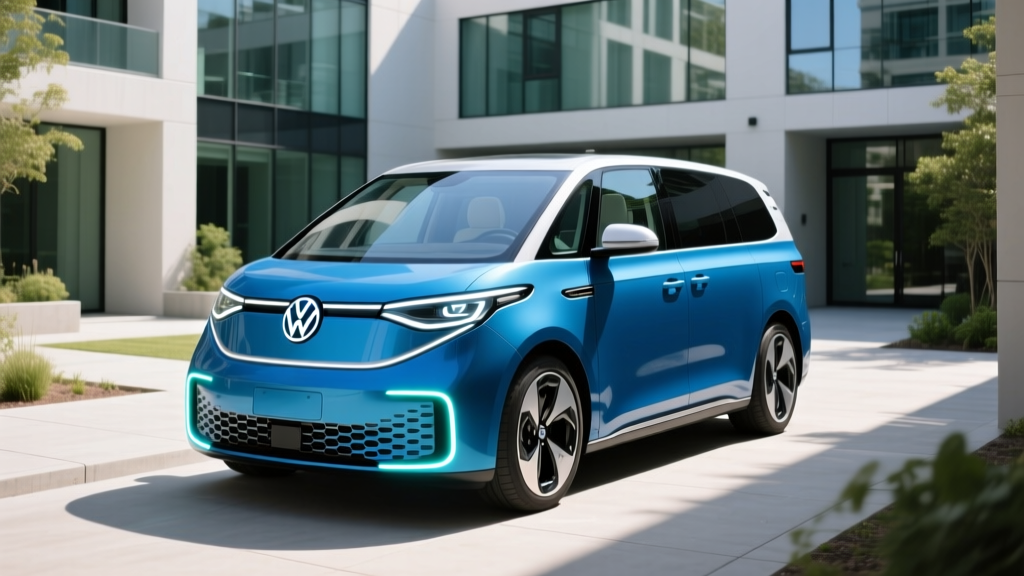
The electric VW bus is no longer a concept — it's the Volkswagen ID. Buzz, a retro-styled, three-row EV that brings the iconic Microbus into the battery-electric era. If you're considering one in 2026, here's what matters: the ID. Buzz offers an EPA-estimated 234 miles of range (RWD Pro S trim), charges from 10-80% in roughly 26 minutes at a DC fast charger, starts around $59,995, and currently does not qualify for the full $7,500 federal §30D tax credit due to its overseas assembly. It's best suited for suburban families who want three-row seating, distinctive styling, and daily electric commuting — but who also have access to home Level 2 charging.
Quick Verdict: Is the Electric VW Bus Worth It?
Yes, if you need a three-row family hauler, have home charging, and value design character over maximum range-per-dollar. No, if you need 300+ miles of EPA range, live in a charging desert, or are strictly optimizing for lowest cost-per-mile. The ID. Buzz is a compelling lifestyle EV, but its 234-mile range and ~$60K starting price put it in a competitive space against the Kia EV9, Hyundai Ioniq 9, and even minivans like the Chrysler Pacifica PHEV.
Range, Battery, and Efficiency: What the Numbers Actually Mean
The 2026 VW ID. Buzz is built on Volkswagen's MEB platform and comes in two drivetrain configurations. Here are the exact specs that matter for daily driving and road trips:
| Spec | Pro S (RWD) | Pro S Plus (AWD) |
|---|---|---|
| Battery (usable) | 86 kWh (NMC) | 86 kWh (NMC) |
| EPA Range | 234 miles | 231 miles |
| MPGe (combined) | 87 MPGe | 84 MPGe |
| Efficiency | 3.0 kWh/mile | 3.1 kWh/mile |
| Peak DC Charge Rate | 175 kW | 175 kW |
| 10–80% DC Fast Charge | ~26 minutes | ~26 minutes |
| Level 2 (AC) Charge Rate | 11 kW | 11 kW |
| Level 2 Full Charge Time | ~8.5 hours | ~8.5 hours |
| Horsepower | 282 hp | 335 hp |
| 0–60 mph | 7.9 sec | 6.5 sec |
Real-World Range Reality Check
The EPA sticker says 234 miles for the RWD model, but plan for real-world variance:
- Highway driving (70–80 mph): Expect ~185–200 miles. The Buzz's boxy shape creates significant aerodynamic drag, which hits efficiency hard above 65 mph.
- Cold weather (below 32°F): Range can drop 20–30%, putting you closer to 165–185 miles. The ID. Buzz does not come standard with a heat pump in all trims — confirm your configuration, as resistive cabin heating is a range killer.
- City / mild weather commuting: You'll see 220–240 miles, close to or slightly above EPA, thanks to regenerative braking in stop-and-go traffic.
For context, the three-row Kia EV9 (Long Range RWD) achieves 304 miles EPA with a 100 kWh battery — roughly 70 more miles per charge. That's a meaningful gap on road trips.
On the charging side, the 175 kW peak DC rate is adequate but not class-leading. The charge curve tapers noticeably above 80% SoC, which is standard for NMC chemistry. If you're relying on public DC fast charging, expect to spend about 30–35 minutes per stop on a road trip to go from 10–80%. The 11 kW onboard AC charger means a full Level 2 charge at home takes about 8.5 hours — essentially an overnight top-up, which works well for daily use.
Pricing, Tax Credits, and the True Cost to Buy
The 2026 ID. Buzz starts at approximately $59,995 for the Pro S (RWD) and climbs to around $69,995 for the Pro S Plus with AWD and 1st Edition packages. Destination charges add roughly $1,395.
| Cost Factor | VW ID. Buzz Pro S (RWD) | Kia EV9 Long Range RWD | Chrysler Pacifica PHEV |
|---|---|---|---|
| Base MSRP | $59,995 | $59,995 | $51,095 |
| Federal Tax Credit (§30D) | $0 (assembled in Germany) | Up to $7,500* | Up to $7,500* |
| Effective Price After Credit | $59,995 | ~$52,495 | ~$43,595 |
| Est. Annual Insurance | $2,200–$2,600 | $2,000–$2,400 | $1,600–$1,900 |
| Battery/Powertrain Warranty | 8 yr / 100,000 mi | 10 yr / 100,000 mi | 8 yr / 100,000 mi (hybrid system) |
*Federal §30D credit eligibility depends on MSRP caps ($80,000 for vans/SUVs), buyer income limits ($300K MFJ / $150K single), and critical-mineral/battery-component sourcing requirements. Verify current eligibility at IRS.gov before purchase. Rules are subject to change.
The ID. Buzz's biggest financial disadvantage is its lack of federal tax credit eligibility. Because it's assembled in Hannover, Germany, it fails the §30D final-assembly requirement. This immediately puts it at a ~$7,500 disadvantage versus US-assembled competitors. Some states offer additional rebates (check your state's energy or DMV website), but those vary widely by jurisdiction.
EV vs. Gas vs. Hybrid: How the ID. Buzz Compares
If you're cross-shopping the electric VW bus against traditional minivans or three-row SUVs, the economics shift depending on your driving patterns and charging access.
| Metric | VW ID. Buzz (EV) | Honda Odyssey (Gas) | Chrysler Pacifica PHEV |
|---|---|---|---|
| EPA Combined Efficiency | 87 MPGe (3.0 kWh/mi) | 22 MPG | 82 MPGe (32 mi electric + 30 MPG gas) |
| Fuel/Energy Cost per Mile | ~$0.04–$0.05 (home charging) | ~$0.16 ($3.50/gal) | ~$0.06–$0.10 (blended) |
| Annual "Fuel" Cost (12K mi/yr) | ~$480–$600 | ~$1,920 | ~$720–$1,200 |
| Annual Maintenance | ~$200–$350 | ~$600–$900 | ~$500–$700 |
| 5-Year Total Energy + Maint. | ~$3,400–$4,750 | ~$12,600–$14,100 | ~$6,100–$9,500 |
The per-mile energy savings of the ID. Buzz are substantial — roughly $1,300–$1,400 per year versus a gas minivan if you charge at home. Over five years, that's $6,500–$7,000 in fuel savings alone, plus another $2,000–$3,000 in reduced maintenance (no oil changes, fewer brake replacements due to regenerative braking, no transmission fluid).
However, that savings does not fully offset the ~$7,500 tax credit gap versus a US-assembled EV competitor, and it takes roughly 5–6 years to close the purchase-price gap versus a gas minivan like the Odyssey (starting ~$38,000). If you're a high-mileage driver (15,000+ miles/year), the payback accelerates. If you drive under 10,000 miles annually, the economics favor a PHEV like the Pacifica, which gives you 32 miles of electric-only range for daily commutes plus a gas engine for road trips — with no range anxiety.
Home Charging and Real-World Ownership Considerations
The ID. Buzz's 11 kW onboard AC charger is a strong point — it's faster than many competitors (the Tesla Model Y, for reference, maxes at 11.5 kW). But you need the right home setup to take advantage of it.
| Item | Estimated Cost | Notes |
|---|---|---|
| Level 2 Charger (40–48A, hardwired) | $400–$700 | ChargePoint Home Flex, Emporia Level 2, Wallbox Pulsar Plus |
| Electrician Labor (240V / 50–60A circuit) | $800–$2,500 | Depends on panel proximity, conduit run length |
| Electrical Panel Upgrade (if needed) | $1,500–$3,500 | Required if you have a 100A panel; 200A recommended |
| Permit & Inspection | $100–$300 | Varies by municipality |
| Total (typical install) | $1,300–$3,500 | Without panel upgrade: $1,300–$2,200 |
If you live in an apartment or condo without dedicated parking and charging access, the ID. Buzz becomes significantly harder to own. Public DC fast charging at 175 kW is viable for road trips, but relying on it daily is expensive ($0.35–$0.50/kWh at networks like Electrify America or EVgo, versus ~$0.12–$0.18/kWh at home) and adds time to your routine. Before purchasing, confirm you have reliable Level 2 access at home or work.
Climate matters, too. If you live in the upper Midwest, Northeast, or Mountain West where winters are harsh, the ID. Buzz's 234-mile range will shrink meaningfully. VW offers a heat pump on select trims/packages — prioritize this option if you regularly see temperatures below freezing. Without it, cabin heating draws directly from the traction battery and can cut range by up to 30% in sub-20°F conditions.
Common Misconceptions About the Electric VW Bus
| Myth | Fact |
|---|---|
| "It qualifies for the $7,500 federal tax credit." | It does not. The ID. Buzz is assembled in Germany, which disqualifies it from the §30D credit's final-assembly requirement. Always verify at fueleconomy.gov. |
| "It has the same range as the old gas Microbus." | The original air-cooled Type 2 got roughly 15–18 MPG with a ~15-gallon tank, giving it ~225–270 miles of range. The ID. Buzz's 234 EPA miles are comparable on paper, but real-world highway and cold-weather range is lower. |
| "It's basically a minivan." | The ID. Buzz is classified as a passenger van. It has three rows but less cargo flexibility than a traditional minivan — no stow-and-go seating, and the third row is best for children or shorter adults. |
| "175 kW charging means it charges at that speed the whole time." | Peak charge rate of 175 kW occurs between roughly 10–40% SoC. Above 60%, the charge curve tapers significantly. The 10–80% average is closer to 110–120 kW sustained. |
| "It can tow like a minivan." | The ID. Buzz has a 2,500-lb towing capacity (with factory hitch). The Chrysler Pacifica can tow 3,600 lbs. If you regularly tow a trailer, this matters. |
Interior, Tech, and What It's Actually Like to Live With
The ID. Buzz's interior is where it earns its lifestyle premium. VW leaned into the retro aesthetic with two-tone paint options, a flat floor, and a minimalist dashboard featuring a 12.9-inch infotainment screen running VW's ID. Software 4.0. The cabin materials are a step above the ID.4, with soft-touch surfaces and available recycled-material upholstery.
Practical notes for families:
- Third-row space: Adequate for children and teens; tight for adults on long trips. The Kia EV9 offers a more usable third row.
- Cargo behind 3rd row: Approximately 18.5 cubic feet — enough for a week of groceries or two carry-on bags. Fold the third row for ~75 cu ft.
- Sliding doors: Power sliding rear doors are standard, a huge practical win for school drop-offs and tight parking spots.
- Frunk: There is no front trunk. The MEB platform's front end houses HVAC and electronics.
On the driver-assistance front, the ID. Buzz comes equipped with VW's IQ.DRIVE suite — adaptive cruise control, lane-keeping assist, and Travel Assist (a Level 2 SAE system combining ACC and lane centering). This is a driver-assist system, not self-driving; you must keep your hands on the wheel and eyes on the road at all times. It competes with Toyota Safety Sense and Honda Sensing in capability, and falls short of GM's Super Cruise or Ford's BlueCruise for hands-free highway driving.
Decision Framework: Should You Buy the Electric VW Bus?
Choose the VW ID. Buzz If:
- You have home Level 2 charging (or can install it)
- Your daily commute is under 80 miles round-trip
- You want a distinctive, retro-styled three-row EV and are willing to pay a design premium
- You rarely drive more than 200 miles without stopping
- You value the sliding-door practicality and flat-floor interior for family use
- State-level incentives in your area help offset the lack of a federal tax credit
Look Elsewhere If:
- You need 300+ miles of real-world range for frequent road trips → Kia EV9 (304 mi EPA) or Rivian R1S (Dual-Motor Max, ~352 mi)
- You're optimizing for the lowest total cost and want the $7,500 federal credit → Kia EV9 or a US-assembled three-row EV
- You need serious towing capacity (3,500+ lbs) → Rivian R1S or F-150 Lightning
- You don't have home charging and rely on public infrastructure → Consider a PHEV like the Pacifica until your charging situation improves
- You regularly fill all three rows with adults → A traditional minivan or large SUV still offers more passenger volume
Frequently Asked Questions
Does the electric VW bus qualify for any tax incentives in 2026?
The ID. Buzz does not qualify for the federal §30D clean vehicle credit because it is assembled outside the United States. However, some states (such as California, Colorado, and New York) offer their own EV rebates that are not tied to assembly location. Check your state's energy office or DMV website for current programs. Always verify federal eligibility at IRS.gov before purchasing.
How long does it take to charge the ID. Buzz at home?
On a Level 2 home charger (240V, 48A), the ID. Buzz charges at up to 11 kW. A full charge from near-empty to 100% takes approximately 8.5 hours. Most owners plug in overnight and wake up to a full battery. On a standard 120V outlet (Level 1), expect roughly 2–3 miles of range per hour of charging — adequate only for emergency trickle charging or very low-mileage drivers.
What's the real highway range of the ID. Buzz?
On a flat, 70-mph highway drive in mild weather (65–75°F), expect approximately 190–205 miles before needing to charge. In cold weather (below 32°F) or at sustained speeds above 75 mph, that drops to 165–185 miles. The boxy aerodynamics are the primary efficiency penalty at highway speed.
Is the ID. Buzz good for road trips?
It's viable but requires planning. With ~190 miles of real highway range and a 10–80% charge time of about 26 minutes at a 175 kW DC fast charger, a 500-mile road trip means roughly two charging stops of 25–35 minutes each. That's manageable, but longer than a gas minivan's single fill-up. Use apps like A Better Routeplanner to map charging stops before you go. VW includes 3 years of complimentary 30-minute DC fast charging sessions at Electrify America stations.
How does the ID. Buzz compare to the Kia EV9?
The EV9 offers more EPA range (304 vs. 234 miles), a more usable third row, a faster charge rate (up to 236 kW on Long Range trims), and eligibility for the $7,500 federal tax credit (US-assembled). The ID. Buzz counters with more distinctive styling, power sliding doors, and a slightly more premium interior feel. If range and value are your top priorities, the EV9 wins on paper. If character and daily family practicality matter more, the Buzz holds its own.