Quick Answer: What Does an Electric VW Bug Conversion Kit Involve?
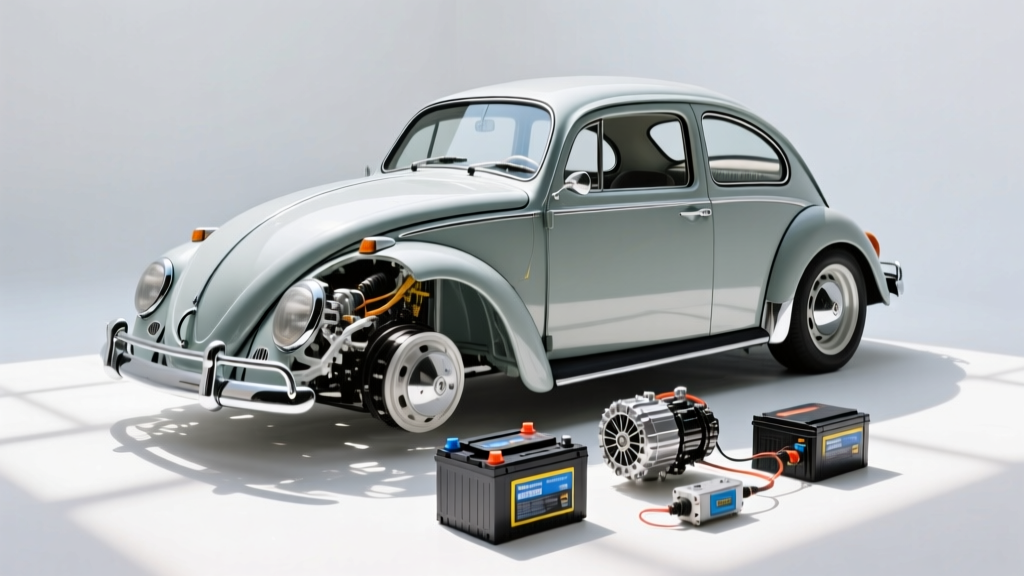
An electric VW Bug conversion kit replaces the original air-cooled flat-four engine and fuel system with an electric motor, battery pack, and power electronics. Complete kits from established suppliers like EV West, Zero EV, or eClassics typically cost between $8,000 and $25,000 for components alone, with professional installation adding $5,000 to $15,000 depending on complexity. Most conversions yield 60 to 150 miles of real-world range from battery packs sized between 15 kWh and 40 kWh, using repurposed Tesla modules, Nissan Leaf packs, or new LFP cells. Charging is typically Level 2 (6.6 kW to 7.2 kW), adding roughly 20–30 miles per hour of charging. These are not highway cruisers — expect a top speed of 75–90 mph and a vehicle best suited for local commuting and weekend driving.
The Real Cost of Converting a Classic VW Beetle to Electric
The appeal of electrifying a classic Beetle is clear: eliminate the carburetor headaches, the oil leaks, the points-and-condenser maintenance, and the 22 MPG combined fuel economy. But the financial picture is nuanced, and buyers should go in with eyes open about total investment versus what they get back.
Component Cost Breakdown
| Component | Budget Build | Mid-Range Kit | Premium Build |
|---|---|---|---|
| Electric motor (AC induction or PMSM) | $1,500–$2,500 | $2,500–$4,000 | $4,000–$6,000 |
| Battery pack (15–40 kWh) | $3,000–$5,000 | $5,000–$10,000 | $10,000–$15,000 |
| Motor controller / inverter | $1,000–$2,000 | $1,500–$3,000 | $2,500–$4,000 |
| Charger (Level 2 onboard) | $500–$800 | $800–$1,500 | $1,500–$2,500 |
| BMS, wiring, adapters, mounts | $1,500–$2,500 | $2,000–$3,500 | $3,000–$5,000 |
| DC-DC converter, gauges, accessories | $500–$1,000 | $800–$1,500 | $1,500–$2,500 |
| Total components | $8,000–$13,800 | $12,600–$23,500 | $21,500–$35,000 |
| Professional installation (if not DIY) | $5,000–$8,000 | $8,000–$12,000 | $12,000–$15,000+ |
| Estimated total project cost | $13,000–$21,800 | $20,600–$35,500 | $33,500–$50,000+ |
These figures don't include the donor vehicle itself. A running-condition classic Beetle (1966–1974 models are the most popular for conversion) typically costs $5,000 to $15,000 in 2026 depending on body condition and title status. A non-running project car can be had for $2,000–$4,000, but expect additional body and suspension work.
Ongoing Operating Costs vs. Gas
| Metric | Original Gas Beetle | Electric Conversion |
|---|---|---|
| Fuel / energy cost per mile | $0.14–$0.17 (at 22 MPG, $3.20/gal) | $0.03–$0.05 (home charging at $0.14/kWh) |
| Annual fuel/energy (8,000 miles) | $1,120–$1,360 | $240–$400 |
| Oil changes per year | 2–3 ($100–$180) | None |
| Annual maintenance estimate | $600–$1,200 (classic car realities) | $150–$300 (brake fluid, cabin, tires) |
| Annual insurance (classic/agreed-value) | $400–$800 | $500–$1,200 (higher agreed value) |
| Total annual operating cost | $2,120–$3,540 | $890–$1,900 |
The annual savings of roughly $1,200 to $1,600 are real, but at a conversion cost of $20,000–$35,000, the payback period is 12 to 29 years for typical weekend-driver mileage. This is a passion project, not a financial optimization. The value comes from driving enjoyment, reliability improvement, and the satisfaction of keeping a classic on the road with modern drivability.
Range, Charging, and Battery Specs: What the Numbers Actually Mean
Understanding the distinction between kW (power — the rate of energy delivery or charging) and kWh (energy — the battery's total capacity) is essential for evaluating any conversion kit. A kit advertising a "30 kWh battery" tells you how much energy is stored; the motor's kW rating tells you how fast it can use that energy.
Typical Conversion Battery and Range Specs
| Battery Configuration | Usable Capacity | Chemistry | Estimated Real-World Range | Weight Added |
|---|---|---|---|---|
| Repurposed Nissan Leaf modules (8–12) | 15–22 kWh | NMC (degraded) | 40–65 miles | 300–450 lbs |
| Tesla Model S salvaged modules | 25–40 kWh | NMC/NCA | 75–120 miles | 450–650 lbs |
| New LFP prismatic cells (CATL/EVE) | 20–35 kWh | LFP | 60–100 miles | 400–600 lbs |
| Custom NMC pack (new cells) | 30–45 kWh | NMC 811 | 90–150 miles | 350–550 lbs |
Real-world range reality: A 30 kWh pack in a converted Beetle weighing approximately 2,100 lbs (stock weight ~1,800 lbs plus battery minus engine) will consume roughly 250–300 Wh/mile in mixed driving at 45–55 mph. That translates to 100–120 miles actual range in moderate weather. Highway driving at 65+ mph pushes consumption to 350+ Wh/mile due to the Beetle's poor aerodynamics (drag coefficient ~0.48), reducing range to 70–85 miles. In cold weather (below 40°F), expect a further 15–25% range loss due to battery chemistry slowdown and cabin heating demands.
Charging Speeds for Converted Beetles
| Charging Level | Power (kW) | Miles Added Per Hour | Full Charge Time (30 kWh pack) | Connector |
|---|---|---|---|---|
| Level 1 (120V outlet) | 1.2–1.4 kW | 3–5 miles/hr | 22–26 hours | Standard NEMA 5-15 |
| Level 2 (240V, 32A) | 6.6–7.2 kW | 20–28 miles/hr | 4–5 hours | J1772 or NACS |
| DC Fast Charge (if equipped) | 25–50 kW | 80–150 miles/hr | 30–45 min (10–80%) | CCS1 or NACS |
Most conversion kits include a Level 2 onboard charger rated at 6.6 kW or 7.2 kW. DC fast charging is available on premium builds using components like the EV West or Zero EV DC-DC systems with CCS or NACS ports, but adds $2,000–$4,000 to the build. For a vehicle with 80–120 miles of range, DC fast charging is useful for extending road trips but not essential for daily driving — overnight Level 2 charging at home fully replenishes the pack.
Electric Conversion vs. Keeping the Gas Engine: A Practical Comparison
The decision between converting and keeping (or restoring) the original powertrain comes down to priorities. Here's how the two paths compare across factors that matter to Beetle owners.
Choose Electric Conversion If:
- You want daily-driver reliability without carburetor tuning, choke issues, or vapor lock
- Your commute is under 50 miles round-trip with home charging access
- You value silent, vibration-free driving and instant torque from stoplights
- You want to eliminate oil changes, fuel system maintenance, and emissions concerns
- You're comfortable with DIY electrical work or have a trusted EV-conversion shop nearby
Keep the Gas Engine If:
- Originality and matching-numbers value matter for collector purposes
- You regularly drive 100+ miles without reliable charging stops
- Your total project budget is under $12,000
- You want to maintain eligibility for classic-car shows judged on originality
- You live in an apartment or lack access to Level 2 home charging
Performance Comparison
| Metric | Stock 1970 Beetle (1500cc) | Typical Electric Conversion |
|---|---|---|
| Horsepower | 57 HP | 60–120 HP (motor-dependent) |
| 0–60 mph | ~20 seconds | 8–14 seconds |
| Top speed | 75 mph (strained) | 80–95 mph |
| Combined efficiency | 22 MPG | 100–130 MPGe (3.0–3.5 kWh/mi) |
| Noise level at 55 mph | Loud (air-cooled flat-four drone) | Quiet (wind and tire noise only) |
The performance uplift is significant. Even a modest 80 HP electric motor transforms the Beetle from a highway liability into a car that merges confidently and pulls away from stops with authority. The low center of gravity from floor-mounted batteries also improves handling compared to the stock rear-engine, tail-heavy weight distribution.
Real-World Ownership Considerations Most Guides Skip
Home Charging Access Is Non-Negotiable
A converted Beetle with 80 miles of range is practical only with reliable home charging. If you park on the street, in a garage without a 240V outlet, or in an apartment complex, this project will create daily frustration rather than joy. A Level 2 home charger installation typically costs $800–$2,500 including equipment and electrician labor, assuming your electrical panel has capacity. Older homes may require a panel upgrade ($1,500–$3,000 additional).
Weight Distribution and Suspension
The stock Beetle was designed around a lightweight (~150 lb) rear-mounted engine. Electric conversions typically place 300–650 lbs of batteries in the front trunk (frunk) and/or under the rear seat and floor pan. This dramatically changes weight distribution and stresses the original torsion-bar suspension. Budget $500–$1,500 for suspension upgrades — stiffer springs, upgraded shocks, and potentially a front beam adjustment to handle the battery weight safely.
Registration, Insurance, and Legal Compliance
EV conversions require re-registration in most states as a "specially constructed" or "modified" vehicle. Requirements vary significantly by jurisdiction — some states require a brake and light inspection, others require a smog-exempt certification, and a few have specific EV-conversion registration pathways. Check with your state DMV before starting the build. Insurance companies like Hagerty and American Modern offer agreed-value classic car policies that can cover conversions, but premiums typically run 20–50% higher than for a stock classic due to the increased replacement value of the EV components.
Tax Credit Eligibility
Unfortunately, the federal §30D clean vehicle tax credit does not apply to EV conversions. The credit is available only for new qualifying vehicles purchased from a manufacturer. There is also no federal credit for used EVs that applies to conversions. Some states offer rebates for EV conversions — California's CC4A program and certain utility district incentives have historically included conversion support, but these programs change frequently. Check your state energy office and local utility for current offerings.
Common Misconceptions About Electric VW Bug Conversions
| Myth | Fact |
|---|---|
| "You can convert a Beetle for $3,000" | Budget builds using salvaged parts and extensive DIY can approach $8,000–$13,000 in components. A $3,000 conversion would use dangerously inadequate batteries and controllers, resulting in under 20 miles of range and potential fire risk from undersized wiring. |
| "The conversion is reversible" | While some builders preserve the original engine and transmission for potential reinstallation, most conversions involve cutting battery mounts, modifying the firewall, and altering wiring harnesses. Plan for the conversion to be permanent. |
| "It'll have 200+ miles of range" | The Beetle's limited physical space caps battery capacity at roughly 35–45 kWh maximum. Given the car's weight and poor aerodynamics, 150 miles is an optimistic upper bound for even premium builds. Anyone advertising 200+ miles is not being realistic about the vehicle's constraints. |
| "Electric means zero maintenance" | You still have brake fluid, windshield washer systems, suspension bushings, tire rotation, and cabin components. Budget $150–$300 annually for basic upkeep. |
| "Any mechanic can service it" | EV conversions use high-voltage systems (typically 96V–144V) that require specific training. Most traditional mechanics won't touch them. Identify an EV-competent shop before you need one. |
Decision Framework: Is an Electric VW Bug Conversion Right for You?
Start Here — Answer Each Question Honestly
1. Do you have access to Level 2 (240V) home charging?
→ No: An EV conversion will be impractical. Consider keeping gas or exploring a PHEV daily driver instead.
→ Yes: Continue to question 2.
2. Is your typical daily driving under 60 miles round-trip?
→ No: Range limitations will create anxiety. A modern production EV (Chevrolet Bolt, Hyundai Ioniq 5) is better for longer commutes.
→ Yes: Continue to question 3.
3. Is your total project budget (car + conversion + charging install + suspension) at least $18,000?
→ No: A budget this tight risks cutting corners on safety-critical components (BMS, wiring gauge, fusing). Wait until you can fund a proper build, or restore the gas engine instead.
→ Yes: Continue to question 4.
4. Are you comfortable with a vehicle that won't be original and may not appreciate like a numbers-matching classic?
→ No: Keep the car stock. Originality drives collector value.
→ Yes: An electric conversion is likely a good fit for your goals.
5. Do you live in a moderate climate, or are you willing to accept 20–25% range loss in winter?
→ Cold climate, range-sensitive: Specify an LFP battery pack (better cold performance, longer cycle life) and consider a small cabin heater circuit in your build.
→ Moderate climate or range-flexible: Either LFP or NMC chemistry works well.
What a First-Time EV Conversion Buyer Should Know
If this is your first EV project, prioritize these practical steps:
- Start with a complete kit from a known supplier. Companies like EV West, Zero EV, and EV Solutions offer documented kits with matched components. Sourcing individual parts from eBay and forums is possible but multiplies the risk of incompatible voltage ratings, undersized contactors, and missing safety interlocks.
- Invest in a quality Battery Management System (BMS). The BMS monitors individual cell voltages and temperatures, preventing overcharge, over-discharge, and thermal runaway. Orion BMS and SimpBMS are widely used in conversions. Never run a pack without one.
- Use proper high-voltage wiring and fusing. EV conversions operate at 96V–144V — well above lethal thresholds. All high-voltage cables should be orange-jacketed, properly crimped (not soldered), and protected by correctly rated fuses and contactors.
- Plan your battery placement before buying cells. The Beetle's front trunk and rear engine bay are the two viable locations. Measure carefully, account for battery enclosures and mounting hardware, and ensure weight is distributed to maintain safe handling.
- Join the community. The DIY Electric Car forums and the VW EV conversion groups on social platforms contain thousands of documented builds with specific part lists, wiring diagrams, and lessons learned. This community knowledge is invaluable for avoiding costly mistakes.
Frequently Asked Questions
How long does an electric VW Bug conversion take?
A professional shop typically completes a conversion in 4–8 weeks. A first-time DIY builder working weekends should plan for 3–6 months, accounting for fabrication, wiring, testing, and troubleshooting. Rushing the build increases the risk of electrical faults.
What is the battery lifespan in a converted Beetle?
It depends on chemistry and usage. New LFP cells can deliver 3,000–5,000 charge cycles before degrading to 80% capacity — roughly 15–20 years at one cycle per day. Repurposed Tesla or Leaf modules may have already consumed 30–50% of their cycle life, giving 8–12 years of useful service. Most conversion builders report less than 2% annual degradation with normal use.
Can I use Tesla Superchargers with a converted Beetle?
Generally no. Tesla's Supercharger network requires communication handshaking via the vehicle's CAN bus that conversion controllers typically don't support. Some builders have added third-party CCS or NACS DC fast-charging ports that work with Electrify America, EVgo, and other public networks. Access to Tesla Superchargers for non-Tesla vehicles has expanded under the NACS standard, but converted vehicles are not currently recognized by the system.
Is a converted Beetle safe in a crash?
The classic Beetle has no crumple zones, no airbags, and no modern safety structure. Electrifying it does not improve crash safety — and improperly secured battery packs could pose additional risk in a collision. Ensure batteries are mounted in steel enclosures with proper tie-downs and that a high-voltage disconnect is accessible. Drive it with the awareness that it's a 1960s safety platform.
Does the conversion increase the car's resale value?
It depends on the buyer. A well-executed conversion by a known shop with documentation may command a premium among EV-enthusiast buyers. However, traditional classic-car collectors typically prefer originality, and a conversion may reduce value in that market. Expect to recover 40–60% of conversion costs in a resale, not the full investment.