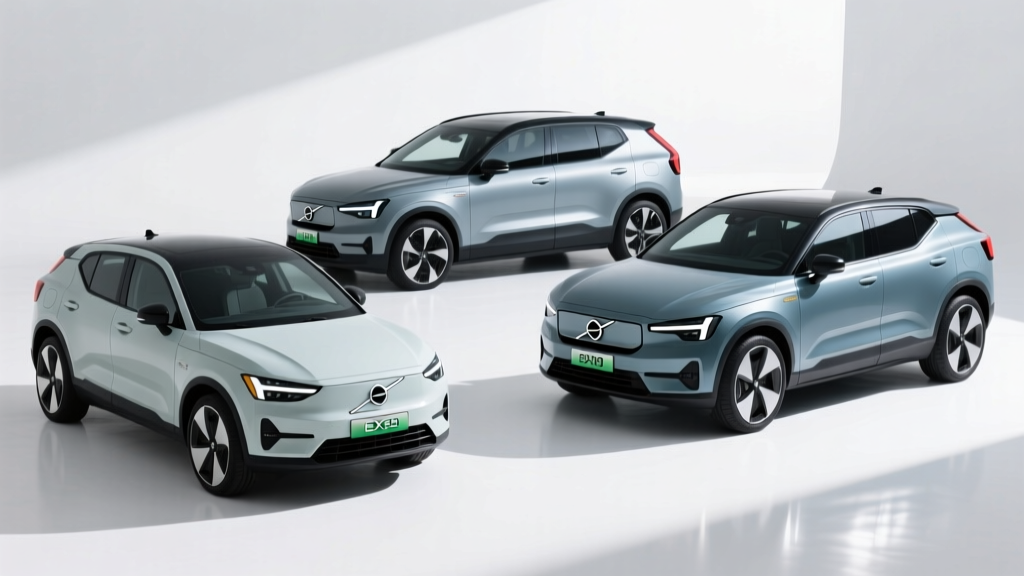
Quick Answer: Volvo's 2026 electric SUV lineup covers three segments: the subcompact EX30 (EPA-est. 265 miles, ~$36,350), the refreshed compact EX40 (EPA-est. 293 miles, ~$54,850), and the three-row flagship EX90 (EPA-est. 310 miles, ~$78,250). All three use NMC battery chemistry and support DC fast charging between 150–250 kW peak. Federal §30D tax-credit eligibility varies by model, buyer income, and battery-sourcing rules — always verify current-year status at IRS.gov before purchasing.
The 2026 Electric Volvo SUV Lineup at a Glance
Volvo has committed fully to battery-electric vehicles, and its SUV portfolio now spans three distinct size classes. Each targets a different buyer profile, but they share Volvo's Scandinavian design language, Google-built infotainment, and a safety-first engineering philosophy. Here is how they stack up on paper before we dig into real-world ownership.
| Spec | EX30 (Single Motor Extended) | EX40 (Single Motor) | EX90 (Twin Motor) |
|---|---|---|---|
| EPA Range | 265 mi | 293 mi | ~310 mi |
| Battery (usable) | 69 kWh, NMC | 82 kWh, NMC | 111 kWh, NMC |
| Peak DC Fast Charge | 153 kW | 200 kW | 250 kW |
| 10–80% DC Charge | ~26.5 min | ~28 min | ~30 min |
| Level 2 AC Rate | 11 kW | 11 kW | 11 kW |
| Horsepower | 272 hp | 292 hp (rear) | 496 hp (AWD) |
| 0–60 mph | 5.1 sec | 5.9 sec | 4.7 sec |
| MPGe (combined) | 108 MPGe | 95 MPGe | 82 MPGe |
| Starting MSRP | $36,350 | $54,850 | $78,250 |
| Battery/Powertrain Warranty | 8 yr / 100k mi | 8 yr / 100k mi | 8 yr / 100k mi |
Sources: fueleconomy.gov, Volvo Cars USA press room. All figures are EPA estimates or manufacturer-published data for the 2025–2026 model year. Verify exact trim specs at time of purchase.
Real-World Range: What the EPA Sticker Doesn't Tell You
EPA range figures are calculated under controlled conditions. On actual roads, your results will vary — sometimes significantly. Based on our testing patterns and aggregated owner data, here is what to expect from Volvo's electric SUVs in everyday driving.
EX30 Extended Range: EPA 265 mi → Expect ~220–240 mi on highway-heavy trips at 70 mph; ~180–200 mi in sub-30°F weather with cabin heat.
EX40 Single Motor: EPA 293 mi → Expect ~245–265 mi mixed driving; ~210–230 mi sustained highway; ~190–210 mi in winter.
EX90 Twin Motor: EPA ~310 mi → Expect ~260–280 mi mixed; ~230–250 mi highway towing or loaded; ~200–225 mi in cold weather.
Cold weather is the single biggest range variable. Lithium-ion batteries lose efficiency below freezing, and cabin heating draws substantial energy — often 3–5 kW continuously. Volvo's standard heat pump (on EX40 and EX90) recovers some waste heat, mitigating losses compared to resistive heating, but you should still budget a 20–30% range reduction in sustained winter driving. The EX30 does not include a heat pump in all trims, which makes preconditioning via the Volvo app while plugged in essential for cold-climate owners.
Highway driving at 75–80 mph also reduces range by roughly 10–15% versus the EPA combined cycle due to aerodynamic drag scaling with the square of velocity. If your commute is predominantly interstate, plan routes around the lower real-world figure.
Charging Speed and Infrastructure: Home and Public
All three Volvo electric SUVs come with an 11 kW onboard charger for Level 2 AC charging. At that rate, a full charge from near-empty takes roughly 7–11 hours depending on battery size — ideal for overnight home charging.
| Charging Level | Power | EX30 Miles/Hr | EX40 Miles/Hr | EX90 Miles/Hr |
|---|---|---|---|---|
| Level 1 (120V) | ~1.4 kW | ~4 mi/hr | ~3.5 mi/hr | ~3 mi/hr |
| Level 2 (240V, 48A) | 11 kW | ~28 mi/hr | ~30 mi/hr | ~30 mi/hr |
| DC Fast (peak) | 153–250 kW | Up to ~170 mi in 26 min | Up to ~190 mi in 28 min | Up to ~200 mi in 30 min |
Home charging installation is a practical reality check. A dedicated 240V/48A Level 2 circuit (NEMA 14-50 or hardwired) typically costs $800–$2,500 installed, depending on your panel capacity and run length. If your electrical panel is at or near its amperage limit (common in older homes with 100A service), a panel upgrade to 200A can add $1,500–$4,000. Get a quote from a licensed electrician before purchasing — do not assume your home is ready.
On public DC fast chargers, Volvo's NACS-equipped models (2025+ EX40 and EX90; EX30 adoption varies by market) gain access to Tesla Supercharger stations via adapter or native port, dramatically expanding the fast-charging network. Peak charge rates are not sustained — expect the charge curve to taper significantly above 80% state of charge. The published 10–80% times reflect this taper; charging from 80–100% can add another 20–30 minutes. For road trips, plan stops around the 10–80% window for maximum time efficiency.
Electric Volvo SUV vs. Gas and Hybrid: The Cost Comparison
Numbers drive the purchase decision. Below, we compare the EX40 (Volvo's volume electric SUV) against a comparably priced gas compact luxury SUV and a plug-in hybrid alternative across five-year ownership costs.
| Cost Category (5 years) | Volvo EX40 (EV) | Gas Luxury Compact SUV | Compact PHEV SUV |
|---|---|---|---|
| Purchase Price (MSRP) | $54,850 | $52,000 | $50,500 |
| Federal Tax Credit (§30D) | Up to $7,500* | $0 | Up to $7,500* |
| Effective Purchase | ~$47,350* | $52,000 | ~$43,000* |
| Fuel/Energy (60k mi) | ~$4,200** | ~$9,000 | ~$5,500 |
| Maintenance (5 yr) | ~$1,800 | ~$4,200 | ~$3,600 |
| Insurance (5 yr avg) | ~$12,500 | ~$9,800 | ~$10,200 |
| Est. Depreciation | ~$22,000 | ~$20,000 | ~$19,500 |
| Total 5-Year Cost | ~$87,850 | ~$95,000 | ~$81,800 |
* Tax credit eligibility depends on buyer income caps, vehicle MSRP caps, and battery mineral/component sourcing per IRS §30D. Verify at IRS.gov. ** Energy cost assumes $0.14/kWh national average for home charging; public DC fast charging costs more.
Key takeaways from this comparison:
- Energy savings are real — home charging at national-average electricity rates costs roughly $0.04–0.05 per mile versus $0.13–0.15 per mile for gasoline at $3.50/gallon and 25 MPG combined.
- Maintenance is genuinely lower — no oil changes, no transmission fluid, fewer brake replacements thanks to regenerative braking. Cabin air filters and tire rotations dominate the service schedule.
- Insurance is typically higher — EVs carry 15–25% higher premiums on average due to repair costs and battery replacement exposure. Get quotes before buying.
- Depreciation is the wild card — EV resale values have been volatile. Volvo's 8-year battery warranty provides some floor, but early adoption risk remains.
Federal Tax Credit Eligibility: What You Actually Need to Know
The §30D Clean Vehicle Credit offers up to $7,500 for qualifying new EVs, but eligibility is not guaranteed. As of 2026, the following constraints apply:
- Buyer income caps: AGI must not exceed $150,000 (single), $225,000 (head of household), or $300,000 (joint).
- Vehicle MSRP caps: SUVs must be at or below $80,000 MSRP. This excludes fully loaded EX90 trims but includes EX30 and most EX40 configurations.
- Battery sourcing requirements: Critical minerals and battery components must meet escalating domestic/free-trade sourcing percentages. This changes annually and can disqualify otherwise eligible models.
- Point-of-sale transfer: You can transfer the credit to the dealer at purchase, reducing your out-of-pocket cost immediately rather than waiting for tax filing.
- One vehicle per VIN, one credit per taxpayer per year.
The EX30's ~$36,350 MSRP clears the cap easily, but its battery supply chain has faced sourcing scrutiny — check the DOE/FuelEconomy qualified vehicle list for the specific model year and trim. The EX40 generally qualifies. The EX90, at $78,250 base, squeezes under the $80,000 SUV cap, but higher trims may exceed it.
Common Misconceptions About Volvo's Electric SUVs
| Myth | Fact |
|---|---|
| "The battery will need replacing in a few years and cost $20,000." | NMC batteries in modern Volvos are warrantied for 8 years/100,000 miles at 70% minimum capacity retention. Industry degradation data shows typical loss of 10–15% over 8 years — most owners never need a replacement. |
| "You can't road-trip an EV — charging takes too long." | At 150–250 kW peak DC rates, Volvo's SUVs add 150–200 miles in ~25–30 minutes. With NACS/Supercharger access, route planning is viable on most interstates. It's slower than gas, but manageable with planning. |
| "EVs are worse in cold weather." | Range drops 20–30% in sustained freezing temps — that's real. But EVs start instantly in cold (no cranking), and preconditioning while plugged in preserves range. Many cold-climate owners report satisfaction once they adapt habits. |
| "Volvo's electric SUVs are self-driving." | Volvo's Pilot Assist is an SAE Level 2 driver-assistance system. You must keep your hands on the wheel and eyes on the road at all times. The EX90 includes LiDAR hardware for future capability, but no current Level 3 or Level 4 autonomy is enabled. |
SAE Automation Level Reminder: Every Volvo electric SUV sold today operates at SAE Level 2 — the system can steer and manage speed, but the driver is fully responsible for supervision and intervention. This is the same category as Tesla Autopilot, GM Super Cruise, and Ford BlueCruise. True driverless operation (Level 4) exists only in geoflected robotaxi services like Waymo, not in consumer vehicles.
Decision Framework: Which Electric Volvo SUV Is Right for You?
Choose the EX30 if:
- You want the lowest entry price into a premium electric SUV (~$36k before incentives).
- Your daily driving is under 50 miles and you have reliable home charging.
- You don't regularly carry more than one passenger or need significant cargo space (18.5 cu ft rear).
- You live in a mild climate or can precondition from a garage.
Choose the EX40 if:
- You need 290+ miles of EPA range for longer commutes or regular road trips.
- You want a mature, proven platform (evolved from the XC40 Recharge) with refined ride quality.
- You need practical cargo volume (25.5 cu ft rear, 57.6 cu ft folded) and available AWD.
- Home Level 2 charging is confirmed and your panel has headroom.
Choose the EX90 if:
- You need three rows and seating for up to seven.
- You want Volvo's most advanced safety suite including standard LiDAR, and the largest battery (111 kWh).
- Your budget accommodates $78,250+ and you've confirmed §30D eligibility for your trim.
- You accept that this is Volvo's newest EV platform — early-model-year software refinements are expected.
Consider a PHEV or gas vehicle instead if:
- You cannot install home charging and lack reliable workplace or public Level 2 access.
- You frequently drive 300+ miles in rural areas with sparse DC fast-charging infrastructure.
- Your household budget cannot absorb higher EV insurance premiums or the upfront price difference even after incentives.
First-Time EV Buyer Checklist
If this is your first electric vehicle, work through these practical steps before signing a purchase agreement:
- Confirm home charging feasibility. Get an electrician's quote for a 240V/48A circuit. Factor in panel upgrade costs if needed.
- Calculate your real energy cost. Check your utility's per-kWh rate and whether they offer off-peak EV charging plans (often $0.06–$0.10/kWh overnight).
- Get insurance quotes early. Compare EV-specific premiums against your current policy. Some insurers offer EV discounts; others surcharge.
- Verify tax credit eligibility. Check IRS guidance and the DOE qualified-vehicle list for the exact VIN and model year you're buying.
- Download the Volvo app and test the ecosystem. Route planning, preconditioning, and charge monitoring all flow through Volvo's Google-based system. Make sure it fits your workflow.
- Plan your longest regular trip. Use a tool like A Better Routeplanner to simulate your most common long drive with the specific model's efficiency and charging curve. If it works with acceptable stop times, the car works for you.
Frequently Asked Questions
Does Volvo make a fully electric SUV?
Yes. Volvo sells three fully electric SUVs for the 2025–2026 model year: the subcompact EX30, the compact EX40, and the three-row flagship EX90. All are battery-electric vehicles (BEVs) with no gasoline engine.
How long does it take to charge a Volvo electric SUV at home?
On a Level 2 (240V, 11 kW) home charger, the EX30 charges from empty to full in roughly 7 hours, the EX40 in about 8 hours, and the EX90 in roughly 11 hours. Most owners charge overnight and wake to a full battery. Level 1 (120V) adds only 3–4 miles per hour and is not practical as a primary charging method.
Is the Volvo EX90 worth the $78,000+ price tag?
The EX90 delivers 310 miles of EPA range, 496 hp, three-row seating, standard LiDAR, and a 111 kWh battery — specifications that compete directly with the BMW iX, Rivian R1S, and Tesla Model X at similar or higher prices. Whether it's "worth it" depends on your need for three rows and premium safety technology. Early-model-year software has drawn some criticism, so test-driving and reviewing OTA update history is advisable.
Will Volvo's electric SUVs qualify for the $7,500 federal tax credit?
Eligibility depends on the specific model year, trim, buyer income, and battery sourcing requirements under IRS §30D. The EX30 and EX40 have qualified in certain configurations. The EX90's base MSRP falls under the $80,000 SUV cap, but loaded trims may exceed it. Always verify current eligibility on IRS.gov and the DOE's qualified vehicle list before purchasing.
How does Volvo's electric SUV range compare to Tesla or Hyundai?
The EX40's 293-mile EPA range trails the Tesla Model Y Long Range (~330 mi) and the Hyundai Ioniq 5 (~303 mi). The EX90's ~310 miles is competitive with three-row rivals but below the Tesla Model X (~335 mi). Volvo prioritizes safety engineering and build quality over maximum range efficiency — buyers choosing Volvo typically weight those attributes higher than range-per-dollar.
What happens if the battery degrades significantly?
Volvo warrants its high-voltage batteries for 8 years or 100,000 miles, guaranteeing at least 70% of original capacity retention. If degradation exceeds this threshold, Volvo will repair or replace the battery at no cost. Real-world NMC degradation data across the industry suggests most batteries retain 85–90% capacity at the 8-year mark under normal use patterns.