Quick Answer: Should You Buy an Electric Volvo?
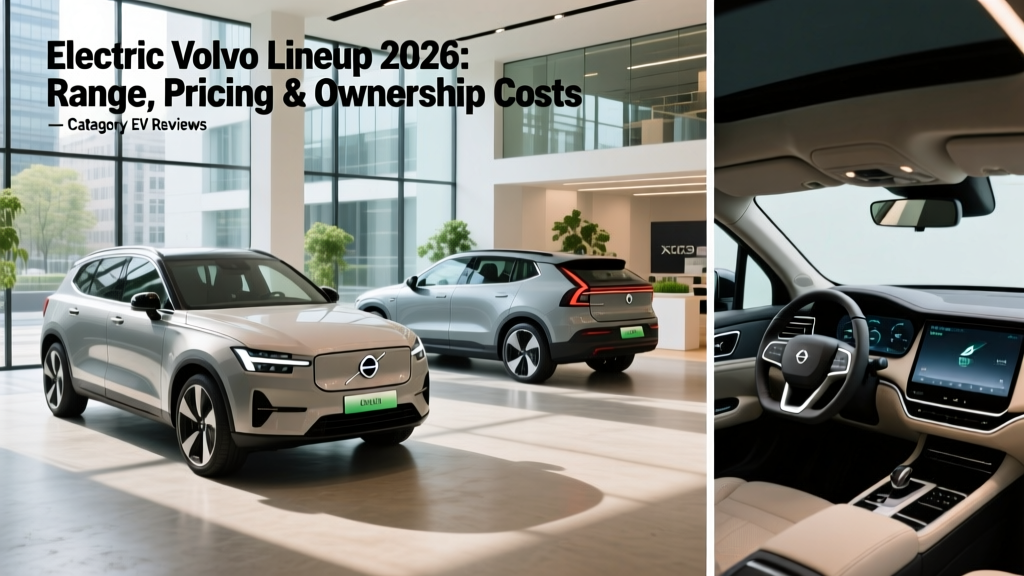
If you want a premium electric SUV with Scandinavian design, strong safety credentials, and EPA range between 250 and 330 miles, Volvo's 2026 lineup — the compact EX30, midsize EX40 (formerly XC40 Recharge), and three-row EX90 — covers most luxury-EV buyer needs. Base pricing starts near $36,000 for the EX30 and climbs to $78,000+ for the EX90. Expect real-world highway range to fall 10–15% below EPA estimates, and plan for home Level 2 charging to unlock the lowest per-mile costs. Federal §30D tax credit eligibility varies by model, battery sourcing, and your income — verify current-year rules at IRS.gov before committing.
Volvo's 2026 Electric Lineup at a Glance
Volvo has committed fully to battery-electric vehicles, phasing out plug-in hybrids in many markets. The 2026 lineup includes three core BEVs, each targeting a different buyer segment:
| Model | Body Style | EPA Range | Battery (usable kWh) | Peak DC Charge | 10–80% Time | 0–60 mph | Starting MSRP |
|---|---|---|---|---|---|---|---|
| EX30 | Subcompact SUV | ~265 mi (Extended Range) | 69 kWh (NMC) | 153 kW | ~26 min | 5.1s (Single Motor) | $36,345 |
| EX40 (Single Motor) | Compact SUV | ~293 mi | 82 kWh (NMC) | 200 kW | ~28 min | 6.2s | $53,550 |
| EX40 (Twin Motor AWD) | Compact SUV | ~276 mi | 82 kWh (NMC) | 200 kW | ~28 min | 4.5s | $57,900 |
| EX90 (Twin Motor) | 3-Row Luxury SUV | ~310 mi | 111 kWh (NMC) | 250 kW | ~20 min | 4.7s (Performance) | $78,145 |
Real-world range note: These EPA figures assume moderate temperatures and mixed driving. In sustained highway driving at 70+ mph, expect 10–12% reduction. In freezing temperatures (below 32°F), range can drop 20–30% due to cabin heating and battery thermal management demands. A 265-mile EX30 might deliver ~190 miles in a cold Midwestern winter — plan accordingly if you lack a heated garage.
Electric Volvo vs. Gas and Hybrid Alternatives: The Numbers
The most common question from buyers cross-shopping an electric Volvo is whether the upfront premium pays off. Here's a five-year cost comparison using the EX40 Twin Motor AWD against the gasoline Volvo XC60 (mild-hybrid B5 AWD) and the plug-in hybrid XC60 Recharge:
| Cost Factor (5 Years) | EX40 Twin Motor (BEV) | XC60 B5 AWD (Gas MHEV) | XC60 Recharge (PHEV) |
|---|---|---|---|
| Starting MSRP | $57,900 | $49,250 | $58,950 |
| Est. Federal Tax Credit (§30D) | $0–$7,500* | $0 | $0–$7,500* |
| Fuel/Energy Cost (75,000 mi) | ~$4,800 (home L2 @ $0.14/kWh) | ~$10,500 (26 MPG @ $3.65/gal) | ~$6,300 (mixed EV + gas) |
| Maintenance (5 yr) | ~$1,500 | ~$3,800 | ~$3,200 |
| Insurance (avg. annual) | ~$2,400/yr | ~$1,950/yr | ~$2,100/yr |
| Est. 5-Year Total Cost | ~$72,200–$64,700 | ~$77,300 | ~$78,550–$71,050 |
* §30D credit eligibility depends on battery critical-mineral sourcing, buyer income caps ($150K single / $300K joint), and MSRP caps ($80K for SUVs). Rules evolve annually — confirm at IRS.gov and with your tax professional. Point-of-sale transfer is available through participating dealers.
Key insight: The BEV's cost advantage grows significantly with home charging at residential electricity rates. If you rely exclusively on public DC fast charging (average $0.35–$0.48/kWh), your five-year energy cost climbs to ~$9,000–$12,000, erasing much of the fuel savings. Home Level 2 access is the single biggest economic variable in EV ownership.
Charging Realities: What You'll Actually Experience
Volvo's current EVs use the CCS1 connector for DC fast charging, though the brand has confirmed adoption of the NACS (Tesla-style) connector for future models. Here's what charging looks like across the three levels:
| Level | Power (kW) | Miles Added per Hour | Typical Use Case | Equipment Needed |
|---|---|---|---|---|
| Level 1 (120V) | ~1.4 kW | ~4–5 mi/hr | Overnight top-up, low-mileage drivers | Included mobile cord |
| Level 2 (240V) | 7.2–11.5 kW | ~25–40 mi/hr | Primary home/workplace charging | Wallbox or outlet; 40–60A circuit |
| DC Fast Charge | 150–250 kW | ~150–250 mi in 20 min | Road trips, quick top-ups | Public stations (Electrify America, EVgo, etc.) |
Charging curve reality: The EX90's 250 kW peak rate only holds from roughly 10–35% State of Charge. Above 50%, the rate tapers to ~120 kW, and above 80% it drops further to ~50 kW. A 10–80% session takes ~20 minutes, but 10–100% takes closer to 45 minutes. This is normal lithium-ion physics — the battery management system slows charging to protect cell health — but it means you should plan road-trip stops around 10–80% cycles, not full charges.
Home installation cost: A typical Level 2 home charger installation (48A hardwired unit, 60A breaker) runs $1,200–$2,500 total, including the $500–$700 charger unit and electrician labor. If your electrical panel needs an upgrade from 100A to 200A service, add $2,000–$4,000. Always get a quote from a licensed electrician before purchase.
Common Misconceptions About Electric Volvos
| Myth | Fact |
|---|---|
| "Volvo batteries degrade quickly and cost $20,000 to replace" | Volvo warranties its EV batteries for 8 years / 100,000 miles, guaranteeing at least 70% capacity retention. Real-world data from similar NMC packs shows ~10–12% degradation over 150,000 miles. Full replacement is rare and typically covered under warranty. |
| "You can't road-trip an electric Volvo" | The EX90's 310-mile EPA range and 250 kW DC charging make 300-mile highway legs practical with a 20-minute stop. The CCS network (Electrify America, EVgo) covers most US interstate corridors, though rural gaps remain in the Mountain West and parts of the South. |
| "All electric Volvos qualify for the $7,500 tax credit" | Credit eligibility depends on battery sourcing (critical minerals and component assembly), buyer income, and MSRP caps. Not all trims qualify every year. The point-of-sale transfer option lets you apply the credit at purchase through a participating dealer, reducing your out-of-pocket cost immediately. |
| "EVs need no maintenance at all" | While EVs skip oil changes, spark plugs, and transmission fluid, they still need tire rotations (EVs wear tires faster due to weight and instant torque), brake fluid checks, cabin air filters, and coolant system service. Budget ~$300/year for basic maintenance. |
Ownership Practicalities: What First-Time EV Buyers Should Know
Beyond the spec sheet, daily EV ownership involves adjustments that catch some first-time buyers off guard:
Home Charging Access Is Non-Negotiable for Most Owners
If you live in an apartment, condo, or street-parking situation without dedicated charging access, owning an electric Volvo becomes significantly less convenient and more expensive. Public DC fast charging costs 2–3× more per kWh than home electricity, and relying on it exclusively means 2–3 weekly stops of 20–40 minutes each. Before buying, confirm you can install a Level 2 charger at home or have reliable workplace charging.
Cold-Weather Range Loss Is Real
Volvo EVs include a heat pump (standard on the EX90, available on EX40) that mitigates winter range loss compared to resistive heating. Still, expect 20–30% range reduction at temperatures below 20°F. The EX40's 293-mile EPA range might deliver ~210 miles in a Minnesota January. Preconditioning the battery while plugged in — a feature accessible through the Volvo Cars app — warms the pack before departure, preserving range and enabling faster DC charging.
Insurance Premiums Run Higher
EV insurance typically costs 15–25% more than equivalent gas vehicles due to higher repair costs (specialized body shop training, battery protection requirements, and parts pricing). Budget an extra $400–$600/year. Shop quotes from multiple insurers — some now offer EV-specific policies with battery coverage endorsements.
Tire Costs Are Higher
EVs are heavier (the EX40 Twin Motor weighs ~4,800 lbs) and deliver instant torque, both of which accelerate tire wear. Expect to replace tires every 30,000–40,000 miles instead of 50,000+. Budget $800–$1,400 per set for EV-rated touring tires (look for low rolling resistance and foam-lined options for reduced road noise).
Decision Framework: Which Electric Volvo Is Right for You?
Choose the EX30 if: You want the most affordable entry into the Volvo EV lineup, primarily drive in urban/suburban settings, need under 250 miles of daily range, and value compact dimensions for tight parking. Best for singles, couples, or as a second car. Note: the EX30 is built in China, which may affect §30D tax credit eligibility due to battery-sourcing rules.
Choose the EX40 if: You want a practical compact luxury SUV with room for a small family, need 270+ miles of range for weekend trips, and want proven Volvo packaging in an electric format. The Single Motor Extended Range offers the best range-to-price ratio; the Twin Motor adds AWD for snowy climates and a 4.5-second 0–60 time.
Choose the EX90 if: You need three rows of seating, want flagship-level technology (including lidar-equipped Pilot Assist, SAE Level 2 driver assistance), and have the budget for a $78K+ luxury SUV. Its 111 kWh battery and 250 kW charging make it the most road-trip-capable Volvo EV. Note: the EX90 is a large, heavy vehicle — real-world efficiency is lower, at ~2.0–2.2 kWh/mile.
Wait or consider a PHEV if: You lack reliable home charging, regularly drive 400+ mile routes through areas with sparse DC fast-charging infrastructure, or live in extreme cold where range loss compounds. A plug-in hybrid like the Volvo XC60 Recharge (35 miles electric-only range, then gas) may serve you better until charging access improves.
Battery Longevity and Warranty
All 2026 electric Volvo models carry an 8-year / 100,000-mile battery warranty that guarantees a minimum of 70% State of Health (capacity retention). Volvo uses NMC (nickel manganese cobalt) chemistry across its lineup, which offers high energy density but is more sensitive to sustained high State of Charge than LFP (lithium iron phosphate). For maximum longevity:
- Set your daily charge limit to 80% for routine driving; charge to 100% only before long trips
- Avoid leaving the car at 100% SoC for extended periods (days)
- Use preconditioning in cold weather to warm the battery before driving and charging
- Minimize repeated DC fast charging from very low SoC (below 5%) — the high-current ramp stresses cells
Independent data from fueleconomy.gov and fleet studies suggest modern NMC packs retain 85–90% capacity at 100,000 miles with reasonable care. Full battery replacement outside warranty would cost approximately $15,000–$22,000 depending on the model, but this scenario remains uncommon for vehicles maintained within normal operating parameters.
Frequently Asked Questions
Do electric Volvos qualify for the federal tax credit in 2026?
Eligibility depends on three factors: (1) the vehicle's battery must meet critical-mineral and component-sourcing thresholds set by the IRS under §30D, (2) your modified adjusted gross income must fall below $150,000 (single) or $300,000 (joint), and (3) the vehicle MSRP must not exceed $80,000 for SUVs. Because sourcing requirements tighten over time, a model that qualifies one year may not the next. Check the current eligible-vehicle list at fueleconomy.gov and confirm with your tax advisor.
How does Volvo's Pilot Assist compare to Tesla Autopilot or GM Super Cruise?
Volvo's Pilot Assist is an SAE Level 2 driver-assistance system offering adaptive cruise control and lane centering. The EX90 adds a lidar sensor for enhanced object detection, but it still requires active driver supervision — hands on or near the wheel, eyes on the road. It is not "self-driving." GM's Super Cruise allows hands-free operation on pre-mapped divided highways (still requiring eye attention), while Tesla's Autopilot and FSD (Supervised) require hands-on-wheel engagement. None of these are Level 4 autonomous systems.
What happens if I need to charge on a road trip?
Volvo's EVs use the CCS1 connector, compatible with Electrify America, EVgo, and most non-Tesla DC fast-charging networks. The built-in navigation system (Google Maps-based) plans routes with charging stops and can precondition the battery before arrival at a charger for faster charging. Expect to add 150–200 miles of range in a 20-minute stop at a 150+ kW station. Tesla Supercharger access for CCS-equipped Volvos requires a NACS adapter (check Volvo's official accessory availability).
Is the EX30 too small for a family?
The EX30 offers ~11.2 cu ft of cargo space behind the rear seats and ~35 cu ft with seats folded — comparable to a subcompact hatchback. It fits two adults in the rear comfortably for short trips, but the rear seat is tight for taller passengers on long drives. For families with children in car seats or anyone regularly carrying more than two passengers, the EX40 (25.8 cu ft cargo) is a more practical choice.
What is the real cost to charge an electric Volvo at home?
At the US average residential electricity rate of ~$0.16/kWh (2025 EIA data), fully charging the EX40's 82 kWh battery from empty costs roughly $13.12 and delivers ~276 miles (Twin Motor). That's approximately $0.047 per mile — compared to $0.14 per mile in a gas XC60 getting 26 MPG at $3.65/gallon. Over 15,000 miles per year, home charging saves roughly $1,400 in fuel costs annually.