Quick Answer: Which Electric Volkswagen Should You Buy?
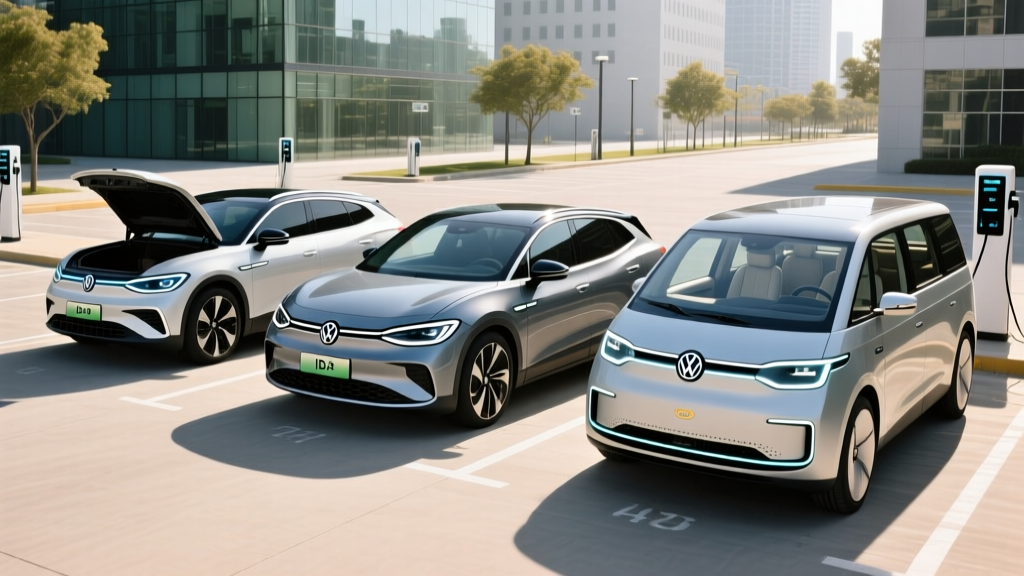
Volkswagen's 2026 U.S. EV lineup includes three models built on the MEB platform: the ID.4 compact SUV (starting ~$40,790, EPA 291 mi), the ID.7 sedan (starting ~$51,990, EPA 340+ mi), and the ID. Buzz three-row minivan (starting ~$61,490, EPA 234 mi). All use NMC battery chemistry and the North American Charging Standard (NACS) port, granting native Tesla Supercharger access. The ID.4 remains the volume seller and best value; the ID.7 targets road-trippers needing maximum range; the ID. Buzz fills a niche no other EV minivan occupies. Federal §30D tax-credit eligibility depends on current-year battery sourcing, your AGI, and the vehicle's MSRP — verify at IRS.gov before purchasing.
The 2026 Volkswagen EV Lineup at a Glance
Volkswagen has committed heavily to electrification, and its 2026 U.S. showroom reflects three distinct MEB-based vehicles targeting different buyer profiles. Each model shares Volkswagen's APP550 rear-axle permanent-magnet motor architecture, a 400-volt electrical system, and liquid-cooled thermal management with a heat pump (standard on U.S. trims since 2025). Here is the specification breakdown:
| Specification | ID.4 (Pro S AWD) | ID.7 (Pro S) | ID. Buzz (AWD) |
|---|---|---|---|
| Base MSRP | $45,290 | $51,990 | $66,490 |
| EPA Range | 263 mi (AWD) / 291 mi (RWD) | ~340 mi (est.) | 234 mi (AWD) |
| Battery (usable) | 82 kWh, NMC | 86 kWh, NMC | 91 kWh, NMC |
| Peak DC Charge Rate | 175 kW | 200 kW | 175 kW |
| 10–80% DC Charge | ~28 min | ~26 min | ~30 min |
| Level 2 Charge Rate | 11 kW (AC) | 11 kW (AC) | 11 kW (AC) |
| 0–60 mph | 5.4 sec (AWD) | ~6.5 sec (RWD) | ~6.9 sec (AWD) |
| Horsepower | 295 hp (AWD) | 282 hp (RWD) | 282 hp (AWD) |
| MPGe (combined) | 104 MPGe | ~115 MPGe (est.) | ~84 MPGe |
| Cargo Volume | 30.3 cu ft (rear up) | ~19.0 cu ft (trunk) | 75.5 cu ft (behind 1st row) |
| Battery Warranty | 8 yr / 100,000 mi | 8 yr / 100,000 mi | 8 yr / 100,000 mi |
Real-world range note: EPA figures assume a blended drive cycle. On sustained highway driving at 70+ mph, expect roughly 10–15% range reduction across all three models. In sub-freezing temperatures (below 30°F), range can drop 20–30% even with the heat pump engaged, due to cabin heating demand and reduced battery chemical efficiency. A 291-mile EPA ID.4 RWD may deliver ~220–240 miles in cold highway conditions.
Charging: Home, Public, and the NACS Advantage
All 2026 electric Volkswagens sold in the U.S. come equipped with the NACS (North American Charging Standard) connector — the same plug used by Tesla. This is a significant practical advantage over vehicles still using CCS1, as the Tesla Supercharger network now includes over 20,000 stalls nationwide, many of which are open to NACS-equipped non-Tesla vehicles.
Home Charging Setup
Each VW EV accepts up to 11 kW on Level 2 AC charging. That translates to roughly 33–37 miles of range added per hour of charging, depending on the model's efficiency. A full 0–100% charge on an 11 kW Level 2 home charger takes approximately 8–9 hours — easily accomplished overnight.
| Item | Typical Cost Range |
|---|---|
| Level 2 EVSE (48A hardwired, e.g., ChargePoint Home Flex, Emporia Level 2) | $500–$750 |
| Electrician labor (240V/50A circuit run, ~40 ft) | $800–$2,000 |
| Permit and inspection | $100–$300 |
| Electrical panel upgrade (if needed, 100A → 200A) | $1,500–$3,500 |
| Total (no panel upgrade) | $1,400–$3,050 |
Have a licensed electrician evaluate your panel capacity before purchasing equipment. Many homes built after 2000 have 200A panels with sufficient headroom; older homes may require an upgrade.
DC Fast Charging in Practice
Volkswagen's 175–200 kW peak DC charge rates are respectable but not class-leading. The critical detail is the charge curve: peak kW is sustained only between roughly 10–40% state of charge (SoC). Above 60%, the rate tapers significantly — dropping to ~80 kW by 70% and ~40 kW above 85%. This is normal for NMC chemistry at 400V architecture and protects long-term battery health, but it means a 10–90% session takes considerably longer than a 10–80% session. For road trips, plan to charge to 80% and go.
At a Tesla Supercharger V3 (250 kW capable) or Electrify America 350 kW stall, the ID.4 will peak around its 175 kW ceiling — the bottleneck is the car's onboard charger, not the station. Preconditioning the battery (triggered automatically when you navigate to a charger via the VW infotainment system) warms the pack for optimal charge acceptance, shaving 3–5 minutes off a cold-weather session.
Cost of Ownership: Electric Volkswagens vs. Gas Equivalents
The sticker price of an EV is only part of the equation. Here is a 5-year total cost of ownership (TCO) comparison between the ID.4 Pro S RWD (~$40,790 MSRP) and a comparably equipped gasoline compact SUV (e.g., Volkswagen Tiguan SEL ~$37,500 MSRP), assuming 12,000 miles/year, $0.14/kWh home electricity, $3.50/gallon gasoline, and 80% home / 20% public DC charging.
| Cost Category (5 Years) | ID.4 Pro S RWD | Gas Compact SUV (Tiguan) |
|---|---|---|
| Purchase Price (MSRP) | $40,790 | $37,500 |
| Federal Tax Credit (§30D, if eligible) | –$3,750 to –$7,500* | $0 |
| Fuel / Electricity (60,000 mi) | $3,600 | $7,875 (25 MPG avg) |
| Maintenance | $1,200 | $3,500 |
| Insurance (avg) | $9,500 | $7,800 |
| Estimated Depreciation | $18,000 | $15,000 |
| Net 5-Year Cost | ~$39,590–$43,340 | ~$71,675 |
* §30D credit amount depends on battery-component and critical-mineral sourcing compliance, your adjusted gross income, and MSRP caps. The ID.4 is assembled in Chattanooga, TN, which improves domestic-content eligibility. Verify current-year rules at IRS.gov and confirm with a tax professional.
The ID.4's lower fuel and maintenance costs (no oil changes, fewer brake replacements due to regenerative braking) offset its higher purchase price within 3–4 years for most drivers. Insurance premiums remain higher for EVs industry-wide — typically 15–25% above gas equivalents — due to higher repair costs and battery replacement risk.
Federal Tax Credit Eligibility for Electric Volkswagens
The §30D New Clean Vehicle Credit provides up to $7,500 for qualifying new EV purchases, but eligibility is complex and model-specific. Here is the 2026 checklist:
- MSRP Cap: SUVs, vans, and pickups must be under $80,000; sedans under $55,000. The ID.4 and ID. Buzz qualify under the SUV/van cap; the ID.7 sedan must stay under $55,000 MSRP (base trims qualify, loaded trims may not).
- Buyer Income Limits: AGI must not exceed $300,000 (married filing jointly), $225,000 (head of household), or $150,000 (single).
- Battery Sourcing: Up to $3,750 depends on critical-mineral sourcing from U.S. or FTA-partner countries; up to $3,750 depends on battery-component manufacturing/assembly in North America. The ID.4's Chattanooga assembly improves component compliance, but critical-mineral sourcing varies by battery batch and model year.
- Point-of-Sale Transfer: You can transfer the credit to the dealer at purchase, reducing your out-of-pocket cost immediately — even if you have no tax liability (the dealer receives the credit as a payment).
- Used EV Credit (§25E): Up to $4,000 or 30% of the sale price (whichever is less) for qualifying used EVs purchased from a dealer, with lower income caps ($150k joint / $75k single).
Always confirm the specific VIN's eligibility using the IRS's official tool and your dealer's documentation before finalizing a purchase. Rules have shifted annually since 2023.
Real-World Ownership Considerations
Home Charging Access
If you can install a Level 2 charger at home (garage or driveway with 240V access), an electric Volkswagen is a low-friction daily driver — you start each morning with a full "tank." If you rely exclusively on public charging, factor in higher per-kWh costs ($0.30–$0.55/kWh at DC fast chargers vs. $0.14/kWh at home) and the time cost of 25–35 minute charging sessions 2–3 times per week. Use apps like PlugShare or the VW in-dash navigation to map chargers near your routine routes.
Cold-Climate Ownership
Volkswagen's heat pump (standard on all 2026 U.S. EVs) recovers waste heat from the drivetrain to warm the cabin, reducing the range penalty of electric heating. However, in sustained sub-20°F conditions, expect 25–30% range loss. The ID.4 AWD's 263-mile EPA range may realistically deliver ~185–200 miles on a cold winter highway run. Preconditioning while plugged in (scheduled via the VW app) mitigates this by warming the battery and cabin on grid power before departure.
Driving Patterns
For daily commutes under 60 miles round-trip with home charging, any VW EV handles the task effortlessly with range to spare. For frequent 300+ mile road trips, the ID.7's ~340-mile range minimizes charging stops to one per trip. The ID. Buzz, with its 234-mile range and large frontal area (which increases highway energy consumption), requires more frequent stops — plan for a 25-minute charge every 180–200 highway miles.
Common Misconceptions About Electric Volkswagens
| Myth | Fact |
|---|---|
| "VW EVs can't use Tesla Superchargers." | All 2026 U.S. VW EVs have native NACS ports and can charge at Tesla Superchargers open to non-Tesla vehicles — no adapter needed. |
| "The battery will need replacing in 5 years." | VW's battery warranty guarantees ≥70% capacity retention for 8 years / 100,000 miles. Real-world MEB pack degradation data from European fleets shows ~5–8% loss over 100,000 miles — well within warranty thresholds. |
| "EVs cost more to own than gas cars." | When home charging is available and the §30D credit applies, the ID.4's 5-year TCO undercuts a comparable gas SUV by $28,000–$32,000, driven primarily by fuel and maintenance savings. |
| "Charging takes too long for road trips." | A 10–80% DC fast charge takes ~26–30 minutes — roughly the time for a rest stop, meal, or restroom break. Plan stops around chargers, not around fuel stations. |
| "The ID.4 is slow." | The AWD ID.4 hits 0–60 mph in 5.4 seconds with 295 hp — quicker than most gas-powered compact SUVs in its price range, with instant torque delivery. |
Decision Framework: Which Electric Volkswagen Fits You?
Choose the ID.4 if:
- You want the best value in VW's EV lineup (under $42k after potential tax credit).
- Your daily driving is under 80 miles and you have home Level 2 charging.
- You need a compact SUV with reasonable cargo space (30.3 cu ft) and available AWD.
- You prioritize a mature, well-reviewed platform with Chattanooga-built domestic content.
Choose the ID.7 if:
- Maximum range is your top priority (~340 mi EPA for fewer road-trip stops).
- You prefer a sedan's driving dynamics and lower energy consumption (~115 MPGe).
- You frequently drive 200+ mile highway routes and want a single-charge solution.
- You can accept a higher starting price (~$52k) and potential §30D MSRP-cap risk on loaded trims.
Choose the ID. Buzz if:
- You need three-row seating for 6–7 passengers — no other electric minivan competes here.
- Cargo volume (75.5 cu ft behind the first row) is essential for family hauling.
- You accept the range trade-off (~234 mi) inherent to a large, boxy vehicle.
- You value the distinctive retro-modern design and are willing to pay a premium (~$61k+).
Choose a PHEV or gas vehicle instead if:
- You have no access to home or workplace charging and your area has sparse public DC infrastructure.
- You regularly tow heavy loads (VW EVs are not rated for significant towing — the ID.4 maxes at ~2,200 lbs with the factory hitch).
- Your budget is strictly under $30,000 and you cannot wait for used-EV market depreciation.
Frequently Asked Questions
Do electric Volkswagens qualify for the full $7,500 federal tax credit?
It depends on the specific model year, trim, and current battery-sourcing rules. The ID.4, assembled in Chattanooga, TN, has strong domestic component content, but critical-mineral sourcing compliance varies. The §30D credit is split into two $3,750 halves — one for battery components, one for critical minerals. Some trims may qualify for $3,750 rather than the full $7,500. Always verify the specific VIN at fueleconomy.gov and consult a tax professional before purchase.
How long does it take to charge a VW ID.4 at home?
On an 11 kW (48A) Level 2 home charger, a full 0–100% charge of the ID.4's 82 kWh usable battery takes approximately 7.5–8.5 hours. Most owners charge from 20–80% overnight, which takes about 4.5 hours and provides roughly 230 miles of range — more than enough for daily driving.
What is the real-world highway range of the ID.4?
The ID.4 Pro S RWD carries a 291-mile EPA rating. In real-world highway testing at 70 mph in moderate temperatures (65–75°F), expect approximately 250–265 miles. In cold weather (below 30°F), highway range drops to roughly 220–240 miles. The AWD variant, rated at 263 miles EPA, delivers approximately 225–240 highway miles in moderate conditions.
Can I charge my VW EV at a Tesla Supercharger?
Yes. All 2026 Volkswagen EVs sold in the U.S. feature the NACS connector natively, which is the same connector used by Tesla Superchargers. You can charge at any Supercharger stall designated for non-Tesla vehicles (many V3 and V4 stalls are now open). Payment is handled through the Tesla app or Supercharger plug-and-charge functionality.
How does VW's battery warranty compare to competitors?
Volkswagen covers the high-voltage battery for 8 years or 100,000 miles against defects and excessive capacity loss (below 70% state of health). This matches the industry standard set by Hyundai, Kia, and most mainstream manufacturers. Tesla offers 8 years / 120,000 miles on the Model Y, which is slightly more generous on mileage. Replacement cost for an MEB battery pack, if out of warranty, is estimated at $12,000–$18,000 depending on capacity and labor — though widespread replacements remain rare based on current degradation data.
Is the VW ID.4 a good first EV for someone new to electric vehicles?
The ID.4 is one of the strongest first-EV choices available. It offers familiar SUV ergonomics, straightforward infotainment (improved significantly over 2021–2023 models), predictable range, NACS Supercharger access, and a price point near $40,000 before incentives. The main adjustment for new EV owners is learning to plan road-trip charging stops and understanding that range fluctuates with temperature and driving style — both of which become second nature within a few weeks of ownership.