The Short Answer on Electric Vehicles in Japan
Japan's EV market in 2026 remains dominated by kei cars and compact models, with the Nissan Sakura and Toyota bZ4X among the best sellers. Battery-electric vehicles (BEVs) account for roughly 3-4% of new car sales — far behind hybrids, which exceed 40%. Home charging is feasible for detached-house owners but challenging in urban apartments. Public DC fast charging relies heavily on CHAdeMO connectors, though NACS adoption is accelerating via Tesla Superchargers. Expect to pay ¥4.0–5.5 million ($27,000–$37,000 USD) for a mainstream EV before Japan's purchase subsidies (up to ¥550,000). Real-world range in Japanese summers matches EPA/WLTP estimates, but winter highway driving in Hokkaido or the Japan Alps can cut range by 25–35%.
Japan's EV Market at a Glance: What's Actually Available
Unlike the US market, where large SUVs and trucks dominate EV sales, Japan's best-selling electric vehicles reflect the country's narrow streets, short commutes, and kei-car culture. The top models available in 2026 include:
| Model | Battery (kWh) | WLTP Range | DC Fast Charge (kW) | 10–80% Time | Price (JPY) | Price (USD est.) |
|---|---|---|---|---|---|---|
| Nissan Sakura | 20 (LFP) | 180 km (112 mi) | ~20 kW | ~40 min | ¥2,999,000 | ~$20,000 |
| Toyota bZ4X | 71.4 (NMC) | 500 km (311 mi) | 150 kW | ~30 min | ¥6,050,000 | ~$40,500 |
| Nissan Ariya (e-4ORCE) | 91 (NMC) | 580 km (360 mi) | 130 kW | ~35 min | ¥7,238,000 | ~$48,500 |
| BYD Dolphin | 60.5 (LFP Blade) | 490 km (305 mi) | 88 kW | ~35 min | ¥4,070,000 | ~$27,200 |
| Hyundai Ioniq 5 | 77.4 (NMC) | 507 km (315 mi) | 240 kW (peak) | ~18 min | ¥5,799,000 | ~$38,800 |
| BMW iX1 | 64.7 (NMC) | 440 km (273 mi) | 130 kW | ~29 min | ¥6,880,000 | ~$46,000 |
Key takeaway: The Nissan Sakura — a kei-class EV — is Japan's volume leader because it fits tight parking spaces, qualifies for generous subsidies, and covers the average Japanese daily commute of ~30 km with ease. For longer intercity trips, the Ariya and Ioniq 5 offer genuine road-trip capability.
Charging Infrastructure: CHAdeMO, NACS, and the Reality on the Ground
Japan has approximately 30,000 public charging points as of 2026, with roughly 9,000 being DC fast chargers. The infrastructure landscape has some quirks that catch newcomers off guard:
Connector Types
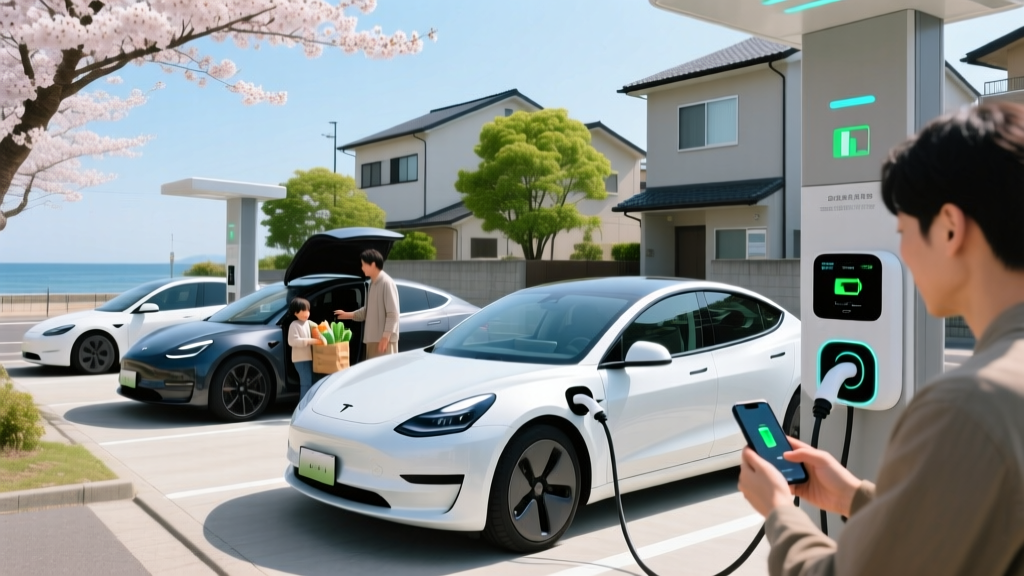
Japan pioneered the CHAdeMO DC fast-charging standard, and it remains the dominant connector at public stations operated by e-Mobility Power (eMP), Nissan dealerships, and highway service areas. However, Tesla Superchargers use NACS, and some newer Hyundai/Kia imports arrive with CCS2 ports. BYD models sold in Japan typically ship with CHAdeMO adapters.
| Connector | Common Networks | Vehicles Using It |
|---|---|---|
| CHAdeMO | eMP, Nissan, highway SA/PA stations | Nissan Sakura, Ariya, Mitsubishi, older Leafs |
| NACS (Tesla) | Tesla Supercharger (some open to non-Tesla) | Tesla Model 3/Y, future Toyota/Nissan models |
| CCS2 | Limited third-party stations | Hyundai Ioniq 5/6, BMW iX1, Mercedes EQ imports |
Charging Speed Reality
Many CHAdeMO chargers at older locations max out at 50 kW — adequate for the Sakura's small battery but painfully slow for a 91 kWh Ariya. Newer highway stations along the Tomei and Tohoku Expressways are being upgraded to 90–150 kW CHAdeMO units. Tesla Superchargers (V3/V4) deliver up to 250 kW but require a Tesla or an approved adapter.
Real-world tip: If you're planning a Tokyo-to-Osaka run (~500 km), the Ioniq 5's 240 kW peak charge rate means a single 18-minute stop at a high-power charger. In the Sakura, you'll need two to three stops at 40 minutes each — feasible but a very different experience.
Cost of Ownership: EV vs. Gas vs. Hybrid in Japan
Japan's fuel prices hover around ¥170–185 per liter (~$4.30–$4.70 USD/gallon) in 2026, making the economics of electrification compelling — especially with off-peak home charging rates of ¥22–30 per kWh.
| Cost Factor | BEV (bZ4X) | Hybrid (Prius) | Gas (Corolla) |
|---|---|---|---|
| Purchase Price (MSRP) | ¥6,050,000 | ¥3,600,000 | ¥2,800,000 |
| Japan EV Subsidy (national + local) | -¥550,000 to -¥850,000 | None | None |
| Effective Purchase Price | ~¥5,200,000 | ¥3,600,000 | ¥2,800,000 |
| Fuel/Energy Cost per 100 km | ¥330–450 (home charge) | ¥900 (35 km/L) | ¥1,200 (15 km/L) |
| Annual Fuel/Energy (10,000 km) | ¥33,000–45,000 | ¥90,000 | ¥120,000 |
| Annual Maintenance | ¥30,000–50,000 | ¥60,000–80,000 | ¥80,000–120,000 |
| Automobile Tax (annual) | ¥0 (EV exemption through 2026) | ¥39,500 | ¥39,500 |
| 5-Year Total Operating Cost | ~¥315,000–475,000 | ~¥748,000–998,000 | ~¥998,000–1,198,000 |
The math: Over five years, a bZ4X owner saves roughly ¥500,000–700,000 in operating costs versus a gas Corolla. The EV's higher purchase price is partially offset by subsidies, tax exemptions, and dramatically lower energy costs. The break-even point versus a Prius hybrid is typically 4–6 years depending on annual mileage and electricity rates.
For reference, see Japan's Ministry of Land, Infrastructure, Transport and Tourism (MLIT) for current subsidy program details and eligibility.
Real-World Range in Japanese Conditions
EPA/WLTP vs. Reality
Toyota bZ4X: WLTP-rated 500 km (311 mi). Expect ~400 km in mixed summer driving, ~320–350 km on winter highway runs in northern Japan (Hokkaido, Tohoku). Cold-weather battery preconditioning helps but is not as aggressive as Hyundai's system.
Hyundai Ioniq 5: WLTP 507 km (315 mi). Expect ~420 km summer, ~340 km winter highway. The Ioniq 5's battery preconditioning for DC charging is among the best in class — it consistently hits its 240 kW peak in cold weather when preconditioned via navigation.
Nissan Sakura: WLTP 180 km (112 mi). Expect ~150 km in summer city driving, ~100–110 km in winter with heater use. Perfectly adequate for daily commutes but requires route planning for any trip over 100 km.
Japan's climate varies enormously — from subtropical Okinawa to subarctic Hokkaido. In Tokyo and Osaka, winter range loss is moderate (10–15%). In Sapporo or Nagano, expect 25–35% loss during January and February due to battery cold-soak and cabin heating demands. Models with heat pumps (Ioniq 5, Ariya) lose noticeably less range than those relying on resistive PTC heaters.
Home Charging: The Apartment Problem
Japan presents a unique home-charging challenge. Approximately 70% of urban residents live in mansions (condominiums) or rental apartments, where installing a personal Level 2 charger (200V, 3–6 kW in Japan's electrical system) requires building-management approval. Many older buildings lack the electrical capacity or parking-space wiring for EV chargers.
Options by Housing Type
- Detached house (ikkodate): Ideal. A 200V/15A outlet (¥30,000–80,000 installation) delivers ~6 kW — enough to fully charge a bZ4X overnight in ~12 hours. A dedicated wallbox (Panasonic, Mitsubishi) costs ¥80,000–150,000 installed.
- Newer mansion/condo: Some buildings constructed after 2022 include shared EV charging in parking garages (typically 3 kW shared units). Availability is first-come, first-served.
- Older apartment: No home charging. You'll rely on public chargers, workplace charging, or dealer chargers (many Nissan/Toyota dealerships allow free or low-cost charging during business hours).
Actionable rule: If you cannot install home charging and your workplace doesn't offer it, a PHEV (like the Prius PHV) may be a more practical electrified option than a full BEV. You get 25–68 km of electric-only commuting and a gas engine for longer trips — eliminating range and charging-access anxiety.
Decision Framework: Which Electrified Vehicle Fits Your Life in Japan?
Choose Your Path
Choose a kei-class BEV (Sakura) if: You own a detached home with charging, your daily driving is under 80 km, you rarely take intercity trips, and you want the lowest possible running costs with maximum subsidy eligibility.
Choose a full-size BEV (Ioniq 5, Ariya, bZ4X) if: You have home or reliable workplace charging, you take regular highway trips (Tokyo–Nagoya, Osaka–Hiroshima), and you want 300+ km of real-world range with DC fast charging under 30 minutes.
Choose a PHEV (Prius PHV, RAV4 PHV) if: You live in an apartment without charging access, you want electric commuting for short trips but gas flexibility for weekend travel to rural areas, or you're a first-time electrified-vehicle buyer unsure about full BEV commitment.
Choose a hybrid (Prius, Yaris Hybrid) if: You have zero charging access, you drive long distances frequently, and you want maximum fuel efficiency (35–40 km/L) without any plug-in infrastructure dependency.
Common Misconceptions About EVs in Japan
| Myth | Fact |
|---|---|
| "Japan has no charging stations." | Japan has ~30,000 public charging points — more per capita than the US. Highway service areas on major expressways have DC fast chargers spaced roughly every 30–50 km. |
| "EVs can't handle Japanese winters." | Range drops 25–35% in sub-zero conditions (Hokkaido), but modern BEVs with heat pumps manage fine. Norwegian EV owners face far harsher winters with no issue. |
| "EV batteries need replacing every 5 years." | Modern NMC and LFP batteries degrade ~2–3% per year. Nissan, Toyota, and Hyundai offer 8-year/160,000 km battery warranties guaranteeing ≥70% capacity. Real-world data from early Leaf owners shows ~80% SoH after 10 years. |
| "The Sakura is the only affordable EV." | The BYD Dolphin starts at ~¥4.07M (~$27,200) and offers 490 km WLTP range. With subsidies, effective prices drop to ¥3.5M or less. |
| "You can't take an EV on long trips in Japan." | The Tomei, Meishin, and Tohoku Expressways all have DC fast chargers at service areas. A Tokyo–Osaka trip in an Ioniq 5 requires one 20-minute charge stop — comparable to a rest break. |
Subsidies, Taxes, and Incentives
Japan's national EV subsidy program (administered by the Ministry of Economy, Trade and Industry) provides up to ¥550,000 for qualifying BEVs, with additional local subsidies available in many prefectures (Tokyo offers up to ¥300,000 additional). Key eligibility points:
- Vehicle must be on METI's approved list (most mainstream BEVs qualify)
- Subsidy amount varies by battery capacity and vehicle class — kei EVs like the Sakura receive up to ¥550,000, while larger BEVs receive ¥350,000–550,000
- Some local subsidies require proof of home-charger installation
- EVs are exempt from automobile acquisition tax and receive reduced annual automobile tax through 2026
For US-based readers considering an EV purchase stateside, note that Japan's subsidies have no income caps or battery-sourcing restrictions like the US IRS §30D federal tax credit. Japan's system is simpler: buy a qualifying EV, receive the subsidy at point of sale or via post-purchase rebate.
Frequently Asked Questions
Are Tesla Superchargers available in Japan?
Yes. Tesla operates over 1,200 Supercharger stalls across Japan as of 2026, concentrated along major expressways and in urban centers. Select Superchargers have opened to non-Tesla EVs via the Tesla app, but CHAdeMO-to-NACS adapter compatibility varies. Check the Tesla app for real-time availability.
Can I import a US-spec EV to Japan?
Technically yes, but it's rarely practical. US-spec vehicles require costly modifications to meet Japanese safety and emissions standards (shaken inspection), and the charging connector (CCS1/NACS) won't match Japan's CHAdeMO-dominant public infrastructure without adapters. Buying a Japan-spec model is almost always the better choice.
What about hydrogen fuel-cell vehicles like the Toyota Mirai?
The Mirai is still sold in Japan (¥7,310,000), but hydrogen refueling stations remain scarce (~170 nationwide as of 2026). FCEVs make sense only in specific corridors (Tokyo, Nagoya, Osaka, Fukuoka) where hydrogen stations cluster. For most buyers, a BEV or PHEV offers far more practical refueling access.
Is the Nissan Sakura really practical as a primary car?
For urban and suburban Japanese drivers with short commutes, absolutely. Its 180 km WLTP range covers several days of typical driving before needing a charge. But if you regularly drive more than 100 km in a single trip or live in a region with harsh winters, a larger-battery EV or PHEV is a safer primary vehicle.
How does Japan's EV market compare to the US or Europe?
Japan's BEV adoption rate (~3-4% of new sales) lags far behind Europe (~20%) and China (~30%). Japan's hybrid dominance, kei-car culture, and urban apartment living create unique barriers. However, government mandates pushing for electrified vehicles by 2035 are accelerating investment, and Chinese entrants like BYD are forcing price competition.