Quick Answer: Do Electric Vehicles Get HOV Lane Access?
Yes — but only in certain states, with conditions. As of 2026, states including California, Colorado, Florida, Georgia, Hawaii, Maryland, New Jersey, New York, Utah, and Virginia offer some form of HOV (carpool) lane access to qualifying electric vehicles, often requiring a special decal or clean-air vehicle sticker. Eligibility typically depends on the vehicle being a zero-emission BEV or fuel-cell vehicle, meeting minimum battery-electric range thresholds, and applying through the state's DMV or environmental agency. PHEVs may qualify in some states but are increasingly being phased out of HOV programs. Federal law does not mandate HOV lane access for EVs — it is entirely state-determined, and programs change frequently.
Why HOV Lane Access Matters for EV Buyers
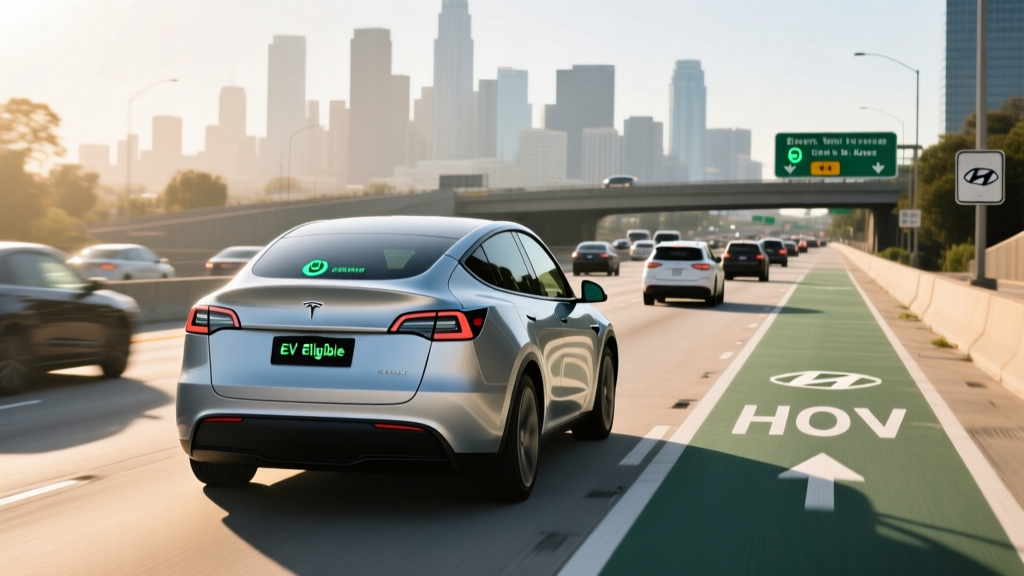
For daily commuters in congested metro areas, HOV lane access is one of the most tangible non-financial perks of owning an EV. A solo driver in a qualifying EV can bypass gridlock in carpool lanes that typically save 10–30 minutes per trip during peak hours. In Los Angeles, for example, the I-405 and I-10 carpool lanes move at 55–65 mph during rush hour while general-purpose lanes crawl at 15–25 mph. That translates to roughly 100+ hours saved per year for a 30-mile round-trip commuter.
Beyond time savings, HOV lane access reduces stop-and-go driving, which actually improves real-world EV efficiency. Regenerative braking recovers energy in traffic, but sustained highway speeds in an HOV lane yield more predictable range consumption — roughly 3.0–3.5 miles per kWh for a mid-size crossover like the Hyundai Ioniq 5 or Tesla Model Y, versus 2.5–2.8 mi/kWh in heavy congestion with constant acceleration and braking cycles.
State-by-State EV HOV Lane Programs (2026)
HOV lane access for single-occupant EVs is not universal. Below is a snapshot of major state programs as of early 2026. Always verify current rules with your state DMV, as legislatures regularly amend or sunset these programs.
| State | Program | Eligible Vehicles | Decal/Sticker Required? | Expiration / Sunset | Notes |
|---|---|---|---|---|---|
| California | Clean Air Vehicle (CAV) Decal | BEVs, FCEVs, qualifying PHEVs (≥50 mi EV range) | Yes — DMV decal application | Decals issued through 9/30/2025 expire 1/1/2029; program under legislative review | Income caps apply for new decals post-2024; California Energy Commission administers |
| Colorado | HOV Lane Exemption | BEVs, FCEVs | Yes — special permit | Ongoing; subject to legislative renewal | Applies to I-25 Express Lanes |
| Florida | HOV Lane Access | BEVs, qualifying hybrids | Yes — annual decal (~$15) | Ongoing | Available on select toll roads and I-95 Express Lanes |
| Georgia | Alternative Fuel Vehicle HOV | BEVs, FCEVs | Yes — special plate/tag | Ongoing | Applies to I-85, I-75, I-575 HOV lanes |
| Hawaii | HOV Lane Exemption | BEVs, FCEVs | Yes — special decal | Program sunset date extended to 2027 | Limited to H-1 freeway on Oahu |
| Maryland | HOV Permit Program | BEVs, PHEVs (≥40 mi EV range) | Yes — MVA permit | Ongoing | Applies to I-270, I-495, US-50 HOV lanes |
| New Jersey | HOV Lane Access | BEVs, FCEVs | Yes — special decal | Ongoing | Applies to NJ Turnpike, Garden State Parkway select lanes |
| New York | Clean Pass Program | BEVs (select models on approved list) | Yes — DMV sticker | Program under review; model list updated annually | Long Island Expressway (I-495) HOV lanes only |
| Utah | HOV Lane Permit | BEVs, FCEVs | Yes — permit from DMV | Ongoing | I-15 Express Lanes; toll discount also available |
| Virginia | HOV Lane Exemption | BEVs, qualifying PHEVs | Yes — special plates ("EV" or "Hybrid") | Phase-out under legislative consideration | I-66, I-395, I-95 Express Lanes; some toll discounts apply |
Critical caveat: Many states are actively restricting or phasing out single-occupant EV HOV access as EV adoption grows. California's CAV decal program, for instance, has faced legislative proposals to end new decal issuance as carpool lane congestion from EVs increases. Always check your state's current rules before making a purchase decision based solely on HOV lane eligibility.
EV vs. Gas: The Real Commute Cost Comparison
HOV lane access is a time-saver, but the financial case for an EV commuter goes deeper. Here's a realistic 5-year cost breakdown comparing a 2026 Tesla Model Y Long Range (AWD, 320 mi EPA, $46,630 MSRP) against a comparable 2026 Toyota RAV4 AWD (29 MPG combined, $33,500 MSRP) for a driver commuting 40 miles round-trip, 250 days/year (10,000 commute miles/year).
| Cost Category | 2026 Tesla Model Y LR | 2026 Toyota RAV4 AWD | 5-Year Difference |
|---|---|---|---|
| Purchase Price (MSRP) | $46,630 | $33,500 | EV +$13,130 |
| Federal Tax Credit (§30D, if eligible) | −$3,750 to −$7,500 (varies by sourcing/income) | $0 | EV saves $3,750–$7,500 |
| HOV Decal/Permit Cost | $0–$100 (state dependent) | $0 (gas cars ineligible) | — |
| Fuel/Energy (5 yrs, 50,000 mi) | $2,800 (home L2 @ $0.14/kWh, 3.2 mi/kWh) | $7,330 (gas @ $3.40/gal, 29 MPG) | EV saves ~$4,530 |
| Maintenance (5 yrs) | $1,200 (cabin filter, wipers, tire rotation) | $3,500 (oil, brakes, filters, fluids) | EV saves ~$2,300 |
| Insurance (5 yrs avg) | $9,500 ($1,900/yr avg) | $7,000 ($1,400/yr avg) | EV costs ~$2,500 more |
| Estimated Depreciation (5 yrs) | ~$18,000 | ~$14,000 | EV costs ~$4,000 more |
| Net 5-Year Cost | ~$37,380 | ~$37,330 | Roughly breakeven |
The raw financials are close to breakeven over five years — but this ignores the time value of HOV lane access. If your commute saves 20 minutes per day, 250 days/year, that's roughly 83 hours/year or 415 hours over 5 years. At a modest $30/hour personal time valuation, HOV access alone is worth over $12,000 to a frequent commuter — a factor no spreadsheet captures but every rush-hour driver feels.
Which EVs Qualify for HOV Lane Access?
Not every EV automatically qualifies. States typically require:
- Zero-emission powertrain: Full BEVs and fuel-cell electric vehicles (FCEVs) qualify in nearly all programs.
- Minimum electric-only range (PHEVs): California now requires ≥50 miles of EPA-rated EV range for new PHEV decals. Maryland requires ≥40 miles. Many older PHEVs with 20–30 miles of range no longer qualify.
- Approved vehicle list: New York's Clean Pass program maintains a specific list of eligible models — not all BEVs are included.
- Income caps (some states): California's post-2024 CAV decals have income thresholds for new applicants (roughly $80,000 single / $160,000 joint for full benefit).
- Application and decal display: You must apply through your state DMV or environmental agency and physically display the decal or special plate. Driving in the HOV lane without a visible, valid decal is a citable offense.
Popular 2026 models that qualify in most HOV programs include the Tesla Model 3 and Model Y, Hyundai Ioniq 5 and Ioniq 6, Ford Mustang Mach-E, Chevrolet Equinox EV, Rivian R1S/R1T, BMW i4 and iX, and all FCEVs (Toyota Mirai, Hyundai Nexo). PHEV eligibility is narrowing — the Toyota RAV4 Prime (42 mi EV range) still qualifies in California and Maryland, but the Chrysler Pacifica Hybrid (32 mi) does not meet California's 50-mile threshold for new decals.
Federal Tax Credits and HOV Lane Access: How They Interact
HOV lane access is a state perk; the federal §30D clean vehicle credit is separate but often compounds the benefit. For 2026, the §30D credit offers up to $7,500 for new qualifying EVs, but eligibility depends on:
- MSRP caps: Vans/SUVs/pickups ≤$80,000; sedans/other ≤$55,000
- Buyer income caps: AGI ≤$150,000 single / ≤$300,000 joint / ≤$225,000 head of household
- Battery sourcing requirements: Critical minerals and battery components must meet escalating domestic-sourcing thresholds — many 2026 models qualify for only $3,750 (half credit) or none at all
- Point-of-sale transfer: Buyers can transfer the credit to the dealer at purchase, reducing the sale price directly
The combination of a $3,750–$7,500 federal credit, state rebates (Colorado offers up to $5,000; California's CVRP offers up to $7,000 for income-qualified buyers), and HOV lane access creates a compelling package for commuters in eligible states. However, always consult a tax professional — credit eligibility is complex and model-specific.
Common HOV Lane Misconceptions — Fact vs. Fiction
| Myth | Fact |
|---|---|
| "All EVs can use HOV lanes everywhere in the US." | HOV access is state-specific and requires a decal, permit, or special plate. Federal law does not grant blanket HOV access to EVs. |
| "I can drive in the HOV lane as soon as I buy an EV." | You must apply for and receive the state decal/permit before using the lane. Processing can take 2–6 weeks. Driving without it is a ticket. |
| "Any hybrid qualifies for HOV lane access." | Most programs now restrict eligibility to BEVs and FCEVs. Conventional hybrids (HEVs) are excluded. Even many PHEVs are being phased out as EV-range thresholds increase. |
| "HOV lane access is permanent once I get the decal." | Decals have expiration dates (typically 3–4 years in California). Programs can be modified or sunset by state legislatures at any time. |
| "HOV lane access saves me money directly." | It saves time, not money (unless your state also offers toll discounts for EVs, as Utah and Virginia do). The financial savings come from lower fuel and maintenance costs. |
| "If I move states, my HOV decal transfers." | Decals are state-specific and non-transferable. You must reapply in your new state, if that state offers a program at all. |
Real-World Ownership Considerations for HOV Lane Commuters
Before buying an EV primarily for HOV lane access, weigh these practical factors:
Home charging access is essential. If you commute 40+ miles daily in an EV, you'll consume roughly 12–15 kWh per day. A Level 2 home charger (240V, 32–48A, 7.7–11.5 kW) replenishes that overnight in 2–3 hours. Without home charging, you'll rely on public DC fast charging or workplace charging — both add cost and time. A 10–80% session on a 150 kW DC charger takes 20–30 minutes for most modern EVs, but you'll pay $0.30–$0.48/kWh at networks like Electrify America or EVgo versus $0.10–$0.16/kWh at home.
Cold weather reduces range by 20–35%. If you commute in Minnesota or New England winters, a 320-mile EPA-rated EV may deliver only 210–250 miles in freezing temperatures with cabin heat running. This rarely threatens a 40-mile commute, but it means more frequent charging sessions. A heat pump (standard on most 2026 BEVs from Tesla, Hyundai/Kia, BMW) mitigates this by 5–10 percentage points.
HOV lane congestion is increasing. As EV adoption grows, carpool lanes in California, Virginia, and other states are seeing more single-occupant EVs, reducing the speed advantage. On the I-405 in Los Angeles, peak-hour HOV lane speeds have dropped from 65 mph to 45–55 mph in some corridors since 2020. The time benefit remains real but is narrowing in high-adoption metros.
Insurance costs more for EVs. Average EV insurance premiums run 15–25% higher than comparable gas vehicles due to higher repair costs (specialized parts, battery replacement risk, certified technician requirements). Budget $400–$700/year more than you'd pay for a gas equivalent.
Decision Framework: Should You Buy an EV for HOV Lane Access?
Choose an EV with HOV lane access if:
- You commute 20+ miles one-way in a congested metro with HOV lanes (LA, SF, DC, Atlanta, Denver, Salt Lake City)
- Your state currently offers an active HOV decal program for BEVs
- You have access to Level 2 home charging (garage or driveway with 240V outlet)
- You qualify for at least a partial federal or state EV incentive
- You value time savings at $20+/hour and your commute is 30+ minutes in general lanes
Stick with a gas car or hybrid if:
- Your state does not offer EV HOV lane access, or the program is sunsetting soon
- You cannot install a home charger and public charging infrastructure is sparse in your area
- Your commute is under 15 miles and HOV lanes don't meaningfully improve your route
- You regularly drive 300+ miles in cold weather or rural areas with limited charging
- The EV price premium exceeds $15,000 after all credits and you cannot recoup the difference in 5 years
Consider a PHEV if:
- Your state still grants HOV access to PHEVs with sufficient EV range (≥40–50 mi)
- You want HOV lane benefits for commuting but need gas flexibility for long road trips
- Home charging is available but you lack confidence in public charging reliability
Frequently Asked Questions
Can I use the HOV lane in any state if my EV has a California CAV decal?
No. HOV lane decals and permits are state-specific. A California CAV decal grants access only to California HOV lanes. If you move to another state, you must apply for that state's program (if one exists) and surrender or let your California decal expire.
Do Tesla vehicles qualify for HOV lane access?
Yes, all Tesla BEVs (Model 3, Model Y, Model S, Model X, Cybertruck) qualify for HOV lane programs in states that offer them, as they are zero-emission vehicles. You still need to apply for the state-specific decal or permit — the vehicle alone does not grant automatic access.
How long does it take to get an HOV lane decal after buying an EV?
Processing times vary by state. California's DMV typically processes CAV decal applications within 2–4 weeks. Some states issue permits at the DMV counter same-day. Apply immediately after taking delivery — do not drive in the HOV lane until the decal is physically on your vehicle.
What happens if I'm caught in the HOV lane without a valid decal?
You'll receive a traffic citation. Fines range from $100 to $500 depending on the state and whether it's a repeat offense. In California, a first-offense carpool lane violation carries a minimum fine of $490 with penalties and assessments.
Will HOV lane access for EVs eventually end?
Several states have already sunset or restricted their programs as EV adoption increases and HOV lanes become congested with single-occupant EVs. California's legislature has debated capping or ending new CAV decals. Virginia has considered phase-outs. If HOV access is a primary purchase motivator, buy now and secure your decal while the program is active — do not assume it will last indefinitely.
Do used EVs qualify for HOV lane decals?
In most states, yes — HOV eligibility is based on the vehicle's powertrain, not its ownership status. However, in California, the CAV decal is tied to the vehicle's VIN and may have already been issued and expired under a previous owner. You can only receive a new decal if the vehicle has never previously held one, or if the prior decal has fully expired and the program still allows reapplication. Check with your state DMV before purchasing a used EV specifically for HOV access.