The Quick Answer: EV Fire Risk in Plain Numbers
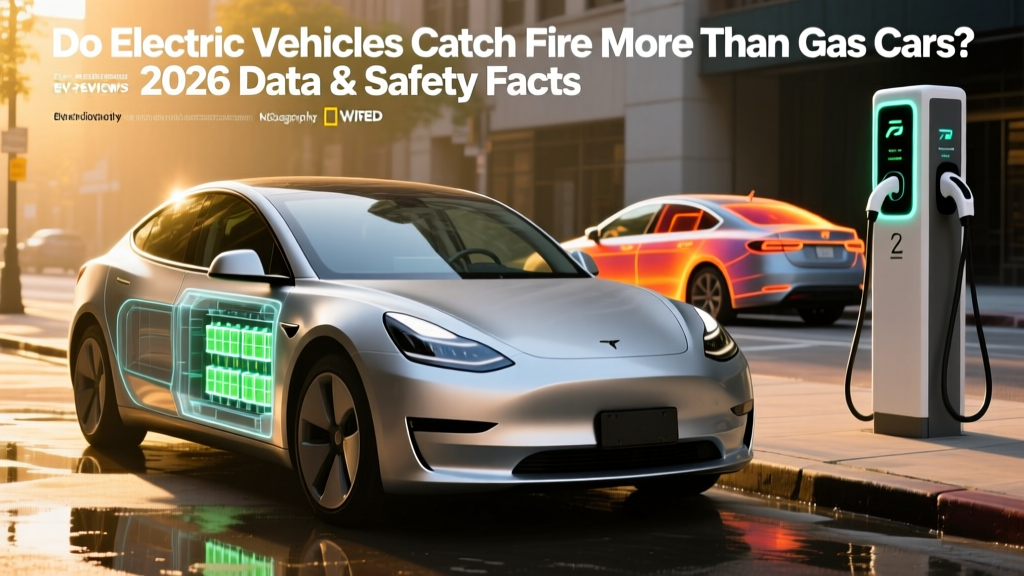
Bottom line: Electric vehicles catch fire at a significantly lower rate than internal combustion engine (ICE) vehicles. According to data analyzed by the National Fire Protection Association (NFPA) and Swedish Civil Contingencies Agency (MSB), EVs experience roughly 25 fires per 100,000 vehicles compared to approximately 1,530 fires per 100,000 for gas-powered cars. That makes gas vehicles roughly 61 times more likely to experience a fire.
However, EV battery fires burn hotter, last longer, and require specialized firefighting techniques — a critical nuance every EV owner and prospective buyer should understand.
The fear that electric vehicles are rolling fire hazards persists in online forums and social media, fueled by viral videos of high-profile incidents. But when you look at the actual data — not the headlines — the picture is very different. This guide breaks down the real fire statistics, what causes EV battery fires, how they compare to gas car fires, and what you should know before buying or owning an EV in 2026.
EV Fire Statistics vs. Gas Car Fires: What the Data Shows
The most reliable comparative data comes from national fire incident databases. Here's how the numbers stack up:
| Metric | Electric Vehicles (BEV) | Gas-Powered Vehicles (ICE) | Hybrids (HEV/PHEV) |
|---|---|---|---|
| Fires per 100,000 vehicles | ~25 | ~1,530 | ~3,475 |
| Primary fire cause | Battery thermal runaway, charging fault | Fuel line leak, electrical short, exhaust heat | Dual systems (fuel + battery) |
| Typical fire temperature | Up to 2,700°F (lithium cell) | ~1,100–1,500°F | Varies by ignition source |
| Avg. suppression water needed | 3,000–8,000+ gallons | 500–1,500 gallons | Varies |
| Re-ignition risk | Yes — hours to days post-fire | Minimal once extinguished | Moderate (battery component) |
| Fire fatality rate (per fire) | Low (thermal mgmt delays spread) | Higher (rapid fuel involvement) | Similar to ICE |
Source: Data compiled from NFPA research reports and the Swedish Civil Contingencies Agency (MSB) 2023 comparative study, which tracked 3.4 million vehicles.
The MSB study is particularly instructive because Sweden has one of the highest EV adoption rates in Europe and maintains meticulous fire records. Their finding: of all vehicle fires reported, EVs were involved in a disproportionately small fraction relative to their share of the vehicle fleet.
Why Hybrids Show Higher Fire Rates
The hybrid fire number surprises many buyers. The explanation is straightforward: hybrids carry both a gasoline fuel system and a high-voltage battery pack. More energy-dense systems in one vehicle means more potential failure points. This doesn't make hybrids dangerous — the absolute numbers remain low — but it does undercut the narrative that adding a battery to a car inherently increases fire risk.
What Causes an Electric Vehicle Fire?
Understanding EV fire causes requires a quick primer on lithium-ion battery behavior. EV battery packs contain hundreds or thousands of individual cells. A fire typically starts when one cell enters thermal runaway — an exothermic chain reaction where the cell overheats, vents flammable gases, and can propagate heat to neighboring cells.
Primary Triggers for EV Battery Fires
- Severe crash damage: A high-speed impact that penetrates the battery enclosure and crushes cells. This is the most common cause in publicized incidents.
- Manufacturing defects: Internal short circuits from metal particles or separator flaws introduced during cell production. These are rare but have triggered recalls (e.g., the 2022 Chevy Bolt recall for LG cell defects).
- Charging system faults: Overcharging or voltage irregularities from faulty DC fast chargers or damaged charge ports. Modern BMS (Battery Management Systems) make this extremely rare in production vehicles.
- Ground clearance impacts: Hitting road debris at speed and puncturing the underbody battery shield. Tesla added titanium underbody shields after early Model S incidents in 2013.
- Aftermarket modifications: Non-OEM charging equipment, improper repairs, or third-party battery modifications that bypass safety systems.
How Battery Chemistry Affects Fire Risk
Not all EV batteries carry the same fire profile. The two dominant chemistries in 2026 are:
- NMC (Nickel Manganese Cobalt): Higher energy density, used in most long-range EVs (Tesla Model 3 Long Range, Hyundai Ioniq 5, Ford Mustang Mach-E Extended Range). More susceptible to thermal runaway at lower temperatures (~210°C onset).
- LFP (Lithium Iron Phosphate): Lower energy density but significantly more thermally stable (~270°C onset). Used in Tesla Model 3/Y RWD, standard-range BYD models, and several 2026 entry-level EVs. LFP cells rarely enter thermal runaway under abuse conditions.
If fire risk is a top concern, an LFP-equipped vehicle offers a measurable safety margin. The trade-off is roughly 10–15% less range for the same battery weight.
EV Fires vs. Gas Car Fires: Key Differences for Owners
While EVs catch fire far less often, the nature of a battery fire is fundamentally different from a gasoline fire. Here's what matters for real-world ownership:
| Myth | Fact |
|---|---|
| "EVs are constantly catching fire." | EVs catch fire at ~25 per 100K vehicles — 61× less than gas cars. |
| "You can't put out an EV fire." | You can, but it requires 3,000–8,000+ gallons of water and extended cooling time. Fire departments now train for this. |
| "EVs explode on impact." | Battery packs are in reinforced enclosures. Thermal runaway typically takes minutes to develop, giving occupants time to exit — unlike flash fuel fires. |
| "Charging your EV overnight is dangerous." | Modern BMS monitors every cell. Home Level 2 charging is extremely safe with UL-listed equipment and proper wiring. |
| "A totaled EV will reignite in the tow yard." | Possible but rare. Fire departments now tag damaged EVs, and tow yards are trained to isolate them for 48–72 hours. |
What This Means for Your Garage and Parking
Most EV fires that occur during charging involve damaged batteries (from prior crashes), faulty non-OEM equipment, or extreme environmental conditions. For a normal EV owner using a properly installed Level 2 home charger:
- The risk of a garage fire from EV charging is vanishingly small.
- Your homeowner's insurance may ask about EV ownership — some carriers adjust premiums slightly, though this is often offset by the vehicle's advanced safety systems.
- Install a UL-listed Level 2 charger (e.g., ChargePoint Home Flex, Emporia Vue) on a dedicated 240V/40A–60A circuit with a licensed electrician. Avoid extension cords and adapters.
Real Costs: Insurance, Safety Features, and Ownership Impact
Fire risk intersects with your wallet primarily through insurance premiums and vehicle safety ratings. Here's how EV ownership costs compare in 2026:
| Cost Factor | Typical EV (2026) | Typical Gas Car (2026) |
|---|---|---|
| Avg. annual insurance premium | $2,100–$2,800 | $1,600–$2,200 |
| Fire-related claim frequency | Very low | Higher (fuel system, exhaust) |
| Total-loss cost after battery fire | $45,000–$75,000+ (full pack replacement) | $15,000–$35,000 (engine/bay rebuild) |
| Annual maintenance (fire-adjacent) | $0 (no fuel lines, exhaust) | $50–$150 (fuel filter, line inspection) |
| NHTSA 5-star crash rating rate | ~85% of tested models | ~65% of tested models |
EV insurance premiums run 15–30% higher than equivalent gas vehicles, but this is driven primarily by higher repair costs after collisions (specialized body shops, battery diagnostics, expensive parts) — not fire risk. Insurers see the fire data; it's the crash-repair economics that push premiums up.
Battery Warranty as a Safety Net
Every major EV sold in the US in 2026 carries a federally mandated minimum battery warranty of 8 years / 100,000 miles (10 years / 150,000 miles in CARB states like California, New York, and Massachusetts). This warranty covers capacity loss below 70% of original — and it also covers manufacturing defects that could lead to thermal events. If your battery develops an internal fault, the manufacturer replaces it at no cost.
Practical Safety Tips for EV Owners and Buyers
Whether you're shopping for your first EV or optimizing ownership of one you already drive, these practices minimize fire-related risk:
Before You Buy
- Check NHTSA and IIHS ratings: Look up crash test scores at nhtsa.gov/ratings and iihs.org. Models with top ratings have robust battery enclosure designs.
- Consider LFP chemistry: If you're choosing between trims, an LFP battery (Tesla Model 3 RWD, BYD models) offers superior thermal stability.
- Research recall history: Check nhtsa.gov/recalls for any battery-related recalls on the specific model year you're considering.
During Ownership
- Use proper charging equipment: Only UL-listed Level 2 chargers installed by a licensed electrician. For DC fast charging, stick to reputable networks (Tesla Supercharger, Electrify America, EVgo) that maintain their equipment.
- Don't ignore warning lights: A battery fault indicator means stop driving and contact the dealer immediately. Most thermal events are preceded by BMS warnings hours or days in advance.
- After a significant collision: Even if the car seems drivable, have the battery inspected. Internal cell damage may not be visible but can lead to delayed thermal runaway.
- Avoid storing a damaged EV in a garage: If your EV has sustained underbody damage, park it outside and away from structures until inspected.
Decision Framework: Should Fire Risk Factor Into Your EV Purchase?
If fire safety is your top vehicle priority → Choose an EV with an LFP battery and top IIHS/NHTSA ratings. The Tesla Model 3 RWD and BYD Atto 3 are strong options with excellent thermal stability.
If you're worried about garage fires from overnight charging → A properly installed Level 2 charger on a dedicated circuit with a UL-listed unit makes this risk negligible. The greater garage fire risk in most homes comes from gas-powered equipment (lawnmowers, generators) and aging wiring.
If you live in an apartment and rely on public charging → Public DC fast chargers from major networks have built-in safety cut-offs. Your risk profile is essentially the same as home charging.
If you're comparing EV vs. gas for a family vehicle → The data clearly favors EVs on fire risk. Gas cars' fuel systems, hot exhaust components, and engine-bay electrical systems create far more ignition opportunities than a sealed, monitored battery pack.
If you drive in extreme heat (Arizona, Texas summers) → Modern EV thermal management systems actively cool the battery during driving and charging. Park in shade when possible and precondition while plugged in. Battery fires from ambient heat alone are essentially unheard of in production EVs with functioning BMS.
Frequently Asked Questions
Are electric vehicles more likely to catch fire than gas cars?
No. By every major dataset available — NFPA, MSB, AutoinsuranceEZ analysis of NTSB data — electric vehicles catch fire at roughly 25 incidents per 100,000 vehicles, compared to approximately 1,530 per 100,000 for gasoline vehicles. EVs are approximately 61 times less likely to experience a fire.
What happens if an EV battery catches fire in my garage?
Lithium-ion battery fires burn very hot (up to 2,700°F) and require large volumes of water to suppress. However, the risk of an EV catching fire during normal home charging with properly installed equipment is extremely low. Modern battery management systems monitor cell voltage and temperature continuously and will shut down charging if anomalies are detected.
Do EV fires release toxic chemicals?
Yes. Burning lithium-ion cells release hydrogen fluoride (HF) gas and other toxic compounds. This is why firefighters use SCBA (self-contained breathing apparatus) at EV fires. However, the same is true of burning gasoline, which releases benzene, carbon monoxide, and other carcinogens. Any vehicle fire produces toxic byproducts.
Is it safe to charge an EV overnight?
Yes. Overnight charging on a properly installed Level 2 home charger is one of the safest charging scenarios. The vehicle's BMS actively manages cell balance and temperature, and charging slows significantly as the battery approaches full capacity. Use only UL-listed charging equipment on a dedicated circuit installed by a licensed electrician.
Which EV battery chemistry is safest?
LFP (Lithium Iron Phosphate) is the most thermally stable chemistry in mass production. LFP cells have a thermal runaway onset temperature of approximately 270°C, compared to roughly 210°C for NMC cells. LFP also doesn't release oxygen during decomposition, which reduces fire intensity. The trade-off is lower energy density, meaning less range per pound of battery.
Will my insurance go up because of EV fire risk?
EV insurance premiums are typically 15–30% higher than gas car equivalents, but fire risk is not the primary driver. Higher repair costs after collisions, expensive battery replacement, and specialized parts are the main factors. Fire claims are actually less frequent on EVs. Shop multiple insurers — some, like Progressive and State Farm, have narrowed the EV premium gap significantly as claims data has matured.