The Short Answer
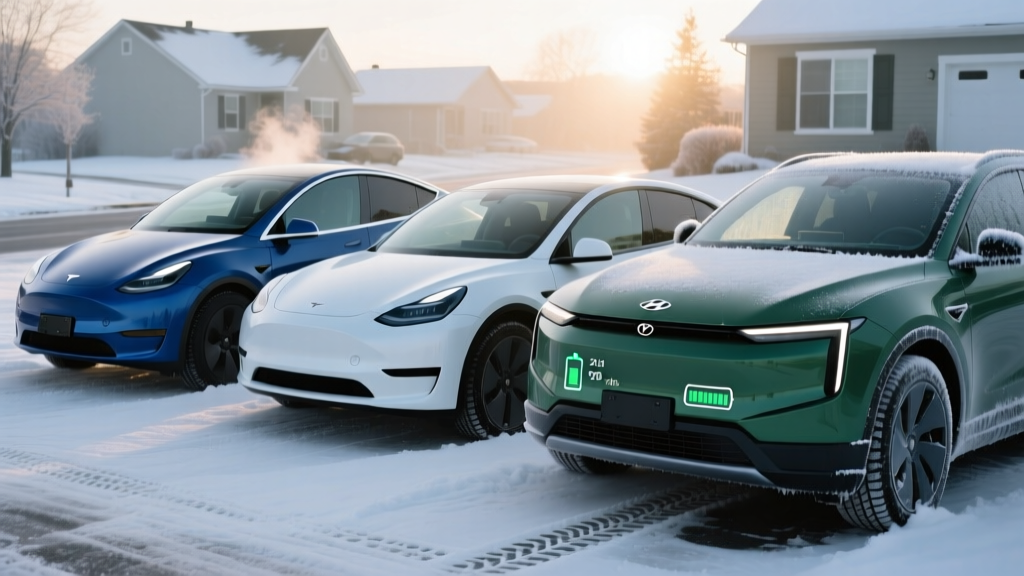
Electric vehicles in cold weather typically lose 20% to 40% of their EPA-rated range when temperatures drop below freezing (32°F / 0°C), with the worst losses occurring below 20°F. A 300-mile EPA-rated EV may deliver just 180–240 real-world winter miles. This happens because lithium-ion batteries operate less efficiently in the cold and because cabin heating draws heavily from the traction battery. However, EVs with heat pump systems reduce heating-related losses by 30–50% compared to resistive heaters, and preconditioning while plugged in can recover most of that lost range for daily commutes.
Why Cold Weather Hits EV Range So Hard
Two physics-driven factors combine to reduce winter range. First, lithium-ion battery cells experience increased internal resistance at low temperatures. The electrochemical reactions that move ions between the anode and cathode slow down, meaning less of the battery's stored energy (measured in kWh) is available for propulsion. Second, unlike internal combustion engines that produce abundant waste heat for cabin warming, EVs must generate heat electrically — pulling directly from the same battery pack that powers the motor.
A gas car wastes roughly 60–70% of its fuel energy as heat, which is "free" for cabin warming in winter. An EV's motor and inverter are 85–95% efficient, meaning very little waste heat is available. When you turn on the cabin heater in an EV, you're spending battery energy that would otherwise go to miles.
Range Loss by Temperature: What the Data Shows
Testing by Recurrent Auto, which tracks over 10,000 EVs in real-world conditions, and data from the AAA Automotive Research Center provide consistent findings:
| Temperature | Average Range Loss (No Cabin Heat) | Average Range Loss (With Cabin Heat) | Heat Pump Mitigation |
|---|---|---|---|
| 40°F (4°C) | 5–10% | 12–18% | Reduces loss to 8–12% |
| 20°F (-7°C) | 12–20% | 25–35% | Reduces loss to 15–22% |
| 0°F (-18°C) | 20–30% | 35–45% | Reduces loss to 22–30% |
The cabin heating column is where most drivers actually live in winter. If your commute requires a warm cabin, plan for the higher loss figures.
EV vs Gas Car: Winter Ownership Compared
A common misconception is that gas cars are unaffected by cold weather. They aren't — but the impact shows up differently.
| Factor | EV (e.g., Tesla Model Y LR) | Gas Car (e.g., Toyota RAV4 AWD) |
|---|---|---|
| EPA Combined Efficiency | 122 MPGe / 28 kWh/100mi | 30 MPG combined |
| Winter Efficiency Drop | 20–40% range loss | 10–15% MPG drop (short trips worse) |
| Winter "Fuel" Cost per Mile | ~$0.045–0.06 (home L2, $0.15/kWh) | ~$0.14–0.17 ($3.40/gal, winter MPG) |
| Cold-Start Behavior | Instant torque, no warm-up needed; battery preconditioning | Engine warm-up period; richer fuel mix when cold |
| Cabin Heat Speed | Resistive: instant; Heat pump: 1–3 min to full output | 3–7 minutes (depends on engine warm-up) |
| Refueling/Charging in Cold | DC fast charge speeds reduced 20–50% without preconditioning | No significant change at the pump |
| Regenerative Braking | Limited or disabled when battery is cold | N/A (traditional friction brakes) |
The EV still costs less per mile to "fuel" in winter — roughly a third of the gas car's cost — but the range reduction is more dramatic and more visible to the driver because it appears on the range estimator in real time.
What Cold Weather Does to Charging Speeds
This is the less-discussed winter penalty. A cold battery cannot accept a DC fast charge at its rated peak kW. Lithium plating — where lithium metal deposits on the anode surface instead of intercalating into it — can occur if you force high current into a cold cell. Battery management systems (BMS) protect against this by throttling charge rates.
Real-World DC Fast Charging in the Cold
Consider a vehicle rated for a peak 250 kW DC fast charge at optimal temperature (roughly 75–85°F / 24–29°C). In sub-freezing conditions without preconditioning:
- Peak charge rate: May be limited to 50–100 kW initially, ramping up slowly as the battery warms
- 10–80% charge time: Can stretch from ~18 minutes (optimal) to 35–50+ minutes (cold, no preconditioning)
- With preconditioning enabled: The vehicle warms the battery en route to the charger, restoring most of the peak charge rate. A preconditioned Model Y or Ioniq 5 in 20°F weather will still charge near its rated curve.
Key takeaway: Always use your EV's navigation to route to a DC fast charger. This triggers battery preconditioning automatically on most modern EVs (Tesla, Hyundai/Kia E-GMP platform, Ford, BMW, Rivian). If your EV lacks nav-based preconditioning, plan to arrive at the charger with the battery warm from driving — ideally after 20–30 minutes of highway travel.
Heat Pumps vs. Resistive Heaters: Why It Matters
The single biggest hardware differentiator for cold-weather EV ownership is the heating system. There are two types:
Resistive (PTC) heater: Works like a space heater — passes current through a resistive element to generate heat. Efficiency ratio is 1:1 (1 kW of electricity produces 1 kW of heat). This is simple, cheap, and effective, but it draws heavily from the battery. A 5 kW resistive heater running for a 1-hour highway drive consumes 5 kWh — roughly 15–20 miles of range from a typical pack.
Heat pump: Works like a reverse air conditioner — extracts thermal energy from ambient air (yes, even cold air contains extractable heat energy) and compresses it for cabin warming. Efficiency ratios of 2:1 to 4:1 are typical, meaning 1 kW of electricity produces 2–4 kW of heat. Modern systems like Hyundai's octovalve or Tesla's "Superbottle"/octovalve integrated thermal system can scavenge waste heat from the motor and inverter, further boosting efficiency.
As of the 2026 model year, most mainstream EVs priced above $40,000 include a heat pump standard. Below that threshold, it varies. Notable 2026 models with standard heat pumps include the Tesla Model Y, Hyundai Ioniq 5, Kia EV6, BMW i4, and Ford Mustang Mach-E (2024+ refresh). Budget-oriented models may still use resistive heating — check the spec sheet before purchasing if you live in a cold climate.
Real Winter Ownership Costs: EV vs Gas vs PHEV
Let's model a realistic winter scenario for a driver in Minneapolis, MN, with a 30-mile round-trip commute, 120 days of sub-freezing temperatures, and home Level 2 charging access.
| Cost Factor (Annual) | EV: Tesla Model Y LR AWD ($46,630 MSRP) | PHEV: Toyota RAV4 Prime ($44,590 MSRP) | Gas: Toyota RAV4 AWD ($31,500 MSRP) |
|---|---|---|---|
| Purchase Price (before incentives) | $46,630 | $44,590 | $31,500 |
| Federal Tax Credit (§30D)* | Up to $7,500 (eligibility varies) | Up to $7,500 (eligibility varies) | $0 |
| Winter Fuel Cost (120 days, 30 mi/day) | ~$108 (home charging at $0.15/kWh, winter efficiency ~35 kWh/100mi) | ~$145 (mix of electric + gas, 42 mi EV range) | ~$490 (25 winter MPG, $3.40/gal) |
| Full-Year Fuel Cost (12,000 mi) | ~$540 | ~$680 | ~$1,530 |
| Annual Maintenance | ~$200 (cabin filter, tire rotation, fluid top-off) | ~$550 (oil changes + EV system checks) | ~$650 (oil, filters, brakes, fluids) |
| Insurance (avg annual) | ~$2,100 | ~$1,700 | ~$1,500 |
| 5-Year Total Operating Cost (fuel + maint + insurance) | ~$14,200 | ~$14,650 | ~$18,400 |
*Federal §30D tax credit eligibility depends on buyer income caps, vehicle MSRP caps, battery critical-mineral sourcing, and point-of-sale transfer rules. Consult IRS guidance and a tax professional for your specific situation. Rules are subject to change.
The EV wins on operating costs even in a harsh winter climate, but the higher insurance premiums (typically 15–30% above comparable gas vehicles) and upfront purchase price narrow the total-cost-of-ownership gap. For buyers without home charging, the winter public-charging experience adds time cost that's harder to quantify.
Cold-Weather EV Buying Decision Framework
Should You Buy an EV for Cold-Weather Driving?
Choose a full BEV if:
- You have home Level 2 charging (240V, 32–48A) and can precondition while plugged in each morning
- Your typical daily driving is under 60% of the vehicle's EPA range (leaving a winter buffer)
- You can select a model with a heat pump and battery preconditioning for DC fast charging
- You're willing to plan longer road trips around charging stops that may take 30–50 minutes in winter vs. 15–20 in summer
- Your winter temperatures rarely drop below 0°F, or you can garage the vehicle
Choose a PHEV if:
- You lack reliable home charging or live in an apartment without EV infrastructure
- You regularly drive 200+ miles in winter conditions where charging infrastructure is sparse
- Your winter temperatures routinely hit -20°F or below (extreme cold where even preconditioned EVs lose 40%+ range)
- You want electric-only commuting (30–45 miles) for most daily driving but gas flexibility for winter road trips
Wait or choose a gas/hybrid vehicle if:
- You rely entirely on street parking with no charging access and your area has limited public DC fast charging
- Your daily commute exceeds 150 miles one-way in sub-zero temperatures
- You tow frequently in winter (towing can compound range loss to 50–60%)
Common Cold-Weather EV Myths vs. Facts
| Myth | Fact |
|---|---|
| "EVs don't work in cold climates — Norway proves it." | Norway has the world's highest per-capita EV adoption (over 80% of new car sales are BEV). Norwegian drivers use home charging, preconditioning, and abundant public infrastructure. Cold is manageable with preparation, not a dealbreaker. |
| "The battery will freeze and be destroyed." | Lithium-ion battery electrolyte freezes at approximately -40°F to -60°F. The BMS will not allow the vehicle to operate or charge if cell temperatures approach dangerous levels. In practice, battery freezing is virtually unheard of in consumer use. |
| "You can't use the heater or you'll run out of range." | You can and should use the heater. A heat pump-equipped EV running the heater at a comfortable 70°F will lose 15–25% range in typical freezing conditions — not the 50%+ that fear-based articles suggest. Seat heaters and steering wheel heaters use far less energy (~50–100W) than cabin air heating and are an efficient supplement. |
| "EVs are dangerous in winter because they're heavier." | EVs are 10–30% heavier than comparable gas vehicles due to the battery pack. This adds momentum in a collision but also provides more traction over the driven wheels (most EVs are AWD with low center of gravity). IIHS crash-test ratings show EVs performing well; the additional mass is managed by structural battery enclosures. |
| "Regenerative braking doesn't work in the cold." | Regen is reduced or temporarily disabled when the battery is cold to prevent lithium plating. After 10–20 minutes of driving, as the battery warms, regen gradually returns to full strength. Plan for reduced regen — and longer braking distances — during the first miles of a cold-weather drive. |
Practical Winter EV Ownership Tips
If you own or are buying an EV for a cold climate, these practices maximize your real-world range and charging speed:
- Precondition while plugged in. Set a departure timer in your EV's app so the battery and cabin warm up using grid power, not battery energy. This is the single most impactful winter habit. A preconditioned EV leaves the garage with a warm battery, full regen, and a heated cabin — drawing zero from the pack.
- Use seat and steering wheel heaters first. These draw 50–100W combined vs. 2,000–5,000W for cabin air heating. Set the cabin thermostat a few degrees lower and let contact heating keep you comfortable.
- Navigate to DC fast chargers. Even if you know the route, entering the charger as your destination triggers the vehicle's battery preconditioning routine. This alone can cut a winter 10–80% charge from 45 minutes to 20 minutes.
- Keep your state of charge between 20–80% for daily use (for NMC batteries). LFP batteries (found in base-model Tesla Model 3/Y, some Ford and Rivian configurations) can be charged to 100% regularly without degradation concerns — check your owner's manual for chemistry-specific guidance.
- Install winter tires. EVs deliver instant torque, which on snow and ice can overwhelm all-season tires. Winter tires (e.g., Michelin X-Ice, Bridgestone Blizzak) improve traction, braking, and regen effectiveness. Expect a 2–5% range reduction from increased rolling resistance — a worthwhile tradeoff for safety.
- Plan for 30–40% range loss on road trips. If your EV has a 300-mile EPA range, plan charging stops as if you have 180–210 miles of range in freezing highway conditions. Use apps like A Better Routeplanner (ABRP) that factor in temperature, elevation, and speed.
Frequently Asked Questions
Do EVs lose range permanently after a cold winter?
No. Winter range loss is temporary and reverses when temperatures rise. Cold slows the electrochemical reactions in lithium-ion cells, but it doesn't cause permanent degradation. Long-term battery degradation (typically 1–2% per year) is driven more by heat exposure, high state-of-charge storage, and fast-charging frequency than by cold weather. In fact, cold climates are generally easier on battery longevity than hot climates like Arizona or Texas.
How much does a home Level 2 charger cost to install?
A typical Level 2 home installation (240V, 40–48A hardwired unit like a ChargePoint Home Flex or Wallbox Pulsar Plus) costs $800–$2,500 total, broken down as: $400–$700 for the charger hardware, $300–$1,200 for electrician labor (depends on panel proximity and conduit run length), and $50–$200 for permits. If your home's electrical panel needs an upgrade from 100A to 200A service, add $1,500–$3,000. A licensed electrician should assess your panel capacity before purchase.
Which 2026 EVs are best for cold weather?
The strongest cold-weather EVs share three traits: heat pump, battery preconditioning for DC fast charging, and AWD. Top performers in our analysis include the Tesla Model Y Long Range (heat pump standard, excellent thermal management, 310-mile EPA range), Hyundai Ioniq 5 (heat pump, 800V architecture for fast preconditioned charging, 305-mile EPA), BMW i4 xDrive40 (integrated heat pump, 282-mile EPA), and Rivian R1S Dual-Motor (heat pump, robust thermal management, 352-mile EPA on Max Pack). For budget buyers, the Volvo EX30 (heat pump standard, 261-mile EPA, ~$36,000 MSRP) is a strong compact option.
Can I charge my EV outdoors in freezing rain or snow?
Yes. All EV charging connectors (NACS, CCS, J1772) are rated for outdoor use and are sealed against moisture (typically IP67 for the vehicle inlet). Charging in rain or snow is safe. The main practical challenge is keeping the connector and port free of ice buildup — a small brush or de-icer spray helps. Many owners use a simple weatherproof charging cable organizer or a garage-mounted retractable reel to keep the cable off wet ground.
Is a PHEV better than a full EV for extreme cold climates?
For climates where temperatures regularly drop below -10°F and daily driving exceeds 80 miles, a PHEV like the Toyota RAV4 Prime (42-mile EV range, 38 MPG combined on gas) or Jeep Wrangler 4xe (22-mile EV range) offers a practical compromise. You get electric commuting most days and gas-engine flexibility on the coldest, longest drives. However, PHEVs carry the maintenance burden of both an internal combustion engine and an electric powertrain, and their smaller battery packs (typically 15–20 kWh) provide less electric range in winter — expect 25–30 real-world winter electric miles from a 42-mile EPA-rated PHEV.