The Short Answer on Electric Vehicle Transmissions
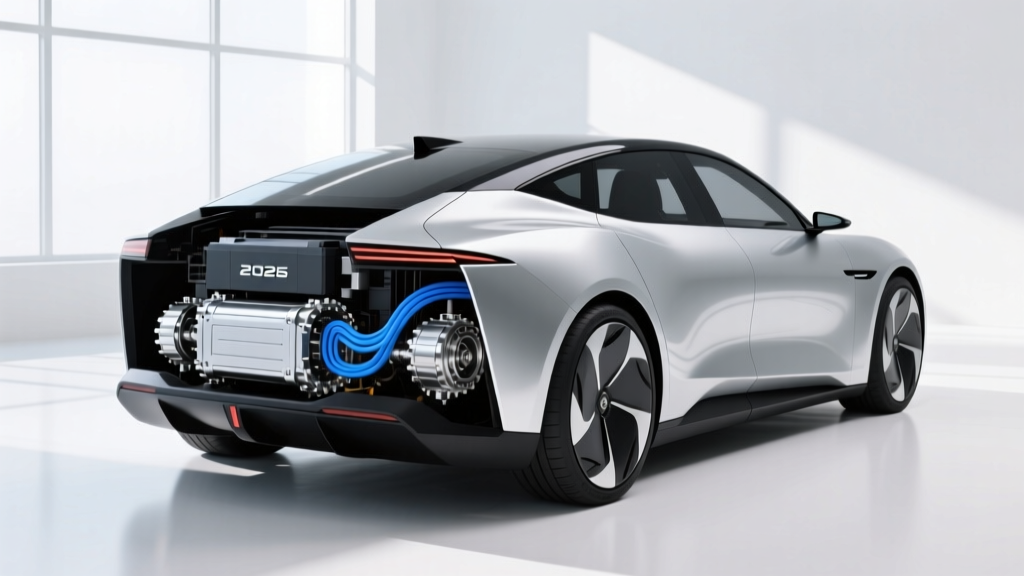
Most battery-electric vehicles do not have a multi-speed transmission. Instead, they use a single-speed reduction gear (typically with a ratio between 9:1 and 10.5:1) that transfers torque from the electric motor to the wheels. Because electric motors produce maximum torque from 0 RPM and can rev to 15,000–20,000 RPM, multiple gears are unnecessary for everyday driving. A few exceptions exist — the Porsche Taycan and Audi e-tron GT use a two-speed gearbox on the rear axle for performance optimization — but for 95% of EVs on the road in 2026, there is no transmission to shift, service, or replace.
Why Electric Motors Don't Need Multiple Gears
A gasoline engine produces usable power in a narrow RPM band — typically 1,500 to 6,000 RPM — and needs a 6-, 8-, or 10-speed automatic transmission to keep the engine in that sweet spot as vehicle speed changes. An electric motor, by contrast, delivers peak torque instantly at 0 RPM and sustains power across a vastly wider range. A motor spinning at 18,000 RPM through a fixed 10:1 reduction gear covers 0 to 130+ mph without ever needing to shift.
This single-speed design has three practical consequences for buyers:
- Smoothness: No shift shocks, no gear hunting on hills, no hesitation during kick-down. Acceleration is linear from stop to highway speed.
- Fewer moving parts: A single-speed reduction gear has roughly 10–15 major components versus 200+ in a modern automatic transmission. There are no clutch packs, torque converters, or shift solenoids to fail.
- Lower maintenance: Most EV reduction gears use a sealed lubricant that requires no scheduled changes. There is no transmission fluid flush interval in the owner's manual of most BEVs.
EV Drivetrain vs. Gas Car Transmission: By the Numbers
| Attribute | Typical BEV (Single-Speed) | Typical Gas Car (8-Speed Auto) |
|---|---|---|
| Gear ratios | 1 (fixed reduction ~9:1 to 10.5:1) | 8 forward + reverse |
| Moving parts in gearbox | ~10–15 | 200+ |
| Transmission fluid changes | None (sealed, lifetime fill on most) | Every 30,000–60,000 mi ($200–$350 each) |
| Replacement cost (out of warranty) | $1,500–$3,500 (reduction gear) | $3,500–$7,000 (rebuilt/replace automatic) |
| Typical lifespan | 200,000+ mi (often outlasts the vehicle) | 120,000–180,000 mi before major service |
| 0–60 mph delivery | Linear, no interruption | Interrupted by shift events (~150–300 ms each) |
The cost advantage is significant over a 10-year ownership period. A gas car owner might pay for two to three transmission fluid services ($400–$1,050 total) and faces a non-trivial risk of a $4,000+ repair after 120,000 miles. An EV owner will likely spend $0 on transmission maintenance over the life of the car.
The Exceptions: When an EV Does Have a Two-Speed Gearbox
The Porsche Taycan (all trims) and the mechanically related Audi e-tron GT use a two-speed transmission on the rear axle. First gear provides aggressive off-the-line acceleration (the Taycan Turbo S hits 0–60 mph in 2.4 seconds), while second gear optimizes high-speed efficiency. The front axle uses a single-speed unit. This setup adds roughly 30–40 lbs and increases complexity, but Porsche engineers determined the performance benefit justified the trade-off for a sports-sedan application.
Some commercial and heavy-duty EVs — like certain electric buses and the Tesla Semi (announced for production) — also use multi-speed gearboxes because they need to move heavy loads from a stop and still cruise efficiently at highway speed. For passenger cars, however, the single-speed reduction gear remains the dominant and most cost-effective design through the 2026 model year.
How the Drivetrain Affects Real-World Range and Efficiency
The single-speed gearbox contributes to EV efficiency in a way that matters at the pump — or rather, at the charger. Without energy losses from a torque converter, clutch-pack drag, or hydraulic pump, more of the battery's stored kilowatt-hours (kWh) reach the wheels. According to fueleconomy.gov, the average 2026 BEV achieves 110–130 MPGe combined, translating to roughly 25–30 kWh per 100 miles driven.
However, the fixed gear ratio does create a trade-off at very high speeds. Above 80 mph, the motor spins at high RPM where efficiency drops, and there is no taller gear to lower the revs. This is one reason EV range decreases noticeably at sustained highway speeds — a 310-mile EPA-rated EV might deliver only 250–270 miles at 75 mph on the interstate. Cold weather compounds this: battery internal resistance increases, and cabin heating draws 2–5 kW, further reducing range to 200–230 miles in sub-freezing conditions.
5-Year Powertrain Maintenance Cost Estimate
| Service Item | BEV (Single-Speed) | Gas Car (8-Speed Auto) |
|---|---|---|
| Transmission fluid service | $0 | $400–$700 (2 services) |
| Engine oil changes (gas only) | N/A | $750–$1,500 (10–15 changes) |
| Brake pad replacement | $0–$250 (regen braking extends life) | $400–$800 (2 axle services) |
| Coolant flush | $150–$250 (battery thermal loop) | $150–$250 |
| Risk of major powertrain repair | Very low (reduction gear rarely fails) | Moderate ($3,500–$7,000 transmission) |
| Estimated 5-yr total | $150–$500 | $1,700–$3,250 |
Source: Author estimates based on manufacturer maintenance schedules and AAA Your Driving Costs 2025 data. Actual costs vary by region and model.
What This Means for Your Purchase Decision
If you are cross-shopping a BEV against a gas car or hybrid, the transmission question rarely shows up in marketing, but it affects your wallet in year five and beyond. Here is a practical framework:
Decision Framework: EV vs. Gas vs. Hybrid
- Choose a BEV if: You have Level 2 home charging access, drive under 250 miles per day, and plan to own the car 5+ years. The near-zero drivetrain maintenance and lower per-mile energy cost (~$0.04/mi on home electricity vs. ~$0.12/mi on gas at 25 MPG and $3.00/gal) add up to $3,000–$5,000 in savings over five years for a 15,000-mile/year driver. Check IRS §30D eligibility — income caps ($150K single / $300K joint), MSRP caps ($55K cars / $80K SUVs and trucks), and battery sourcing rules apply.
- Choose a PHEV if: You want electric commuting (typically 30–45 miles of EV range) but lack reliable home charging or take frequent 400+ mile road trips. You still get a conventional multi-speed transmission for gas operation, with the maintenance costs that entails.
- Choose a gas car if: You live in an apartment without charging access, regularly tow heavy loads (5,000+ lbs), or drive in extreme cold (-20°F or below) where EV range loss exceeds 30%.
Common Myths About EV Transmissions — Corrected
| Myth | Fact |
|---|---|
| "EVs have no gears at all." | They have a single fixed-ratio reduction gear — typically ~10:1 — that multiplies motor torque before sending it to the differential. It is a gear set, just not a multi-speed transmission. |
| "The transmission will need expensive replacement." | Single-speed reduction gears have extremely low failure rates. The electric motor and inverter are more likely to need attention, and both are covered under the federally mandated 8-year/100,000-mile EV powertrain warranty. |
| "EVs can't handle hills because they only have one gear." | Electric motors produce peak torque at 0 RPM, making them exceptional climbers. A Tesla Model Y Long Range (346 lb-ft of torque from 0 RPM) will out-climb most V6 gas SUVs on a grade without any gear hunting. |
| "No transmission means no maintenance ever." | EVs still need tire rotations, cabin air filters, brake fluid checks, windshield washer fluid, and coolant service for the battery thermal management loop. Budget $300–$600/year for non-drivetrain maintenance. |
| "All EVs use the same drivetrain." | Single-motor (FWD or RWD), dual-motor AWD, and tri-motor setups exist, each with its own reduction gear unit(s). The Porsche Taycan's two-speed rear axle is a notable outlier. |
Frequently Asked Questions
Do I ever need to change fluid in an EV's reduction gear?
Most manufacturers — including Tesla, Hyundai, Ford, and Rivian — specify the reduction gear lubricant as a "lifetime fill" with no scheduled drain interval. Some owners opt for a drain-and-fill at 100,000 miles as a precaution, which costs roughly $100–$200 at an independent shop. Check your specific owner's manual; the Chevrolet Bolt EUV, for example, does list a drive-unit fluid check at 150,000 miles.
Does regenerative braking put extra wear on the gearbox?
No. Regen braking reverses the motor's function — the wheels spin the motor, which generates electricity back into the battery. The torque flows through the same reduction gear in the same direction as during acceleration, just at lower force. The gear set is designed to handle bidirectional torque loads. What regen does do is dramatically reduce wear on the friction brake pads, which is why many EV owners report original brake pads at 80,000+ miles.
Can an EV's single-speed design limit towing capacity?
Partially. A fixed gear ratio optimized for 0–130 mph passenger driving isn't ideal for pulling 7,500 lbs up a 6% grade at low speed. This is one reason the Ford F-150 Lightning (max tow 10,000 lbs) and Rivian R1T (11,000 lbs) use powerful dual-motor setups with robust cooling, and why the Tesla Semi uses a multi-speed gearbox. For typical light towing under 5,000 lbs — a boat, small trailer, or bike rack — a single-speed EV handles it without issue, though expect range to drop 30–50% while towing.
Will future EVs switch to multi-speed transmissions?
Unlikely for mainstream models. Motor efficiency has improved enough (modern permanent-magnet motors exceed 95% efficiency across a wide RPM band) that the added weight, cost, and complexity of a second gear rarely pays off. The two-speed setup in the Taycan remains a niche performance choice. As battery energy density improves and motors get more efficient at high RPM, the case for multi-speed gearboxes in passenger EVs gets weaker, not stronger.
What does the EV powertrain warranty actually cover?
Federal law mandates that EV battery and powertrain components — which include the electric motor(s), inverter, and reduction gear — be warranted for a minimum of 8 years or 100,000 miles (whichever comes first). In California and states that follow CARB rules, that extends to 10 years / 150,000 miles. Some manufacturers go further: Hyundai and Kia offer 10 years / 100,000 miles nationwide. Per the NHTSA, these warranties cover defects and capacity loss below a stated threshold (typically 70% of original capacity for the battery).