If you're researching an electric vehicle Porsche, you're likely weighing the Taycan sedan or the newer Macan EV against their gas counterparts — and against luxury EV rivals from Tesla, BMW, and Audi. Here's the practical bottom line: Porsche's electric lineup delivers class-leading 800-volt charging architecture (up to 320 kW peak on the Taycan, 270 kW on the Macan EV), real-world range between 220 and 310 miles depending on trim and conditions, and a driving experience that justifies the premium. But expect to pay $80,000–$200,000+ before options, budget $1,500–$2,500 for a home Level 2 charger installation, and accept that federal tax credit eligibility is limited by MSRP caps and battery-sourcing rules. This guide breaks down exact costs, range realities, and the decision framework to help you choose wisely.
Quick Answer: Is an Electric Vehicle Porsche Worth It?
Porsche's EVs (Taycan and Macan Electric) are performance-first luxury vehicles that sacrifice some range efficiency for driving dynamics and ultra-fast DC charging. They make sense if you have home charging access, prioritize driving engagement over maximum range, and can absorb a premium purchase price. They do not qualify for the full $7,500 federal §30D tax credit on most trims due to MSRP caps and battery-sourcing requirements.
Porsche's EV Lineup in 2026: Taycan and Macan Electric
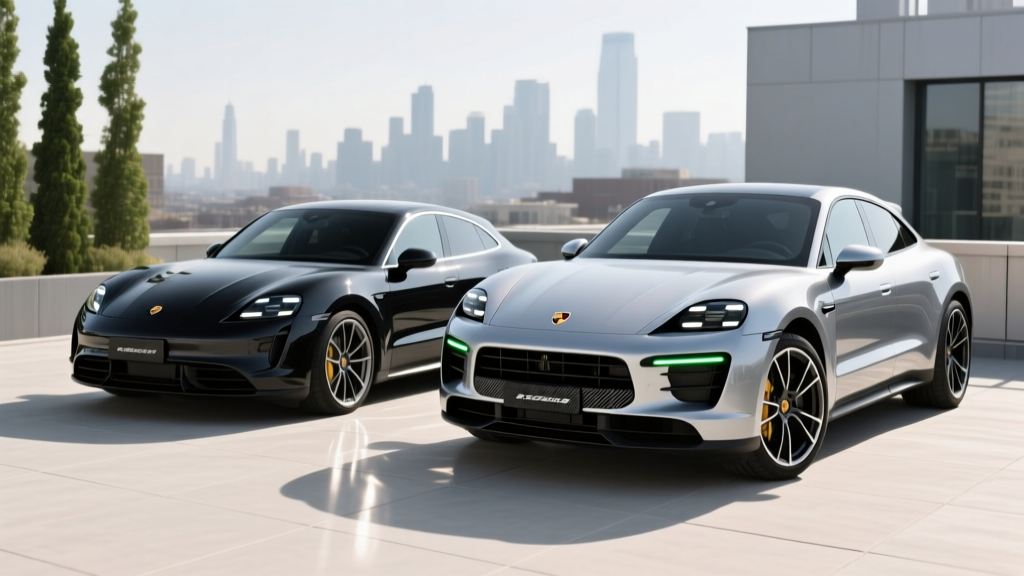
Porsche currently offers two battery-electric vehicles in the U.S. market. The Taycan (sedan, Cross Turismo, and Sport Turismo variants) has been in production since 2020 and received a significant refresh for the 2025 model year with improved battery chemistry and faster charging. The Macan Electric launched for the 2025 model year on the PPE (Premium Platform Electric) architecture co-developed with Audi, replacing the gas Macan in Porsche's EV transition.
| Model / Trim | Battery (kWh usable) | EPA Range | Peak DC Charge | 10–80% DC Time | 0–60 mph | Base MSRP |
|---|---|---|---|---|---|---|
| Taycan (RWD) | 89 kWh (NMC) | 310 mi | 320 kW | ~18 min | 5.1 sec | $92,350 |
| Taycan 4S | 89 kWh (NMC) | 285 mi | 320 kW | ~18 min | 3.7 sec | $108,050 |
| Taycan Turbo GT | 89 kWh (NMC) | 252 mi | 320 kW | ~18 min | 2.1 sec | $231,400 |
| Macan Electric (RWD) | 95 kWh (NMC) | 308 mi | 270 kW | ~21 min | 5.5 sec | $78,800 |
| Macan 4 Electric | 95 kWh (NMC) | 288 mi | 270 kW | ~21 min | 4.9 sec | $84,600 |
Real-world range caveat: EPA figures assume mixed driving. On sustained highway trips at 75+ mph, expect a 10–15% reduction. In cold weather (below 32°F), lithium-ion batteries lose efficiency and cabin heating draws significant energy — plan for 20–30% less range on winter road trips. The Taycan RWD's 310-mile EPA sticker realistically translates to ~250–270 miles on a summer highway drive and ~210–230 miles in freezing conditions.
Range Reality Check
EPA Sticker: 310 mi (Taycan RWD) / 308 mi (Macan Electric RWD)
Real-World Highway (70°F): ~260–275 mi
Real-World Highway (25°F): ~210–235 mi
City / Commute Mixed: ~280–300 mi (regen braking recovers energy in stop-and-go)
Electric Vehicle Porsche vs. Gas Porsche: Cost Comparison
The most common question from luxury car shoppers: does going electric actually save money with a Porsche? The answer depends heavily on your mileage, electricity rate, and how long you keep the vehicle. Let's compare a 2026 Macan Electric against a gas Macan over five years and 75,000 miles.
| Cost Category | Macan Electric (RWD) | Gas Macan (Base 2.0T) |
|---|---|---|
| Purchase Price (MSRP) | $78,800 | $62,900 |
| Federal Tax Credit (§30D) | $0–$3,750* | $0 |
| Fuel / Electricity (75k mi) | $3,900† | $9,400‡ |
| Maintenance (5 yr) | $1,800 | $4,200 |
| Insurance (5 yr avg) | $14,500 | $11,200 |
| Estimated Depreciation | $38,000 | $30,000 |
| Total 5-Year Cost | ~$135,000 | ~$117,700 |
*Porsche's MSRP exceeds the §30D cap for SUVs ($80,000) on most trims. The base Macan Electric at $78,800 may qualify for a partial credit depending on battery-sourcing compliance — check current IRS guidance.
†Assumes 80% home charging at $0.16/kWh, 20% DC fast charging at $0.40/kWh, and 3.0 mi/kWh efficiency.
‡Assumes 22 MPG combined and $3.70/gal premium unleaded.
The numbers are clear: the Macan Electric saves roughly $7,900 in fuel and maintenance over five years, but costs approximately $15,900 more upfront (after any partial credit) and carries higher insurance premiums and steeper depreciation. You do not buy a Porsche EV to save money — you buy it for the driving experience, lower daily operating costs, and zero tailpipe emissions. The total cost of ownership gap narrows if you drive more than 15,000 miles annually or if your utility offers off-peak charging rates below $0.10/kWh.
Charging at Home and on the Road: What Porsche EV Owners Need
Porsche's 800-volt architecture is the brand's biggest EV advantage. While most luxury EVs use 400-volt systems that peak around 150–200 kW, the Taycan and Macan Electric sustain high charge rates deeper into the session. A Taycan at a 350 kW Electrify America station will pull its full 320 kW peak (if the battery is preconditioned and below ~30% SoC), tapering gradually rather than cliff-dropping like many 400V competitors.
| Level | Power | Miles Added per Hour | Typical Use Case |
|---|---|---|---|
| Level 1 (120V) | ~1.4 kW | ~4–5 mi/hr | Emergency trickle; not practical for daily use |
| Level 2 (240V, 48A) | 11.5 kW | ~34–38 mi/hr | Home overnight charging (full charge in ~8–9 hr) |
| DC Fast (Taycan) | Up to 320 kW | ~190 mi in 10 min | Road trips; 10–80% in ~18 min |
| DC Fast (Macan EV) | Up to 270 kW | ~160 mi in 10 min | Road trips; 10–80% in ~21 min |
Home charging setup: Both models accept up to 11.5 kW on Level 2 (48 amps on a 60-amp circuit). Porsche offers the Mobile Charger Connect as standard, but most owners install a dedicated wall unit. Budget $1,200–$2,500 for a professional Level 2 installation, including a NEMA 14-50 outlet or hardwired charger and electrical panel assessment. If your home has a 100-amp panel, you may need a $2,000–$4,000 panel upgrade to support a 60-amp EV circuit alongside existing loads.
Preconditioning matters: Both Porsche EVs feature battery preconditioning for DC fast charging. When you navigate to a charge station in the infotainment system, the car warms or cools the battery to optimal temperature, enabling peak charge rates. Without preconditioning — especially in cold weather — your peak charge rate may drop by 30–50%. Always use the built-in navigation to route to chargers.
Connector note: Porsche uses the CCS1 connector for DC fast charging and J1772 for Level 2 in North America. With the industry shifting toward NACS (Tesla's connector), Porsche has confirmed future models will adopt NACS, but current Taycan and Macan EV owners will rely on CCS-to-NACS adapters at Tesla Superchargers. Porsche includes a CCS adapter for Tesla Supercharger access on 2025+ models.
Federal Tax Credit and Incentive Reality for Porsche EVs
This is where many luxury EV buyers encounter disappointment. The federal §30D clean vehicle credit offers up to $7,500, but strict rules limit eligibility for Porsche's lineup:
- MSRP Cap: SUVs (Macan) must be under $80,000; sedans (Taycan) under $55,000. The base Macan Electric at $78,800 barely qualifies; every Taycan trim exceeds the cap.
- Income Limits: Buyer AGI must not exceed $300,000 (joint), $225,000 (head of household), or $150,000 (single).
- Battery Sourcing: The $7,500 credit splits into two halves — $3,750 for critical minerals and $3,750 for battery component manufacturing. Sourcing requirements tighten annually. Check the latest eligible vehicle list on fueleconomy.gov.
- Point-of-Sale Transfer: Eligible buyers can transfer the credit to the dealer at purchase, reducing the sale price directly rather than waiting for a tax refund.
Bottom line: The base Macan Electric RWD is the only Porsche EV with any realistic §30D eligibility, and even that depends on battery-sourcing compliance and buyer income. Every Taycan trim is disqualified by MSRP. Do not base your purchase decision on the assumption of a $7,500 credit.
Common Misconceptions About Porsche EVs
| Myth | Fact |
|---|---|
| "Porsche EVs have terrible range compared to Tesla." | The 2026 Taycan RWD achieves 310 miles EPA — competitive with the Tesla Model S Long Range (320 mi). The Macan Electric RWD hits 308 miles, exceeding the Model Y Long Range's ~310. Porsche's earlier 2020–2023 models had lower range (200–227 mi), creating an outdated reputation. |
| "You can't take a Porsche EV on road trips." | With 800V charging at 320 kW (Taycan), a 10–80% charge takes ~18 minutes. On a 500-mile trip, you'll add one 20-minute charging stop. Electrify America's 350 kW station network covers most U.S. interstates. |
| "EV batteries need replacement every few years." | Porsche warranties its high-voltage battery for 8 years / 100,000 miles with a capacity retention threshold of 70%. Real-world data from earlier Taycan models shows degradation of approximately 5–8% over 100,000 miles with proper charging habits (avoiding sustained 100% SoC). |
| "All Porsche EVs qualify for the $7,500 tax credit." | Only the base Macan Electric RWD ($78,800) has potential eligibility, subject to battery-sourcing rules and buyer income limits. No Taycan qualifies due to the $55,000 sedan MSRP cap. |
Real-World Ownership Considerations
Home charging access is essential. Porsche EVs are not practical as sole vehicles for apartment dwellers without reliable charging. Level 1 (120V) adds only 4–5 miles per hour — insufficient for daily driving. If you cannot install Level 2 at home, confirm you have dependable workplace or public Level 2 access before purchasing.
Insurance costs run 15–25% higher than gas Porsche equivalents. EV-specific insurance factors include higher repair costs for battery-adjacent damage, specialized technician requirements, and elevated parts pricing. Get quotes from multiple carriers before committing.
Maintenance is genuinely lower. No oil changes, no spark plugs, no transmission fluid. Brake pad replacement is rare thanks to aggressive regenerative braking (Porsche estimates brake pads may last 100,000+ miles). Expect cabin air filter replacement ($150–$250), tire rotation, and wiper fluid as your primary service items. Porsche's scheduled maintenance plan covers the first year or 10,000 miles.
Tires wear faster on EVs. The instant torque and heavier curb weight (Taycan: ~4,700–5,200 lbs; Macan EV: ~5,200–5,400 lbs) accelerate tire wear by 20–30% compared to gas equivalents. Budget $1,200–$2,000 for a set of premium tires every 25,000–35,000 miles. Porsche's OEM tire selections (Michelin Pilot Sport EV, Pirelli P Zero Elect) are optimized for low rolling resistance and noise reduction.
Climate impact is real. If you live in a region with sustained sub-freezing winters, the combination of reduced battery efficiency and cabin heating demand will cut your usable range by 20–30%. Both Porsche EVs feature heat pumps (standard on Macan EV, optional on some Taycan trims) that reduce heating energy consumption by roughly 30% compared to resistive heaters — worth confirming on your specific build.
Decision Framework: Which Porsche EV Is Right for You?
Choose the Taycan if:
- You prioritize driving dynamics and want the closest EV equivalent to a 911 or Panamera
- You need 320 kW peak charging for frequent road trips
- Sedan or wagon body style suits your lifestyle
- Your budget allows $95,000–$200,000+ (realistic transaction prices with options)
Choose the Macan Electric if:
- You need SUV practicality (28.2 cu ft cargo behind rear seats vs. Taycan's 14.3 cu ft trunk)
- You want a more accessible entry price ($78,800 base)
- You may qualify for partial §30D credit on the base RWD trim
- You commute and road-trip in a crossover form factor
Look elsewhere if:
- Maximum range is your top priority (consider Lucid Air at 516 mi EPA or Tesla Model S at 320+ mi for less money)
- You lack home charging access and your area has sparse public DC infrastructure
- You want a three-row EV SUV (consider Rivian R1S or Kia EV9)
- Budget is under $70,000 — no Porsche EV fits this range
Frequently Asked Questions
How long does it take to charge a Porsche EV at home?
On a Level 2 home charger (11.5 kW / 48A), a full 0–100% charge takes approximately 8–9 hours for the Taycan (89 kWh battery) and 9–10 hours for the Macan Electric (95 kWh battery). Most owners plug in overnight and wake to a full battery. You rarely need a full charge — a 20–80% top-up takes about 5–6 hours on Level 2.
Can I use Tesla Superchargers with a Porsche EV?
Yes, with an adapter. Porsche provides a CCS-to-NACS adapter on 2025+ models, enabling access to Tesla's Supercharger network (V3 stalls at 150 kW and V4 stalls at up to 250 kW). Charging speeds will be limited by the Supercharger's output rather than the Porsche's 800V capability, so expect 150–250 kW peaks instead of the 270–320 kW you'd get at an Electrify America 350 kW station.
What is the battery replacement cost for a Porsche EV?
Out-of-warranty high-voltage battery replacement for the Taycan is estimated at $25,000–$35,000 based on current parts and labor pricing. The Macan EV's larger 95 kWh pack may cost $28,000–$38,000. However, Porsche's 8-year / 100,000-mile battery warranty (70% capacity retention threshold) and real-world degradation data suggest most owners will never face this expense. Battery prices continue to decline approximately 8–12% annually.
Is the Porsche Taycan reliable?
The Taycan has improved significantly since its 2020 launch. Early models had software glitches and 12V battery issues that Porsche addressed through updates and recalls. J.D. Power's 2025 U.S. Vehicle Dependability Study placed Porsche above the industry average. The Taycan's powertrain has fewer moving parts than a gas equivalent, reducing mechanical failure risk. Check NHTSA recall data for specific model-year campaigns.
Does regenerative braking allow one-pedal driving?
Partially. Porsche's regenerative braking system recovers up to 290 kW (Taycan) during deceleration, but the car does not come to a complete stop in most drive modes — you still need the brake pedal at very low speeds. This is a deliberate engineering choice: Porsche prioritizes a natural brake-pedal feel and blending between regen and friction braking. If full one-pedal driving (complete stop) is a priority, Tesla, Hyundai, and Nissan offer more aggressive implementations.
What's the real insurance cost for a Porsche EV?
Expect $2,500–$3,500 annually for a Taycan and $2,200–$2,900 for a Macan Electric, depending on your driving record, location, and coverage level. That's 15–25% more than gas equivalents. EV-specific factors include higher total-loss valuations (battery replacement cost), limited certified repair centers, and parts availability. Shop quotes from carriers with EV-specific programs (e.g., Lemonade, Root, or traditional carriers with EV discounts).
Sources: EPA range and efficiency data from fueleconomy.gov; MSRP and specifications from Porsche USA; federal tax credit rules from IRS §30D guidance. All figures reflect 2025/2026 model-year data available at time of publication. Verify current pricing and credit eligibility before purchasing.