Quick Answer: Which Electric Vehicle Plug Do You Need?
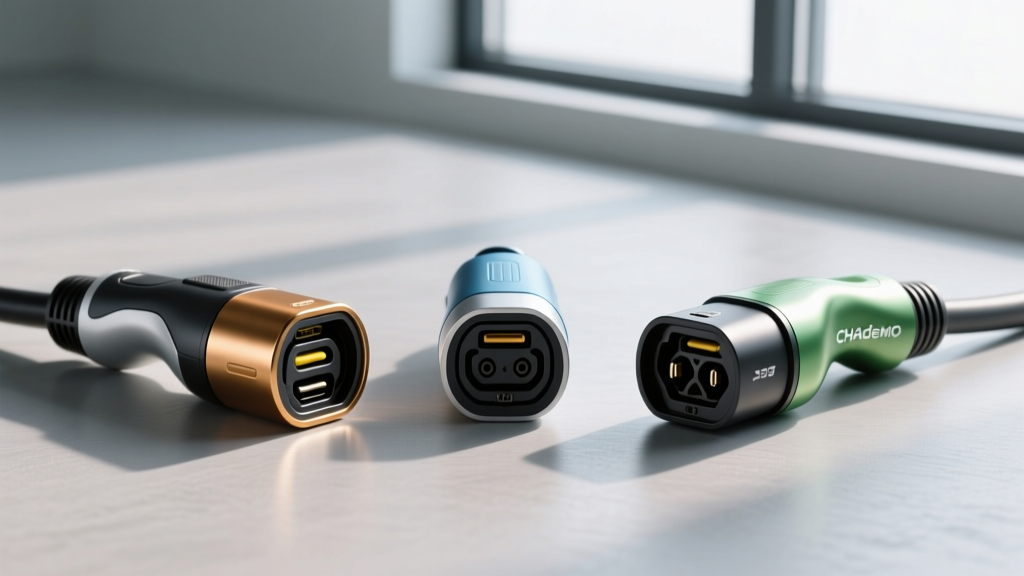
There are three main electric vehicle plugs on U.S. roads today. NACS (North American Charging Standard), developed by Tesla, is now the dominant standard — adopted by Ford, GM, Rivian, Hyundai/Kia, BMW, and most major automakers starting with 2025–2026 model-year vehicles. CCS (Combined Charging System) remains on most non-Tesla EVs built before 2025 and is still widely supported at public chargers. CHAdeMO is a legacy connector found only on the Nissan Leaf and Mitsubishi Outlander PHEV; no new vehicles use it.
For Level 2 (home and destination) AC charging, every EV except Tesla uses the J1772 connector. Tesla vehicles include a J1772 adapter in the glovebox. If you buy a CCS-equipped EV today, a CCS-to-NACS adapter (roughly $200–$250) unlocks Tesla Superchargers.
The Three Electric Vehicle Plug Types: Specs at a Glance
Before we break down each connector, here is a side-by-side comparison of the physical plug standards and their maximum charging capabilities. Note the critical distinction: kW (kilowatts) measures charging power — how fast energy flows — while kWh (kilowatt-hours) measures battery capacity — how much energy the pack stores.
| Plug Type | AC Level 2 Max | DC Fast Charge Max | Current Vehicles Using It | Future Outlook |
|---|---|---|---|---|
| NACS (J3400) | 19.2 kW (80A) | Up to 350 kW (theoretical); most vehicles peak 150–250 kW | Tesla (all years), Ford F-150 Lightning / Mustang Mach-E (2025+), GM Ultium vehicles (2025+), Rivian (2025+), Hyundai/Kia (2026+), BMW, Volvo, Polestar | Industry standard going forward |
| CCS1 (Combo) | 19.2 kW (via J1772 upper section) | Up to 350 kW (theoretical); most vehicles peak 150–270 kW | Hyundai Ioniq 5/6 (pre-2026), Kia EV6/EV9 (pre-2026), VW ID.4, BMW i4/iX (pre-2025), older Ford/GM EVs | Being phased out on new models; adapters available |
| CHAdeMO | N/A (uses J1772 for AC) | Up to 100 kW (most vehicles peak 50–62 kW) | Nissan Leaf (all years), Mitsubishi Outlander PHEV (older models) | Legacy only; no new vehicles |
| J1772 (AC only) | 19.2 kW (80A) | N/A (AC charging only) | Every EV for Level 2/home charging (Tesla via adapter) | Remains the AC standard indefinitely |
NACS: How Tesla's Connector Became the Industry Standard
When Tesla opened its proprietary connector as the North American Charging Standard in late 2022, it set off a chain reaction. By 2026, NACS — now formally codified as SAE J3400 — is the plug on the majority of new EVs sold in the U.S. The reasons are practical, not just political:
- Smaller and lighter: The NACS connector is roughly half the size and weight of a CCS plug, making it easier to handle, especially in cold weather when cables stiffen.
- One port for everything: NACS handles both AC (Level 1 and Level 2) and DC fast charging through the same compact inlet. CCS requires a larger, combined port with separate AC pins on top and DC pins below.
- Supercharger network access: Tesla's Supercharger network — over 25,000 stalls in North America — is consistently the most reliable DC fast-charging network, with uptime rates exceeding 95% according to third-party studies. This was the single biggest driver of automaker adoption.
Which 2026 Models Ship with NACS?
Most new EVs arriving for the 2025 and 2026 model years now feature a native NACS port. Key examples:
- Ford F-150 Lightning (2025+): NACS native; charges at up to ~150 kW DC on Superchargers
- Cadillac Optiq / Lyriq (2025+): NACS native; up to ~190 kW DC
- Rivian R1T / R1S (2025+): NACS native; up to ~200 kW DC
- Hyundai Ioniq 5 (2026 refresh): NACS native; up to ~240 kW DC on compatible chargers
- Kia EV6 (2026 refresh): NACS native
- All Tesla models: Model 3, Model Y, Model S, Model X, Cybertruck — NACS since day one
If you are shopping for a new EV in 2026, expect NACS on most vehicles. The main exception is any carryover model that hasn't been refreshed since the transition.
CCS: Still Functional, Still Supported — But Transitioning
If you own a CCS-equipped EV or are buying a slightly used one (2023–2024 model year), the connector is far from obsolete. Electrify America, EVgo, and ChargePoint continue to maintain CCS connectors at their stations, and most new DC fast-charging installations still include CCS cables alongside NACS.
The real limitation is Supercharger access. Tesla began opening select Supercharger stalls to non-Tesla CCS vehicles in 2024, but coverage is limited. The practical solution is a NACS-to-CCS adapter (for CCS cars visiting Superchargers) or a CCS-to-NACS adapter (for NACS cars visiting CCS-only stations). Expect to pay $180–$250 for a quality, UL-listed adapter from manufacturers like Lectron, A2Z, or Tesla's own CCS adapter ($250 direct from Tesla).
CCS Charging Speeds: What to Expect
CCS vehicles can charge at very high speeds — the connector itself supports up to 500 kW theoretically, though no production vehicle charges that fast. Real-world peaks:
- Hyundai Ioniq 5 (2024, CCS): Peaks at ~240 kW on a 350 kW Electrify America stall; 10–80% in approximately 18 minutes under ideal conditions
- VW ID.4 (2024, CCS): Peaks at ~170 kW; 10–80% in approximately 28 minutes
- BMW iX xDrive50 (2024, CCS): Peaks at ~200 kW; 10–80% in approximately 31 minutes (105.2 kWh usable battery)
Remember that peak kW is not sustained kW. Charging curves taper significantly above 80% State of Charge (SoC) to protect battery health. A vehicle that peaks at 240 kW at 20% SoC may drop to 60 kW by the time it reaches 85%.
CHAdeMO: The Legacy Connector You Can Skip (Unless You Drive a Leaf)
CHAdeMO was the original DC fast-charging standard, championed by Japanese automakers. Today, the Nissan Leaf remains the only widely available EV still using it, and Nissan has confirmed future EVs will adopt NACS.
The practical issue: CHAdeMO charging speeds top out around 50–62 kW on the Leaf (which has a 40 kWh or 60 kWh battery, depending on trim). That means a 10–80% charge takes roughly 40–60 minutes — significantly longer than modern NACS or CCS vehicles. CHAdeMO stalls are also being retired at many charging stations as operators prioritize NACS and CCS.
If you are considering a used Nissan Leaf, it remains a solid budget EV for commuting (EPA range up to 212 miles on the SV Plus trim with the 60 kWh pack). Just know that long road trips will require more planning and patience.
Home Charging: J1772, Wall Connectors, and What You Actually Need
Regardless of which DC fast-charging plug your EV uses, Level 2 home charging universally relies on the J1772 connector (or Tesla's proprietary connector, which is electrically identical to J1772 for AC). Here is what that means in practice:
| Charging Level | Voltage | Max Power (kW) | Miles of Range Added per Hour | Typical Use Case |
|---|---|---|---|---|
| Level 1 (120V) | 120V AC | 1.4–1.9 kW | 3–5 miles/hr | Overnight trickle; PHEV topping off |
| Level 2 (240V) | 240V AC | 7.2–19.2 kW | 20–60 miles/hr | Daily home/work charging; primary method for most owners |
| DC Fast Charge | 400–800V DC | 50–350 kW | 150–1,000+ miles/hr (at peak) | Road trips; rapid top-ups |
Home Charger Installation Cost Breakdown
Most EV owners install a Level 2 home charger on a 240V circuit. Costs vary widely depending on your electrical panel's capacity and the distance from the panel to your garage or driveway.
| Component | Typical Cost Range | Notes |
|---|---|---|
| Level 2 charger (hardware) | $350–$700 | Emporia Vue, ChargePoint Home Flex, Tesla Wall Connector |
| Electrician (labor + materials) | $500–$2,000 | Depends on run length, conduit, and local rates |
| Electrical panel upgrade (if needed) | $1,500–$4,000 | Required if your panel is 100A or less and lacks spare breaker slots |
| Permit | $50–$250 | Varies by municipality; some jurisdictions waive for EV chargers |
| Total (no panel upgrade) | $900–$2,950 | Most common scenario for a 200A panel |
| Total (with panel upgrade) | $2,400–$6,950 | Older homes with 100A service |
Always hire a licensed electrician and pull a permit. The IRS §30C credit may cover up to $1,000 of home charger installation costs for eligible taxpayers in qualifying census tracts — check current-year rules with a tax professional.
EV vs Gas: How Charging Connectors Factor into Real Costs
The plug on your EV affects more than just where you charge — it impacts charging speed, network reliability, and ultimately your cost per mile. Here is how a typical NACS-equipped EV compares to a gas vehicle on annual fueling costs:
| Factor | NACS-Equipped EV (e.g., 2026 Tesla Model Y Long Range) | Gas Equivalent (e.g., 2026 Toyota RAV4 AWD) |
|---|---|---|
| EPA Efficiency | 118 MPGe combined (28 kWh/100 mi) | 30 MPG combined |
| Annual Miles | 12,000 | 12,000 |
| Energy/Fuel Cost (annual) | ~$540 home charging ($0.16/kWh avg) / ~$1,340 if 100% public DC ($0.40/kWh avg) | ~$1,440 ($3.60/gal avg) |
| Network Access | Tesla Supercharger network (25,000+ stalls, 95%+ uptime) + CCS networks with adapter | 145,000+ gas stations nationwide |
| "Refueling" Time (typical) | Home: overnight (no active time). Road trip: 20–30 min per DC stop | 5 min per gas stop |
| Annual Maintenance | ~$300–$500 (no oil, fewer brake replacements due to regen) | ~$800–$1,200 (oil changes, transmission fluid, brake pads) |
Source: Efficiency data from fueleconomy.gov. Electricity and gas prices are U.S. averages and vary by region.
Adapter Strategy: What to Buy Based on Your EV's Plug
The transition from CCS to NACS means adapters are now an essential accessory. Here is a decision framework:
Your EV Has a NACS Port (2025+ Ford, GM, Rivian, Hyundai, Kia, Tesla)
- At home (Level 2): Use a Tesla Wall Connector or any NACS-compatible Level 2 charger. No adapter needed.
- Tesla Superchargers: Plug in directly. Use the Tesla app or your vehicle's built-in navigation for routing.
- Electrify America / EVgo / ChargePoint (CCS-only stalls): Carry a NACS-to-CCS adapter (~$200). This is critical for road trips through areas where Supercharger coverage is sparse.
Your EV Has a CCS Port (Pre-2025 Non-Tesla EVs)
- At home (Level 2): Use any J1772 charger. No adapter needed.
- Electrify America / EVgo / ChargePoint: Plug in directly with CCS.
- Tesla Superchargers: You need a CCS-to-NACS adapter (~$200–$250). Ford and GM provide or subsidize these adapters for their EV owners. Check availability for your brand.
Your EV Has a CHAdeMO Port (Nissan Leaf)
- At home: J1772 Level 2 charger. No adapter needed for AC charging.
- DC fast charging: Use CHAdeMO stations (increasingly rare). No practical adapter exists from CHAdeMO to NACS or CCS.
- Road trips: Plan routes carefully using PlugShare or A Better Routeplanner to find remaining CHAdeMO stalls.
Common Misconceptions About EV Plugs — Myth vs. Fact
| Myth | Fact |
|---|---|
| "There are too many plug types — it's too confusing to buy an EV." | As of 2026, NACS is the clear standard. Home charging uses J1772 universally. The only complexity is carrying one adapter for road trips — similar to carrying a phone charging dongle. |
| "CCS chargers are going away, so my CCS car will be useless." | CCS infrastructure is not disappearing overnight. Networks like Electrify America are adding NACS cables alongside CCS. A $200 adapter keeps your CCS car compatible with NACS-only stations. |
| "Tesla Superchargers only work with Teslas." | Since 2024, Tesla has opened Superchargers to non-Tesla NACS vehicles. Ford, GM, Rivian, and other NACS-equipped EVs can charge at Superchargers natively. CCS vehicles can access select Superchargers with an adapter and the Tesla app. |
| "I need a special electrical outlet for every plug type." | Your home Level 2 charger uses J1772 (or Tesla's connector) regardless of your car's DC fast-charge port. One home charger works for every EV you will ever own — you just might need the car's included adapter. |
| "NACS charges slower than CCS because the plug is smaller." | Connector size does not determine charge speed. NACS supports up to 350 kW DC theoretically, matching CCS. Actual charge speed is determined by the vehicle's onboard charging system and battery chemistry, not the plug shape. |
First-Time EV Buyer's Plug Checklist
If you are shopping for your first EV, here is what to verify before signing the paperwork:
- What plug does the vehicle have? Check the spec sheet. For 2026 models, expect NACS on most brands; CCS on carryover models; CHAdeMO only on the Nissan Leaf.
- Does your home electrical panel support Level 2? You need a dedicated 240V circuit (typically 40A or 50A). Get a quote from a licensed electrician before purchase.
- Which adapter(s) do you need? If your EV has CCS, budget for a CCS-to-NACS adapter for Supercharger access. If your EV has NACS, budget for a NACS-to-CCS adapter for non-Tesla DC chargers.
- What does your road-trip corridor look like? Search PlugShare or your EV's built-in route planner for charger availability along your most common long-distance routes.
- Does the vehicle qualify for the §30D federal tax credit? The credit — up to $7,500 — depends on MSRP caps ($55,000 for sedans, $80,000 for SUVs/trucks), buyer income limits, and battery critical-mineral sourcing requirements. Rules are current-year specific; verify on irs.gov or with a tax professional.
Frequently Asked Questions
Can I charge a NACS car at a CCS station?
Yes, with a NACS-to-CCS adapter ($180–$250). Plug the adapter into the station's CCS cable, then plug the adapter into your NACS port. Charging speed will be limited by the station's kW output and your vehicle's maximum charge rate.
Can I charge a CCS car at a Tesla Supercharger?
Yes, at select Supercharger stalls equipped with Tesla's "Magic Dock" CCS adapter or by using your own CCS-to-NACS adapter. Access is expanding but not universal — check the Tesla app for station compatibility before driving there.
Is J1772 being phased out?
No. J1772 remains the standard for AC Level 1 and Level 2 charging across all EVs. Even Tesla vehicles use J1772-compatible AC charging (via an included adapter or a Tesla Wall Connector). Only the DC fast-charging connectors are transitioning to NACS.
Do I need a different home charger if I switch from a Tesla to a Ford or vice versa?
Not necessarily. If you have a hardwired Tesla Wall Connector, it has a NACS plug — perfect for any NACS-equipped vehicle (Ford, GM, Rivian, etc. from 2025+). If you switch to a CCS vehicle, you would need either a J1772 home charger or a J1772-to-CCS adapter. Universal J1772 home chargers (like the ChargePoint Home Flex) work with every EV using the car's included adapter.
Will CHAdeMO stations disappear entirely?
CHAdeMO infrastructure is declining as operators prioritize NACS and CCS. While some stations still maintain CHAdeMO cables — particularly in areas with high Nissan Leaf adoption — new installations rarely include them. If you rely on CHAdeMO for DC fast charging, plan for reduced availability over time.
Does the plug type affect my EV's charging speed?
The plug type sets the maximum theoretical speed, but your vehicle's onboard charger, battery chemistry (LFP vs. NMC), and thermal management system determine actual charging speed. A Hyundai Ioniq 5 charges at ~240 kW whether it has a CCS port (2024) or a NACS port (2026), because the vehicle's 800V architecture — not the plug — is the bottleneck.