For fleet managers and small business owners, electric vehicle fleet leasing offers a concrete path to lower per-mile operating costs, but the math depends heavily on your duty cycles, depot charging access, and how you structure the lease to capture federal incentives. The short answer: leasing EVs for a fleet typically yields a 20–40% lower total cost of ownership (TCO) versus equivalent internal combustion engine (ICE) vehicles over a 3-to-5-year term, driven primarily by fuel and maintenance savings — but only if your routes align with current battery range and charging infrastructure realities.
Quick Answer: Is EV Fleet Leasing Worth It?
Yes, for predictable, depot-based routes under 200 miles/day. Fleets that return to a central yard nightly and can install Level 2 chargers see the fastest payback. The §45W commercial clean vehicle credit (up to $7,500 for light-duty, $40,000 for heavy-duty) applies to leased vehicles under IRC §30D commercial rules when structured properly through a lessor. Monthly lease payments for popular fleet EVs like the Ford E-Transit or Chevrolet Bolt EUV typically range from $450–$850/month depending on term, mileage allowance, and residual.
The Business Case for EV Fleet Leasing vs. Buying
Leasing shifts the risk of battery degradation, residual value uncertainty, and technology obsolescence to the lessor. For a fleet of 20 vehicles, this matters enormously. A 2026-model-year EV battery carries an 8-year/100,000-mile warranty (mandated minimum under federal law), but actual degradation curves vary by chemistry. Lithium Iron Phosphate (LFP) packs — now standard in base-trim Tesla Model 3, Ford F-150 Lightning standard range, and several commercial vans — retain roughly 90–92% capacity after 100,000 miles. Nickel Manganese Cobalt (NMC) packs typically retain 85–88% over the same distance.
When you lease, you're paying for the depreciation slice of the vehicle's life, not the full asset. This means:
- Lower upfront capital outlay: Typical commercial EV leases require first month's payment plus a security deposit ($1,000–$3,000 per vehicle), versus $35,000–$65,000 purchase price per unit.
- Predictable monthly costs: Lease payments lock in for 24–48 months, simplifying fleet budgeting.
- Tech refresh cycles: A 36-month lease lets you cycle into newer models with better range and faster charging without disposing of depreciated assets.
- Maintenance inclusion: Many commercial fleet leases bundle scheduled maintenance, reducing administrative overhead.
EV vs. Gas Fleet: The Real Cost Comparison
The table below compares a mid-size electric fleet vehicle (2026 Chevrolet Equinox EV Fleet, 315 miles EPA range, 85 kWh LFP battery) against its gasoline counterpart (2026 Chevrolet Equinox AWD, 28 MPG combined) over a 4-year, 60,000-mile lease term. Electricity priced at $0.14/kWh (commercial average); gasoline at $3.45/gallon (national average as of early 2026).
| Cost Category | EV (Equinox EV Fleet) | Gas (Equinox AWD) | Difference |
|---|---|---|---|
| Lease/Acquisition Cost | $27,600 ($575/mo × 48) | $21,120 ($440/mo × 48) | +$6,480 EV |
| Fuel/Energy | $2,940 (8,820 kWh) | $7,410 (2,143 gallons) | −$4,470 EV |
| Maintenance | $1,800 (tires, cabin filter, fluid top-offs) | $3,600 (oil, filters, brakes, belts) | −$1,800 EV |
| Insurance | $7,200 ($150/mo avg) | $6,000 ($125/mo avg) | +$1,200 EV |
| Federal Tax Credit (§45W) | −$7,500 (passed through lessor) | $0 | −$7,500 EV |
| Depot Charging Install (amortized) | $1,600 ($400/vehicle share) | $0 | +$1,600 EV |
| Total 4-Year Cost | $33,640 | $38,130 | −$4,490 EV savings |
| Cost Per Mile | $0.561 | $0.636 | −$0.075/mi EV |
For a fleet of 20 vehicles, that's roughly $89,800 in savings over four years. The breakeven point typically arrives between months 24 and 30, depending on local electricity rates and how aggressively the lessor passes through the tax credit.
How Federal Tax Credits Work for Fleet Leases
This is where most fleet managers get tripped up. Under IRS §45W, the commercial clean vehicle credit is available to businesses and tax-exempt organizations. The credit is up to $7,500 for vehicles under 14,000 lbs GVWR and up to $40,000 for heavier vehicles. However, the credit technically goes to the owner of the vehicle — which in a lease is the lessor (the leasing company).
Here's how to ensure your fleet benefits:
§45W Commercial Credit Checklist for Fleet Leases
- Lessor pass-through: Confirm in writing that the leasing company passes the full $7,500 credit to you as a capitalized cost reduction or monthly payment reduction. Major fleet lessors (Element, Holman, ARI) now routinely do this.
- Vehicle eligibility: The vehicle must be a qualified plug-in EV or fuel cell vehicle with ≥7 kWh battery capacity (virtually all current fleet EVs qualify).
- MSRP caps: Unlike the consumer §30D credit, the §45W commercial credit has no MSRP cap — critical for larger fleet vehicles like the F-150 Lightning Pro ($59,990 MSRP) or E-Transit ($47,995 MSRP).
- Income caps: No adjusted gross income limitation for commercial entities.
- Domestic assembly: Vehicle must be assembled in North America (check VIN — first character 1, 4, or 5 for US; 2 for Canada; 3 for Mexico).
- Business use: Vehicle must be used predominantly in the US for business purposes.
Pro tip: Some lessors offer a "commercial lease with credit pass-through" structure where the $7,500 reduces the capitalized cost at signing, lowering your monthly payment by roughly $150–$175/month on a 48-month term. Always request the lease worksheet showing the credit application before signing.
Charging Infrastructure: The Make-or-Break Factor
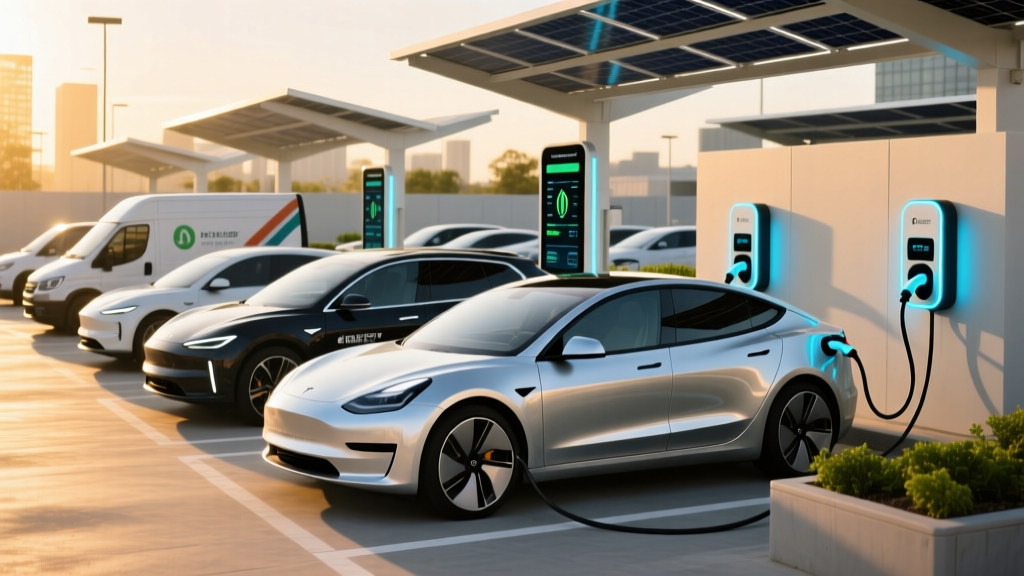
No EV fleet lease succeeds without a charging plan. For depot-based fleets (vehicles return nightly), Level 2 charging is the backbone. Here's what installation actually costs and looks like for a 10-vehicle fleet:
| Component | Unit Cost | Quantity | Total |
|---|---|---|---|
| Level 2 Chargers (48A/11.5 kW, commercial-grade) | $1,200–$2,500 | 10 | $12,000–$25,000 |
| Electrical panel upgrade (400A service) | $5,000–$15,000 | 1 | $5,000–$15,000 |
| Wiring, conduit, trenching (10 stalls) | $800–$2,000/stall | 10 | $8,000–$20,000 |
| Permitting & inspections | $2,000–$5,000 | 1 | $2,000–$5,000 |
| Smart charging software (load management) | $50–$100/mo | 12 months | $600–$1,200 |
| Total Estimated Cost | $27,600–$66,200 | ||
| Per-Vehicle Amortized (4 years) | $690–$1,655 | ||
Smart load management software (from providers like ChargePoint, EVgo Business, or AmpX) is critical for a 10-vehicle depot. Without it, 10 chargers pulling 11.5 kW each would demand 115 kW simultaneously — requiring a massive (and expensive) utility service upgrade. With managed charging, vehicles charge sequentially or at staggered rates, typically capping depot draw at 40–60 kW total. This can cut your panel upgrade cost by 50% or more.
Charging speed reality check: A commercial EV like the Ford E-Transit (68 kWh usable, LFP) charges at a peak of 115 kW on DC fast charging. But at a depot on Level 2 at 11.5 kW, a full 0–100% charge takes roughly 6 hours — perfectly adequate for overnight turnaround. The key metric is not peak DC speed but whether your overnight window covers the energy consumed during the day's routes.
Which Fleet EVs Make Sense? A Decision Framework
Fleet EV Selection: Choose Based on Duty Cycle
Choose a compact EV (Bolt EUV, Equinox EV) if:
- Daily routes are under 180 miles (real-world range ~250 miles in mild weather, ~200 in cold)
- Vehicles are sedans/crossovers for sales reps, inspectors, or home health workers
- Budget is $35,000–$45,000 MSRP per unit
- Lease target: $450–$600/month
Choose a mid-size EV (Tesla Model Y, Ioniq 5) if:
- Daily routes are under 220 miles (real-world highway range ~260 miles)
- You need DC fast charging capability for occasional longer trips (peak 250 kW on Model Y, 10–80% in ~18 min)
- Cargo flexibility is needed (hatchback/liftgate)
- Budget is $42,000–$55,000 MSRP per unit
- Lease target: $550–$750/month
Choose a commercial van (E-Transit, BrightDrop Zevo 600) if:
- Daily routes are under 120 miles (E-Transit real-world range ~108–126 miles loaded)
- You need cargo volume (up to 487 cu ft in E-Transit high-roof extended)
- Vehicles return to depot nightly with predictable schedules
- Budget is $48,000–$75,000 MSRP per unit
- Lease target: $650–$950/month
Stick with gas or PHEV if:
- Routes exceed 250 miles daily with no mid-day charging opportunity
- Vehicles operate in extreme cold (below 0°F) where range drops 30–40%
- You operate in areas with no public DC fast charging infrastructure and no depot charging option
- Upfitting requires PTO or heavy auxiliary loads not yet supported by EV platforms
Common Fleet EV Misconceptions — Corrected
| Myth | Fact |
|---|---|
| "EV batteries need replacing every 5 years" | Modern LFP batteries retain 90%+ capacity at 100,000 miles. DOE/EPA data shows median degradation of 2.3% per year across all chemistries. Warranty covers 8 years/100,000 miles minimum, and most leases end well before meaningful degradation. |
| "Charging takes too long for fleet operations" | Depot Level 2 charging adds ~35–40 miles of range per hour. An overnight 8-hour window replenishes 280+ miles — more than 95% of fleet duty cycles consume daily. DC fast charging (for mid-day top-ups) adds 150+ miles in 20 minutes on current platforms. |
| "EV insurance is unaffordable for fleets" | Commercial EV fleet insurance premiums run 15–25% higher than ICE equivalents, but the gap has narrowed since 2024 as repair networks expanded and claims data matured. Factor this into TCO — it's a real cost, not a dealbreaker. |
| "There's no charging infrastructure" | As of 2026, the US has over 200,000 public charging ports (AFDC). For depot-based fleets, public charging is supplementary — your Level 2 yard handles 95% of needs. For route-based fleets, tools like A Better Routeplanner integrate commercial vehicle profiles. |
| "Cold weather kills EV range" | Real, but quantifiable: at 20°F, expect 20–30% range reduction. At 0°F, up to 40%. Preconditioning (warming the battery while plugged in) recovers 10–15% of that loss. For cold-climate fleets, spec vehicles with heat pumps (standard on Ioniq 5, Model Y) — they reduce HVAC energy draw by 30–50% versus resistive heaters. |
First-Time EV Fleet Buyer: What You Must Know Before Signing
If this is your first electrified fleet transition, these five items separate successful deployments from expensive mistakes:
- Audit your duty cycles first. Pull GPS or telematics data from your current vehicles. You need daily mileage, stop frequency, idle time, and return-to-depot timing. Any route consistently under 200 miles/day is an EV candidate. Routes with high stop frequency (delivery, service calls) actually benefit more from EVs because regenerative braking recovers energy in stop-and-go driving and eliminates brake wear.
- Get a utility demand charge analysis. Commercial electricity rates include demand charges ($/kW) based on your peak draw. Ten Level 2 chargers running simultaneously can spike your demand charge significantly. Contact your utility's commercial EV program — many now offer managed charging rate structures or infrastructure rebates that offset 50–80% of installation cost.
- Negotiate the lease around the tax credit. Request a "closed-end commercial lease" with the §45W credit applied as a cap cost reduction. Verify the money factor (lease interest equivalent), residual value, and mileage allowance (typically 12,000–15,000 miles/year for commercial leases; excess mileage penalties run $0.15–$0.25/mile).
- Plan charging for year one, not year five. Don't overbuild infrastructure. Start with chargers for 50–70% of your fleet count, then expand as you add vehicles. Smart load management lets you scale without re-doing electrical work.
- Train your drivers. EV fleet drivers need 30–60 minutes of orientation covering: regenerative braking behavior, one-pedal driving mode, preconditioning routines, charging plug operation, and range-estimation display interpretation. Fleets that skip training see 10–15% higher energy consumption from inefficient driving habits.
Fleet EV Leasing FAQ
Can my business claim the $7,500 EV tax credit on a leased vehicle?
Under §45W, the commercial credit goes to the vehicle owner — which is the lessor in a lease. However, most major commercial fleet lessors pass the credit through as a capitalized cost reduction, effectively lowering your monthly payment. Confirm this in writing before signing. The credit is non-refundable but can offset tax liability for your business entity.
What happens if the EV battery degrades significantly during the lease?
Federal law mandates a minimum 8-year/100,000-mile battery warranty covering capacity loss below 70% of original. Most 36–48 month leases end well before this threshold. If degradation exceeds warranty limits, the manufacturer replaces the battery at no cost to the lessor or lessee. In practice, modern LFP and NMC packs rarely trigger warranty claims within the first 100,000 miles.
How does EV fleet leasing compare to a traditional gas fleet lease in monthly cost?
Monthly lease payments for EVs are typically 10–20% higher than equivalent ICE vehicles due to higher MSRP. However, when you factor in fuel savings ($0.04–$0.05/mile for electricity vs. $0.12–$0.15/mile for gasoline) and maintenance savings (roughly $0.03/mile less), the total monthly operating cost is usually 8–15% lower for EVs on routes under 200 miles/day.
Do I need to install chargers before taking delivery of leased EVs?
Yes. Plan for a 60–90 day lead time from electrical contractor engagement to energized chargers. This includes site assessment, utility coordination, permitting, installation, and inspection. Order chargers and begin electrical work before signing vehicle lease agreements to avoid paying for vehicles that sit idle.
What's the end-of-lease process for a commercial EV?
Standard closed-end commercial leases work the same as ICE: return the vehicle at term end, pay any excess mileage or wear charges, and walk away or lease a new vehicle. The lessor handles battery health assessment and resale. There is no separate battery return or disposal obligation for the lessee. Some lessors now offer purchase options at lease end at the predetermined residual value — which can be attractive if the vehicle has been well-maintained and you want to extend its service life.
Is EV fleet leasing available for heavy-duty vehicles like box trucks or semis?
Yes, but the market is narrower. Heavy-duty EV leases are available for vehicles like the BrightDrop Zevo 600 (step-in van, 250-mile range), Ford E-Transit cutaway, and select Class 8 electric trucks from manufacturers like Volvo and Peterbilt. The §45W credit increases to up to $40,000 for vehicles over 14,000 lbs GVWR. Lease terms tend to be longer (48–72 months) due to higher acquisition costs. Infrastructure requirements scale significantly — DC fast charging at 150–350 kW becomes necessary for heavy-duty depot operations.