The Quick Answer
An electric vehicle fleet conversion in 2026 typically costs $45,000–$75,000 per light-duty vehicle before incentives, with the IRS §30D clean vehicle credit offering up to $7,500 per qualifying unit and the §45W commercial credit providing up to $7,500 for vehicles under 14,000 lbs GVWR (or $40,000 for heavier classes). Most fleets with predictable sub-150-mile daily routes see fuel and maintenance savings of $3,500–$6,000 per vehicle annually, reaching break-even in 4–7 years depending on duty cycle, local electricity rates, and charging infrastructure costs. The conversion is strongest for last-mile delivery, municipal, and service fleets that depot-charge overnight — and weakest for long-haul or extreme-cold operations without careful route planning.
Why Fleets Are Going Electric Now
Fleet electrification has shifted from early-adopter experiment to mainstream operations strategy. The economics have changed dramatically: battery pack prices have fallen below $120/kWh at the cell level for many LFP (lithium iron phosphate) platforms, commercial electricity rates average $0.12–$0.18/kWh in most U.S. markets, and the commercial vehicle lineup has matured beyond a handful of options.
For a fleet manager running 20 Class 2–3 vans or pickups covering 80–120 miles daily, the math is increasingly compelling. A Ford E-Transit (EPA-estimated 126 miles range, 68 kWh usable battery) or a BrightDrop Zevo 600 (EPA-estimated 272 miles range, 165 kWh battery) can cover most urban and suburban routes on a single overnight charge at a depot Level 2 charger.
The key driver isn't environmental sentiment — it's total cost of ownership (TCO). Electric drivetrains eliminate oil changes, transmission fluid, exhaust systems, and most brake wear (regenerative braking extends pad life to 100,000+ miles in stop-and-go fleet duty). According to fueleconomy.gov, a commercial EV operating at 2.0–2.5 kWh/mile costs roughly $0.06–$0.09 per mile to "fuel" on commercial electricity, versus $0.18–$0.24 per mile for a comparable gasoline van at $3.50/gallon and 15 MPG combined.
Comparing Fleet EVs to Gas and Hybrid Alternatives
The decision isn't simply EV vs. gas — many fleets also consider plug-in hybrids (PHEVs) as a bridge. Here's how the numbers stack up for a typical light-duty commercial van operating 25,000 miles/year:
| Category | BEV (e.g., E-Transit) | PHEV (e.g., Pacifica Hybrid) | Gas (e.g., Transit 3.5L V6) |
|---|---|---|---|
| Fuel / Energy Cost | $2,000–$2,500 | $2,800–$3,600 | $5,800–$6,000 |
| Maintenance | $600–$900 | $1,400–$1,800 | $2,200–$2,800 |
| Insurance (avg) | $2,400–$3,200 | $2,000–$2,600 | $1,800–$2,400 |
| Estimated Annual Total | $5,000–$6,600 | $6,200–$8,000 | $9,800–$11,200 |
Key observations: BEVs save $3,500–$5,000/year per vehicle in fuel and maintenance alone. Insurance runs 15–35% higher for EVs due to repair costs for battery enclosures and specialized labor — a real cost that fleet budgets must absorb. PHEVs offer a middle ground but still require oil changes and carry dual-powertrain maintenance complexity.
The Real Costs: Purchase, Charging Infrastructure, and Incentives
An electric vehicle fleet conversion isn't just about swapping vehicles — it's an infrastructure project. Here's a realistic cost breakdown for a 10-vehicle light-duty depot conversion in 2026:
| Item | Cost Range | Notes |
|---|---|---|
| 10× BEV Vans ($50K–$65K each) | $500,000–$650,000 | Before incentives; LFP trims often cheaper |
| 10× Level 2 Chargers (19.2 kW) | $8,000–$15,000 | Hardware only; smart/networked units |
| Electrical Panel Upgrade | $5,000–$25,000 | May need 400A–800A service; varies widely |
| Electrician + Trenching + Conduit | $15,000–$45,000 | Depends on distance from panel to parking |
| Permits + Utility Interconnection | $2,000–$8,000 | Demand charges may apply; negotiate with utility |
| Fleet Management Software | $2,000–$5,000/yr | Charge scheduling, telematics, SoC monitoring |
| Total Infrastructure | $32,000–$98,000 | One-time; amortize over fleet life |
Incentive stack: The §45W commercial clean vehicle credit provides up to $7,500 per qualifying light-duty vehicle (or $40,000 for vehicles over 14,000 lbs GVWR). Many states and utilities layer on additional rebates — California's Hybrid and Zero-Emission Truck and Bus Voucher Incentive Project (HVIP), for example, can cover $20,000–$60,000 per Class 2b–8 vehicle. Utility demand-charge credits or make-ready programs can offset 50–100% of infrastructure costs in some territories. Always verify current-year eligibility with a tax professional and your local utility.
Charging Logistics: What Fleet Operators Must Plan For
The single biggest mistake in fleet electrification is underestimating charging infrastructure lead time. Utility interconnection for a 10-charger depot can take 6–18 months from application to energization, especially if a new transformer or service upgrade is required.
Charging Speeds and Fleet Scheduling
For depot-based overnight charging, Level 2 is the workhorse:
| Level | Power (kW) | Miles Added/Hour | Best For |
|---|---|---|---|
| Level 1 (120V) | 1.4–1.9 kW | 4–6 mi/hr | Not viable for fleet use |
| Level 2 (240V, 19.2 kW) | 7.2–19.2 kW | 22–58 mi/hr | Overnight depot charging (primary) |
| DC Fast Charge | 50–150+ kW | 150–400+ mi/hr | Mid-day top-ups, route extension |
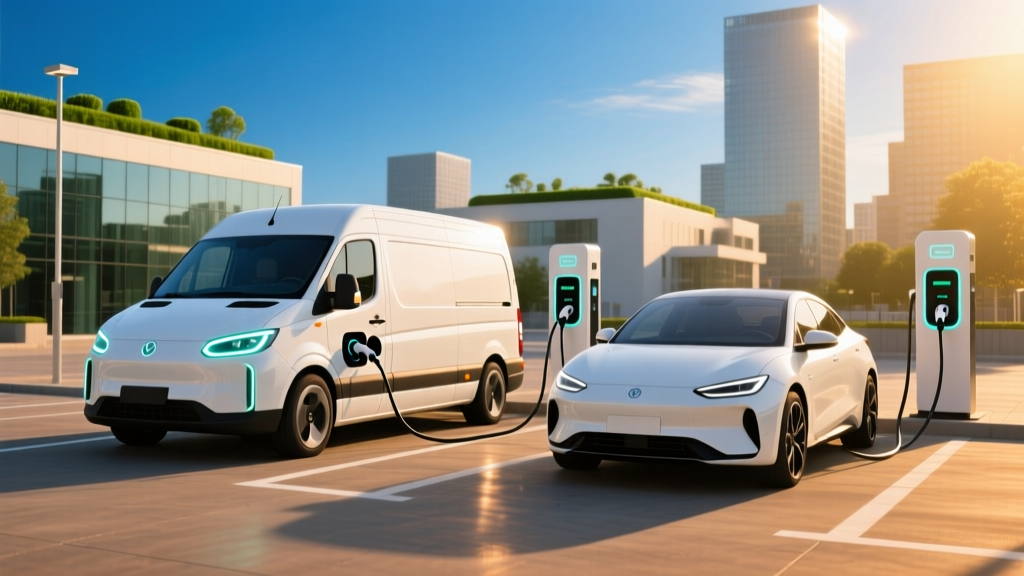
A 19.2 kW Level 2 charger can fully replenish a 68 kWh E-Transit battery in roughly 4.5 hours — ideal for overnight depot cycles. For fleets running two shifts or needing mid-day top-ups, a single 50–150 kW DC fast charger at the depot can add 80–120 miles of range in 20–30 minutes (real-world, accounting for charge-curve taper above 80% SoC).
Charge-curve reality: Peak kW ratings are not sustained rates. A van rated for 115 kW DC fast charging will typically sustain that peak only between 10–40% SoC, then taper progressively. Plan mid-day charging stops for the 10–70% window where speeds are highest, and avoid routine charging above 85% unless needed for route completion — this also extends battery longevity.
Cold-Weather Range Loss
Fleets operating in northern climates must budget for significant range reduction. At 20°F, expect 25–40% range loss versus EPA estimates, driven by cabin heating loads and reduced battery efficiency. A van rated at 126 miles EPA may deliver only 75–95 miles in January in Minnesota. Solutions include:
- Specifying vehicles with heat pumps (30–40% more efficient heating than resistive elements)
- Preconditioning batteries and cabins while still plugged in at the depot
- Reducing winter route lengths or adding mid-day DC fast-charge stops
- Considering LFP chemistry limitations — LFP batteries lose more capacity in extreme cold than NMC, though they offer longer cycle life and lower cost
Battery Longevity, Warranty, and Replacement Risk
Fleet buyers thinking in 7–10 year vehicle lifecycles need concrete battery data:
- Warranty: Most commercial EVs carry 8-year/100,000-mile battery warranties guaranteeing ≥70% capacity retention. Ford's E-Transit, for example, warranties its 68 kWh pack at 70% retention for 8 years or 100,000 miles.
- Degradation data: Real-world fleet data from early EV adopters (e.g., Amazon's Rivian EDV fleet, various municipal Leaf deployments) shows 10–15% capacity loss over 5 years and 80,000–120,000 miles of typical duty-cycle use. LFP packs tend to degrade more slowly than NMC in high-cycle applications.
- Replacement cost: Out-of-warranty battery replacement for a commercial van runs $12,000–$25,000 in 2026 — a real risk for high-mileage fleets. Factor this into 10-year TCO models.
Common Fleet EV Myths vs. Reality
| Myth | Fact |
|---|---|
| "EVs don't have enough range for fleet routes" | 75% of U.S. commercial fleet vehicles travel under 120 miles/day. Most current commercial BEVs cover this with margin. |
| "Charging infrastructure is too expensive" | Depot Level 2 for 10 vehicles: $32K–$98K total. Utility make-ready programs and §45W credits can offset 40–70%. |
| "Batteries won't last the vehicle's life" | Modern LFP/NMC packs are warrantied for 8yr/100K mi at 70%+ capacity. Fleet data shows 10–15% loss at 5 years. |
| "EVs cost more to insure" | True — typically 15–35% higher premiums. Factor this into TCO; it rarely erases fuel/maintenance savings. |
| "You need DC fast chargers at every depot" | Most depot fleets need only Level 2 overnight. One DC unit per 10–15 vehicles handles mid-day exceptions. |
Decision Framework: Is Fleet Electrification Right for Your Operation?
If X, Then Y — Fleet EV Suitability
- If your vehicles return to a central depot nightly AND daily routes are under 150 miles → Strong candidate for full BEV conversion. Start with Level 2 depot charging.
- If your routes vary between 50–250 miles daily with unpredictable detours → Consider a mixed fleet: BEVs for predictable short routes, PHEVs or gas for variable/long routes.
- If you operate in extreme cold (sustained sub-20°F) without garage parking → Budget 35–40% range loss; spec heat pumps; consider NMC chemistry for better cold performance, or retain PHEVs for winter months.
- If your depot electrical service is under 200A and upgrade costs exceed $30,000 → Engage your utility early. Many offer make-ready programs covering transformer and service upgrades. Timeline: 6–18 months.
- If vehicles are on the road 16+ hours/day (double shifts) → BEV-only may not work without mid-day DC fast charging. Evaluate DC infrastructure cost or retain hybrid units for high-utilization routes.
- If your fleet includes Class 4–8 heavy trucks → The §45W credit jumps to $40,000 per vehicle. Vehicles like the Tesla Semi, Freightliner eCascadia, or Volvo VNR Electric are viable for drayage and regional haul. Charging infrastructure scales to 350+ kW per stall — engage utility and charger OEM early.
First-Time Fleet EV Buyer Checklist
If you're managing your first electric vehicle fleet conversion, here's what separates successful deployments from costly missteps:
- Audit daily route data before buying anything. Pull GPS/telematics data for 90 days. Identify max daily miles, longest single route, and vehicles that exceed 130% of your target BEV range. Those outliers determine your fleet mix.
- Engage your utility before signing vehicle POs. Demand charges, interconnection timelines, and make-ready incentives vary enormously. Some utilities will fund the entire service upgrade for commercial EV adoption.
- Buy chargers with load management. Networked Level 2 units (ChargePoint, EVBox, Blink) with dynamic load balancing let you run 10 chargers on a smaller electrical service by distributing available amperage based on each vehicle's SoC.
- Spec LFP batteries for high-cycle, depot-charged fleets. LFP chemistry offers 3,000–5,000+ full cycles vs. 1,000–2,000 for NMC, lower cost per kWh, and no cobalt/nickel supply-chain risk. Trade-off: lower energy density (heavier pack for same range) and worse extreme-cold performance.
- Train drivers on regen braking and preconditioning. One-pedal driving and proper preconditioning can recover 10–15% of range versus untrained driving habits. This is the lowest-cost range extension available.
- Model TCO over 7 years, not sticker price. Include the §45W credit, state incentives, utility rebates, electricity cost, maintenance reduction, insurance increase, and battery replacement risk at year 8–10. Most fleet TCO models show BEV parity or advantage by year 4–5.
Frequently Asked Questions
Does the §45W commercial clean vehicle credit apply to all fleet EVs?
The §45W credit provides up to $7,500 for vehicles under 14,000 lbs GVWR and up to $40,000 for heavier vehicles. However, the vehicle must be from a qualified manufacturer, meet battery-sourcing requirements that tighten annually, and your business must have sufficient tax liability to use the credit (it is not refundable, though it can be transferred in some structures). Consult a tax professional and review current IRS guidance before projecting incentives into your TCO model.
Can we use public charging networks for fleet vehicles instead of depot chargers?
You can, but it's not recommended as a primary strategy. Public DC fast charging costs $0.35–$0.55/kWh (versus $0.12–$0.18 for depot Level 2), charger uptime averages 78–85% on many networks, and drivers lose 20–40 minutes per session. Reserve public charging for route emergencies and occasional overflow — not daily operations.
What happens if a fleet EV battery fails out of warranty?
Replacement costs $12,000–$25,000 for light-duty commercial vans. Some fleets mitigate this by purchasing extended battery warranties, leasing vehicles (shifting risk to the lessor), or planning a 7-year vehicle replacement cycle that stays within the 8-year factory battery warranty. Third-party battery refurbishment is emerging as a lower-cost option ($6,000–$12,000) but availability varies by model.
How does towing or heavy payload affect EV fleet range?
Significantly. A fully loaded E-Transit (max payload ~3,800 lbs) or a van towing 5,000 lbs can see 25–40% range reduction versus empty-cargo EPA estimates. If your fleet routinely operates at max payload, spec vehicles with 30–40% more range than your longest route requires, or plan mid-day charging.
Is V2L (vehicle-to-load) useful for commercial fleets?
For service fleets (electricians, HVAC, construction), V2L capability — where the vehicle battery powers external tools and equipment — can eliminate the need for separate generators. The Ford F-150 Lightning's Pro Power Onboard, for example, provides up to 9.6 kW of continuous 240V output. This is a genuine productivity feature that gas vans can't match without carrying fuel and a generator.