The idea of swapping a gas engine for an electric motor in a classic or beloved car is appealing, but an electric vehicle conversion is a complex, expensive project that rarely makes financial sense compared to buying a purpose-built EV. In 2026, a professional EV conversion typically costs between $20,000 and $50,000 on top of the donor vehicle price, yields 80–180 miles of real-world range, and comes with no federal tax credits, no warranty, and significant registration hurdles depending on your state.
That doesn't mean conversions are pointless — they're ideal for classic car enthusiasts who want to preserve a vintage body with modern, reliable, zero-tailpipe-emission drivetrains. But if your goal is simply to save money on fuel or commute in an EV, a conversion is almost never the right path. Below, we break down exactly what an EV conversion involves, what it costs, how the range and charging stack up against production EVs, and who should (and shouldn't) consider one.
Quick Answer: A full electric vehicle conversion in 2026 costs $20,000–$50,000+ (parts and labor) plus the donor vehicle. Expect 80–180 miles of real-world range, Level 2 home charging only (no DC fast charging in most builds), and zero eligibility for the federal §30D tax credit. For daily transportation, a new or used production EV is cheaper, safer, and more practical. Conversions make sense primarily for classic/enthusiast vehicles where preservation is the goal.
What an Electric Vehicle Conversion Actually Involves
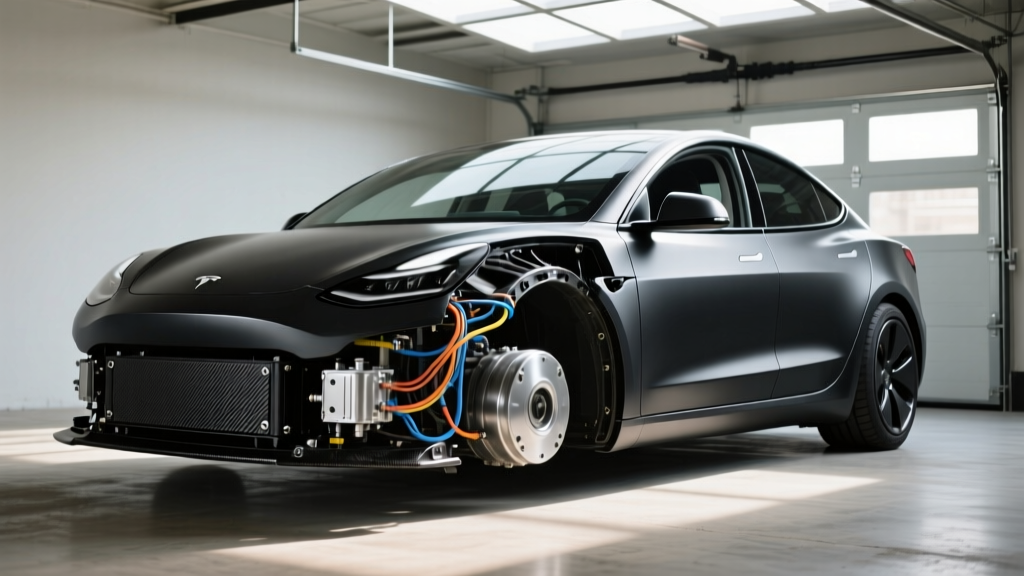
An EV conversion replaces a vehicle's internal combustion engine, fuel tank, exhaust system, and transmission with an electric motor, motor controller, battery pack, onboard charger, and associated wiring and thermal management. The donor vehicle's 12V electrical system, brakes, steering, and HVAC may also need modification or upgrades to work with the new powertrain.
Key components in a typical conversion include:
- Electric motor: Commonly sourced from salvaged Tesla drive units, NetGain Hyper9 motors, or Cascade Motion systems. Output ranges from 80 kW (~107 hp) to 200+ kW (~268+ hp) depending on the build.
- Battery pack: Salvaged Tesla modules, Chevy Bolt packs, or new LiFePO4 (LFP) packs from suppliers like Thunderstruck Motors or EV West. Usable capacity typically runs 25–60 kWh in most builds.
- Motor controller: Matches the motor — examples include the Cascade Motion CM2000 or Tesla inverter paired with an open-source controller like the EV Controls Tesseract.
- Onboard charger: Usually 3.3 kW or 6.6 kW (Level 2 AC). DC fast charging is extremely rare in conversions due to cost, complexity, and communication-protocol challenges with CCS or NACS.
- BMS (Battery Management System): Critical for cell balancing, temperature monitoring, and safety. Orion BMS and SimpBMS are common choices.
- Instrumentation and integration: Adapting the original dashboard gauges or installing a digital display to show speed, state of charge (SoC), and energy consumption.
A professional shop like EV West (Oceanside, CA), Legacy Motorworks, or Electric Classic Cars (UK-based, with US project shipping) can handle full turnkey builds. DIY conversions are possible for those with high-voltage electrical experience, but working with 300V–400V+ battery systems carries serious shock and fire risk if done improperly.
Electric Vehicle Conversion Cost Breakdown
The total investment in an EV conversion is substantial. Here's a realistic cost breakdown for a typical classic-car conversion (e.g., 1965–1975 Porsche 911, VW Beetle, Ford Bronco, or Chevrolet C10 truck) in 2026:
| Component / Service | Budget Build (DIY) | Professional Build |
|---|---|---|
| Donor vehicle | $5,000–$25,000 | $10,000–$60,000+ |
| Battery pack (30–60 kWh usable) | $5,000–$12,000 | $10,000–$20,000 |
| Motor + controller | $3,000–$6,000 | $5,000–$12,000 |
| Onboard charger + BMS + wiring | $1,500–$3,500 | $3,000–$6,000 |
| HVAC, power steering, brakes upgrade | $500–$2,000 | $2,000–$5,000 |
| Fabrication and labor | $0 (your time) | $10,000–$25,000 |
| Engineering, testing, registration | $500–$1,500 | $2,000–$5,000 |
| Total estimated cost | $15,500–$50,000 | $42,000–$133,000+ |
For context, a 2026 Tesla Model 3 starts at approximately $38,990 MSRP and may qualify for the federal §30D clean vehicle credit of up to $7,500 (subject to MSRP caps, buyer income limits, and battery-sourcing requirements — consult a tax professional). That puts a new, warrantied, DC-fast-charging EV at roughly $31,500 after potential incentives — well below even a budget conversion, and with far better range, safety, and convenience.
Range, Charging, and Performance: Conversion vs. Production EV
This is where the gap between converted and purpose-built EVs becomes stark. Production EVs benefit from years of engineering in battery packaging, thermal management, aerodynamics, and software integration that a conversion simply cannot replicate.
| Metric | Typical EV Conversion | 2026 Tesla Model 3 RWD | 2026 Hyundai Ioniq 5 SEL |
|---|---|---|---|
| Battery (usable kWh) | 30–60 kWh (varies) | 57.5 kWh (LFP) | 77.4 kWh (NMC) |
| EPA range | Not EPA-rated; ~80–180 mi real-world | 341 mi (EPA) | 318 mi (EPA) |
| Motor output | 80–200 kW (107–268 hp) | 194 kW (260 hp) | 168 kW (225 hp) |
| 0–60 mph | 6–10 sec (varies widely) | 5.8 sec | 7.2 sec |
| DC fast charging | Rarely available | 170 kW peak; 10–80% in ~25 min | 240 kW peak; 10–80% in ~18 min |
| Level 2 AC charging | 3.3–6.6 kW (~12–25 mi/hr) | 11.5 kW (~44 mi/hr) | 10.9 kW (~42 mi/hr) |
| Thermal management | Often passive or basic | Active liquid cooling + heat pump | Active liquid cooling + heat pump |
| Battery warranty | None (shop-dependent) | 8 yr / 120,000 mi | 10 yr / 100,000 mi |
| Federal tax credit | Not eligible | Up to $7,500 (see IRS §30D rules) | Up to $7,500 (see IRS §30D rules) |
A few critical observations from this comparison:
Range is severely limited by packaging. A classic car's chassis wasn't designed around a flat battery skateboard. Batteries get stuffed into the engine bay, trunk, and sometimes the rear seat area — limiting total kWh. Combined with poor aerodynamics (a 1960s truck has the drag coefficient of a brick), real-world range often falls well below what the battery capacity might suggest. Expect 2.5–4.0 miles per kWh in most conversions, versus 3.5–4.5 mi/kWh in optimized production EVs.
No DC fast charging is a dealbreaker for road trips. Most conversions rely on Level 2 AC charging only. At 6.6 kW, fully recharging a 50 kWh pack takes roughly 7–8 hours. A production EV like the Ioniq 5 can add 200 miles of range in 18 minutes at a 240 kW DC fast charger. If you plan to drive more than 150 miles in a day, a conversion is impractical.
Cold weather hits conversions harder. Without sophisticated active thermal management (liquid heating/cooling loops for the battery pack), converted EVs can lose 30–50% of their range in freezing temperatures. Production EVs with heat pumps and preconditioned battery systems typically lose 15–30%. Check fueleconomy.gov for production EV efficiency data to compare against your climate.
EV Conversion vs. Buying a Gas Car or Hybrid: The Economics
Let's address the question most searchers actually have: "Would converting my current gas car to electric save me money?" The short answer is no — not even close. Here's a 5-year total cost comparison:
| Cost Factor (5 years, 60,000 mi) | EV Conversion (on existing car) | Keep Gas Car (25 MPG combined) | New 2026 EV (e.g., Model 3) |
|---|---|---|---|
| Upfront cost | $25,000–$50,000 | $0 (already owned) | ~$31,500 (after potential credit) |
| Fuel / energy (60K mi) | $2,400–$4,200 (home charging) | $7,800–$9,600 ($3.25–$4.00/gal) | $2,400–$4,200 (home charging) |
| Maintenance | $500–$1,500 | $2,500–$4,000 | $500–$1,500 |
| Insurance (5 years) | $6,000–$10,000 (specialty) | $5,000–$8,000 | $6,000–$9,000 |
| 5-year total | $33,900–$65,700 | $15,300–$21,600 | $40,400–$46,200 |
The conversion only approaches parity with a new EV purchase if you already own a donor car with significant sentimental or collector value that you want to keep on the road. Purely as transportation economics, buying a new or used production EV dominates.
Common Misconceptions About EV Conversions
| Myth | Fact |
|---|---|
| "I'll save money converting my daily driver to electric." | Conversion costs ($25K–$50K+) far exceed 5 years of fuel savings ($5K–$7K). A new EV with tax credits is cheaper overall. |
| "A converted EV gets the same range as a Tesla." | Most conversions achieve 80–180 miles real-world. Production EVs routinely deliver 250–350+ miles EPA. Poor aero and limited battery packaging are the main culprits. |
| "I can fast-charge a converted EV on road trips." | DC fast charging (CCS/NACS) requires complex communication protocols and high-current wiring that most conversions don't support. Expect Level 2 only. |
| "EV conversions qualify for the $7,500 federal tax credit." | The §30D credit applies only to new qualifying vehicles from certified manufacturers. Conversions are not eligible. |
| "It's a simple weekend project." | Even experienced builders spend 200–500+ hours on a conversion. Professional shops quote 3–6 months for turnkey builds. |
| "A converted car is just as safe as a production EV." | Converted vehicles retain the crash structure of the original car (often a 1960s–1980s design with no airbags or crumple zones). High-voltage systems in conversions lack the crash-safety engineering of production EV battery enclosures. |
Registration, Insurance, and Legal Considerations
Before committing to a conversion, understand the regulatory landscape:
State registration varies widely. Some states (California, Oregon, Washington) have established processes for registering converted EVs, often requiring a referee station inspection, brake and light certification, and a VIN verification. Other states have no clear pathway, which can leave your vehicle unregistrable for street use. Contact your state DMV before starting a build.
Insurance is specialty-only. Standard auto insurers generally won't cover a converted EV at its full build value. You'll need a specialty or agreed-value policy from companies like Hagerty, Grundy, or Heacock Classic. Premiums for a $60,000 converted classic typically run $1,200–$2,000/year with limited-mileage restrictions.
Safety inspections may apply. States with annual safety or emissions inspections (Pennsylvania, Virginia, Massachusetts, New York) may flag a converted vehicle. Some states exempt EVs from emissions testing, but the conversion itself may need documentation proving the high-voltage system is safe and properly enclosed.
No NHTSA crash testing. Unlike production EVs evaluated by NHTSA and IIHS, converted vehicles have no crash-test data. You're relying on the original vehicle's structural integrity — which, for pre-1990 cars, means significantly less occupant protection than any modern vehicle.
Who Should (and Shouldn't) Convert a Vehicle to Electric
Choose an EV conversion if:
- You own a classic or collector car (1950s–1980s) that you want to drive regularly without maintaining an aging gas engine, carburetor, and exhaust system.
- You have a specific sentimental vehicle (family heirloom, barn find) and want to preserve the body while modernizing the drivetrain.
- You're an experienced fabricator or high-voltage electrician and want a challenging, rewarding project — not a daily-driver solution.
- You understand the build will cost $30,000–$80,000+ and accept that it will not save money compared to buying a production EV.
- You plan to drive the converted vehicle locally (under 100 miles per trip) and have reliable Level 2 home charging.
Buy a production EV instead if:
- Your goal is to save money on fuel and maintenance — a new or used EV with available tax credits is the economically rational choice.
- You need 250+ miles of range, DC fast charging for road trips, or all-weather reliability in cold climates.
- You want modern safety features (automatic emergency braking, lane-keeping, airbags, crumple zones).
- You want a warranty, dealer service network, and established insurance without specialty policies.
- You don't have a specific donor car with personal or collector value.
Frequently Asked Questions
How long does an electric vehicle conversion take?
A professional, turnkey EV conversion typically takes 3–6 months from donor vehicle delivery to completed build. DIY builds can stretch to 12–18 months depending on your available time, skill level, and parts sourcing. Expect 200–500+ labor hours for a quality conversion with proper wiring, thermal management, and instrumentation.
Can I use Tesla batteries and motors in a conversion?
Yes — salvaged Tesla drive units (from Model S, Model 3, or Model Y) and battery modules are among the most popular components in the conversion community. However, Tesla's proprietary BMS communication protocols require aftermarket controller solutions (such as those from EV West or OpenInverter) to operate outside a Tesla vehicle. Availability of salvaged Tesla parts has increased as more Teslas reach salvage yards, but prices remain significant: a complete Model 3 rear drive unit runs $3,000–$5,000 in 2026.
What's the real-world range of a typical conversion?
Most conversions with 30–50 kWh of usable battery capacity deliver 80–150 miles of real-world range in mixed driving. Highway driving at 70+ mph, cold weather (below 40°F), and hilly terrain can reduce that by 25–40%. Vehicles with poor aerodynamics (trucks, Jeeps, classic SUVs) will be at the lower end. For reference, data from fueleconomy.gov shows that production EVs achieve 3.5–4.5 mi/kWh, while conversions typically achieve 2.5–3.5 mi/kWh due to weight distribution, drag, and less efficient power electronics.
Is an EV conversion safe in a crash?
This is a serious concern. A converted classic car retains the crash structure of its original design — which, for vehicles from the 1960s–1980s, means no airbags, minimal crumple zones, and rigid steering columns. Additionally, the high-voltage battery pack (300–400V) in a conversion is not housed in the engineered, crash-tested enclosures that production EVs use. In a severe collision, there is a risk of high-voltage exposure or battery thermal runaway. For daily commuting in traffic, a modern production EV is dramatically safer.
Can I get the $7,500 federal tax credit for an EV conversion?
No. The IRS §30D Clean Vehicle Credit applies only to new vehicles purchased from a certified manufacturer that meet specific battery-sourcing, critical-mineral, MSRP cap ($55,000 for cars, $80,000 for SUVs/trucks/vans), and buyer income requirements. An aftermarket conversion performed by an individual or shop does not qualify. Some states may offer separate incentives for EV conversions — check your state energy office — but these are typically modest ($500–$2,500) and vary widely.
What's the best donor car for an EV conversion?
Lightweight, simple, and well-supported vehicles make the best conversion candidates. Popular choices include the VW Beetle and Karmann Ghia (light weight, large enthusiast community), Porsche 914 and early 911 (light, balanced), 1965–1972 Ford F-100 / Chevy C10 trucks (roomy engine bay, collector interest), and classic Fiat 500 or BMW 2002. Heavier vehicles like full-size SUVs or luxury sedans require larger (more expensive) battery packs and more powerful motors, driving up costs and reducing range.
How does a conversion compare to buying a used EV?
A used production EV (e.g., a 2022–2024 Chevy Bolt EV for $18,000–$24,000, or a 2021–2023 Tesla Model 3 for $22,000–$30,000) delivers far more range, charging speed, safety, and convenience for less money than a conversion. The used EV also comes with remaining factory battery warranty and may qualify for the §25E used clean vehicle credit of up to $4,000 (subject to income and price caps). The only scenario where a conversion wins is when the donor vehicle has irreplaceable personal or collector value.