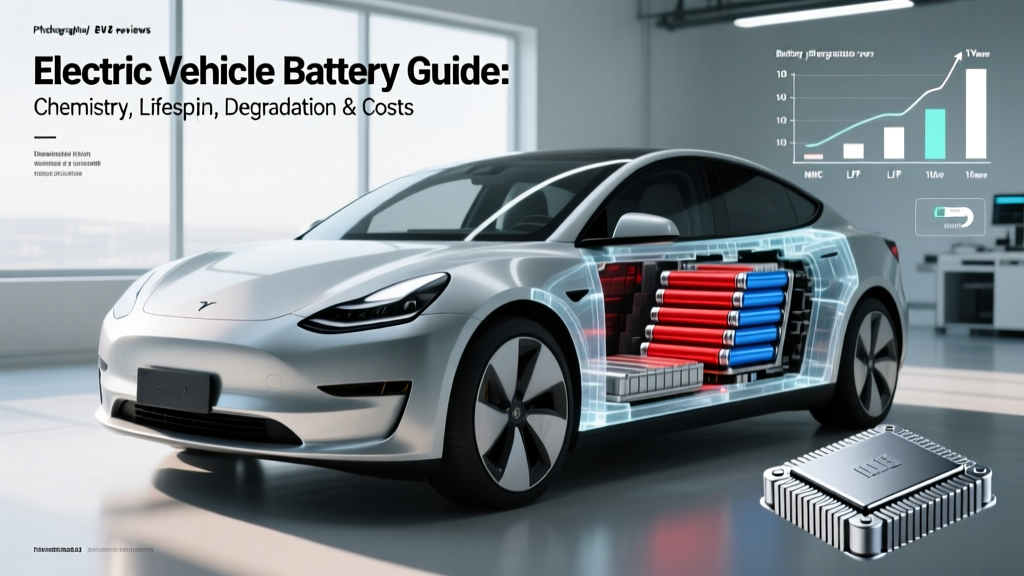
The single most expensive component in any EV is the high-voltage traction battery — the pack that stores energy and powers the motors. For buyers and owners alike, understanding what's inside that pack, how it ages, and what it costs to replace is the difference between confident ownership and expensive surprises.
This guide breaks down electric vehicle battery technology with real numbers: chemistry trade-offs, degradation curves pulled from fleet data, warranty thresholds from every major automaker, and replacement costs by model. We'll also cover what you can control — charging habits, thermal management, and State of Health monitoring — to maximize your pack's useful life.
LFP vs NMC/NCA: Which Battery Chemistry Is Right for You?
Not all lithium-ion batteries are built the same. The cathode chemistry determines energy density, cycle life, cold-weather behavior, cost, and safety. In 2026, two chemistries dominate the EV market: NMC (nickel manganese cobalt) / NCA (nickel cobalt aluminum) and LFP (lithium iron phosphate).
NMC and NCA packs offer higher energy density — more kWh in a smaller, lighter package — which translates to longer range in a given vehicle footprint. They're the chemistry of choice for long-range sedans and performance models. LFP packs sacrifice some energy density but gain significant advantages in cycle life (often 3,000+ full cycles vs ~1,500 for NMC), thermal stability, and cost. LFP also contains no cobalt or nickel, reducing supply-chain and ethical concerns.
| Attribute | LFP (Lithium Iron Phosphate) | NMC / NCA |
|---|---|---|
| Energy Density | ~160–180 Wh/kg (cell level) | ~220–260 Wh/kg (cell level) |
| Cycle Life | 3,000–5,000+ full cycles | 1,000–2,000 full cycles |
| Cold-Weather Performance | Reduced; slower charging below 32°F | Better low-temp charge acceptance |
| Cost (per kWh, pack level) | ~$90–$110 | ~$120–$150 |
| Thermal Stability | Excellent; higher runaway threshold | Good; requires active thermal mgmt |
| Typical Use Cases | Standard-range models, fleet vehicles | Long-range, performance models |
| Recommended Daily SoC | 100% (no penalty) | 80% for daily; 100% for trips only |
| Examples (2025–2026) | Tesla Model 3 RWD, Ford Mustang Mach-E Select (base), BYD Seal | Tesla Model Y LR, Hyundai Ioniq 5 LR, Rivian R1T |
The practical takeaway: If you need maximum range or tow frequently, NMC/NCA is the better fit. If you charge at home nightly, drive a predictable commute, and want a pack that will likely outlast the car, LFP is hard to beat — and you can charge it to 100% daily without the degradation guilt.
How Long Do EV Batteries Actually Last?
The short answer: far longer than most buyers fear. Data from fleet operators, telematics companies, and owner surveys consistently show that modern EV batteries lose roughly 1–2% of capacity per year under normal use, with the steepest drop occurring in the first year or two (often 2–5%) before leveling into a slow, linear decline.
Real-World Degradation Data Points
- Tesla Model 3/Y (NMC, 2020–2024 fleet data): Average ~12% capacity loss at 150,000 miles; ~7% at 80,000 miles. Tesla's own 2024 Impact Report cites an average of <15% degradation at 200,000 miles across the fleet.
- Nissan Leaf (passive air-cooled, 2013–2017): Notorious outlier — some packs lost 20–30% by 80,000 miles due to lack of active thermal management. A cautionary tale for why cooling matters.
- Chevrolet Bolt EV/EUV (NMC, liquid-cooled): Geotab fleet data shows ~8–10% loss at 100,000 miles. The 2022–2024 recall replacement packs reset the clock entirely.
- Hyundai/Kia E-GMP platform (Ioniq 5, EV6): Early data (2022–2025 models) suggests ~5–8% loss at 60,000 miles, aided by aggressive battery preconditioning and thermal management.
- LFP packs (Tesla Model 3 RWD, BYD): Geotab and fleet analyses show <5% loss at 100,000 miles in many cases, consistent with LFP's superior cycle life.
How long in years? Most modern liquid-cooled packs should deliver 15–20 years of service before falling below 70% capacity — the typical warranty threshold. At an average of 13,500 miles/year (per the FHWA), that's 200,000+ miles before the pack is "degraded" by warranty standards — and even at 70% capacity, the car remains fully drivable, just with reduced range.
The critical variable is thermal management. Every current-generation EV from Tesla, Hyundai, Ford, GM, Rivian, BMW, and Volkswagen uses liquid cooling and heating. This single engineering decision is the biggest reason modern packs outlast their predecessors.
What Does the Battery Warranty Actually Cover?
Federal law mandates that EV batteries carry a minimum warranty of 8 years / 100,000 miles (10 years / 150,000 miles in California and states that follow CARB rules). Most automakers meet or exceed this floor. The warranty guarantees that the pack will retain a specified percentage of its original capacity — typically 70% — for the warranty period.
| Manufacturer | Warranty Period | Capacity Threshold | Notes |
|---|---|---|---|
| Tesla (Model 3/Y) | 8 yr / 120,000 mi (LR/AWD); 8 yr / 100,000 mi (RWD) | 70% | Includes module/pack replacement as needed |
| Hyundai / Kia (E-GMP) | 10 yr / 100,000 mi | 70% | Among the longest coverage periods |
| Ford (Mach-E, F-150 Lightning) | 8 yr / 100,000 mi | 70% | Covers battery components & capacity |
| GM (Ultium platform) | 8 yr / 100,000 mi | 70% (some trims 60% for commercial) | Modular pack allows section replacement |
| Rivian (R1T / R1S) | 8 yr / 175,000 mi | 70% | Highest mileage threshold in segment |
| BMW (i4, iX, i7) | 8 yr / 100,000 mi | 70% | Includes thermal management system |
| Volkswagen (ID.4) | 8 yr / 100,000 mi | 70% | Covers net usable capacity |
Key nuances:
- The warranty covers capacity loss, not just total failure. If your 80 kWh pack can only hold 54 kWh (below 70%), you're covered.
- Some warranties exclude "abuse" — consistently DC fast-charging to 100% in extreme heat, or leaving the car at 0% SoC for extended periods, could theoretically void coverage (though enforcement is rare).
- Warranty replacements may use refurbished or remanufactured modules, not necessarily brand-new packs. The replacement must meet the capacity threshold.
- California and CARB-adopting states (NY, MA, WA, CO, and others) often require 10 yr / 150,000 mi coverage — check your state's rules via the California Air Resources Board or your state's environmental agency.
How Much Does an EV Battery Cost to Replace?
This is the question that generates the most anxiety — and the most misinformation. Let's ground it in real numbers.
| Model | Pack Size (kWh) | Estimated Pack Cost | Labor & Total |
|---|---|---|---|
| Tesla Model 3 (Standard / LFP) | ~60 kWh | $7,000–$9,000 | $10,000–$13,000 |
| Tesla Model Y Long Range (NMC) | ~75 kWh | $10,000–$14,000 | $14,000–$18,000 |
| Hyundai Ioniq 5 Long Range | ~77.4 kWh | $11,000–$15,000 | $15,000–$20,000 |
| Ford Mustang Mach-E Extended Range | ~91 kWh | $14,000–$18,000 | $18,000–$24,000 |
| Ford F-150 Lightning Extended Range | ~131 kWh | $20,000–$28,000 | $25,000–$35,000 |
| Chevrolet Silverado EV (large Ultium) | ~200 kWh | $28,000–$38,000 | $35,000–$45,000 |
| Rivian R1T (Large Pack) | ~135 kWh | $20,000–$26,000 | $25,000–$33,000 |
Context that matters:
- Most owners never pay this. The battery is under warranty for 8–10 years, and pack costs are declining ~8–12% annually. By the time a 2024 model's pack needs replacement (if ever, likely in the 2035+ timeframe), the cost will be a fraction of today's figures.
- Modular repair is increasingly common. GM's Ultium platform and some Hyundai packs allow individual module replacement rather than a full pack swap, cutting costs by 50–70% for isolated cell failures.
- Full pack failure is rare. Most "battery replacements" under warranty involve swapping one or two degraded modules, not the entire pack.
- The car will likely be totaled or traded before the battery dies. A 2024 EV with 200,000 miles on the odometer is 12+ years old; its residual value will be minimal regardless of battery health.
Factors That Accelerate (or Preserve) Battery Life
Battery degradation is not purely a function of time or mileage — it's driven by how the pack is used. The following factors have the largest measurable impact on longevity:
Battery Care: What Hurts vs What Helps
- ❌ Exclusive DC fast charging: Daily use of 150+ kW DC chargers generates sustained heat. Occasional road-trip fast charging is fine; making it your daily routine accelerates degradation by an estimated 1–3% over 5 years vs Level 2 charging.
- ❌ Sitting at 100% SoC: For NMC/NCA packs, prolonged storage at full charge stresses the cathode. If you're not driving the next day, 80% is the sweet spot. (LFP is exempt — charge to 100% freely.)
- ❌ Deep discharges to 0%: Dropping below ~10% SoC regularly strains the anode. Most EVs have a buffer that prevents true 0%, but habitually running the pack nearly empty isn't ideal.
- ❌ Extreme heat without preconditioning: Fast-charging a hot, un-preconditioned pack in 100°F+ weather is the single worst thing you can do. Always use the car's navigation-based preconditioning (Tesla, Hyundai, Ford, BMW all offer this).
- ✅ Level 2 home charging as your baseline: Gentle, overnight AC charging at 7–11 kW generates minimal heat and is the healthiest diet for any lithium-ion pack.
- ✅ Keep SoC between 20–80% (NMC/NCA): This is the "happy zone" for nickel-based chemistries. Many EVs let you set a charge limit — use it.
- ✅ Precondition before DC fast charging: Navigate to the charger using the car's built-in nav, which triggers thermal preconditioning. This warms or cools the pack to the optimal temperature for fast charging, reducing stress.
- ✅ Drive it: Batteries degrade slightly even when sitting idle (calendar aging). Regular use with moderate cycles is better than months of storage.
How to Check Your Battery's State of Health (SoH)
State of Health (SoH) is the percentage of original capacity your battery can still hold. A brand-new pack is 100% SoH; at 70%, you've hit the typical warranty threshold. Here's how to monitor it:
- In-car displays: Tesla shows battery health indirectly through range estimates at full charge (compare your current max range to the EPA sticker). Hyundai/Kia's infotainment includes an EV battery status screen showing SoH percentage on newer models. BMW's iDrive shows a battery health indicator in the EV menu.
- OBD-II diagnostic apps: Tools like OBDeleven, LeafSpy (for Nissan), and Scan My Tesla read the battery management system (BMS) directly and report SoH, cell voltage variance, and pack temperature. A $30–$50 OBD-II dongle plus a free or low-cost app gives dealer-level data.
- Dealer diagnostics: Any authorized service center can run a full battery health report. Request this during routine service or before a warranty claim.
- Third-party services: Companies like Recurrent offer battery health reports based on telematics data, useful for used-EV buyers who want independent verification before purchase.
What to watch for: Cell voltage variance (the spread between the highest and lowest cell groups in the pack) is often a better early indicator of problems than overall SoH. A variance exceeding 0.2V under load may signal an imbalanced or failing module — addressable under warranty before it cascades.
What's Next: Solid-State, Silicon Anodes, and Beyond
Emerging battery technologies promise step-change improvements, but timelines matter. Here's where things stand as of 2026:
- Silicon anode cells: Companies like Sila Nanotechnologies and Group14 are shipping cells with silicon-dominant anodes that boost energy density 20–40% over graphite. These are appearing in limited production (Mercedes-Benz's G-Class 580e uses Sila cells, and Porsche has announced silicon-anode packs for upcoming models). Expect broader availability by 2027–2028.
- Semi-solid-state batteries: NIO's 150 kWh semi-solid pack (available in China) delivers ~620 miles of range in the ET7 sedan. Toyota has announced a solid-state battery targeting 2027–2028 production, with claims of 745 miles and 10-minute fast charging. Samsung SDI is targeting 2027 for solid-state pilot production.
- True solid-state: Full solid-state batteries — replacing the liquid electrolyte with a solid ceramic or polymer — remain in pilot and validation phases. Toyota, QuantumScape (with VW backing), and Solid Power (with BMW/Ford) are leading, but mass production at automotive scale is realistically a 2028–2030 proposition. Early adoption will be limited to premium models.
- Sodium-ion: CATL and BYD are producing sodium-ion cells for low-cost, short-range EVs and energy storage. Lower energy density (~120–140 Wh/kg) but cheaper and cobalt-free. Appearing in Chinese-market micro-EVs and potentially US-market fleet/urban vehicles by 2027.
Practical advice: Don't delay an EV purchase waiting for solid-state. Current lithium-ion chemistries are mature, well-warrantied, and improving incrementally. By the time solid-state reaches mainstream pricing, today's EVs will be well into their useful life — and the used market will reflect that transition.
Frequently Asked Questions
How long do electric vehicle batteries last in years and miles?
Modern liquid-cooled EV batteries typically last 15–20 years or 200,000+ miles before falling below 70% of original capacity. Real-world fleet data from Tesla, Geotab, and Recurrent consistently shows 1–2% annual capacity loss after the initial break-in period. Many packs will outlast the vehicle they're installed in.
How much does it cost to replace an EV battery out of warranty?
Out-of-warranty replacement costs range from ~$10,000 for a Tesla Model 3 standard-range pack to $35,000+ for a Ford F-150 Lightning extended-range pack, including labor. However, pack costs are declining 8–12% annually, and most owners will never face this expense — the battery is under warranty for 8–10 years, and modular repairs (replacing individual modules rather than the full pack) can cut costs by 50–70%.
What does the EV battery warranty cover, and what's excluded?
The federal minimum is 8 years / 100,000 miles (10 yr / 150,000 mi in CARB states), guaranteeing the pack retains at least 70% of original capacity. This covers both total failure and excessive capacity loss. Exclusions may include damage from accidents, modifications, or extreme abuse (though enforcement of "abuse" clauses is rare). Check your specific manufacturer's warranty booklet for exact terms.
How do I check and maximize my EV battery health?
Monitor SoH through your car's infotainment display, an OBD-II diagnostic app (like Scan My Tesla or OBDeleven), or a dealer diagnostic report. To maximize longevity: use Level 2 home charging as your baseline, keep NMC/NCA packs between 20–80% SoC for daily use (LFP can go to 100%), always precondition before DC fast charging, and avoid leaving the car at 0% SoC for extended periods.
LFP vs NMC — which battery chemistry is better?
Neither is universally better; they serve different needs. LFP wins on cycle life (3,000–5,000+ cycles), cost (~$90–110/kWh), thermal safety, and the ability to charge to 100% daily — making it ideal for commuters and fleet use. NMC/NCA wins on energy density (~220–260 Wh/kg), cold-weather charging performance, and range-per-pound — making it the choice for long-range, towing, and performance applications. If your daily drive is under 200 miles and you charge at home, LFP is arguably the more durable and economical choice.
Does frequent DC fast charging damage the battery?
Occasional DC fast charging (road trips, a few times a month) has a negligible effect on modern packs with active thermal management. However, exclusive reliance on DC fast charging — especially at 150+ kW in hot weather without preconditioning — can add 1–3% additional degradation over 5 years compared to Level 2 charging. Use DC fast charging when you need it; don't make it your only option if you have access to Level 2.
Can I still drive the car if the battery degrades below 70%?
Absolutely. A pack at 70% SoH still functions normally — you simply have 70% of the original range. A vehicle with an EPA-rated 300-mile range would offer ~210 miles at 70% SoH. Many EVs continue operating well below this threshold. The 70% figure is a warranty benchmark, not a cliff where the car becomes unusable.
Sources: Tesla Impact Report 2024, Geotab EV Battery Health Study, fueleconomy.gov (EPA range and efficiency data), manufacturer warranty documentation. Battery cost estimates based on BloombergNEF battery price survey and industry teardown analyses. Tax credit and regulatory information per IRS §30D guidelines.