The Bottom Line on Electric Vans in 2026
If you run a delivery route under 150 miles per day with predictable depot charging, a 2026 electric van will cut your per-mile fuel and maintenance costs roughly in half versus a gas equivalent — but expect higher upfront pricing ($50,000–$72,000 MSRP before incentives), and plan for Level 2 depot charging infrastructure at $1,500–$4,000 per stall. The BrightDrop Zevo 600 leads on range (EPA 272 miles), the Ford E-Transit wins on dealer/service network depth, and the VW ID. Buzz targets passenger/lifestyle use. None of these are suited for long-haul, rural, or extreme-cold routes without careful planning.
The 2026 Electric Van Landscape at a Glance
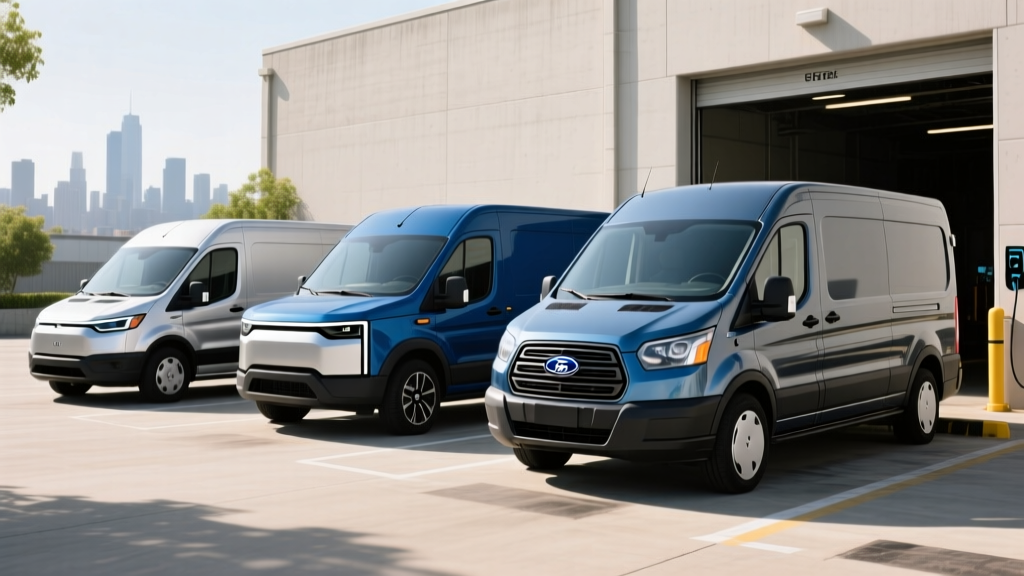
The commercial electric van market in 2026 has consolidated around three serious contenders for US buyers, each targeting a distinct use case. GM's BrightDrop division has scaled production of the Zevo 400 and Zevo 600 after winning major fleet contracts with FedEx and Walmart. Ford's E-Transit continues as the volume option for small-to-mid-size fleets already invested in Ford's commercial dealer network. Volkswagen's ID. Buzz occupies a unique niche as a three-row passenger van with lifestyle appeal, though its cargo variant remains limited in availability.
What hasn't materialized is a flood of new entrants. The Rivian EDV remains exclusive to Amazon, the Mercedes-Benz eSprinter is priced out of contention for most small fleets ($74,000+ MSRP), and Stellantis has yet to bring a Ram ProMaster EV to US showrooms in meaningful volume. For most buyers, the decision comes down to the three models below.
| Spec | BrightDrop Zevo 600 | Ford E-Transit (LR) | VW ID. Buzz (LWB) |
|---|---|---|---|
| EPA Range | 272 mi | 126 mi (148 mi est. cargo low-roof) | 234 mi |
| Battery (usable) | 165 kWh (NMC) | 68 kWh (NMC) | 86 kWh (NMC) |
| Peak DC Charge Rate | 120 kW | 115 kW | 185 kW |
| 10–80% DC Charge Time | ~85 min | ~45 min | ~26 min |
| Level 2 Rate | 11.5 kW | 11.3 kW | 11 kW |
| Horsepower / Torque | 260 hp / 325 lb-ft | 266 hp / 317 lb-ft | 282 hp / 413 lb-ft |
| 0–60 mph | ~8.5 sec | ~8.0 sec | ~7.9 sec |
| Cargo Volume | 412 cu ft | 487 cu ft (high-roof, extended) | 163 cu ft (behind 3rd row) |
| Max Payload | 2,800 lb | 3,880 lb | 1,346 lb |
| Base MSRP | $59,900 | $52,995 | $62,995 |
| Battery/Powertrain Warranty | 8 yr / 100,000 mi | 8 yr / 100,000 mi | 8 yr / 100,000 mi |
Real-World Range Reality Check
BrightDrop Zevo 600: EPA 272 miles. Expect 210–230 miles on a mixed highway/urban delivery route with A/C; 170–190 miles in sub-30°F winter conditions with frequent door openings and cabin heating. The 165 kWh battery gives a genuine buffer for longer routes, but payload weight (near max 2,800 lb) will shave another 10–15%.
Ford E-Transit: EPA 126 miles (cargo, low-roof). This is a purpose-built urban delivery vehicle. Expect 100–115 miles real-world in stop-and-go routes with regenerative braking assisting; under 85 miles in cold weather. Ford's own data shows the average commercial van route is under 75 miles/day, which makes this adequate for most fleet use — but it is not a highway cruiser.
VW ID. Buzz LWB: EPA 234 miles. Expect 190–210 miles in mixed driving; 160–180 miles in cold weather. The 86 kWh battery and relatively efficient thermal management (heat pump standard) help, but the boxy aerodynamics hurt at sustained highway speeds above 70 mph.
Electric Van vs. Gas Van: The Cost Breakdown
The upfront premium for an electric van is real — typically $10,000–$18,000 more than an equivalent gas Ford Transit or Ram ProMaster. The question is whether operational savings close that gap within a reasonable ownership window. Here's a five-year cost comparison for a fleet operator running 15,000 miles per year on a typical delivery route, using national average energy prices.
| Cost Category | Ford E-Transit (EV) | Ford Transit 350 (Gas) |
|---|---|---|
| Base MSRP | $52,995 | $44,500 |
| Federal Tax Credit (§30D, commercial) | Up to $7,500* | $0 |
| Effective Purchase Price | $45,495 | $44,500 |
| Fuel / Energy (5 yr / 75,000 mi) | $5,625 ($0.075/mi at $0.15/kWh) | $14,062 ($0.1875/mi at $3.50/gal, 16 MPG) |
| Maintenance (5 yr) | $1,800 (tires, cabin filter, brake inspection) | $4,200 (oil, filters, brakes, transmission) |
| Insurance (5 yr avg.) | $12,500 | $10,500 |
| Depreciation (est. 5 yr) | $22,000 | $18,000 |
| Total 5-Year Cost | $87,420 | $91,262 |
| Cost Per Mile | $0.583 | $0.617 |
*The §30D commercial EV credit is subject to battery sourcing and critical mineral requirements per IRS guidelines. Consult a tax professional. Fle purchasing more than one vehicle may qualify for multiple credits, but MSRP caps and income limits do not apply to the commercial credit (§45W) — a distinction fleet buyers should discuss with their CPA.
The crossover point where EV savings overtake the purchase premium is typically Year 3–4 for fleet operators running daily routes under 120 miles with access to overnight Level 2 charging. If you're paying commercial electricity rates above $0.22/kWh or running routes exceeding 140 miles daily, the math tightens considerably.
Charging Infrastructure: The Hidden Cost
Buying an electric van without solving charging is like buying a gas van without access to a fuel station. Depot charging is the backbone of commercial EV van operations, and the installation costs vary widely based on your existing electrical service.
| Component | Low Estimate | High Estimate |
|---|---|---|
| Level 2 Charger (48A hardwired) | $600 | $1,500 |
| Electrical panel upgrade (200A → 400A) | $0 (if capacity exists) | $4,000 |
| Conduit, wiring, trenching (per stall, up to 100 ft run) | $800 | $3,000 |
| Electrician labor (licensed) | $500 | $2,000 |
| Permit and inspection | $150 | $500 |
| Total Per Stall | $2,050 | $11,000 |
The wide range reflects a critical variable: whether your existing electrical panel has sufficient spare amperage. A small fleet operator with a modern 400A service adding 2–3 chargers might spend $2,500 per stall. A larger operation needing a panel upgrade plus 10+ chargers should budget for utility transformer upgrades and demand charges — which can push per-stall costs well above $10,000.
DC fast charging at the depot is generally unnecessary for overnight fleet charging and adds $25,000–$80,000 per unit. Most fleet operators rely on Level 2 overnight charging (adding ~25–30 miles per hour at 11.5 kW) and use public DC fast chargers only for mid-day top-ups on longer routes. The Ford E-Transit's smaller 68 kWh battery charges 10–80% in about 45 minutes at a 115 kW public charger — adequate for a lunch-break top-up if your route demands it.
Charging Speed and Connector Compatibility
All three 2026 electric vans use the CCS1 (Combined Charging System) connector for DC fast charging and the J1772 connector for Level 2 AC charging. None have adopted the Tesla NACS connector natively, though CCS-to-NACS adapters are available for access to Tesla Supercharger stations where commercial vehicles are permitted.
A critical nuance: the peak charge rate is not the sustained rate. The BrightDrop Zevo 600 peaks at 120 kW but tapers significantly above 60% state of charge (SoC), meaning the final 20% (60–80%) takes disproportionately longer. The VW ID. Buzz sustains closer to its 185 kW peak through 50% SoC before tapering, giving it a meaningful advantage for mid-day fast-charging scenarios. This is the charge-curve reality that spec sheets don't show.
Who Should Buy Which Electric Van?
Choose the BrightDrop Zevo 600 if:
- Your daily route is 120–200 miles and you cannot mid-day charge
- You need the longest EPA range available in a cargo van (272 miles)
- Your fleet is large enough (10+ vehicles) to justify direct manufacturer support and depot charging infrastructure
- You value GM's Ultium battery platform and its proven thermal management
Choose the Ford E-Transit if:
- Your daily route is under 100 miles (urban delivery, last-mile logistics)
- You need the deepest commercial dealer and service network in the US
- Cargo volume is a priority — the high-roof extended wheelbase offers up to 487 cu ft
- You want the lowest entry MSRP among the three ($52,995)
- You're replacing existing Ford Transit vans and want fleet continuity
Choose the VW ID. Buzz if:
- You need a passenger van (7-seat, three-row) rather than a cargo hauler
- DC fast charging speed matters — 185 kW peak, 10–80% in ~26 minutes
- You're a small business owner who also uses the van for personal/family transport
- Driving refinement and interior quality matter more than max payload
Do NOT buy any electric van if:
- Your daily route exceeds 200 miles with no mid-day charging option
- You operate in sustained sub-10°F climates without heated depot storage
- You lack access to overnight Level 2 charging at home or at a depot
- Your payload regularly exceeds 3,500 lb (consider a gas Transit 350 HD)
Common Misconceptions About Electric Vans
| Myth | Fact |
|---|---|
| "Electric vans can't handle cold weather." | Cold weather reduces range 15–30% depending on temperature and cabin/ cargo heating demands. The BrightDrop Zevo 600's 272-mile EPA range drops to ~190 miles in sub-20°F conditions — still sufficient for most urban routes under 120 miles. Preconditioning the battery while plugged in mitigates some loss. |
| "Battery replacement will cost more than the van is worth." | All three vans carry 8-year/100,000-mile battery warranties with a 70% capacity retention threshold. Current NMC battery replacement costs run $12,000–$18,000 for these pack sizes, but NREL data shows modern packs retaining 85–90% capacity at 150,000 miles under normal use. |
| "You need DC fast chargers at the depot." | For overnight fleet charging, Level 2 (11.5 kW) is sufficient and dramatically cheaper to install. An E-Transit fully recharges from 10% in roughly 6 hours on Level 2 — more than enough for next-morning deployment. DC fast chargers are a luxury, not a necessity, for depot-based fleets. |
| "Electric vans have lower payload capacity." | The Ford E-Transit offers a 3,880 lb max payload — competitive with a gas Transit 250. Battery weight is offset by the absence of a heavy engine, transmission, and exhaust system. Payload parity is largely achieved in the current generation. |
| "The federal tax credit covers the full $7,500 for everyone." | Under current IRS §30D rules, the credit depends on battery component sourcing and critical mineral requirements that change annually. For 2026, some trims may qualify for only $3,750 or none at all depending on where battery minerals are sourced. Always verify eligibility with the manufacturer and your tax professional before purchase. |
Ownership Considerations First-Time EV Van Buyers Overlook
Insurance costs are higher. Commercial EV insurance runs 15–25% more than equivalent gas vans, driven by higher repair costs for battery-adjacent collision damage and limited collision-repair training among commercial body shops. Budget an extra $300–$500/year per vehicle and get quotes before purchasing.
Tire wear accelerates. Electric vans are heavier (the E-Transit weighs ~6,100 lb curb) and deliver instant torque. Expect to replace tires every 25,000–35,000 miles rather than the 45,000–55,000 miles typical for gas vans. Factor $800–$1,200 per tire set into your maintenance budget every 2–3 years.
Regenerative braking changes driver behavior. One-pedal driving is available in all three vans, but fleet drivers accustomed to gas vans need a 1–2 week adaptation period. Some fleet operators report minor increases in minor rear-end incidents during the transition as drivers adjust to the deceleration profile. Include a structured onboarding program.
Utility demand charges can surprise you. If you're installing 5+ Level 2 chargers at a commercial depot, your utility may assess demand charges based on your peak kW draw — sometimes adding $0.05–$0.15/kWh on top of the energy rate. Smart charging software (like ChargePoint Fleet or Ford Pro's charging management) can stagger charge start times to flatten your peak and reduce these charges significantly. This is non-negotiable for fleets of any size.
Resale value is uncertain. The commercial EV van market is young, and 5-year depreciation estimates carry wide confidence intervals. Early data suggests EV vans depreciate faster than gas equivalents in the first 3 years (partly due to rapid battery tech advancement making older models less desirable), but this may stabilize as the market matures. Lease rather than buy if depreciation risk concerns you.
Frequently Asked Questions
Can I tow with a 2026 electric van?
The Ford E-Transit is rated for up to 7,500 lb towing capacity (with the tow package), and the BrightDrop Zevo 600 for up to 10,000 lb. However, towing at or near max capacity will reduce range by 30–50% due to the combined weight and aerodynamic drag. If towing is a regular part of your route, model your energy consumption conservatively and plan for mid-day charging.
Do electric vans qualify for the §30D tax credit in 2026?
Potentially, but eligibility depends on meeting battery component manufacturing and critical mineral sourcing requirements that tighten each year under the Inflation Reduction Act. For commercial fleet purchases, the §45W commercial clean vehicle credit (up to $7,500 for vehicles under 14,000 lb GVWR) may be more accessible, as it does not have the same MSRP caps or buyer income limits. Consult the IRS clean vehicle credit page and your tax advisor for current-year eligibility.
What happens if the battery degrades before the warranty expires?
All three manufacturers warrant their batteries to retain at least 70% of original capacity for 8 years or 100,000 miles. If your van's battery drops below that threshold within the warranty period, the manufacturer must repair or replace it at no cost. In practice, based on DOE and fleet data, most modern NMC packs retain 85–92% capacity at 100,000 miles under normal charging habits (avoiding frequent DC fast charging above 90% SoC and deep discharges below 10%).
Is public DC fast charging reliable enough for commercial use?
Reliability varies by network. Electrify America and EVgo have improved uptime to roughly 90–95% at well-maintained stations, but rural charger availability remains sparse. For commercial use, never plan a route that depends on a single public charger — always have a backup station identified. Fleet management software that integrates real-time charger availability (Ford Pro Intelligence, BrightDrop's fleet dashboard) helps route around outages.
Should I wait for solid-state battery vans?
Solid-state batteries promise higher energy density and faster charging, but no commercial van with solid-state cells is announced for US delivery before 2029 at the earliest. Current NMC technology is mature, well-understood, and cost-effective for routes under 200 miles. If an electric van solves your operational needs today, waiting for next-generation chemistry means 3+ more years of higher fuel and maintenance costs on gas vehicles.
How do I calculate if an electric van saves my fleet money?
Use this formula: Annual fuel savings = (Annual miles ÷ gas MPG × gas price) − (Annual miles ÷ van efficiency in kWh/mi × electricity cost per kWh). For the E-Transit at 2.0 kWh/mile efficiency and $0.15/kWh electricity vs. a gas Transit at 16 MPG and $3.50/gallon, running 15,000 miles/year: gas costs $3,281/year; electricity costs $1,125/year — a $2,156 annual savings per vehicle. Multiply by your fleet size, subtract the purchase premium (after tax credits), and divide by the annual savings to find your payback period in years.