The Business Case for an Electric Van Lease
Fleet operators and small-business owners evaluating an electric van lease in 2026 face a more complex calculus than a simple sticker-price comparison. The upfront MSRP of a battery-electric cargo van remains higher than its diesel or gasoline counterpart, but the total cost of ownership (TCO) over a typical 5-year or 60-month lease cycle can tip decisively in the EV's favor — provided you qualify for federal incentives, have access to affordable Level 2 charging, and drive predictable urban or suburban routes.
This guide dissects every dollar: purchase or lease price, federal and state incentives under current IRS §30D rules, real-world charging costs versus gasoline, maintenance savings, the insurance premium reality, and depreciation trends for electric commercial vans like the Ford E-Transit, Mercedes-Benz eSprinter, and BrightDrop Zevo 600.
5-Year Total Cost of Ownership Breakdown
The table below models a realistic 5-year ownership scenario for a mid-size electric cargo van (using the 2026 Ford E-Transit 350 as a representative baseline) versus a comparable gasoline Ford Transit 350. Figures assume 15,000 miles/year, $0.14/kWh average electricity cost, $3.65/gallon regular unleaded, and standard commercial insurance rates.
| Cost Category | Ford E-Transit 350 (EV) | Ford Transit 350 (Gas) |
|---|---|---|
| Base MSRP / Lease Acquisition | ~$54,000 (lease ~$725/mo) | ~$46,000 (lease ~$620/mo) |
| Federal Tax Credit (§30D) | Up to -$7,500 * | $0 |
| Fuel / Electricity (5 yr) | $5,250 | $13,690 |
| Maintenance (5 yr) | $1,800 | $4,500 |
| Insurance (5 yr) | $11,400 | $9,000 |
| Estimated Depreciation | ~$24,300 | ~$18,400 |
| Total 5-Year Cost | ~$66,450** | ~$77,990 |
* §30D eligibility depends on MSRP caps, buyer income limits, and battery-sourcing requirements — see detailed checklist below. ** Lease structures vary; figures represent equivalent ownership cost.
The EV shows a roughly $11,500 advantage over 60 months, driven primarily by fuel and maintenance savings that offset its higher acquisition cost, elevated insurance, and steeper depreciation. But this gap is highly sensitive to your electricity rate, annual mileage, and whether you actually capture the full federal credit.
Federal Tax Credit: IRS §30D Eligibility Rules for 2026
The federal clean vehicle credit under IRS §30D can reduce your tax liability by up to $7,500 for a qualifying new electric van — or, as of 2024 and continuing through 2026, be transferred to the dealer at the point of sale as an upfront price reduction. For a leased vehicle, the credit technically flows to the lessor (the leasing company), though most major fleet lessors pass it through as a capitalized-cost reduction.
§30D Eligibility Checklist for Electric Cargo Vans
- Vehicle MSRP cap: Vans, SUVs, and pickup trucks must have an MSRP ≤ $80,000
- Buyer income cap: Modified AGI ≤ $150,000 (single), $225,000 (head of household), $300,000 (joint)
- Battery sourcing: $3,750 requires ≥ 80% of battery minerals from US/FTA partners; additional $3,750 requires ≥ 100% of battery components manufactured or assembled in North America (2026 thresholds)
- Foreign entity of concern (FEOC): Vehicles with battery components from a FEOC are disqualified entirely
- Assembly: Final assembly must occur in North America
- Point-of-sale transfer: Buyer can elect to transfer credit to dealer for immediate price reduction (new for 2024+, still available in 2026)
For the Ford E-Transit (MSRP ~$54,000, assembled in Claycomo, Missouri), most buyers should qualify for at least the $3,750 battery-mineral half of the credit. The full $7,500 depends on North American battery-component sourcing percentages, which shift annually. Always verify the specific VIN on fueleconomy.gov before signing a lease agreement.
Charging Cost vs. Gasoline: The Per-Mile Math
This is where an electric van lease makes its strongest financial argument. The E-Transit carries a 68 kWh usable battery (LFP chemistry) and achieves an EPA-rated efficiency of approximately 2.0 kWh/mile in combined driving — roughly equivalent to 1.67 miles per kWh.
| Metric | Ford E-Transit (EV) | Ford Transit 350 (Gas) |
|---|---|---|
| Energy Efficiency | 2.0 kWh/mile (2.0 MPGe: 108 MPGe) | 15 MPG combined |
| Fuel Cost | $0.14/kWh (national avg commercial) | $3.65/gallon |
| Cost Per Mile | $0.07/mile | $0.24/mile |
| Annual Fuel Cost (15k mi) | $1,050 | $3,650 |
| 5-Year Fuel Cost | $5,250 | $18,250 |
At $0.07 per mile versus $0.24 per mile, the electric van saves roughly $2,600 per year or $13,000 over five years on energy alone. This gap widens further if you charge primarily at a depot on off-peak utility rates ($0.08–$0.10/kWh) and narrows if you rely heavily on public DC fast charging ($0.30–$0.48/kWh at networks like Electrify America or EVgo).
For fleet operators installing depot Level 2 chargers, the per-mile cost can drop to $0.05 or below — making the electric van essentially unbeatable on operating cost for last-mile delivery routes under 120 miles round-trip.
Maintenance Savings: Fewer Parts, Less Downtime
Electric vans eliminate the entire internal-combustion maintenance schedule: no oil changes, no transmission fluid, no spark plugs, no exhaust system, no timing belts. The single-speed reduction gear requires minimal service. Regenerative braking significantly extends brake pad and rotor life — many EV fleet operators report original brake pads at 80,000+ miles.
| Service Item | EV Van | Gas Van |
|---|---|---|
| Oil Changes | $0 | $750 (15 changes) |
| Brake Pads & Rotors | $300 (rear only, 1 set) | $1,200 (2–3 sets) |
| Transmission Service | $0 | $350 |
| Coolant / Filters | $200 | $600 |
| Tires (heavier EV) | $1,100 | $900 |
| Miscellaneous / Cabin Filter | $200 | $700 |
| Total | $1,800 | $4,500 |
The net maintenance saving is approximately $2,700 over five years, though EV tire costs run 15–25% higher due to greater vehicle weight and instant torque. The Ford E-Transit weighs roughly 6,100 lbs curb — about 800 lbs more than a comparable gas Transit — which accelerates tire wear. Budget for one extra tire rotation per year and plan to replace tires at ~40,000 miles rather than the 55,000 miles typical for a gas van.
Insurance: The Cost Category Where EVs Lose
Insurance is the line item that consistently runs higher for electric vans, and it deserves honest treatment. Based on 2026 commercial fleet data, insuring an E-Transit costs approximately 20–30% more than an equivalent gas Transit — roughly $2,280/year versus $1,800/year for a single-vehicle commercial policy.
The reasons are structural, not arbitrary:
- Higher repair costs: Battery-pack damage from collision often triggers total-loss thresholds; specialized high-voltage training is required for body shops
- Parts cost and availability: EV-specific components (inverter, onboard charger, battery modules) are more expensive and sometimes slower to source
- Vehicle value: Higher MSRP means higher comprehensive/collision payouts
- Limited claims data: Insurers still have smaller actuarial pools for electric commercial vans, leading to conservative pricing
For fleet operators, the insurance gap can be mitigated by bundling multiple vehicles, working with commercial insurers experienced in EV fleets (Progressive Commercial, Liberty Mutual, and Hartford have developed EV-specific fleet programs), and maintaining clean driver records. For a single-van owner-operator, expect to pay an additional $400–$600 per year — a real cost that partially offsets fuel and maintenance savings.
Depreciation and Resale Value: The Evolving Picture
EV depreciation has been a moving target. In 2023–2024, Tesla's aggressive price cuts and rapid battery-technology evolution caused used EV values to plummet — the E-Transit lost roughly 50% of its value in the first two years. By 2026, the market has stabilized somewhat as EV adoption matures and price wars cool.
Current 5-year depreciation estimates for electric cargo vans:
- Ford E-Transit: ~45% depreciation over 60 months (improved from ~55% in 2024)
- Gas Ford Transit: ~40% depreciation over 60 months
- Mercedes-Benz eSprinter: ~50%+ (lower volume, higher MSRP base)
The residual-value gap between EV and gas vans has narrowed to roughly 5 percentage points, but it remains a real cost factor. Leasing actually insulates you from depreciation risk — the lessor absorbs residual-value fluctuations, which is one reason an electric van lease can make more financial sense than purchasing if you're uncertain about long-term resale trends.
Factors that could further stabilize EV van residuals include: growing demand for used electric commercial vehicles as urban clean-air zones expand, battery-health certification programs emerging from third parties, and the increasing cost of diesel fuel pushing fleet buyers toward used EVs.
State, Local, and Utility Incentives
Important: State, local, and utility incentives vary dramatically by jurisdiction and change frequently. The figures below are illustrative examples — always verify current programs with your state energy office, local air-quality district, and utility provider before committing to a lease.
Beyond the federal §30D credit, many jurisdictions offer stacking incentives that can dramatically improve the economics of an electric van lease:
- California HVIP (Hybrid and Zero-Emission Truck and Bus Voucher Incentive Project): Up to $20,000–$45,000 voucher per Class 2b–3 electric van, applied at point of sale (2026 funding subject to legislative renewal)
- New York Truck Voucher Incentive Program: Up to $40,000 for Class 2b–3 zero-emission vans
- Colorado commercial EV tax credit: Up to $5,000 state credit stackable with federal
- Utility make-ready programs: PG&E, SCE, Con Edison, and others offer $2,000–$10,000+ toward depot Level 2 charger installation for commercial customers
- Local air-district grants: South Coast AQMD, Bay Area AQMD, and similar agencies often fund electric van replacements for fleets operating in non-attainment zones
For a California-based fleet operator, stacking the federal $7,500 credit with a $25,000 HVIP voucher and a $5,000 utility charger rebate can reduce the effective acquisition cost of an E-Transit by $37,500 — making it cheaper than the gas equivalent from day one. This is why electric van lease economics are profoundly location-dependent.
Charging Infrastructure: The Depot Advantage
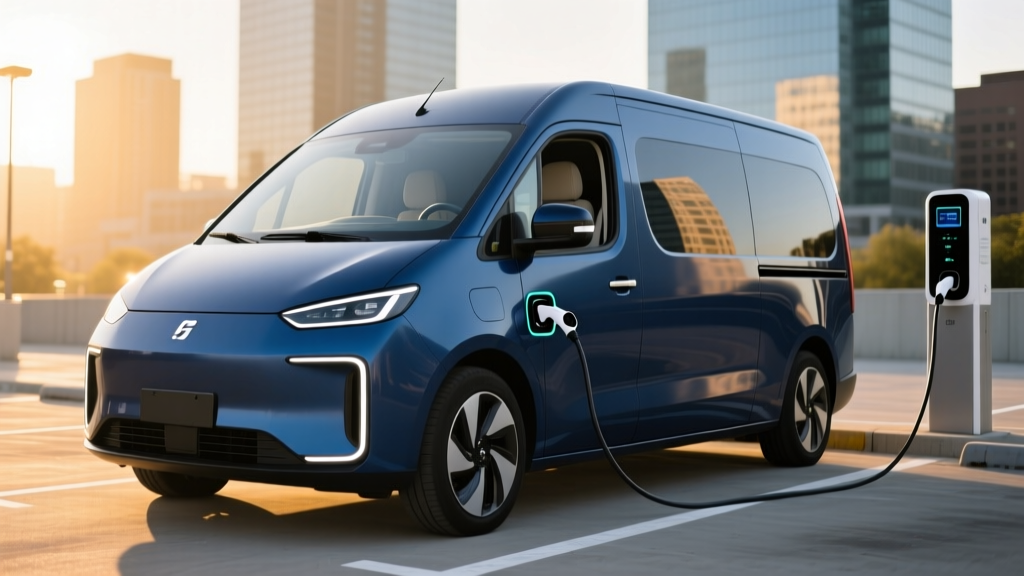
The E-Transit's 68 kWh LFP battery supports a peak DC fast-charge rate of 115 kW, reaching 10–80% in approximately 45 minutes. On Level 2 (11.5 kW onboard charger), a full 0–100% charge takes about 6.5 hours — ideal for overnight depot charging.
The EPA-rated range is 126 miles for the standard low-roof 350 model. In real-world cargo-loaded, mixed-highway driving, expect 95–110 miles of usable range, and as low as 80–90 miles in cold weather or fully loaded to the 3,800-lb payload capacity. This makes the E-Transit purpose-built for urban last-mile routes, not long-haul intercity runs.
For fleet depot charging, budget approximately $3,000–$7,000 per Level 2 charge point (equipment: $600–$1,200 for a commercial-grade ChargePoint CT4000 or similar; electrician labor and permitting: $2,000–$5,500; potential panel upgrade: $1,500–$4,000 if your facility requires additional 240V/60A circuits). Utility make-ready programs can offset much of the electrical infrastructure cost.
Which Electric Vans Qualify and What They Cost
| Model | Battery (kWh) | EPA Range | Peak DC Charge | 10–80% DC | Payload | Base MSRP | §30D Eligible |
|---|---|---|---|---|---|---|---|
| Ford E-Transit 350 | 68 kWh (LFP) | 126 mi | 115 kW | ~45 min | 3,800 lbs | $54,000 | Yes (verify VIN) |
| Mercedes-Benz eSprinter | 113 kWh (NMC) | ~200 mi (est.) | 115 kW | ~50 min | 2,624 lbs | $72,000 | Likely partial |
| BrightDrop Zevo 600 | 165 kWh (NMC) | ~250 mi | 120 kW | ~60 min | 2,500 lbs | $75,000 | Limited (fleet) |
The E-Transit dominates on price and §30D eligibility, the eSprinter offers superior range at a premium, and the BrightDrop targets large fleet contracts (FedEx, Walmart) with limited retail availability.
Frequently Asked Questions
How much does it really cost to own an electric van over 5 years?
For a Ford E-Transit leased at ~$725/month with the full $7,500 federal credit applied, expect approximately $66,000–$70,000 in total 5-year cost including fuel, maintenance, insurance, and depreciation. That's roughly $10,000–$12,000 less than a comparable gas Transit, assuming you charge primarily at depot rates and drive 15,000 miles/year.
Do I qualify for the $7,500 federal EV tax credit on a leased van?
Possibly. Under §30D, the vehicle must meet MSRP (≤$80,000 for vans), income (≤$300,000 joint AGI), and battery-sourcing requirements. For leases, the credit technically goes to the lessor, but most fleet leasing companies pass it through as a cap-cost reduction. Verify the specific VIN on fueleconomy.gov and consult a tax professional for your situation.
How much do I save on fuel and maintenance with an electric van?
Combined fuel and maintenance savings run approximately $15,700 over 5 years at 15,000 miles/year — roughly $13,000 in fuel savings ($0.07/mi vs. $0.24/mi) and $2,700 in maintenance savings. These figures assume $0.14/kWh commercial electricity and $3.65/gallon gasoline.
Are electric vans more expensive to insure?
Yes — typically 20–30% more than an equivalent gas van. For a single commercial policy, expect ~$2,280/year versus ~$1,800/year. Higher repair costs, battery replacement risk, and limited actuarial data drive the premium gap. Fleet bundling and EV-experienced insurers can help narrow it.
How well do electric cargo vans hold their value?
Depreciation has improved but still trails gas vans. Expect ~45% depreciation over 5 years for an E-Transit versus ~40% for a gas Transit. Leasing transfers residual-value risk to the lessor, which is one reason leasing can be advantageous for electric commercial vehicles where long-term resale values remain uncertain.
Is an electric van lease better than buying?
For most small businesses in 2026, leasing offers three advantages: (1) the §30D credit passes through as a cap-cost reduction, (2) you avoid depreciation risk on a rapidly evolving technology, and (3) you can upgrade to newer models with better range and charging at lease-end. Purchasing makes more sense if you drive very high mileage (where lease penalties apply) or plan to keep the van 8+ years.
Sources: IRS §30D Clean Vehicle Credit, fueleconomy.gov, Ford Motor Company commercial specifications. Tax credit eligibility and incentive programs change frequently — verify current rules with the IRS and your state energy office before making a purchase or lease decision.