The Short Answer: Electric V8s Beat Gas on Torque, Trail on Range
Bottom line: If you want V8-grade towing and acceleration with daily-driver efficiency, an electric pickup or SUV now delivers 500+ hp and 700+ lb-ft of torque at a lower cost-per-mile than a gas V8 — but only if you can charge at home. Expect 270–340 miles of real-world range (not the 400-mile EPA stickers), 30–45 minute DC fast-charge stops on road trips, and a $55,000–$95,000 entry price before the §30D federal tax credit (up to $7,500, subject to MSRP caps, buyer income limits, and battery-sourcing rules per IRS §30D). Buyers without Level 2 home charging should consider a hybrid V8 like the Ford F-150 PowerBoost or Toyota Tundra i-FORCE MAX instead.
What "Electric V8" Actually Means in 2026
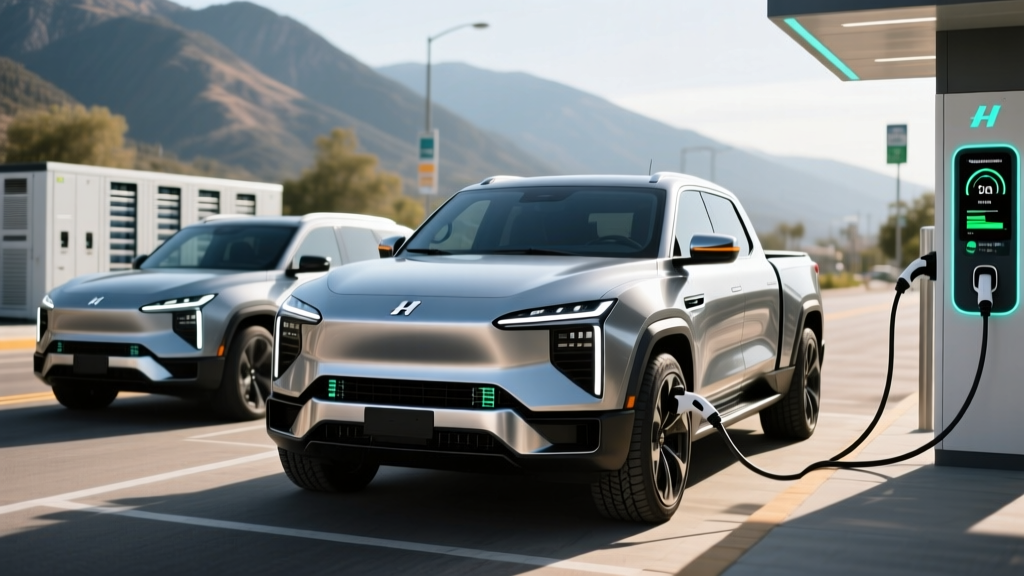
There's no such thing as a literal electric V8 — electric motors don't have cylinders. But the term has stuck as shorthand for any full-size electric truck or SUV that replaces a gas V8's role: heavy towing (8,000–13,000 lbs), 0-60 in the 4-second range, and the cabin space of an F-150, Silverado, or Tahoe. In 2026, the main contenders are:
- Ford F-150 Lightning (extended-range, 131 kWh usable, NMC)
- Chevrolet Silverado EV (4WT and RST trims, ~200 kWh Ultium pack)
- Rivian R1T Dual-Motor / Tri-Motor (149 kWh Max Pack, LFP on Standard)
- Tesla Cybertruck (123 kWh, NMC, with range-extender option announced)
- GMC Sierra EV (Denali Edition 1, 400+ mi EPA target)
These aren't compact crossovers. They're body-on-frame (or unibody-in-the-Rivian's-case) haulers built for the same jobs a 5.0L Coyote or 6.2L small-block used to do — towing a boat, hauling lumber, dragging a camper cross-country.
Spec Showdown: Electric V8 Trucks vs. Gas V8 Baseline
| Spec | F-150 Lightning Ext. Range (2026) | Silverado EV RST (2026) | Rivian R1T Tri-Motor Max (2026) | F-150 5.0L V8 Gas (2026) |
|---|---|---|---|---|
| Powertrain | Dual-motor AWD | Dual-motor AWD | Tri-motor AWD | 5.0L V8, 10-spd auto |
| Horsepower | 580 hp | 664 hp | 850 hp | 400 hp |
| Torque (lb-ft) | 775 | 780 | 1,103 | 410 |
| 0-60 mph | 4.0 sec | 4.5 sec | 2.9 sec | 5.8 sec |
| Battery / Fuel | 131 kWh NMC | ~200 kWh NMC | 149 kWh NMC | 26-gal tank |
| EPA Range | 320 mi | 390 mi | 410 mi (est.) | ~550 mi (22 mpg avg) |
| Real-World Range* | ~250–280 mi | ~310–340 mi | ~320–360 mi | ~480–520 mi |
| Towing Capacity | 10,000 lbs | 12,000 lbs | 11,000 lbs | 13,000 lbs |
| Max DC Charge | 150 kW | 350 kW | 220 kW | n/a |
| 10–80% DC Time | ~41 min | ~20 min | ~30 min | ~5 min (refuel) |
| Base MSRP | $69,995 (Lariat) | $87,300 (RST) | $99,900 (Tri-Motor Max) | $49,995 (XLT) |
*Real-world range assumes 70 mph highway driving at 65°F. Towing a 6,000-lb trailer cuts range by 40–55%. Cold weather (below 32°F) reduces range 20–30%. Data per fueleconomy.gov and manufacturer testing.
Real Costs: Electric V8 vs. Gas V8 Over 5 Years
The sticker price of an electric truck is $15,000–$45,000 higher than a comparable gas V8. The math only works if you recoup that through fuel and maintenance savings. Here's a 5-year / 75,000-mile breakdown for a typical owner who drives 15,000 miles/year, charges 80% at home (Level 2, $0.14/kWh national average) and 20% on DC fast chargers ($0.40/kWh):
| Category | F-150 Lightning (EV) | F-150 5.0L V8 (Gas) | 5-Year Delta |
|---|---|---|---|
| Purchase Price (MSRP) | $69,995 | $49,995 | +$20,000 |
| Federal Tax Credit (§30D) | −$3,750 to −$7,500** | $0 | −$3,750 to −$7,500 |
| Fuel / Energy (75k mi) | $4,100 | $12,200 (17 mpg, $3.40/gal) | −$8,100 |
| Maintenance | $1,200 (tires, cabin filter, fluid top-offs) | $4,800 (oil, filters, plugs, brakes) | −$3,600 |
| Insurance (avg) | $11,500 ($2,300/yr) | $8,500 ($1,700/yr) | +$3,000 |
| Depreciation (est. 45%) | $31,500 | $22,500 | +$9,000 |
| Total 5-Yr Cost | ~$114,545 | ~$97,995 | +$16,550 |
**Tax credit caveat: The §30D credit phases based on critical-mineral and battery-component sourcing requirements that tighten annually. Many 2026 trucks qualify for only $3,750 due to sourcing rules, not the full $7,500. Income caps ($150k single / $300k joint) and MSRP caps ($80k for trucks) apply. Verify eligibility at irs.gov or via the point-of-sale transfer at the dealer.
The honest verdict: Over 5 years, the electric V8 still costs $10,000–$20,000 more than the gas V8 for most buyers. The gap closes to near-parity at 8–10 years of ownership, or if you tow infrequently and commute daily (where the EV's efficiency advantage is largest). If you tow a camper 10,000+ miles a year, the gas V8 wins on both range and cost.
Charging Reality: Home, Highway, and the Towing Problem
The single biggest ownership variable is where you charge. An electric V8's 131–200 kWh battery is enormous — roughly 2–3× the size of a Tesla Model Y's pack. That means:
- Level 1 (120V, 1.4 kW): Adds ~4 miles/hour. A full charge takes 90–140 hours. Not viable as a primary strategy.
- Level 2 (240V, 11.5 kW home charger): Adds ~30–35 miles/hour. A full 0–100% charge takes 11–17 hours. Overnight top-ups from 30% to 80% take 5–6 hours — fine for daily use.
- DC Fast Charging (150–350 kW): Adds 150–400 miles/hour at peak, but the charge curve tapers sharply above 80%. The Silverado EV's 350 kW peak is only sustained for the first 10–15% of the session; average rate to 80% is closer to 180 kW.
Home charging install cost: A 48-amp Level 2 charger (e.g., ChargePoint Home Flex or WallConnector) runs $600–$800 for hardware plus $800–$2,500 for electrician labor, depending on panel proximity. If your home has a 100-amp service panel, a $2,000–$4,000 panel upgrade to 200 amps may be required — a common gotcha for first-time EV buyers in older homes.
The towing range cliff: Towing a 7,000-lb travel trailer at 65 mph on the highway will cut an F-150 Lightning's range from 280 miles to roughly 130–150 miles. That means DC fast-charge stops every 90–110 miles on a road trip, each lasting 30–45 minutes. For a 600-mile camping haul, plan on 3–4 charging stops adding 2–3 hours to your trip. Gas V8 buyers should internalize this before committing to electric for heavy-towing use cases.
Common Misconceptions — Myth vs. Fact
| Myth | Fact |
|---|---|
| "Electric trucks can't tow as much as gas V8s." | The Silverado EV tows 12,000 lbs — only 1,000 lbs short of a max-tow F-150 gas. Torque (780 lb-ft) actually exceeds any gas V8 in the class. |
| "Batteries need replacing every 5 years." | Manufacturer warranties cover 8 years/100,000 miles with a 70% capacity retention floor. Real-world data from Tesla and Leaf fleets shows ~10–15% degradation at 150k miles. Replacement (if needed out of warranty) costs $18,000–$30,000. |
| "Electric V8s are cheaper to own." | Only if you drive 15k+ miles/year, charge at home, and keep the truck 7+ years. Short-term ownership and low mileage favor gas. |
| "You can't take an electric truck off-road." | Rivian R1T and F-150 Lightning have proven off-road capable, with instant torque aiding rock crawling. The limitation is range, not capability — remote backcountry trips require careful planning. |
| "The tax credit is a guaranteed $7,500." | Many 2026 trucks qualify for only $3,750 due to battery-sourcing rules. Income and MSRP caps further restrict eligibility. Always verify before purchase. |
Decision Framework: Should You Buy an Electric V8?
Buy an electric V8 (Lightning, Silverado EV, R1T) if:
- You have Level 2 home charging (garage or driveway with 240V access)
- Your daily commute is under 100 miles round-trip
- You tow fewer than 5,000 miles per year
- You plan to keep the truck 7+ years (to recoup the upfront premium)
- You value instant torque, quiet operation, and frunk cargo space
- You qualify for at least $3,750 in federal or state incentives
Stick with a gas or hybrid V8 (F-150 PowerBoost, Tundra i-FORCE MAX, Silverado 6.2L) if:
- You lack reliable home or workplace Level 2 charging
- You tow a camper, horse trailer, or boat more than 8,000 miles/year
- You regularly drive in sub-zero temperatures (range loss compounds with towing)
- You live in a charging-desert region (rural Montana, West Virginia panhandle, etc.)
- You plan to trade in within 4–5 years (depreciation still favors gas trucks)
- You need a sub-$55,000 purchase price and can't absorb the EV premium
Consider a PHEV (if available in your segment): As of 2026, no full-size PHEV pickup is widely sold in the US, but the Jeep Wrangler 4xe and upcoming Ram 1500 Ramcharger (EREV, 130-mile electric range + gas generator) bridge the gap for buyers who want electric commuting without range-anxiety towing. Watch for 2027 model announcements.
First-Time Buyer Checklist: What to Know Before You Sign
- Test the charge curve, not the peak kW number. A 350 kW peak means nothing if the truck only sustains it for 2 minutes. Ask for a demo DC fast-charge session and watch the actual kW on the dashboard.
- Verify your electrical panel. Hire an electrician for a $150–$250 pre-install inspection before ordering the truck. A 200-amp panel with spare breaker slots is ideal.
- Run the §30D eligibility check. Use the IRS VIN-lookup tool at fueleconomy.gov to confirm your exact trim qualifies — sourcing rules vary by build month.
- Factor in insurance. EV truck premiums run 25–40% higher than gas equivalents. Get quotes from Geico, Progressive, and State Farm before committing.
- Plan your first road trip. Use A Better Routeplanner or PlugShare to map a real tow-trip. If the charging stops feel untenable, a hybrid V8 is the honest choice.
- Ask about battery chemistry. NMC packs (Lightning, Silverado EV) offer higher energy density but should be charged to 80% daily. LFP packs (Rivian Standard) tolerate daily 100% charges but are heavier and less energy-dense.
Frequently Asked Questions
What electric truck has the most horsepower in 2026?
The Rivian R1T Tri-Motor Max produces 850 hp and 1,103 lb-ft of torque, making it the most powerful production electric truck currently sold. The GMC Hummer EV Pickup edges it at 1,000 hp (Watts to Freedom mode), but that's a $110,000+ niche vehicle.
Can I tow a 30-foot travel trailer with an electric V8?
Yes, mechanically — the Silverado EV and F-150 Lightning are rated for 10,000–12,000 lbs, which covers most 30-foot trailers. The real limitation is range: expect 130–160 miles per charge while towing at highway speeds, requiring a DC fast-charge stop roughly every 90 minutes.
Do electric trucks lose range in winter?
Yes. NMC batteries lose 20–30% of their EPA range at 20°F, and up to 40% at 0°F, due to cabin heating loads and reduced battery chemistry efficiency. Preconditioning the battery while plugged in (a standard feature) recovers 5–10% of that loss. LFP packs degrade slightly more in cold than NMC.
Is the Ford F-150 Lightning being discontinued?
No. Ford confirmed the Lightning continues through the 2026 model year with updated battery sourcing to maximize §30D credit eligibility. Production remains at the Rouge Electric Vehicle Center in Michigan.
How much does it cost to charge an electric truck at home per month?
At 15,000 miles/year and 2.0 kWh/mile efficiency (typical for a full-size electric truck), you'll consume ~30,000 kWh/year. At $0.14/kWh (national average), that's ~$4,200/year or $350/month — roughly one-third the cost of fueling a gas V8 at $3.40/gallon and 17 mpg.