The Bottom Line on Electric USPS Vehicles
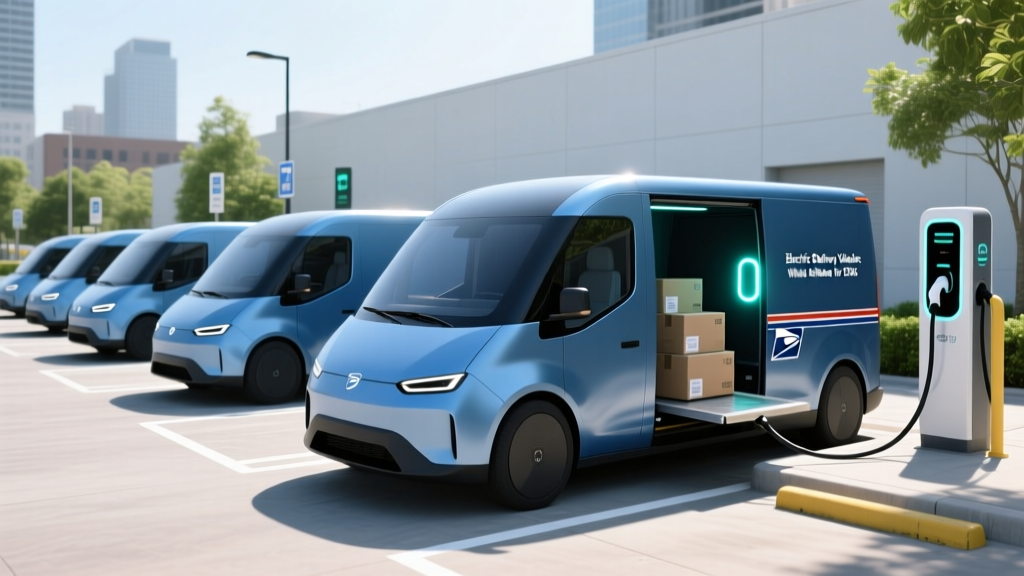
The United States Postal Service is mid-transition to a modernized delivery fleet under its Next Generation Delivery Vehicle (NGDV) program. Of the 60,000 vehicles planned by 2028, at least 45,000 will be battery-electric BEVs built by Oshkosh Defense. These right-hand-drive electric mail trucks carry a ~130 kWh battery pack, target roughly 70–90 miles of real-world range in stop-and-go delivery routes, and depot-charge overnight on Level 2 (AC) infrastructure. The program represents one of the largest single-buyer commercial EV fleet deployments in U.S. history, with direct implications for local grid load, depot charging buildouts, and the broader electrification of last-mile logistics.
Why the USPS Is Going Electric — and Why It Matters
For decades, the USPS relied on the Grumman LLV (Long Life Vehicle), a boxy, aluminum-body van introduced in 1987 with a 2.5-liter GM four-cylinder rated around 17 MPG. By the mid-2020s, those trucks were averaging 25+ years of service, with rising maintenance costs, zero modern safety equipment, and fuel consumption that became untenable at scale.
The NGDV contract, awarded to Oshkosh Defense in February 2021, originally called for a mixed fleet of battery-electric and low-emission internal-combustion variants. Following a 2022 environmental review and pressure from the EPA and the Biden administration, the USPS committed to a predominantly electric fleet: a minimum of 75% BEV across the 60,000-vehicle order, with the remaining 25% as ICE vehicles for extreme-climate or ultra-rural routes where charging infrastructure remains impractical.
For EV buyers and fleet watchers, the electric USPS rollout is significant not because individual consumers can buy one, but because of its downstream effects: depot-level charging installations at thousands of postal facilities, grid-upgrade investments, and a real-world stress test of commercial BEV durability in stop-start, high-cycle duty.
Oshkosh NGDV Electric: Specs, Range, and Powertrain
The NGDV BEV is purpose-built for last-mile delivery, not highway cruising. Its architecture prioritizes low-speed torque, frequent regenerative braking, and all-day HVAC operation over range-per-kWh efficiency. Here's what the published and observed specs look like as of the 2025–2026 production ramp:
| Spec | Value |
|---|---|
| Powertrain | Single-motor BEV (rear-drive) |
| Battery Pack | ~130 kWh usable, NMC lithium-ion |
| EPA-Targeted Range | ~70–90 mi (delivery cycle); up to ~130 mi (steady-state) |
| Peak Motor Output | ~200 kW (~268 hp) |
| Max Speed | ~70 mph (governed) |
| AC Charging (Level 2) | ~19.2 kW onboard; full overnight recharge in ~7–8 hrs |
| DC Fast Charging | CCS1 capable; ~50–80 kW peak (depot-configured) |
| Payload Capacity | ~2,000 lbs cargo + driver |
| Cargo Volume | ~120 cu ft |
| GVWR | ~9,100 lbs |
| Warranty | Vehicle: 3 yr / 36,000 mi; Battery: 8 yr / 100,000 mi (est.) |
Real-World Range Reality
A delivery route isn't a highway loop. NGDV routes average 20–30 miles with 150–300 stops, heavy idling, and constant HVAC load. The 130 kWh pack is oversized for daily mileage but sized to absorb summer A/C, winter cabin heating (resistance-based, no heat pump in early builds), and battery degradation over an 8–10 year service life. Expect a Year-1 daily consumption of ~1.5–2.0 kWh/mi in mixed delivery conditions, dropping effective range well below any steady-state figure.
Charging Infrastructure: The Real Bottleneck
The NGDV's 130 kWh battery is roughly equivalent to a Ford F-150 Lightning Extended Range pack. Charging 45,000 of them — often clustered at a single postal depot — requires serious electrical infrastructure.
The USPS and federal partners have budgeted approximately $3.3 billion for facility upgrades and charging equipment under the NGDV program. Most depot installations target Level 2 AC charging at 19.2 kW per vehicle, which is sufficient for overnight replenishment (7–8 hours from near-empty) but means each depot needs substantial panel capacity. A 50-vehicle depot charging simultaneously at 19.2 kW draws roughly 960 kW of continuous load — approaching 1 MW, which typically requires a dedicated utility feeder upgrade or on-site transformer replacement.
| Level | Power | Time to Full (130 kWh) | Use Case |
|---|---|---|---|
| Level 1 (120V) | ~1.4 kW | ~93 hours | Emergency / trickle only |
| Level 2 (208/240V) | ~19.2 kW | ~7–8 hours | Primary overnight depot charging |
| DC Fast (CCS1) | ~50–80 kW | ~1.5–2.5 hours (10–80%) | Mid-day top-up / contingency |
Some larger sorting facilities are piloting DC fast-charger installations for mid-day top-ups on split-shift routes, but the baseline plan assumes overnight L2 is sufficient for the vast majority of single-shift delivery patterns.
Cost Breakdown: Electric NGDV vs. Legacy Grumman LLV
The economics of the electric USPS fleet hinge on total cost of ownership (TCO) over a 10–15 year service life, not sticker price. Here's a simplified comparison based on USPS Inspector General reports, Oshkosh contract disclosures, and DOE fleet-cost modeling:
| Cost Category | NGDV BEV | Grumman LLV (Legacy ICE) |
|---|---|---|
| Vehicle Acquisition | ~$70,000–$85,000 | Fully depreciated (original ~$18,000 in 1987 $) |
| Fuel / Electricity (10 yr, 12k mi/yr) | ~$8,000–$12,000 | ~$25,000–$35,000 (at 17 MPG, $3.50/gal avg) |
| Maintenance (10 yr) | ~$5,000–$8,000 | ~$20,000–$30,000 (aging fleet avg) |
| Charging Infrastructure (amortized) | ~$10,000–$20,000 | $0 |
| Estimated 10-Yr TCO | ~$93,000–$125,000 | ~$45,000–$65,000 (replacement ICE: ~$70k–$90k) |
The NGDV BEV's TCO advantage emerges primarily in fuel and maintenance savings — electric drivetrains eliminate oil changes, transmission service, exhaust repairs, and the chronic mechanical failures of a 30-year-old ICE fleet. The breakeven point against a new ICE replacement (not the fully-depreciated LLV) typically falls between years 5–7, depending on local electricity rates and route intensity.
EV vs. Gas Fleet: What the Data Shows
For fleet managers and policy analysts weighing EV vs. ICE for last-mile delivery, the NGDV program offers a live case study. Key data points:
| Metric | NGDV BEV | Legacy ICE (LLV / ICE NGDV) |
|---|---|---|
| Energy Cost per Mile | ~$0.07–$0.10 (at $0.12/kWh avg) | ~$0.20–$0.25 (at 17 MPG, $3.50/gal) |
| Maintenance Events per Year | ~1–2 (brakes, tires, cabin filter) | ~4–6 (oil, filters, belts, exhaust, cooling) |
| Regen Braking Pad Life | ~80,000–100,000 mi | ~25,000–40,000 mi (friction only) |
| Idling Emissions | Zero (no engine) | High (LLV idles 30–40% of route time) |
| Cabin HVAC Efficiency | Electric resistance / PTC heater; high battery draw | Engine waste heat (free in winter); A/C compressor load in summer |
| Cold-Weather Range Impact | ~25–40% reduction (heating + battery chemistry) | ~5–10% MPG reduction |
The cold-weather row is the critical one. In northern-tier states (Minnesota, North Dakota, Maine), the NGDV's effective winter range can drop to 45–55 miles under heavy heating loads. This is why the USPS retained a 25% ICE allocation for extreme-climate and ultra-long rural routes. For the majority of suburban and urban routes in temperate zones, the 130 kWh pack provides ample buffer even in winter.
Common Misconceptions About the Electric USPS Fleet
| Myth | Fact |
|---|---|
| "Electric mail trucks can't handle rural routes." | Most rural routes are under 40 miles round-trip. The NGDV's 70+ mile real-world range covers the vast majority. Only extreme-distance rural routes (>80 mi) are assigned ICE variants. |
| "They'll break down in winter." | Cold-weather range loss is real (~25–40%), but the oversized 130 kWh pack provides buffer. Depot preconditioning and route planning mitigate most issues. ICE vehicles remain for the coldest, longest routes. |
| "The USPS can't afford electric trucks." | Upfront cost is higher, but 10-year TCO is competitive with new ICE vehicles due to fuel and maintenance savings. Federal appropriations and IRA-era fleet electrification grants offset a significant portion of acquisition cost. |
| "Charging 45,000 trucks will crash the grid." | Depot charging is managed-load (overnight, off-peak). Utility coordination and smart-charging software spread demand across 8–10 hour windows. Individual depot upgrades are significant but planned. |
| "These are just modified consumer EVs." | The NGDV is a ground-up commercial platform by Oshkosh Defense, with a reinforced body-on-frame chassis, right-hand drive, and military-spec durability testing. It shares no platform with any consumer vehicle. |
What This Means for EV Buyers and Owners
You can't buy an NGDV, but the electric USPS program affects the broader EV ecosystem in concrete ways:
- Grid upgrades at postal depots expand local distribution capacity, which can benefit nearby residential EV charging and reduce future panel-upgrade costs in those neighborhoods.
- Charging-equipment procurement at scale drives down per-unit costs for commercial L2 hardware, accelerating price declines for fleet and residential chargers from suppliers like ChargePoint, EVBox, and Tritium.
- Real-world fleet durability data from 45,000 high-cycle BEVs will inform battery degradation models, warranty structures, and second-life battery markets for years to come.
- Workforce electrification — USPS technicians trained on high-voltage systems expand the national pool of EV-qualified service professionals.
Decision Framework: Who Should Watch the NGDV Program
If You're a Fleet Manager
Watch closely. The NGDV's depot-charging blueprint, managed-load strategies, and TCO data are directly transferable to any last-mile delivery fleet (Amazon DSPs, FedEx Ground contractors, municipal fleets). Oshkosh and USPS are publishing operational learnings that will shape commercial EV adoption playbooks through 2030.
If You're a Residential EV Buyer
Indirect benefit. The infrastructure buildout around postal depots may improve your local grid's capacity for Level 2 home charging, especially in older neighborhoods with aging distribution transformers. Monitor your utility's distribution-upgrade filings for capacity expansions near postal facilities.
If You're an EV Policy Analyst
Critical case study. The NGDV is the largest federally funded commercial BEV fleet deployment in U.S. history. Its procurement, infrastructure, and operational data will inform GAO reports, DOE modeling, and congressional appropriations debates for the next decade. Track the USPS Office of Inspector General (uspsoig.gov) for audit reports.
Frequently Asked Questions
Can I buy an electric USPS truck for personal use?
No. The NGDV is a purpose-built federal fleet vehicle manufactured by Oshkosh Defense under a sole-source government contract. There is no consumer variant, and decommissioned units (when they eventually retire, likely in the 2040s) will be subject to federal surplus-property rules — not standard used-vehicle sales.
How many electric USPS vehicles are on the road in 2026?
Production ramped through 2024–2025, with the USPS targeting approximately 10,000–15,000 NGDV BEVs deployed by mid-2026. The full 45,000-vehicle BEV commitment is scheduled for completion by 2028, though production pacing depends on congressional appropriations and depot-charging buildout timelines.
What battery chemistry does the NGDV use?
The NGDV BEV uses NMC (nickel-manganese-cobalt) lithium-ion cells, chosen for energy density and cold-weather performance over LFP. The ~130 kWh pack is designed for a 10–15 year service life with managed charging protocols to minimize degradation.
Will the electric USPS fleet strain local power grids?
Depot charging is planned as managed overnight load (off-peak), coordinated with local utilities. Individual depots serving 50+ vehicles may require dedicated transformer upgrades or new feeder lines, which are budgeted under the USPS's $3.3 billion infrastructure plan. The impact is local and planned — not a sudden grid shock.
How does the NGDV compare to Amazon's Rivian EDV?
Both are purpose-built electric delivery vans, but the NGDV is larger (~120 cu ft cargo vs. Rivian EDV's ~660 cu ft for the larger variant), heavier, and designed for right-hand-drive rural/suburban routes. The Rivian EDV charges at up to ~150 kW DC (10–80% in ~30 min) vs. the NGDV's ~50–80 kW DC capability. Amazon's fleet is privately funded; the NGDV is federally appropriated. (fueleconomy.gov for consumer EV comparisons.)
What's the biggest risk to the electric USPS program?
Funding continuity. The NGDV program depends on multi-year congressional appropriations, and shifts in administration or budget priorities could slow the procurement pace. The secondary risk is depot-charging buildout delays — if electrical upgrades lag vehicle delivery, newly arrived BEVs may sit idle until chargers are energized.
Sources: USPS Next Generation Delivery Vehicle program documentation; USPS Office of Inspector General NGDV audit reports; EPA Green Vehicles fleet-emissions data; Oshkosh Defense NGDV contract disclosures.