Quick Answer: Are Electric Tuk Tuks Practical in the US?
Electric tuk tuks (three-wheeled electric vehicles) offer 40–80 miles of real-world range, charge on standard 120V outlets in 6–10 hours, and cost $8,000–$25,000 new. They excel for short urban trips, campus shuttles, and resort/fleet use. However, most are classified as Low-Speed Vehicles (LSVs) or Neighborhood Electric Vehicles (NEVs) under NHTSA rules, limiting them to roads with speed limits of 35 mph or less. They do not qualify for the federal §30D EV tax credit because they are not highway-capable four-wheeled vehicles. For last-mile urban use with home charging, operating costs run roughly $0.03–$0.05 per mile — a fraction of gas alternatives.
What Exactly Is an Electric Tuk Tuk?
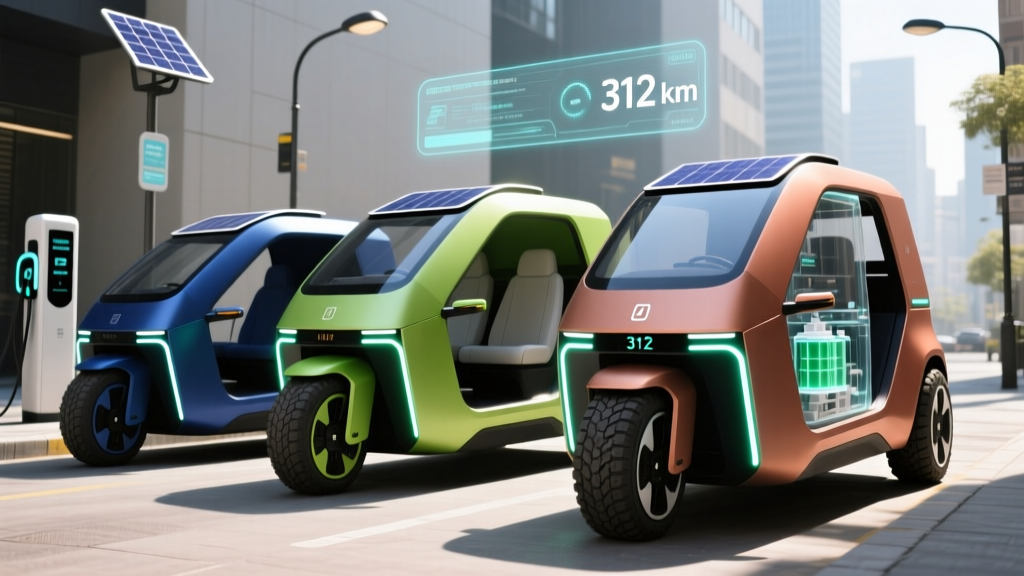
The term "tuk tuk" originates from the auto-rickshaws common across South and Southeast Asia — small, three-wheeled vehicles traditionally powered by two-stroke gasoline engines. Electric tuk tuks replace the internal combustion engine with a battery-electric powertrain, typically using a rear-mounted electric motor driving the single rear wheel (or dual rear wheels) and a lithium-ion battery pack mounted under the floor or seat.
In the US market, these vehicles fall into specific regulatory categories:
- Low-Speed Vehicles (LSVs): Governed to a maximum of 25 mph, must meet FMVSS 500 standards including headlamps, turn signals, seat belts, and a VIN. These are street-legal on roads posted at 35 mph or below.
- Neighborhood Electric Vehicles (NEVs): Functionally identical to LSVs in federal regulation; the terms are often used interchangeably.
- Off-road / private-property use: Some models are sold without LSV certification for use on campuses, resorts, farms, and private communities.
Major manufacturers selling electric three-wheelers in or to the US market include Mahindra (Treo series, primarily for export/fleet markets), Piaggio (Ape E-City, limited US availability), and several Chinese manufacturers like Xianghe and Jinpeng whose units are imported by US-based distributors. Domestic brands such as Polaris have offered electric utility vehicles in the three-wheel space, though availability shifts year to year.
Electric Tuk Tuk Specifications: Range, Battery, and Charging
Understanding the numbers behind an electric tuk tuk requires distinguishing between kW (kilowatts — the rate of power delivery or charging speed) and kWh (kilowatt-hours — the total energy stored in the battery, analogous to gallons in a gas tank).
| Specification | Typical Range (US Models) | Notes |
|---|---|---|
| Battery Capacity | 4.5 – 12 kWh (lithium-ion, usually LFP) | LFP chemistry favored for cycle life and thermal stability |
| Motor Output | 3 – 8 kW continuous / 8 – 15 kW peak | Equivalent to roughly 4 – 20 HP |
| EPA / Certified Range | 50 – 80 miles (varies by model and payload) | Many models lack formal EPA certification; manufacturer claims often 60–100 mi |
| Real-World Range | 40 – 65 miles | Expect 20–30% reduction with full passenger/cargo load, hills, or cold weather below 40°F |
| Top Speed | 25 mph (LSV-governed) / up to 35 mph (unrestricted off-road) | Federal LSV limit is 25 mph |
| Level 1 Charging (120V) | 6 – 10 hours (0–100%) | Most units ship with a standard 120V charger; no Level 2 or DC fast charging on most models |
| Level 2 Charging (240V) | 2 – 4 hours (if supported) | Rare; requires optional onboard charger upgrade on select models |
| 0–25 mph | 8 – 15 seconds | Adequate for urban stop-and-go; not designed for highway merging |
| Battery Warranty | 2 – 5 years / 1,000 – 5,000 cycles | Varies widely by manufacturer; confirm in writing before purchase |
Charging-curve reality: Because most electric tuk tuks use relatively small battery packs (under 12 kWh) and charge at low power levels (under 2 kW on Level 1), the charge curve is fairly linear. You won't experience the dramatic taper that larger EVs see above 80% State of Charge (SoC) at DC fast chargers. However, if your model supports Level 2 charging, expect the final 10–15% to take proportionally longer as the Battery Management System (BMS) balances cells.
Electric Tuk Tuk vs. Gas Tuk Tuk: Cost and Efficiency Comparison
For fleet operators and individual buyers weighing electric against gasoline three-wheelers, the economics shift dramatically depending on daily mileage and electricity rates.
| Factor | Electric Tuk Tuk | Gas Tuk Tuk (4-stroke, ~200cc) |
|---|---|---|
| Purchase Price (new) | $8,000 – $25,000 | $4,000 – $9,000 |
| Fuel / Energy Cost per Mile | $0.03 – $0.05 (at $0.14/kWh national avg) | $0.12 – $0.18 (at 40 MPG, $3.80/gal) |
| Annual Fuel Cost (15 mi/day, 300 days) | $135 – $225 | $540 – $810 |
| Maintenance (annual) | $100 – $250 (tires, brakes, cabin filter) | $400 – $800 (oil, spark plugs, carburetor, exhaust) |
| 5-Year Operating Cost (fuel + maintenance) | $1,175 – $2,625 | $4,700 – $8,050 |
| Emissions (tailpipe) | Zero (upstream depends on grid mix) | CO₂, NOₓ, particulates |
| Noise Level | Very low (~55 dB at 25 mph) | Moderate to high (~75 dB) |
| Federal Tax Credit (§30D) | Not eligible (not a highway-capable 4-wheel vehicle) | N/A |
The break-even point: At 15 miles per day and $0.14/kWh electricity, the electric tuk tuk recovers its higher purchase price within 2.5 to 4 years through fuel and maintenance savings alone. For high-utilization fleet operations (30+ miles/day), payback can occur in under 18 months.
However, the upfront cost gap is real. A buyer paying cash for a $15,000 electric tuk tuk versus a $5,500 gas model faces a $9,500 premium. Without access to the §30D federal credit (which applies only to highway-capable four-wheeled vehicles per IRS guidelines), that premium must be recovered purely through operating savings. Some states and municipalities offer separate incentives for LSVs or commercial electric fleet vehicles — check your state energy office for current programs.
Real-World Ownership: What First-Time Buyers Must Know
Charging Access
Most electric tuk tuks charge on a standard 120V household outlet, which eliminates the need for a dedicated Level 2 home charger installation (typically $800–$2,500 for a full-size EV). However, charging at 120V means a full charge takes 6–10 hours. If your daily driving exceeds 40 miles, you'll need to charge during the day or upgrade to a 240V circuit — assuming your model's onboard charger supports it.
Practical tip: Confirm the vehicle's onboard charger capacity in kW before assuming a 240V outlet will charge it faster. A 1.5 kW onboard charger will draw the same power from a 240V outlet as from 120V (limited by the charger, not the outlet). Only models with a 3+ kW onboard charger benefit meaningfully from Level 2.
Climate Considerations
LFP (lithium iron phosphate) batteries, which dominate the electric tuk tuk segment, handle cold weather better than NMC cells in terms of safety and longevity, but still lose capacity in freezing temperatures. Expect a 15–25% range reduction at temperatures below 32°F (0°C). Unlike full-size EVs, most tuk tuks lack battery preconditioning or active thermal management — the battery simply sits at ambient temperature.
If you operate in a climate with sustained sub-freezing winters (Minnesota, Maine, Colorado), plan for 35–50 miles of real range instead of the sticker 60–80 miles. Indoor or garage charging mitigates some of this loss.
Insurance and Registration
LSV-classified electric tuk tuks require registration and a title in most states, but insurance costs are generally low — typically $200–$500 annually for personal use, reflecting the low vehicle value and limited speed. Commercial fleet policies may differ. Confirm your state's LSV registration requirements; some states require specific safety equipment (mirrors, windshield, wipers) that base models may not include.
Where You Can (and Can't) Drive
Federal law permits LSVs on roads with posted speed limits of 35 mph or less. States may impose additional restrictions. You cannot take an LSV on highways, interstates, or most roads posted above 35 mph. This makes electric tuk tuks viable for:
- Neighborhood errands and last-mile trips
- College campuses and corporate parks
- Resort communities and planned developments
- Delivery routes in dense urban cores (where local law permits)
They are not viable for highway commuting, intercity travel, or rural routes with high-speed roads.
Common Misconceptions About Electric Tuk Tuks
| Myth | Fact |
|---|---|
| "They qualify for the $7,500 federal EV tax credit." | False. The §30D credit applies only to highway-capable, four-wheeled vehicles meeting specific MSRP, income, and battery-sourcing requirements per the IRS. Three-wheeled LSVs do not qualify. |
| "You need a special charger installed at home." | Most electric tuk tuks charge on a standard 120V household outlet. Level 2 is optional and model-dependent. |
| "They're street-legal everywhere, like a car." | LSVs are restricted to roads with speed limits of 35 mph or less. They are not legal on highways or high-speed arterials. |
| "The batteries need replacing every 2–3 years." | Modern LFP packs are rated for 1,500–5,000 charge cycles. At one cycle per day, that's 4–13+ years before reaching 80% capacity. Degradation is gradual, not sudden. |
| "They're toys, not real vehicles." | LSVs are federally regulated motor vehicles with VINs, subject to FMVSS 500 safety standards. They carry real payloads (400–800 lbs) and serve commercial fleet roles worldwide. |
| "Range is the same year-round." | Cold weather reduces range by 15–25% due to increased battery internal resistance and cabin heating loads. Plan accordingly. |
Decision Framework: Should You Buy an Electric Tuk Tuk?
Choose an Electric Tuk Tuk If:
- Your daily driving is under 40 miles and stays on roads posted 35 mph or below.
- You have access to a standard 120V outlet near where the vehicle is parked overnight (garage, carport, or driveway).
- You want to eliminate fuel and oil-change costs and are willing to pay a higher upfront price for long-term savings.
- You operate a fleet (resort, campus, delivery, community shuttle) and can benefit from per-mile cost reductions at scale.
- You live in a mild climate or can charge/store the vehicle indoors during winter.
- Noise and emissions matter — you operate in pedestrian-heavy areas where quiet, zero-tailpipe-emission vehicles are preferred.
Look Elsevier (Full-Size EV, PHEV, or Gas) If:
- You need highway speeds or drive on roads posted above 35 mph regularly.
- Your daily mileage exceeds 60 miles — even the best electric tuk tuks can't cover this reliably in all conditions.
- You need the federal §30D tax credit to make the math work — it does not apply to three-wheeled LSVs.
- You carry more than 2–3 passengers or need enclosed, climate-controlled comfort in extreme weather.
- You lack any charging access — unlike gas tuk tuks, you can't refuel in 2 minutes at a corner station.
Cost Breakdown: 5-Year Ownership Projection
| Cost Category | Electric Tuk Tuk ($15,000 base) | Gas Tuk Tuk ($5,500 base) |
|---|---|---|
| Purchase Price | $15,000 | $5,500 |
| Federal Tax Credit | $0 (not eligible) | $0 |
| Registration & Title (5 yrs) | $500 – $750 | $500 – $750 |
| Insurance (5 yrs) | $1,250 – $2,500 | $1,250 – $2,500 |
| Fuel / Electricity (5 yrs, 15 mi/day) | $675 – $1,125 | $2,700 – $4,050 |
| Maintenance (5 yrs) | $500 – $1,250 | $2,000 – $4,000 |
| Total 5-Year Cost | $17,925 – $20,625 | $11,950 – $16,800 |
| Cost per Mile (5 yrs, 22,500 mi total) | $0.80 – $0.92 | $0.53 – $0.75 |
Key takeaway: The electric tuk tuk's higher purchase price means its 5-year total cost of ownership is often slightly higher than a gas equivalent when driven only 15 miles per day. The economic case strengthens significantly at higher daily mileage (25+ miles/day), where fuel savings compound and the per-mile cost advantage of electricity dominates. Fleet operators running 30–50 miles per day typically see the electric option win on total cost within 2–3 years.
Frequently Asked Questions
Do I need a driver's license to operate an electric tuk tuk?
Yes, in most states. LSVs are classified as motor vehicles and require a valid driver's license, registration, and insurance. State requirements vary — check with your local DMV.
Can I drive an electric tuk tuk on the highway?
No. Federal law restricts LSVs to roads with posted speed limits of 35 mph or less. They are not designed or legal for highway use.
How long does the battery last before needing replacement?
LFP batteries common in electric tuk tuks are rated for 1,500–5,000 full charge cycles before degrading to 80% of original capacity. At one charge per day, that translates to 4–13+ years. Replacement packs typically cost $1,500–$4,000 depending on capacity and manufacturer.
Are electric tuk tuks safe in a crash?
LSVs must meet FMVSS 500 standards, which include seat belts, headlamps, and reflectors, but they do not undergo the same crash testing as full-size passenger vehicles (NHTSA's 5-star program or IIHS ratings). Their low speed reduces crash severity, but they offer far less structural protection than a car. Drive defensively and use seat belts.
Can I charge an electric tuk tuk from a solar panel system?
Yes. A typical electric tuk tuk battery (8 kWh) can be charged from a home solar array. At 4 peak sun hours, a 2 kW solar array produces roughly 8 kWh per day — enough for a full daily charge. This effectively reduces your per-mile energy cost to near zero after the solar system payback period.
What happens if I run out of charge on the road?
Unlike a gas tuk tuk, you cannot refuel in minutes at a nearby station. Options include towing the vehicle to a charging point, carrying a portable generator (which defeats the purpose), or planning routes conservatively to maintain a 20% battery buffer. Most electric tuk tuks lack roadside charging infrastructure compatibility (no CCS or NACS connector).