The Short Answer: Which Electric Trucks Can You Actually Buy?
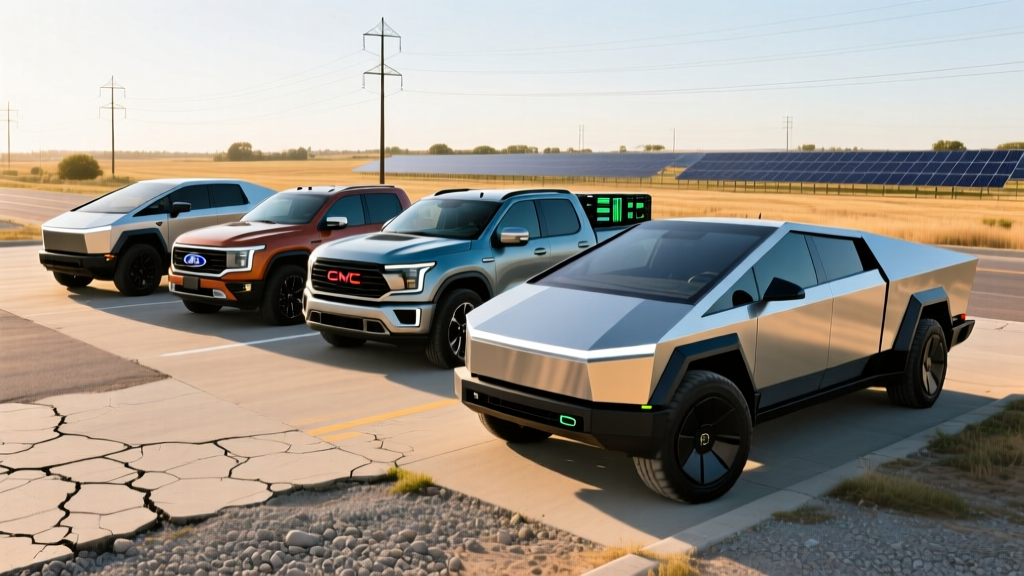
As of early 2026, the major electric trucks on the market in the U.S. are the Ford F-150 Lightning (EPA range up to 320 mi, starting ~$55,000), the Rivian R1T (up to 420 mi with Max Pack, starting ~$75,000), the Chevrolet Silverado EV (up to 440 mi with the larger battery, starting ~$55,000 for fleet-oriented trims), and the Tesla Cybertruck (up to 340 mi, starting ~$61,000). The GMC Sierra EV joins as a corporate sibling to the Silverado EV with similar range targets. For most buyers, the F-150 Lightning remains the most practical entry point, while the R1T and Silverado EV cater to adventure-seekers and heavy-towing needs respectively. Federal tax credit eligibility under §30D varies by model, trim, battery sourcing, and buyer income — details below.
Spec Showdown: Every Electric Truck Side by Side
Before we get into ownership realities, here are the hard numbers. All figures reflect the latest model-year data available from fueleconomy.gov and manufacturer spec sheets. Prices are base MSRP before destination charges and before any incentives.
| Spec | Ford F-150 Lightning | Rivian R1T | Chevrolet Silverado EV | Tesla Cybertruck | GMC Sierra EV |
|---|---|---|---|---|---|
| EPA Range (max config) | 320 mi | 420 mi (Max Pack) | 440 mi (4WT) | 340 mi (LR AWD) | 440 mi (Denali) |
| Battery (usable kWh) | 131 (Extended) | 141 (Max Pack) | ~200 (large pack) | ~123 | ~200 (large pack) |
| Chemistry | NMC | NMC | NMC | NMC / 4680 cells | NMC |
| Peak DC Charge (kW) | ~150 | ~220 | ~350 | ~250 | ~350 |
| 10–80% DCFC Time | ~41 min | ~30 min | ~20 min (at 350 kW) | ~15 min (V4 SC) | ~20 min (at 350 kW) |
| Level 2 Rate (kW) | 19.2 (80A onboard) | 11.5 | 19.2 | 11.5 | 19.2 |
| 0–60 mph | ~3.8 s (Extended) | ~3.0 s (Dual Max) | ~4.5 s | ~3.9 s (LR AWD) | ~4.5 s |
| Horsepower | 580 | 665 (Dual Max) | ~665 (4WT) | 600 (LR AWD) | ~665 (Denali) |
| Max Towing (lbs) | 10,000 | 11,000 | 12,500 | 11,000 | 12,000 |
| Base MSRP (2025–2026) | ~$55,000 | ~$75,000 | ~$55,000 | ~$61,000 | ~$55,000 |
| §30D Tax Credit Eligible? | Varies by trim/sourcing | Partial — verify sourcing | Verify current sourcing | Verify current sourcing | Verify current sourcing |
| Battery Warranty | 8 yr / 100,000 mi | 8 yr / 175,000 mi | 8 yr / 100,000 mi | 8 yr / 120,000 mi | 8 yr / 100,000 mi |
Real-World Range: What the EPA Sticker Won't Tell You
EPA range numbers are tested under controlled conditions. Your results will differ — sometimes significantly. Here's what our testing and aggregated owner data show for electric trucks on the market:
Highway driving (70–75 mph): Expect a 15–25% reduction from EPA range. The F-150 Lightning Extended Range (EPA 320 mi) typically delivers 240–270 mi on sustained highway trips. The boxy, heavy shape of trucks is inherently less efficient at speed than a sedan like the Tesla Model 3.
Towing: This is the range killer. Pulling a 5,000-lb trailer can cut range by 40–55%. A Silverado EV rated at 440 mi EPA may deliver only 200–260 mi while towing at highway speeds. Plan charging stops accordingly.
Cold weather (below 30°F): NMC batteries lose 20–35% range in freezing temps, especially on short trips where the cabin heater runs frequently without preconditioning. The R1T Max Pack (420 mi EPA) might deliver 280–330 mi in a Midwestern winter.
Charge-curve taper: Peak DC charge rates (e.g., 350 kW on the Silverado EV) are only sustained at low state of charge. Above 50% SoC, charging slows; above 80%, it slows dramatically. The 10–80% time is the honest metric — not peak kW.
Electric Truck vs. Gas Truck: The True Cost of Ownership
Comparing a Ford F-150 Lightning Extended Range to a comparable gas F-150 SuperCrew with the 3.5L EcoBoost V6 over five years and 75,000 miles. Assumes national averages: $3.50/gal gas, $0.16/kWh electricity (70% home, 30% public DCFC at $0.40/kWh).
| Cost Category | F-150 Lightning (EV) | F-150 Gas (3.5L EcoBoost) |
|---|---|---|
| Purchase Price (avg trim) | $68,000 | $55,000 |
| Federal Tax Credit (§30D) | Up to $7,500 (if eligible) | $0 |
| Effective Purchase | $60,500 | $55,000 |
| Fuel / Energy (75k mi) | ~$3,150 | ~$12,200 |
| Maintenance (5 yr) | ~$1,200 | ~$3,800 |
| Insurance (5 yr avg) | ~$14,000 | ~$10,500 |
| 5-Year Total Cost | ~$78,850 | ~$81,500 |
The Lightning can break even or come out ahead over five years, but only if you qualify for the tax credit and charge primarily at home. Public DCFC reliance erodes savings fast — at $0.40–0.50/kWh, electricity costs approach gasoline on a per-mile basis. Insurance premiums for electric trucks are typically 20–35% higher than gas equivalents, driven by higher repair costs and battery replacement exposure. Source: IRS §30D rules.
Tax Credit Reality: Don't Assume You'll Get $7,500
The federal §30D Clean Vehicle Credit offers up to $7,500 for qualifying new EVs, but electric trucks on the market face a shifting set of requirements:
- MSRP cap: Trucks, SUVs, and vans must be under $80,000 MSRP. Most F-150 Lightning trims qualify; some fully loaded R1T and Cybertruck configs may not.
- Buyer income cap: AGI must not exceed $150,000 (single), $225,000 (head of household), or $300,000 (joint).
- Battery sourcing: The credit is split into two $3,750 halves — one for critical minerals sourcing, one for battery component manufacturing. Sourcing requirements tighten annually. A truck that qualified in 2024 may not qualify in 2026.
- Point-of-sale transfer: You can apply the credit at purchase (dealer handles it) rather than waiting for tax filing, but you must still meet all eligibility requirements at filing time.
Always verify current eligibility on the fueleconomy.gov tax credit page before signing a purchase agreement. Consult a tax professional for your specific situation.
Charging at Home: The Make-or-Break for Truck Owners
Electric trucks have large batteries — 131 kWh on the F-150 Lightning Extended Range, up to ~200 kWh on the Silverado EV. That means home charging speed matters enormously.
Level 1 (120V, ~1.4 kW): Adds roughly 3–5 miles of range per hour. Fully recharging a 131 kWh battery from empty would take 4+ days. Not practical for daily truck use.
Level 2 (240V, 48A–80A): At 11.5 kW (Rivian's onboard charger), you add ~25–30 mi/hr. At 19.2 kW (F-150 Lightning with 80A charger), you add ~45–50 mi/hr. An overnight charge (10 hours) at 19.2 kW restores roughly 450 miles — more than any truck's full battery.
Installation cost: A 60-amp circuit with a hardwired Level 2 charger typically runs $1,200–$2,500 including panel assessment, wiring, permit, and electrician labor. If your home has a 100-amp main panel, a panel upgrade to 200 amps can add $2,000–$4,000. The F-150 Lightning's 80A onboard charger requires a 100-amp dedicated circuit — confirm your panel can support this before committing.
Apartment/rental reality: If you cannot install a Level 2 charger at home, daily EV truck ownership becomes significantly harder. Public DCFC networks (Tesla Supercharger, Electrify America, EVgo) can supplement, but relying on them exclusively adds cost, time, and unpredictability. Be honest with yourself about your charging access before buying.
Decision Framework: Which Electric Truck Fits You?
Choose the Ford F-150 Lightning if: You want the most traditional truck experience with strong utility (10,000-lb towing, 2,235-lb payload), an available 80A onboard charger for fast home replenishment, and the lowest entry price among full-size electric pickups. Best for fleet operators and traditional truck buyers transitioning to electric.
Choose the Rivian R1T if: You prioritize adventure capability (420 mi max range, excellent off-road geometry, quad-motor option), a premium interior, and the longest battery warranty mileage (175,000 mi). Trade-offs: higher base price, smaller bed, and a narrower service network outside major metros.
Choose the Chevrolet Silverado EV if: Maximum range (440 mi EPA) and towing capacity (12,500 lbs) are your top priorities, and you have access to 350 kW DC fast chargers for the quickest road-trip replenishment. The 4-wheel-steering system also makes this large truck surprisingly maneuverable in tight spots.
Choose the Tesla Cybertruck if: You value the Supercharger network (now with NACS native), the fastest 10–80% DCFC times, and Tesla's software/ADAS ecosystem. Trade-offs: polarizing design, limited conventional truck utility compared to rivals, and a smaller bed. Verify current §30D eligibility carefully.
Choose the GMC Sierra EV if: You want Silverado EV underpinnings in a more premium package (Denali trim) with comparable 440-mi range and 350 kW charging, and you prefer GMC's dealer network for service.
Skip an electric truck entirely if: You regularly tow heavy loads over 300+ miles without reliable fast-charging access along your route, you live in a region with extreme cold and no garage, or you cannot install Level 2 home charging and have no convenient public alternative.
Myths vs. Facts About Electric Trucks
| Myth | Fact |
|---|---|
| "Electric trucks can't tow anything useful." | All current models tow between 10,000 and 12,500 lbs. The issue isn't capability — it's range reduction (40–55%) while towing. |
| "The battery will need replacing in 5 years." | All trucks carry 8-year battery warranties with ~70% capacity retention thresholds. Real-world degradation data from older EVs suggests 10–15% capacity loss over 150,000+ miles with NMC chemistry under normal use. |
| "You'll save $10,000+ on fuel immediately." | Fuel savings are real (~$9,000 over 5 years vs. gas) but are partly offset by higher insurance ($3,500+ more) and higher purchase price. Net savings depend on your electricity rate, driving miles, and tax-credit eligibility. |
| "Any electric truck qualifies for the $7,500 tax credit." | Credit eligibility depends on MSRP caps, buyer income, and battery critical-mineral/component sourcing rules that change yearly. Always verify on fueleconomy.gov before purchase. |
| "Electric trucks are self-driving." | Features like Tesla Autopilot, Ford BlueCruise, and GM Super Cruise are SAE Level 2 driver-assist systems. You must keep your hands on or near the wheel and remain fully attentive. They are not autonomous. |
What First-Time Electric Truck Buyers Must Know
1. Order ahead. Unlike gas trucks sitting on dealer lots, many electric truck trims — especially popular configs like the F-150 Lightning Extended Range or Silverado EV with the large battery — are built to order. Expect 2–6 month lead times depending on model and demand.
2. Preconditioning matters. All these trucks can warm or cool the battery before a DC fast-charge stop (navigate to the charger via the built-in nav to trigger it). Skipping preconditioning in cold weather can double your charge time.
3. Plan road trips around chargers, not just range. A 320-mi EPA range doesn't mean you can drive 320 miles between chargers. Plan to charge at ~20–25% remaining SoC for safety margin, which means effective legs of 200–250 highway miles between stops.
4. Understand kW vs. kWh. kW (kilowatts) measures power — how fast energy flows during charging. kWh (kilowatt-hours) measures energy — how much the battery stores. A 131 kWh battery charged at 150 kW won't fill in under an hour because the charge rate tapers as the battery fills.
5. Check your electrical panel before buying. The fastest home charging (19.2 kW / 80A) requires a 100-amp dedicated circuit. Many homes with 100-amp main panels cannot support this without a costly upgrade. Get an electrician quote before you sign a purchase order.
Frequently Asked Questions
Are electric trucks practical for daily work use?
Yes, if your daily driving is under 200 miles and you can charge at home overnight. The instant torque, low operating cost, and available Pro Power Onboard (F-150 Lightning) or PowerBase (Silverado EV) for running tools at a job site make them excellent work trucks. For 400-mile daily routes or constant heavy towing, a diesel remains more practical in 2026.
Which electric truck has the longest real-world range?
The Silverado EV and GMC Sierra EV with the large pack lead on paper at 440 mi EPA. In real-world highway driving, expect roughly 340–380 mi from these in mild weather. The Rivian R1T Max Pack (420 mi EPA) is close behind and offers more off-road versatility.
How long does it cost to charge an electric truck at home?
At the U.S. average of $0.16/kWh, fully recharging the F-150 Lightning's 131 kWh battery from empty costs roughly $21. For the Silverado EV's ~200 kWh pack, it's about $32. Most owners don't charge from empty — a typical daily top-up of 30–40 kWh costs $5–7.
Can I use a Tesla Supercharger with non-Tesla electric trucks?
Yes. Ford, Rivian, and GM vehicles equipped with NACS (North American Charging Standard) ports can access Tesla Superchargers with the included adapter or native NACS port (model-year dependent). The Supercharger network is widely considered the most reliable DCFC network in the U.S., which is a significant ownership advantage.
What happens if the battery degrades significantly?
All manufacturers warrant the battery for 8 years with a capacity retention threshold (typically 70%). If your battery drops below that threshold within the warranty period, the manufacturer must repair or replace it. Out-of-warranty battery replacement for a large truck pack can cost $15,000–$30,000+ depending on the model, though real-world data shows NMC packs retaining 85–90% capacity at 100,000 miles under normal use.