The short answer: The electric trucks market in 2026 has matured into a competitive segment with seven major models spanning $50,000 to over $100,000. The Ford F-150 Lightning remains the volume leader with up to 320 miles of EPA range and a starting MSRP around $55,000, while the Rivian R1T targets adventure buyers with up to 410 miles (Max Pack) and 750+ hp. The Chevrolet Silverado EV now offers a 450-mile Work Truck variant, and the Tesla Cybertruck sits at the polarizing end of the spectrum. For most buyers, an electric truck makes financial sense if you can charge at home, drive under 250 miles daily, and qualify for the §30D federal tax credit — but towing heavy trailers long-distance remains the segment's biggest real-world limitation.
The Electric Trucks Market at a Glance
The pickup truck segment was the last major vehicle category to go electric, and for good reason. Trucks demand enormous energy to move heavy payloads, tow trailers, and conquer off-road terrain. Battery packs large enough to handle these tasks add weight and cost that early EV platforms simply couldn't support.
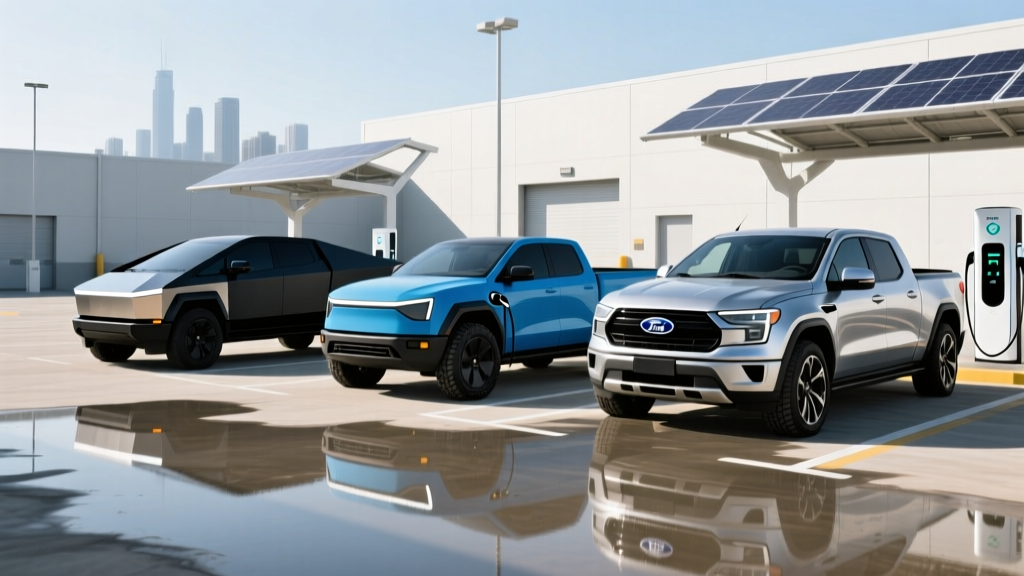
That changed starting in 2022 with the Ford F-150 Lightning and Rivian R1T, and by 2026 the electric trucks market includes production models from Ford, GM (Chevrolet Silverado EV and GMC Sierra EV), Stellantis (Ram 1500 REV), Rivian, Tesla, and the emerging Chevrolet Colorado EV. Competition has driven prices down and capability up, but the physics of electrified towing haven't changed — expect range to drop 40-60% when pulling a heavy trailer at highway speeds.
| Model | EPA Range | Battery (kWh usable) | Peak DC Charge (kW) | 10–80% Time | Max Towing | Starting MSRP |
|---|---|---|---|---|---|---|
| Ford F-150 Lightning (Extended Range) | 320 mi | 131 kWh (NMC) | 150 kW | ~41 min | 10,000 lbs | $59,995 |
| Rivian R1T (Dual Max Pack) | 410 mi | 149 kWh (NMC) | 200+ kW | ~30 min | 11,000 lbs | $89,900 |
| Chevrolet Silverado EV (4WT) | 450 mi | ~200 kWh (NMC) | 350 kW | ~20 min | 10,000 lbs | $55,900 (WT) |
| GMC Sierra EV (Denali Edition 1) | 440 mi | ~200 kWh (NMC) | 350 kW | ~20 min | 10,000 lbs | $99,495 |
| Ram 1500 REV (Large Battery) | 350 mi (est.) | ~168 kWh (NMC) | 350 kW | ~23 min | 10,500 lbs | $65,995 |
| Tesla Cybertruck (AWD) | 340 mi | ~123 kWh (NMC) | 250 kW | ~28 min | 11,000 lbs | $79,990 |
Sources: Manufacturer specifications, fueleconomy.gov. Range figures reflect EPA estimates; real-world highway range is typically 10-20% lower. Ram 1500 REV figures are preliminary estimates as of early 2026.
Electric Truck vs. Gas Truck: The Real Cost Comparison
Sticker prices for electric trucks remain higher than their internal-combustion counterparts, but total cost of ownership tells a different story for buyers who can charge at home. Here's a five-year breakdown comparing the Ford F-150 Lightning Extended Range against the gas-powered F-150 4x4 with the 3.5L EcoBoost V6, assuming 15,000 miles per year, home charging at $0.14/kWh, and gas at $3.40/gallon.
| Category | F-150 Lightning (Extended Range) | F-150 EcoBoost 4x4 Gas |
|---|---|---|
| Base MSRP | $59,995 | $49,500 |
| Federal Tax Credit (§30D) | −$3,750 (partial, subject to sourcing rules) | $0 |
| Effective Purchase Price | $56,245 | $49,500 |
| Fuel / Electricity (5 yrs) | $3,675 (75,000 mi ÷ 2.0 mi/kWh × $0.14) | $13,500 (75,000 mi ÷ 19 MPG × $3.40) |
| Maintenance (5 yrs) | $1,200 (cabin filter, tire rotation, wipers) | $3,800 (oil, filters, brakes, transmission fluid) |
| Insurance (5 yrs, avg.) | $11,500 | $9,200 |
| Estimated Depreciation (5 yrs) | $24,000 | $19,500 |
| Total 5-Year Cost | $96,620 | $95,500 |
The numbers are close — within roughly $1,100 over five years — but that gap narrows further if your state offers additional rebates, if you install solar panels, or if gas prices rise above $3.40. The Lightning pulls ahead decisively in year six and beyond as the gas truck's maintenance costs accelerate (timing chain, spark plugs, exhaust components).
Key caveat on the §30D tax credit: Under current IRS rules, the credit amount depends on battery component sourcing and critical-mineral requirements, which shift annually. The F-150 Lightning currently qualifies for a partial credit. MSRP caps ($80,000 for trucks/vans/SUVs) and buyer income limits ($300,000 joint / $150,000 single) also apply. Always verify eligibility before purchase — the credit can be transferred to the dealer at point of sale.
Real-World Range: What the EPA Sticker Doesn't Tell You
EPA range estimates for electric trucks are calculated under mixed driving conditions at moderate temperatures. In practice, three factors compress that number significantly:
Highway driving (70+ mph): Expect 80-88% of EPA range. A 320-mile F-150 Lightning delivers roughly 260-280 miles at sustained interstate speeds. Aerodynamic drag increases with the square of velocity, and trucks are already aerodynamically challenged.
Cold weather (below 32°F): Lithium-ion batteries lose efficiency in cold temperatures, and cabin heating draws substantial power. Expect 60-75% of EPA range in sub-freezing conditions without preconditioning. The Lightning's heat pump (standard on 2025+ models) mitigates this by ~10% compared to resistive heating.
Towing a trailer: This is where electric trucks face their harshest reality. Pulling a 6,000-lb enclosed trailer at 65 mph can cut range by 45-60%. A 320-mile Lightning might deliver just 140-170 miles before needing a charge. For frequent heavy towing over long distances, a diesel or gas truck remains the pragmatic choice in 2026.
Charging-curve reality also matters. When you see a "350 kW peak charge rate" on the Silverado EV, understand that this is the maximum instantaneous power — not a sustained rate. The battery management system tapers charge speed as the state of charge climbs, typically cutting power in half above 60% SoC and to a trickle above 85%. That's why manufacturers quote 10-80% times rather than 0-100%.
Home Charging: The Make-or-Break Factor
Every electric truck owner we've surveyed agrees: home charging access is the single most important ownership variable. These trucks have batteries ranging from 123 to 200 kWh. On a standard 120V outlet (Level 1), you'd add roughly 3-4 miles of range per hour — it would take days to fully recharge a depleted Silverado EV.
| Level | Power | Miles of Range per Hour | Full Charge Time (131 kWh pack) |
|---|---|---|---|
| Level 1 (120V / 12A) | 1.4 kW | 3–4 mi/hr | ~93 hours |
| Level 2 (240V / 48A) | 11.5 kW | 25–30 mi/hr | ~11.5 hours |
| Level 2 (240V / 80A — truck-capable) | 19.2 kW | 40–48 mi/hr | ~7 hours |
| DC Fast Charge (150 kW) | 150 kW | ~3 mi/min (peak) | 10–80% in ~41 min |
| DC Fast Charge (350 kW) | 350 kW | ~6 mi/min (peak) | 10–80% in ~20 min |
Installation cost reality: A 48-amp Level 2 home charger (the practical minimum for truck owners) requires a dedicated 60-amp circuit. Professional installation typically runs $800–$2,500 if your electrical panel has capacity. If you need a panel upgrade from 100A to 200A service, add $1,500–$3,500. The Ford Charge Station Pro (80A capable) runs about $1,200 for the unit itself and requires a 100-amp dedicated circuit — consult a licensed electrician before committing.
For apartment dwellers or those without garage access, public DC fast charging is viable but adds cost ($0.30–$0.50/kWh at networks like Electrify America or EVgo) and time. Charging a 131 kWh pack from 20-80% at a public station costs roughly $25–$40 per session versus $7–$12 at home.
Towing and Payload: Where Physics Meets Marketing
Electric trucks deliver instant torque — the F-150 Lightning produces 563 lb-ft from zero RPM, and the Cybertruck's tri-motor variant hits 60 mph in 2.6 seconds. But towing capability involves more than acceleration.
Payload capacity is generally lower on electric trucks due to battery weight. The Lightning's maximum payload is around 2,235 lbs versus 3,325 lbs on a comparably equipped gas F-150. If you regularly haul heavy materials in the bed, verify the specific trim's payload rating.
Towing capacity numbers look competitive on paper (10,000–11,000 lbs), but the range penalty is severe. Rivian addresses this with the R1T Max Pack's 410-mile buffer, which shrinks to roughly 180-220 miles under heavy tow — enough for a 150-mile trip with margin, but tight for cross-country hauling without extended charging stops.
Trailer brake controllers are standard or available on all major electric trucks, and features like Ford's Pro Trailer Hitch Assist and the Silverado EV's available trailering camera system are genuine advantages. Regenerative braking while towing helps recover energy on downhill grades, partially offsetting the uphill consumption.
Common Misconceptions About Electric Trucks
| Myth | Fact |
|---|---|
| "Electric trucks can't tow anything." | All major electric trucks are rated for 10,000+ lbs. The limitation is range under tow, not towing capability itself. Short-haul towing (construction sites, boat launches within 50 miles) works well. |
| "You'll save $10,000 in fuel immediately." | Annual fuel savings are real ($1,500–$2,500/yr for typical drivers) but offset by higher purchase price and insurance. Break-even typically occurs in years 4–6 depending on mileage and electricity rates. |
| "The battery will need replacing in 5 years." | Manufacturer warranties cover 8 years/100,000 miles minimum. Real-world degradation data from 2022–2024 Lightning and R1T owners shows 5-8% capacity loss over 100,000 miles. Full battery replacement costs $15,000–$25,000 but is rarely needed within normal ownership. |
| "Electric trucks are worse off-road." | Instant torque, precise individual-wheel control, and a low center of gravity give electric trucks legitimate off-road advantages. The Rivian R1T's quad-motor tank turns and the Lightning's available off-road package are genuinely capable. |
| "You can charge at any station." | Connector compatibility varies. Ford, Rivian, and GM have adopted the NACS (Tesla-style) connector for 2025+ models. Older CCS-equipped trucks need adapters for Tesla Superchargers. Always verify connector type before planning a road trip. |
Decision Framework: Should You Buy an Electric Truck?
Choose an electric truck if:
- You have reliable home Level 2 charging access (garage or driveway with 240V circuit)
- Your daily driving is under 250 miles round-trip
- You tow occasionally for short distances (under 100 miles one-way) or don't tow at all
- You value low operating costs and reduced maintenance over the long term
- You want V2L (vehicle-to-load) capability — the Lightning can power tools at a job site or serve as a backup generator during outages (up to 9.6 kW with Ford's Intelligent Backup Power system)
- You qualify for partial or full §30D tax credit, narrowing the upfront price gap
Stick with a gas or diesel truck if:
- You frequently tow heavy trailers over 200+ miles without time for extended charging stops
- You live in an apartment or lack access to reliable home or workplace charging
- You operate in extreme cold (regularly below 0°F) where range loss compounds with towing loss
- You need maximum payload capacity for commercial bed loads
- Your budget is strictly under $45,000 — no new electric truck currently starts below $50,000 before incentives
Consider a plug-in hybrid (PHEV) truck if:
- The Ram 1500 Ramcharger (EREV with 69 miles electric + gas range-extender) fits your use case — it offers electric daily driving with unlimited gas range for towing trips
- You want EV-like daily costs without any range anxiety on long hauls
What First-Time Electric Truck Buyers Should Know
Plan your charging before you buy the truck. Order a Level 2 charger and schedule an electrician visit before delivery day. Driving home a new electric truck with a 120V-only option means days of impractical charging.
Understand kW vs. kWh. Kilowatts (kW) measure power — how fast energy flows. Kilowatt-hours (kWh) measure energy — the battery's total capacity. A 131 kWh battery charged at 11.5 kW takes about 11.5 hours from empty. This is the most common confusion among new EV buyers.
Precondition before fast charging. All modern electric trucks can warm or cool the battery to its optimal temperature before you arrive at a DC fast charger. Use the navigation system to route to the charger — this triggers preconditioning automatically and can shave 5-10 minutes off your charge time, especially in cold weather.
Insurance costs more. Electric trucks carry 15-25% higher insurance premiums than gas equivalents due to higher repair costs and battery replacement risk. Get quotes before committing to a purchase — we've seen premiums vary by $400–$800/year across insurers for the same F-150 Lightning.
Tire costs are higher. Electric trucks are heavy (the Lightning weighs over 6,500 lbs) and produce instant torque. Expect tire replacement every 30,000–40,000 miles rather than 50,000+, and budget $1,200–$2,000 for a set of truck-rated EV tires.
Frequently Asked Questions
Which electric truck has the longest range in 2026?
The Chevrolet Silverado EV 4WT leads with an EPA-estimated 450 miles, followed by the GMC Sierra EV Denali at 440 miles. Both use GM's Ultium platform with roughly 200 kWh battery packs. However, these are fleet-oriented Work Truck trims. Among consumer trims, the Rivian R1T Max Pack offers up to 410 miles.
Can I use an electric truck as a backup generator?
Yes — the Ford F-150 Lightning supports V2H (vehicle-to-home) through Ford's Intelligent Backup Power system, delivering up to 9.6 kW — enough to run essential home circuits for 3+ days during an outage. The Silverado EV also supports V2L/V2H. This feature alone has driven significant Lightning sales in storm-prone regions.
Do electric trucks qualify for the $7,500 federal tax credit?
Eligibility varies by model and purchase date. Under IRS §30D rules, trucks must meet MSRP caps (under $80,000), buyer income limits ($300,000 joint), and increasingly strict battery-sourcing and critical-mineral requirements. Many electric trucks qualify for a partial credit ($3,750) rather than the full $7,500. The credit can be transferred to the dealer at point of sale as an instant discount. Consult a tax professional for your specific situation.
How long do electric truck batteries last?
Based on data from 2022–2025 model-year trucks, NMC battery packs show 5-8% degradation over 100,000 miles. All manufacturers warrant the battery for 8 years/100,000 miles against falling below 70% capacity (Ford) or 60-65% (varies by maker). Real-world replacement before 150,000 miles remains uncommon. Full pack replacement costs $15,000–$25,000 depending on the model.
Is an electric truck practical for a construction business?
For local and regional work where the truck returns to a depot nightly, absolutely — fuel and maintenance savings are substantial, and V2L capability eliminates the need for a separate jobsite generator. For long-haul towing or remote job sites without charging infrastructure, a diesel remains more practical in 2026. Ford's F-150 Lightning Pro and Silverado EV WT trims are specifically designed for fleet and commercial use with telematics and upfitter integration.
What's the cheapest electric truck available?
The Ford F-150 Lightning Pro starts at approximately $55,000 (Standard Range, ~240 miles EPA), followed closely by the Chevrolet Silverado EV Work Truck at $55,900. After applicable federal and state incentives, effective prices can dip below $50,000. No electric truck currently starts under $50,000 MSRP before incentives.