The Short Answer: Which Electric Trucks Are Available or Coming Out in 2026?
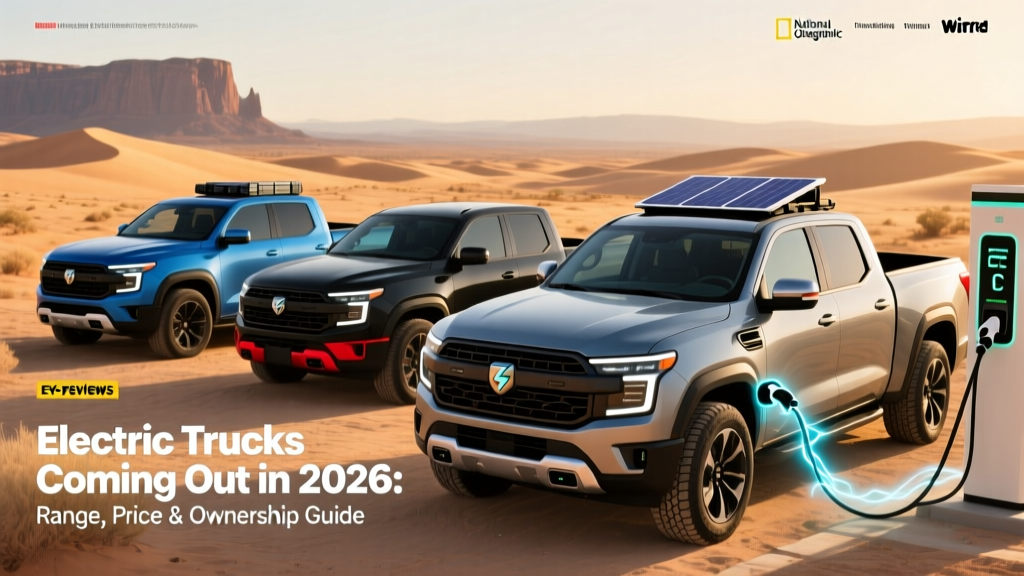
As of early 2026, the electric truck market includes the Ford F-150 Lightning (EPA range up to 320 miles), Rivian R1T (up to 420 miles with the Max Pack), Chevrolet Silverado EV (up to 492 miles on the top 4WT trim), and the Tesla Cybertruck (up to 340 miles). The GMC Sierra EV (Denali Edition 1, up to 440 miles) is ramping production now, while the Ram 1500 REV (announced up to 500 miles with the optional 229 kWh pack) is expected to begin deliveries in late 2026. The Chevrolet Silverado EV Trail Boss and mid-trim Ram 1500 REV variants are also slated for 2026 model-year availability.
Real-world highway range typically drops 15–25% below EPA estimates, and towing can cut range in half. Plan for 200–280 miles of practical range in most daily and highway scenarios.
The 2026 Electric Truck Landscape: What's Available and What's Coming
The electric pickup segment has matured rapidly. What started with the F-150 Lightning and Rivian R1T in 2022 has expanded into a competitive field with genuine variety in price, capability, and battery strategy. Here's where each model stands for the 2026 model year.
| Model | EPA Range | Battery (usable kWh) | Chemistry | Peak DC Charge (kW) | 10–80% Time | 0–60 mph | Max Tow (lbs) | Base MSRP |
|---|---|---|---|---|---|---|---|---|
| Ford F-150 Lightning (Std Range) | 240 mi | 98 kWh | NMC | 120 kW | ~44 min | ~5.8s | 7,700 | $54,995 |
| Ford F-150 Lightning (Ext Range) | 320 mi | 131 kWh | NMC | 155 kW | ~38 min | ~4.5s | 10,000 | $69,995 |
| Rivian R1T (Dual Max) | 420 mi | 141 kWh | NMC | 220 kW | ~30 min | ~3.5s | 11,000 | $89,900 |
| Chevy Silverado EV 4WT | 492 mi | 205 kWh | NMC | 350 kW | ~25 min | ~4.5s | 12,500 | $74,900 |
| Tesla Cybertruck (AWD) | 340 mi | 123 kWh (est.) | NMC | 250 kW | ~28 min | ~4.1s | 11,000 | $79,990 |
| GMC Sierra EV Denali Ed. 1 | 440 mi | 200 kWh (est.) | NMC | 350 kW | ~25 min | ~4.3s | 12,000 | $99,495 |
| Ram 1500 REV (announced) | ~500 mi (est.) | 229 kWh (opt.) | NMC | 350 kW | ~25 min (est.) | ~4.4s | 14,000 | ~$72,000 (est.) |
Sources: fueleconomy.gov, manufacturer press sites. Ram 1500 REV specs are preliminary and subject to change. MSRPs exclude destination charges.
Real-World Range Reality Check
EPA estimates assume mixed driving at moderate temperatures. Expect the following in practice:
- Highway-only at 75 mph: Subtract 15–20%. A 320-mile F-150 Lightning delivers roughly 260–275 miles.
- Towing a 5,000-lb trailer: Expect 40–50% range loss. That 320-mile truck may deliver 160–190 miles.
- Cold weather (below 30°F): Subtract 20–30% due to battery resistance and cabin heating. LFP chemistries are less affected, but no current full-size electric truck uses LFP.
- Combined realistic daily range: 200–280 miles for most drivers in most conditions, regardless of the sticker number.
Electric Truck vs Gas Truck: Cost and Capability Compared
The purchase price of an electric truck remains higher than a comparably equipped gas truck, but operating costs tell a different story. Here's a data-driven comparison between the Ford F-150 Lightning Extended Range and a similarly equipped Ford F-150 3.5L EcoBoost 4WD (SuperCrew, Lariat trim, ~$65,000 MSRP).
| Category | F-150 Lightning (Ext Range) | F-150 3.5L EcoBoost Gas |
|---|---|---|
| MSRP (approx.) | $69,995 | $64,500 |
| Fed. Tax Credit (§30D) | Up to $7,500* | $0 |
| Effective Purchase Price | ~$62,495 | $64,500 |
| Fuel/Energy Cost (15,000 mi/yr) | $650–$1,100/yr (home charging) | $2,200–$2,800/yr (gas at $3.30/gal, 19 MPG) |
| 5-Year Fuel/Energy Total | $3,250–$5,500 | $11,000–$14,000 |
| Maintenance (5 yr) | ~$1,200 (tires, cabin filter, fluid top-offs) | ~$3,500 (oil, filters, plugs, brakes, fluids) |
| Insurance (avg/yr) | $2,400–$3,000 | $1,800–$2,300 |
| Est. 5-Year Total Cost | $72,000–$82,000 | $80,000–$92,000 |
*§30D tax credit eligibility depends on MSRP caps ($80,000 for trucks/vans/SUVs), buyer income limits ($300K MFJ / $150K single), and battery critical-mineral sourcing requirements. Verify current eligibility at irs.gov. Point-of-sale transfer is available through registered dealers.
The Towing Trade-Off
Electric trucks match or exceed gas trucks in peak torque and max towing ratings. The Silverado EV 4WT is rated at 12,500 lbs, and the Ram 1500 REV targets 14,000 lbs. But range while towing is the critical limitation. A gas F-150 with a 36-gallon tank and 16 MPG while towing can cover roughly 575 miles before refueling. An electric truck towing the same load will need a charge stop every 150–190 miles, and DC fast charging a 130+ kWh battery from 10–80% takes 25–40 minutes. For frequent heavy towing over long distances, a diesel or gas truck remains more practical in 2026.
Real Costs of Electric Truck Ownership
Beyond the sticker price and fuel savings, electric truck ownership involves specific costs that first-time buyers should budget for.
| Expense | Typical Cost Range | Notes |
|---|---|---|
| Home Level 2 Charger (hardware) | $400–$750 | ChargePoint Home Flex, Wallbox Pulsar Plus, Ford Charge Station Pro |
| Home Charger Installation | $800–$3,500 | Depends on panel capacity, conduit run, permit. 200A panel upgrade adds $1,500–$3,000. |
| Electricity (15,000 mi/yr, home) | $650–$1,100 | At $0.13–$0.22/kWh; varies by state and time-of-use rates |
| Public DC Fast Charging | $0.30–$0.60/kWh | Supplemental; road-trip charging. Adds $1,000–$2,000/yr if heavily used. |
| Insurance | $2,400–$3,000/yr | Typically 20–35% higher than equivalent gas trucks |
| Tire Replacement | $1,200–$2,000 (set of 4) | Heavier vehicle weight wears tires faster; expect 25,000–35,000 mi life |
Home Charging: The Make-or-Break Factor
Electric truck ownership is dramatically cheaper and more convenient when you can charge at home. A Level 2 charger (240V, 48A) adds roughly 20–30 miles of range per hour of charging — enough to fully replenish a 130 kWh battery overnight. But not every buyer has access:
- Garage or driveway with 200A panel: Ideal. Budget $1,200–$2,500 for a hardwired 48A charger installation.
- Older home with 100A panel: You'll likely need a panel upgrade ($1,500–$3,000) or opt for a lower-amperage charger (32A), which charges more slowly but avoids the upgrade.
- Apartment or street parking: Public charging only. This is viable but more expensive ($0.30–$0.60/kWh at DC stations vs. $0.13–$0.22/kWh at home) and less convenient. Factor in 30–45 minutes per session, 2–3 times per week.
If you cannot install home charging, an electric truck's cost advantage shrinks significantly, and the inconvenience grows — especially for a vehicle with a 130+ kWh battery that takes a long time to fill at public chargers.
Common Electric Truck Misconceptions
| Myth | Fact |
|---|---|
| "Electric trucks can't tow." | They can tow competitively — the Silverado EV is rated for 12,500 lbs. But range drops 40–50% while towing, requiring more frequent stops than gas. |
| "Batteries won't last and cost $30K to replace." | All major electric trucks carry 8-year/100,000-mile battery warranties (10 yr/150,000 mi in CARB states) guaranteeing ≥70% capacity retention (fueleconomy.gov). Real-world degradation data from older EVs shows 10–15% loss over 150K miles. Out-of-warranty replacement is expensive ($15,000–$25,000) but rarely needed within the vehicle's practical life. |
| "The $7,500 tax credit applies to everyone." | The §30D credit has MSRP caps ($80K for trucks), buyer income caps ($300K joint / $150K single), and strict battery-sourcing requirements that change annually. Some trims qualify; others don't. Always verify at irs.gov before purchasing. |
| "Electric trucks are slower to charge than you think." | True for large batteries. A 200+ kWh pack (Silverado EV, Sierra EV) charging at 350 kW can add 100 miles in ~10 minutes, but a full 10–80% session still takes 25–35 minutes. Smaller packs like the Lightning's 131 kWh charge at lower peak rates (155 kW) and take ~38 minutes. |
| "Electric trucks are useless off-road." | The Rivian R1T has proven otherwise with quad-motor torque vectoring, adjustable air suspension (up to 14.4" ground clearance), and tank turns. The Cybertruck AWD includes adaptive damping and 16" ground clearance. However, off-roading consumes energy rapidly — plan for reduced range. |
Charging Infrastructure: What Truck Buyers Need to Know
Full-size electric trucks have large batteries that demand high-power DC fast charging. Here's how the current infrastructure handles them:
| Level | Power (kW) | Miles Added per Hour | Typical Use Case |
|---|---|---|---|
| Level 1 (120V) | 1.4 kW | 3–4 mi/hr | Emergency/trickle only — impractical for daily truck use |
| Level 2 (240V, 48A) | 11.5 kW | 25–32 mi/hr | Home overnight charging — primary method for most owners |
| DC Fast (150 kW) | 150 kW | ~300 mi/hr (peak) | Common public stations; adequate for Lightning-class batteries |
| DC Fast (350 kW) | 350 kW | ~500+ mi/hr (peak) | Required to efficiently charge 200+ kWh packs (Silverado/Sierra EV) |
Charge curve reality: No truck sustains its peak charge rate for the full session. A Silverado EV at a 350 kW station will peak near 350 kW at low SoC but taper to ~150 kW above 60% and ~50 kW above 85%. The published 10–80% time accounts for this taper, but 10–100% takes significantly longer. Plan your road-trip stops around the 10–80% window for efficiency.
Connector note: Ford, Rivian, and GM have adopted the NACS (Tesla) connector for 2025+ models, granting access to Tesla Supercharger stations via native port or adapter. The Cybertruck uses NACS natively. Stellantis (Ram) is expected to follow. CCS1 adapters remain useful for Electrify America and other networks.
Decision Framework: Which Electric Truck (If Any) Is Right for You?
Choose based on your actual driving pattern:
Choose the Ford F-150 Lightning if: You want the most mainstream, serviceable electric truck with strong dealer support, reasonable pricing starting at ~$55K, and your daily driving is under 200 miles. Best for fleet buyers and traditional truck owners making the switch.
Choose the Rivian R1T if: You prioritize adventure capability, off-road performance, and maximum range (420 miles with the Max Pack). Accept the premium pricing ($90K+) and limited service-center network. Best for outdoor enthusiasts and tech-forward buyers.
Choose the Chevrolet Silverado EV if: You need maximum range (492 miles on the 4WT) and the largest battery in the segment, and you can absorb the $75K+ price. Best for commercial users and long-commute drivers who want to minimize charge stops.
Choose the Tesla Cybertruck if: You want distinctive design, strong performance (4.1s 0–60), native Supercharger access, and Tesla's software ecosystem. Accept the polarizing styling, limited trim options, and uncertain long-term build quality. Best for Tesla loyalists and early adopters.
Choose the GMC Sierra EV if: You want a premium experience with 440 miles of range and 350 kW charging, and budget is less of a concern (Denali Edition 1 starts near $100K). Best for luxury truck buyers transitioning from Denali/Sierra HD trims.
Wait for the Ram 1500 REV if: You want the highest projected towing capacity (14,000 lbs), a potential 500-mile range option, and competitive pricing (~$72K est.). Understand that deliveries are not yet confirmed and early-production issues are common with new platforms.
Stick with a gas or hybrid truck if: You tow heavy loads (7,000+ lbs) over long distances regularly, lack home charging access, drive in extreme cold frequently, or your budget is under $50K. The Ford F-150 PowerBoost hybrid (25 MPG combined, $60K range) or Toyota Tundra i-FORCE MAX (22 MPG combined) offer meaningful fuel savings without range or charging compromises.
Federal Tax Credits and Incentives for Electric Trucks
The §30D Clean Vehicle Credit can reduce the effective price of an eligible electric truck by up to $7,500. But eligibility is not guaranteed and depends on multiple factors:
- MSRP cap: Trucks, vans, and SUVs must have an MSRP at or below $80,000. This eliminates the GMC Sierra EV Denali Edition 1 and some top-trim Rivian and Cybertruck configurations.
- Buyer income cap: Modified adjusted gross income must not exceed $300,000 (married filing jointly), $225,000 (head of household), or $150,000 (single).
- Battery sourcing: Increasing percentages of critical minerals and battery components must be sourced from the US or FTA partners. These thresholds tighten annually — a truck that qualified in 2025 may not qualify in 2026.
- Point-of-sale transfer: You can transfer the credit to the dealer at purchase, reducing your out-of-pocket cost immediately rather than waiting for a tax refund.
- Commercial vehicle credit (§45W): If you purchase through a business entity, the commercial clean vehicle credit has no MSRP or income caps but different qualification rules. Consult a tax professional.
Always verify current eligibility on the official IRS Clean Vehicle Credits page and confirm with your dealer before finalizing a purchase.
Frequently Asked Questions
What electric trucks are coming out in 2026 that I can actually buy?
The Ford F-150 Lightning, Rivian R1T, Chevrolet Silverado EV, Tesla Cybertruck, and GMC Sierra EV are all in production and available for purchase or order in 2026. The Ram 1500 REV is announced and expected to begin deliveries in late 2026, but exact timing remains unconfirmed. The Chevrolet Silverado EV Trail Boss mid-trim is also rolling out for the 2026 model year.
How much does it cost to charge an electric truck at home?
At the US average residential electricity rate of ~$0.16/kWh, fully charging a 131 kWh F-150 Lightning Extended Range battery costs roughly $21. Charging a 205 kWh Silverado EV costs about $33. For 15,000 miles of annual driving, expect $650–$1,100 in home electricity costs depending on your state's rates and time-of-use pricing.
Can electric trucks handle cold weather?
Yes, but with range penalties. Expect 20–30% range reduction below 30°F due to battery chemistry resistance and cabin heating demands. All current electric trucks include battery preconditioning and heat pumps (or resistive heating) to mitigate this. Preconditioning the battery while plugged in before departure preserves range. If you live in a consistently cold climate, buy 25–30% more range than you think you need.
Are electric trucks good for towing?
They're excellent at pulling — instant torque and high tow ratings (10,000–14,000 lbs) make them capable haulers. The limitation is range: towing typically cuts range by 40–50%. A truck with a 320-mile EPA rating may deliver only 160–190 miles while towing a 5,000-lb trailer. For short tows (under 100 miles round-trip), electric trucks work well. For long-distance towing, gas and diesel remain more practical in 2026.
What should a first-time electric truck buyer know?
Three things matter most: (1) Home charging access — if you can install a Level 2 charger, ownership is dramatically cheaper and easier. Without it, public charging costs more and adds time. (2) Real-world range — subtract 15–25% from EPA estimates for highway driving, more for towing and cold weather. (3) Total cost of ownership — higher purchase price is offset by lower fuel and maintenance costs over 5+ years, but insurance is typically 20–35% higher. Run the numbers for your specific commute, electricity rate, and driving pattern before committing.