Quick Answer: What's the Buzz About Electric Trucks at ConExpo 2026?
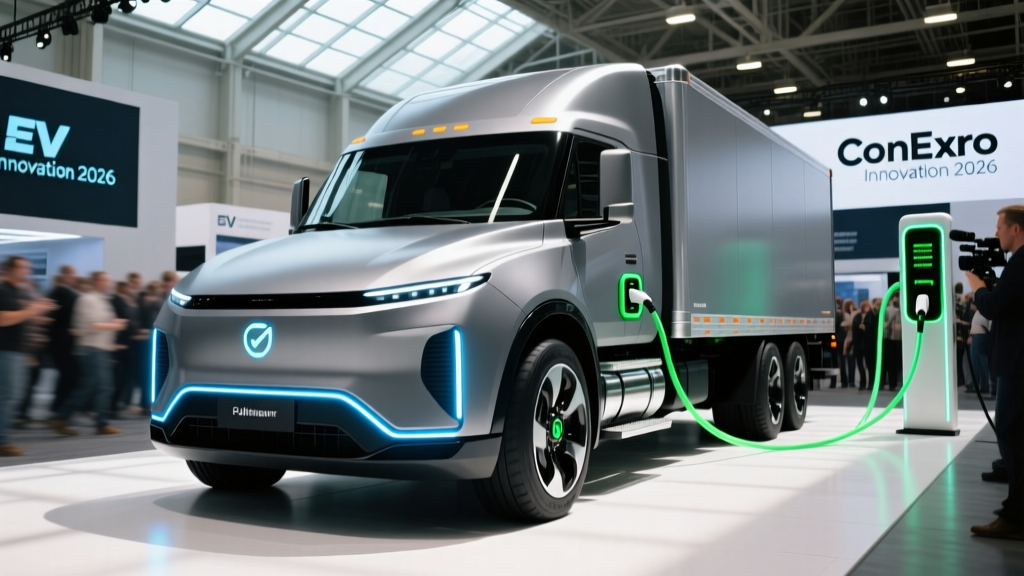
ConExpo-Con/Agg 2026 (March 3–7, Las Vegas) is the premier construction and heavy-equipment trade show, and a new electric truck is generating buzz for ConExpo 2026 — specifically the expanding lineup of Class 8 battery-electric vocational and haul trucks from manufacturers like Mack, Volvo, Peterbilt, and emerging players. These trucks target construction fleets, dump-truck operators, and heavy-haul contractors looking to cut fuel and maintenance costs while meeting tightening emissions mandates in states like California. For buyers, the core decision comes down to duty cycle: if your trucks run predictable daily routes under 150 miles with depot charging access, a battery-electric truck can slash operating costs by 40–60% versus diesel. If you run long-haul or remote-site work without charging infrastructure, diesel or a hybrid-electric setup remains the practical choice for now.
Why ConExpo 2026 Is a Turning Point for Electric Trucks
ConExpo happens once every three years, and the 2026 edition arrives at a critical inflection point. When ConExpo last convened in 2023, electric trucks were largely prototypes or limited-run pilot vehicles. By 2026, multiple OEMs have entered serial production of Class 6–8 electric trucks with batteries ranging from 150 kWh to over 450 kWh, DC fast-charging capability up to 350 kW, and payloads that approach diesel equivalents for many vocational applications.
The buzz isn't hype alone — it's driven by real market forces:
- California's Advanced Clean Fleets rule requires drayage and vocational fleets to transition toward zero-emission vehicles on a phased schedule, pushing construction and haul companies to evaluate electric trucks now.
- Diesel costs remain volatile. At roughly $4.00–$4.80/gallon nationally in early 2026, diesel represents a massive variable cost for fleets running 30,000–60,000 miles annually per truck.
- Battery costs have dropped. Pack-level pricing for commercial-grade LFP (lithium iron phosphate) cells has fallen below $100/kWh for high-volume buyers, making 300+ kWh packs economically viable for the first time.
- Federal and state incentives stack. The Commercial Clean Vehicle Credit (§45W) offers up to $40,000 per qualifying Class 8 truck, and state programs like California's HVIP can add $60,000–$120,000 per vehicle in point-of-sale vouchers.
Specs That Matter: Range, Battery, Charging, and Payload
Consumer EV buyers obsess over 0–60 times. Commercial truck buyers care about energy consumption per mile, payload capacity, and whether the truck can complete a full shift before needing a charge. Here's what the leading Class 8 electric truck platforms deliver in 2026:
| Spec | Mack LR Electric (Refuse/Vocational) | Volvo VNR Electric (Regional Haul) | Peterbilt 579EV (Day Cab) |
|---|---|---|---|
| Battery Capacity (usable) | ~254 kWh (NMC) | ~375 kWh (NMC) | ~396 kWh (NMC) |
| EPA-Estimated Range | ~130 mi (vocational cycle) | ~275 mi (regional haul) | ~250 mi (day cab config) |
| Real-World Range (loaded, mixed terrain) | ~90–110 mi | ~180–220 mi | ~170–200 mi |
| Peak DC Fast Charge Rate | 150 kW (CCS1) | 250 kW (CCS1) | 350 kW (CCS1/MCS capable) |
| 10–80% Charge Time (DCFC) | ~90 min | ~60 min | ~45 min |
| Motor Output | 448 hp (continuous) | 455 hp (continuous) | 670 hp (peak) |
| GCWR (Gross Combined Weight Rating) | 66,000 lbs | 82,000 lbs | 82,000 lbs |
| Payload Penalty vs. Diesel (battery weight) | ~3,000–4,000 lbs less | ~4,000–5,000 lbs less | ~4,500–5,500 lbs less |
| Estimated Base MSRP | ~$350,000–$400,000 | ~$400,000–$450,000 | ~$420,000–$480,000 |
| Warranty (battery) | 5 yr / unlimited mi (70% SoH) | 5 yr / unlimited mi (70% SoH) | 5 yr / 600,000 mi (70% SoH) |
Critical note on range: Unlike consumer EVs, heavy truck range is profoundly affected by payload, grade, and auxiliary loads (PTO equipment, hydraulic systems, mixer drums). A truck rated at 275 miles running empty on flat interstate may deliver only 150 miles fully loaded on a hilly quarry route. Always spec your truck against your actual duty cycle, not the brochure number.
Electric Truck vs. Diesel: Real Operating Cost Breakdown
The purchase price of an electric Class 8 truck is roughly 2–3× that of a comparable diesel. The economic case rests entirely on lower operating costs over the truck's service life. Here's a realistic comparison for a regional-haul dump truck running 40,000 miles/year:
| Cost Category | Electric Truck | Diesel Truck |
|---|---|---|
| Purchase Price (after incentives) | $280,000 (est. after §45W + HVIP) | $175,000 |
| Fuel/Energy (5 yr, 200,000 mi total) | $40,000 (depot charging @ $0.12/kWh, ~2.2 kWh/mi) | $140,000 (~6.5 mpg, $4.30/gal avg) |
| Maintenance (5 yr) | $12,000 (no oil, filters, DEF, minimal brake wear w/ regen) | $45,000 (oil changes, DPF/EGR service, brakes, DEF) |
| Insurance (5 yr) | $35,000 (est. ~15% higher due to repair costs) | $30,000 |
| Charging Infrastructure (one-time) | $40,000–$80,000 per truck (Level 2 depot + electrical) | $0 |
| 5-Year Total Cost | $407,000–$447,000 | $390,000 |
| Cost Per Mile (all-in) | $1.02–$1.12 | $0.98 |
The numbers show near-parity at 5 years, with the electric truck pulling ahead in years 6–10 as the fuel and maintenance savings compound and the diesel faces DPF and transmission overhauls. Fleets running higher mileage (60,000+ mi/yr) or operating in states with expensive diesel and cheap electricity (California, for instance, where diesel often exceeds $5.50/gal while off-peak commercial rates can be $0.08–$0.10/kWh) see payback in 3–4 years.
The infrastructure variable is the wildcard. Installing a single 150 kW DC fast charger at a depot can cost $80,000–$150,000 including utility upgrades, trenching, and permitting. For a fleet of 5+ trucks, smart-charging software that staggers charge sessions and leverages off-peak rates becomes essential. The U.S. Department of Energy's Alternative Fuels Data Center maintains a database of state and utility incentive programs that can offset 50–100% of charging infrastructure costs.
Real-World Ownership: What First-Time Electric Truck Buyers Must Plan For
Buying an electric commercial truck is not like buying a diesel and driving it off the lot. The planning horizon is 12–18 months before delivery. Here's what you need to address:
Depot Charging Is Non-Negotiable
Public DC fast charging for Class 8 trucks is extremely limited in 2026. The WattEV and TeraWatt Infrastructure networks are building truck-specific charging corridors along I-5, I-10, and I-80, but for daily operations, you need depot charging. Most fleets install 19.2 kW Level 2 chargers (adding ~25–30 miles of range per hour) for overnight top-ups, supplemented by one or two 150–350 kW DC fast chargers for opportunity charging during shift changes.
Electrical Service Upgrades
A depot with 5 trucks charging simultaneously at 150 kW each needs roughly 750 kW of electrical capacity — equivalent to a small industrial facility. Expect utility interconnection studies, potential transformer upgrades, and lead times of 6–12 months. Budget $30,000–$100,000+ for electrical work depending on your existing service.
Cold-Weather Range Loss
Lithium-ion batteries lose 15–30% of usable capacity in sub-freezing temperatures, and cabin/equipment heating draws additional energy. If your trucks operate in Minnesota winters, spec 25–30% more battery than your summer duty cycle requires. Battery preconditioning (warming the pack before charging) is essential for maintaining charge speed in cold weather — confirm your OEM's thermal management system supports this.
Driver Training
Regenerative braking in electric trucks is significantly stronger than diesel engine braking. Drivers need training on one-pedal-style operation, charge-management habits (keeping SoC between 20–90% for battery longevity), and understanding the dash energy-consumption readouts. Fleets report a 2–4 week adjustment period.
Incentives and Tax Credits: What's Actually Available in 2026
The incentive landscape for commercial electric trucks is substantial but complex. Here are the primary programs:
- §45W Commercial Clean Vehicle Credit: Up to $40,000 for Class 8 vehicles (or 30% of purchase price, whichever is less). This is a business tax credit claimed on IRS Form 8936 — consult your tax professional, as eligibility depends on battery sourcing requirements and your tax liability. See the IRS clean vehicle credits page for current rules.
- State HVIP Programs: California's Hybrid and Zero-Emission Truck and Bus Voucher Incentive Project offers $60,000–$120,000 per Class 8 truck, with higher amounts for fleets operating in disadvantaged communities. New York, New Jersey, and Colorado have similar but smaller programs.
- Utility Make-Ready Programs: Many investor-owned utilities (PG&E, SCE, Con Edison) cover 50–100% of the electrical infrastructure cost for depot charging — the wiring, panels, and conduit — while you pay for the chargers themselves.
- IRA §179 Deduction: Electric trucks may qualify for accelerated depreciation, allowing you to deduct a substantial portion of the purchase price in year one. Coordinate with your CPA.
Common Misconceptions About Electric Trucks
| Myth | Fact |
|---|---|
| "Electric trucks can't handle construction payloads." | Battery weight reduces payload by 3,000–5,500 lbs depending on the platform. For many dump-truck and mixer applications, this is within acceptable margins — especially with federal bridge-formula weight exemptions for EVs (an additional 2,000 lbs allowed on the steer axle). For max-payload gravel hauls, diesel still wins. |
| "Charging takes too long for a work shift." | Overnight depot charging (8–10 hours on Level 2) fully replenishes a 300–400 kWh pack. Opportunity charging at 250–350 kW adds 80–120 miles in 30 minutes during a lunch break. The constraint is infrastructure, not charge speed. |
| "The battery will need replacing at huge cost." | Commercial NMC packs are warranted for 5 years at 70% State of Health. Real-world data from early-adopter fleets shows ~2–3% annual degradation. A replacement pack in 2026 costs $150–$250/kWh (so $60,000–$100,000 for a 400 kWh pack), but most packs outlast the truck's first-owner service life. |
| "There are no electric trucks available — it's all vaporware." | Mack, Volvo, Peterbilt, Kenworth, and Freightliner all have serial-production Class 8 electric trucks available for order in 2026, with lead times of 3–9 months. ConExpo 2026 will showcase next-gen platforms, but current-gen trucks are buying and hauling today. |
| "Electric trucks can't tow." | Electric motors produce peak torque at 0 RPM. The Volvo VNR Electric and Peterbilt 579EV both carry 82,000-lb GCWR ratings. The challenge isn't pulling power — it's the range reduction when towing at max weight (expect 30–50% range loss vs. bobtail operation). |
Decision Framework: Is an Electric Truck Right for Your Operation?
If / Then Buyer Guide
Choose an electric truck if:
- Your daily routes are under 150 miles (loaded) and trucks return to a fixed depot nightly.
- You operate in a state with strong incentives (CA, NY, NJ, CO, WA) and high diesel prices.
- Your fleet runs 5+ days/week at high mileage — the fuel savings scale with utilization.
- You have (or can install) depot charging with adequate electrical service.
- Emissions compliance matters for contracts (many government and port contracts now require or prefer zero-emission equipment).
- Your duty cycle involves frequent stop-and-go (refuse, delivery, dump runs) where regenerative braking recovers significant energy.
Stick with diesel (or wait) if:
- Your trucks regularly exceed 250 miles/day on varying routes without predictable charging access.
- You operate in extreme cold (consistent sub-10°F) where range loss and battery heating demands are severe.
- You need maximum payload on every load — the 3,000–5,500 lb battery penalty directly cuts revenue per trip.
- Your operation is remote (mining, rural construction) with no grid capacity or charging within 100+ miles.
- Your trucks sit idle for days between jobs — the high capital cost demands high utilization to justify.
Consider a hybrid or hydrogen fuel-cell truck if:
- You need extended range (400+ mi) but want some electrification for PTO/equipment operation — hydrogen FCEV platforms from Hyundai (XCIENT) and Nikola are entering limited service in California.
- Your duty cycle splits between short urban runs and long highway segments — a PHEV powertrain can handle the urban portion on battery and switch to diesel for highway legs.
What to Watch at ConExpo 2026
Beyond the production trucks already available, several developments expected at ConExpo 2026 will shape the next generation of electric commercial vehicles:
- Megawatt Charging System (MCS) adoption: The SAE J3105 MCS standard enables charging at up to 1,200 kW — enough to add 200+ miles in 15 minutes for a Class 8 truck. Watch for OEM announcements on MCS-capable truck platforms and infrastructure partnerships.
- LFP battery options: Lithium iron phosphate packs offer lower energy density but dramatically longer cycle life (4,000+ cycles vs. ~1,500–2,000 for NMC) and lower cost. For high-utilization fleets, LFP may become the preferred chemistry despite a range trade-off.
- Vehicle-to-Grid (V2G) capability: Some platforms now support bidirectional charging, allowing parked trucks to sell stored energy back to the grid during peak demand. At commercial electricity rates, this can generate $3,000–$8,000/year per truck in grid-services revenue.
- Integrated fleet-management software: OEMs are bundling route-optimization, charge-scheduling, and predictive-maintenance platforms that can reduce energy consumption 8–12% through smarter dispatching.
Frequently Asked Questions
How long does it take to charge a Class 8 electric truck?
On a 19.2 kW Level 2 depot charger, a full charge of a 375 kWh battery takes approximately 18–20 hours — fine for overnight top-ups if the truck used 50–60% of its battery during the shift. On a 250 kW DC fast charger, 10–80% takes roughly 60 minutes. On a 350 kW charger, 10–80% drops to about 45 minutes. Charging slows significantly above 80% SoC to protect battery health — the charge curve tapers to under 50 kW in the final 20%.
What's the real-world range of an electric dump truck on a job site?
A Class 8 electric dump truck with a 300–400 kWh battery typically achieves 1.8–2.5 kWh/mile depending on load and terrain. Fully loaded on a mixed-terrain haul route, expect 130–200 miles of real-world range. Stop-and-go site work with heavy regenerative braking can actually improve efficiency versus steady highway driving. Always add a 20% buffer for unexpected detours, PTO use, and climate demands.
Do electric trucks qualify for the $7,500 consumer tax credit?
No. The §30D consumer credit applies to light-duty vehicles under 14,000 lbs GVWR. Commercial Class 8 trucks (over 33,000 lbs GVWR) qualify instead for the §45W Commercial Clean Vehicle Credit, which provides up to $40,000 per vehicle (30% of cost or $40K, whichever is less). This is a business credit — eligibility depends on your tax situation, battery sourcing compliance, and MSRP thresholds. Consult a tax professional.
What happens if the battery degrades past the warranty threshold?
Most OEM warranties guarantee 70% State of Health (SoH) over 5 years. If degradation exceeds this, the manufacturer replaces or refurbishes the pack at no cost. Out of warranty, a replacement pack for a 375 kWh system runs $60,000–$95,000 in 2026. However, degradation data from early fleet deployments (Port of Los Angeles drayage trucks, FedEx delivery fleets) shows annual loss rates of 2–3%, meaning a truck should retain 80–85% SoH after 5 years under normal use.
Can I charge an electric truck at a public Tesla Supercharger or Electrify America station?
No. Public DC fast-charging networks are designed for light-duty vehicles with CCS1 or NACS connectors at 150–350 kW. Class 8 trucks require higher-power connectors, larger parking bays, and often MCS (Megawatt Charging System) infrastructure. Truck-specific charging corridors from WattEV, TeraWatt, and Greenlane are being built along major freight routes, but depot charging remains the primary strategy for 2026 fleet operations.
How does cold weather affect electric truck performance?
At 20°F, expect 15–20% range reduction. At 0°F or below, range loss can reach 25–35%. Battery preconditioning (heating the pack to optimal temperature before charging and driving) mitigates some loss but consumes energy itself. Fleets in northern climates should spec 25–30% more battery capacity than warm-climate equivalents and install heated depot parking where possible. Cabin heating in electric trucks draws 5–10 kW continuously — a non-trivial load on a 300 kWh pack over a 10-hour shift.