The Short Answer on Electric Travel Trailers
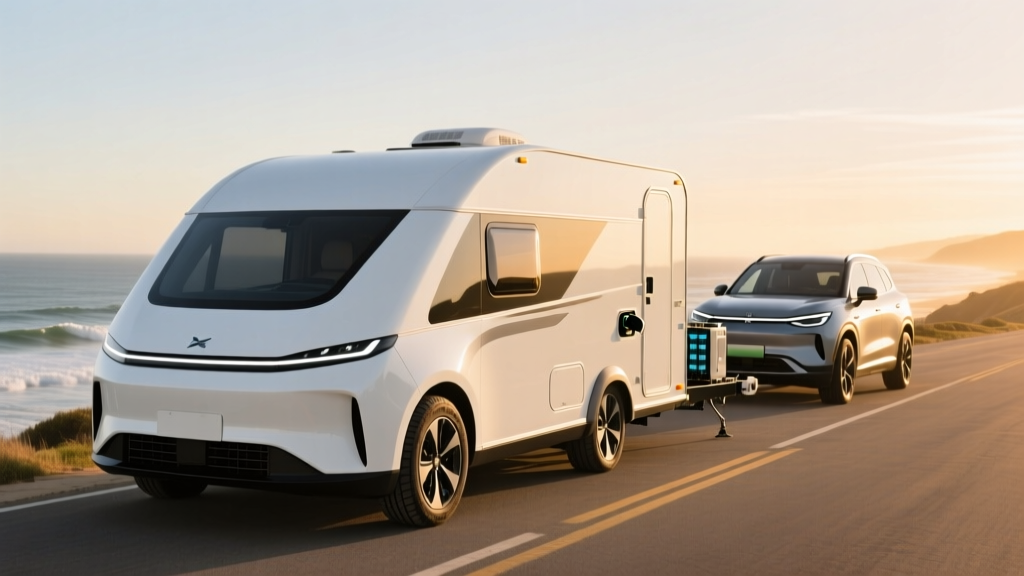
An electric travel trailer is a battery-equipped camper that uses integrated motors and regenerative braking to assist the tow vehicle — reducing range loss, stabilizing the trailer, and even providing off-grid power at the campsite. As of early 2026, the category is led by the Lightship L1 (announced, deliveries expected mid-2026) and a handful of concept-stage competitors. Expect a base price between $75,000 and $95,000, a trailer-side battery of 80–125 kWh, and a net tow-vehicle range penalty of roughly 15–30% instead of the 40–60% loss you'd see with a conventional travel trailer of similar size. If you own an EV with a tow rating of 5,000+ lbs (Ford F-150 Lightning, Rivian R1T, Tesla Cybertruck, Chevrolet Silverado EV), an electric travel trailer can make EV camping viable — but public DC fast-charging with a trailer in tow remains the category's biggest unsolved problem.
What Is an Electric Travel Trailer — and How Does It Differ From a Conventional Camper?
A conventional travel trailer is a passive load: dead weight on wheels that the tow vehicle must accelerate, climb hills with, and brake for entirely on its own. An electric travel trailer adds a high-voltage battery pack (typically LFP chemistry for safety and longevity), one or two electric drive axles, and a control system that senses the tow vehicle's behavior and provides proportional assist.
In practice, this means:
- Propulsion assist on inclines: The trailer's motors push alongside the tow vehicle on grades, cutting the energy draw from the truck's battery.
- Regenerative braking on descents: The trailer recaptures energy going downhill, reducing brake wear on both truck and trailer.
- Trailer-level stabilization: Active torque on individual wheels can counteract sway before it starts — a significant safety upgrade over passive friction sway bars.
- Campsite power station: A 100+ kWh trailer battery can run A/C, induction cooktops, and lights for days without a generator — or power a home during an outage via V2H/V2L connections.
Range Impact: EV vs. Gas Truck Towing Comparison
The single biggest question from EV owners considering a travel trailer is range. Here is how the numbers stack up for a 5,500-lb, 27-foot trailer at highway speeds (65 mph, flat terrain, 70°F):
| Metric | Conventional Trailer (Gas Truck) | Conventional Trailer (EV Truck) | Electric Travel Trailer (EV Truck) |
|---|---|---|---|
| Tow-vehicle range without trailer | 450 mi (30-gal tank) | 320 mi (EPA est.) | 320 mi (EPA est.) |
| Range while towing | ~275 mi | ~160–190 mi | ~230–270 mi |
| Range loss percentage | ~39% | ~41–50% | ~15–28% |
| Energy cost per mile (towing) | $0.32–$0.45 (gas) | $0.10–$0.18 (electric) | $0.12–$0.22 (electric, both batteries) |
| Refuel/recharge time | 8 min (gas station) | 40–70 min (DCFC, unhitched) | 50–90 min (DCFC, unhitched) |
The electric travel trailer's range advantage is real but physics-limited. You are still moving 9,000–11,000 lbs of combined vehicle weight through the air, and aerodynamic drag dominates at highway speed. The trailer's battery and motors offset the steepest energy spikes (hills, acceleration) but cannot eliminate the drag penalty. Expect real-world highway range with an electric trailer to land between 230 and 270 miles on a truck like the F-150 Lightning Extended Range — a meaningful improvement over the ~170 miles you'd see with a conventional trailer, but still requiring route planning around charging stops.
2026 Electric Travel Trailer Models: Specs and Pricing
| Spec | Lightship L1 | Pebble Flow (Announced) |
|---|---|---|
| Status (early 2026) | Pre-orders open; deliveries expected mid-2026 | Concept/reservations; production TBD |
| Trailer battery | ~125 kWh (LFP) | ~45–60 kWh (estimated) |
| Propulsion assist | Dual-motor, self-propelling to campsite | Single-motor assist (estimated) |
| Length | 27 ft | ~22 ft (estimated) |
| GVWR | ~7,500 lbs | ~4,500 lbs (estimated) |
| Sleeping capacity | 4–6 | 2–4 |
| Off-grid power output | Up to 20 kW (V2L/V2H capable) | ~5–10 kW (estimated) |
| Solar roof | Up to 3 kW integrated | Planned (specs TBD) |
| Base MSRP | $85,000–$95,000 (est.) | $45,000–$55,000 (est.) |
| Federal tax credit (§30D) | Not eligible (not a motor vehicle) | Not eligible |
A critical note on pricing: electric travel trailers are not eligible for the federal §30D clean vehicle credit (source: IRS). That credit applies to new clean motor vehicles placed in service — a trailer, regardless of its battery size, does not qualify. However, the tow vehicle itself may qualify for up to $7,500 if it meets current-year MSRP caps, income thresholds, and battery-sourcing requirements. Consult a tax professional for your specific situation.
Charging Logistics: The Unsolved Problem
Here is where the electric travel trailer concept meets its stiffest real-world test. Most DC fast-charging stations are not designed for vehicles with trailers attached. You face three options at every charging stop:
- Pull-through charging: A small but growing number of stations (some Electrify America and Tesla Supercharger locations) offer pull-through stalls where you can charge without unhitching. These remain rare — as of early 2026, fewer than 5% of public DCFC sites have them.
- Unhitch and charge: Disconnect the trailer in a parking area, drive the truck to the charger, charge, then reconnect. This adds 10–15 minutes to every stop and requires a safe, flat staging area.
- Charge the trailer separately: Some electric trailers (like the L1) can accept a charge independently via a secondary CCS or NACS inlet. If the campsite or station supports it, you can charge both batteries simultaneously — but this requires two chargers or a splitter setup.
| Charging Method | Power (kW) | Trailer 10–80% Time | Notes |
|---|---|---|---|
| Level 1 (120V outlet) | 1.4 kW | ~60+ hours | Emergency/trickle only |
| Level 2 (240V, 48A) | 11.5 kW | ~8–10 hours | Overnight at campsite or home |
| DC Fast Charge (CCS/NACS) | 80–150 kW (est.) | ~45–70 min | Requires unhitching or pull-through stall |
| Solar (integrated roof) | 1.5–3 kW | N/A (supplemental) | Adds ~8–15 mi/day of equivalent energy |
For home charging, a Level 2 setup at your residence is practical if you have a 240V/50A circuit near your parking spot. Expect to pay $800–$2,500 for a hardwired Level 2 EVSE installation (equipment + electrician + permit, per DOE guidance). Charging a 125 kWh trailer battery from 20% to full on Level 2 takes roughly 9–11 hours — fine for overnight, but plan accordingly.
Total Cost of Ownership: Electric Travel Trailer vs. Conventional
| Cost Category (5-Year Estimate) | Conventional Travel Trailer ($35K) | Electric Travel Trailer ($90K) |
|---|---|---|
| Purchase price | $35,000 | $90,000 |
| Fuel/energy (50 camping nights, 6,000 tow-mi total) | $2,400 (gas for truck) | $1,100 (electric, truck + trailer) |
| Generator fuel (campsite power) | $600 | $0 (battery-powered) |
| Trailer maintenance (brakes, bearings, tires) | $1,800 | $900 (regen reduces brake wear) |
| Insurance (5 years) | $2,500 | $4,500 (higher replacement value) |
| Battery degradation/replacement reserve | $0 | $0–$2,000 (LFP degrades slowly; warranty typically 8–10 yr) |
| Campsite fees (hookup premium) | $500 | $0 (off-grid capable, boondock more) |
| 5-Year Total | $42,800 | $98,500 |
The math is clear: an electric travel trailer costs significantly more upfront and will not break even against a $35,000 conventional trailer on fuel savings alone within any realistic ownership window. The value proposition is different — it's about enabling EV towing that would otherwise be impractical, eliminating generator noise and emissions, providing off-grid power resilience, and reducing sway-related safety risk. If those benefits matter to you, the premium may be justified. If you're purely cost-optimizing, a conventional trailer behind a gas truck remains cheaper for the next decade.
Real-World Ownership Considerations
Home Charging Access
You need a 240V circuit rated for at least 50 amps near where you park the trailer. Many homeowners will need an electrical panel upgrade ($1,500–$3,500) if their current panel is at capacity. Confirm with a licensed electrician before committing.
Climate and Cold Weather
LFP batteries — the likely chemistry for most electric trailers due to thermal stability and long cycle life — lose roughly 20–30% of usable capacity in sub-freezing temperatures. If you camp primarily in cold climates (Rocky Mountains, northern states in shoulder season), plan for significantly reduced trailer assist and off-grid runtime.
Driving Patterns
Electric travel trailers shine on trips under 250 miles between stops — regional camping, state park weekends, and basecamp-style trips. For cross-country towing (500+ mile days), the charging logistics become a serious friction point. Plan routes around pull-through DCFC stations or accept the time cost of unhitching.
Tow Vehicle Compatibility
Not every EV can tow an electric travel trailer. The trailer's GVWR must fall within your vehicle's rated tow capacity:
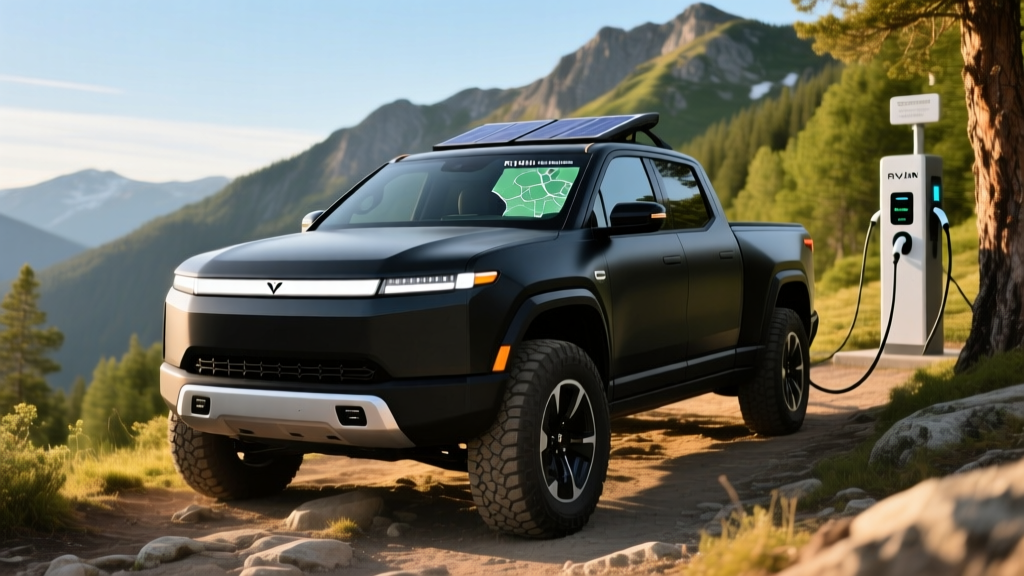
- Ford F-150 Lightning (Extended Range): 10,000-lb max tow rating — compatible with most electric trailers
- Rivian R1T (Dual/Quad Motor): 11,000-lb max — compatible
- Tesla Cybertruck (AWD): 11,000-lb max — compatible
- Chevrolet Silverado EV: 10,000–12,000 lb depending on trim — compatible
- Tesla Model X: 5,000-lb max — only compatible with the lightest electric trailers (Pebble Flow class)
Always check your specific model-year tow rating on the manufacturer's spec page or the door-jamb sticker. Tow ratings vary by trim, battery size, and axle ratio.
Common Misconceptions — Myth vs. Fact
| Myth | Fact |
|---|---|
| "An electric trailer eliminates all range loss." | It reduces range loss to ~15–30%, not zero. Aerodynamic drag and total mass still require energy. |
| "I can charge at any Supercharger with the trailer attached." | Most Supercharger stalls are not pull-through. You will likely need to unhitch. Tesla is expanding pull-through sites, but coverage is limited. |
| "The trailer battery qualifies for the $7,500 tax credit." | It does not. §30D applies to motor vehicles, not trailers. Your tow vehicle may qualify separately. |
| "Electric trailers are available to buy right now." | As of early 2026, the Lightship L1 is in pre-production with deliveries expected mid-2026. Most others are concept or reservation stage. |
| "I don't need a heavy-duty truck to tow one." | You still need a vehicle rated for the trailer's GVWR. The trailer's self-propulsion reduces energy draw but does not reduce the physical weight your hitch must handle. |
| "The trailer battery will need replacing in 5 years." | LFP chemistry typically retains 80%+ capacity after 3,000+ cycles. With moderate use, expect 10–15+ years before significant degradation. |
Decision Framework: Should You Buy an Electric Travel Trailer?
Choose an Electric Travel Trailer If:
- You already own (or plan to buy) an EV truck with a 7,500+ lb tow rating
- Your typical camping trips are under 250 miles from home or between charging stops
- You value silent, generator-free off-grid camping with full A/C and induction cooking
- You want active sway stabilization and regenerative braking for safer towing
- You can install a 240V/50A circuit at home for overnight trailer charging
- You have the budget for an $80,000–$95,000 trailer and accept the premium over conventional options
Choose a Conventional Travel Trailer If:
- You tow with a gas or diesel truck and don't plan to switch to an EV
- You regularly take cross-country towing trips (400+ mile days)
- Your budget is under $50,000 for the trailer
- You lack reliable home charging access for a large trailer battery
- You camp at established RV parks with full hookups and don't need off-grid power
- You want immediate availability and an established dealer/service network
Frequently Asked Questions
Can I tow an electric travel trailer with a Tesla Model Y or Model 3?
No. The Model Y has a 3,500-lb tow rating (when equipped with the tow package), and the Model 3 is not rated for towing in the US market. Electric travel trailers have a GVWR of 4,500–7,500 lbs, requiring a truck-class EV like the F-150 Lightning, Rivian R1T, or Cybertruck.
How long does it take to charge an electric travel trailer at home?
On a 240V Level 2 charger at 11.5 kW, a 125 kWh trailer battery takes roughly 9–11 hours from 20% to full. On a standard 120V outlet (Level 1), it would take 60+ hours — impractical for anything beyond trickle maintenance.
Do electric travel trailers have their own brakes?
Yes. They use electric-over-hydraulic or fully electric brakes, augmented by regenerative braking from the drive motors. This significantly reduces wear on both the trailer's friction brakes and the tow vehicle's brakes compared to conventional trailers.
What happens if the trailer battery runs out on the road?
The trailer reverts to a conventional passive load — the tow vehicle must handle all propulsion and braking. Your range will drop to conventional-trailer levels (~160–190 mi depending on the truck). The trailer's friction brakes remain functional regardless of battery state.
Are electric travel trailers safe in a crash?
The high-voltage battery pack is typically mounted low in the chassis within a reinforced enclosure, similar to EV skateboard architectures. Specific crash-test data for electric trailers is limited as of early 2026 since production models are not yet on the road. Monitor NHTSA for future safety evaluations.
Can the trailer battery power my home during an outage?
Yes — if the trailer supports V2H (vehicle-to-home) or V2L (vehicle-to-load) output. The Lightship L1 is designed for up to 20 kW output, which can run essential home circuits for multiple days. You'll need a compatible transfer switch or inverter setup, installed by a licensed electrician.
Will more electric travel trailers become available after 2026?
Several startups and established RV manufacturers have announced electric or electrified trailer programs. Expect 3–5 additional models to reach production or advanced prototype stage by 2028. The category is growing, but supply remains very limited in 2026.