Quick Answer: Should Your Fleet Go Electric for Refuse?
An electric trash truck (Class 8 battery-electric refuse vehicle) makes financial sense in 2026 if your routes are under 120 miles daily, your depot can support Level 2 or DC fast charging, and you can stack federal, state, and utility incentives to offset the $400,000–$550,000 purchase price. Fuel and maintenance savings of $35,000–$55,000 per truck per year versus diesel are well-documented, but range, payload penalties from battery weight, and depot electrical upgrades are real constraints. If your routes exceed 150 miles or you lack depot charging access, a CNG or diesel hybrid remains the practical choice for now.
What Is an Electric Trash Truck?
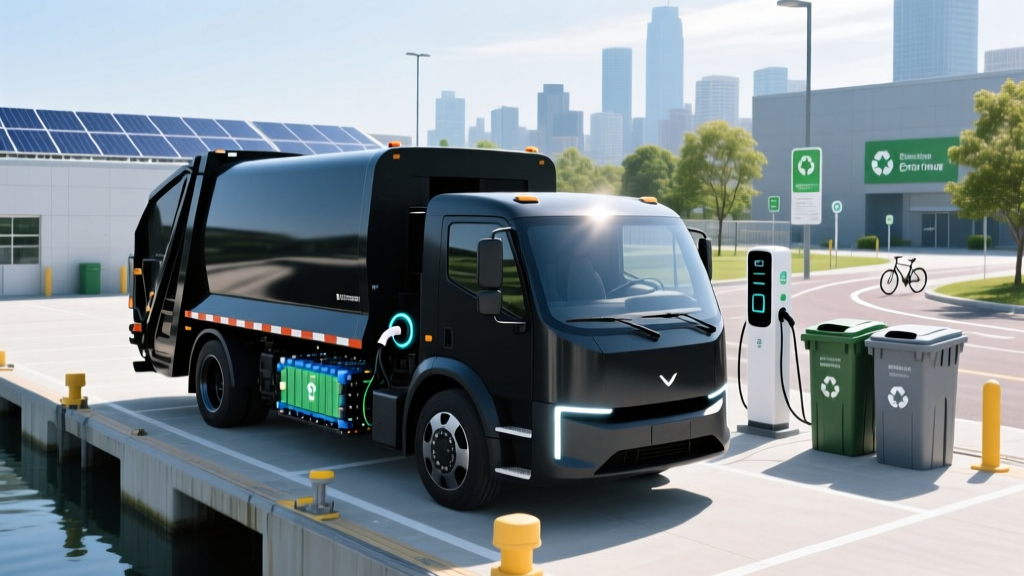
An electric trash truck is a battery-electric vehicle (BEV) built on a Class 8 chassis and fitted with a refuse body — typically a rear-loader, side-loader, or automated side-loader (ASL) compactor. Unlike consumer EVs, these are heavy-duty work machines rated at 33,001+ lbs GVWR, powered by large NMC or LFP battery packs ranging from 200 kWh to over 400 kWh usable capacity. They produce zero tailpipe emissions, operate far more quietly than diesel equivalents, and deliver instant torque ideal for the stop-start, low-speed duty cycle of residential and commercial collection routes.
As of early 2026, the primary production models available in North America include:
- Mack LR Electric — Mack's purpose-built electric refuse chassis, offered with up to 376 kWh of NMC battery capacity across four battery packs, dual electric motors producing 448 HP (continuous) and ~4,000 lb-ft of torque at the wheels via a two-speed transmission.
- Peterbilt 520EV — PACCAR's electric refuse platform with up to ~396 kWh battery capacity and 536 HP peak output, available in multiple axle configurations.
- BYD 8F / Class 8 refuse — BYD's integrated chassis-plus-body offering with LFP chemistry packs (known for longer cycle life and thermal stability), typically around 280–350 kWh depending on spec.
- Autocar E-ACX — A cab-forward electric chassis with up to ~300 kWh battery capacity, designed specifically for refuse and vocational applications.
These are not concept vehicles — they are in active fleet service with municipalities and private haulers across the U.S. and Canada, with thousands of units on order or deployed.
Electric vs Diesel Trash Truck: The Numbers
The case for electrifying a refuse fleet comes down to a total cost of ownership (TCO) calculation, not sticker price. Here's how a typical Class 8 electric refuse truck compares to a diesel equivalent over a 12-year service life, based on aggregated fleet data and manufacturer specifications:
| Metric | Electric Refuse (Class 8 BEV) | Diesel Refuse (Class 8) |
|---|---|---|
| Purchase Price (chassis + body) | $400,000–$550,000 | $250,000–$320,000 |
| Federal Incentive (IRA §45W Commercial Clean Vehicle Credit) | Up to $40,000 per vehicle | $0 |
| Battery Capacity (usable) | 280–400 kWh (NMC or LFP) | N/A (diesel tank: 60–100 gal) |
| Typical Daily Range (loaded, refuse cycle) | 75–130 miles real-world | 200–350 miles |
| Fuel / Energy Cost per Mile | $0.20–$0.45/mi (electricity) | $0.75–$1.30/mi (diesel) |
| Annual Fuel/Energy Cost (~25,000 mi/yr) | $5,000–$11,250 | $18,750–$32,500 |
| Annual Maintenance Cost | $4,000–$8,000 | $12,000–$18,000 |
| Regenerative Braking Benefit | Extends brake life 2–3x vs diesel | Standard friction brakes |
| Powertrain Warranty | Typically 5–7 yr / unlimited mi (varies by OEM) | Typically 2–5 yr / 250,000 mi |
| Estimated 12-Year TCO | $650,000–$900,000 | $800,000–$1,200,000 |
| Tailpipe Emissions | Zero | NOx, PM, CO2 |
| Noise Level at Curb | ~60–65 dBA (motor whine, hydraulics) | ~80–85 dBA (diesel idle + compactor) |
Sources: Manufacturer spec sheets (Mack Trucks, Peterbilt, BYD); fleet TCO data from the National Renewable Energy Laboratory (NREL) and EPA Green Vehicles program; diesel pricing based on EIA national averages.
Range Reality: What Refuse Routes Actually Look Like
The single biggest concern fleet managers raise is range. Here's the practical breakdown:
A typical residential refuse route covers 60–100 miles with 800–1,200 stops, operating at average speeds of 8–15 mph. The compactor body draws significant energy — hydraulic systems for the loader arm and compaction ram can consume 15–25% of total battery capacity over a shift. Combined with propulsion, a fully loaded electric trash truck in real-world service typically achieves:
- 75–100 miles on heavy commercial routes with frequent compaction cycles and hilly terrain
- 90–130 miles on standard residential routes with moderate terrain
- 50–70 miles in extreme cold (below 20°F) without preconditioning, due to battery chemistry limitations and cabin heating draw
Real-World Range vs. Sticker: Manufacturers may advertise 150+ miles of range under ideal conditions. In actual refuse service with a loaded body, active compaction, and HVAC running, expect 75–130 miles. Cold-weather operations in northern climates can reduce this by 25–40%. Always spec your battery pack for worst-case route days, not best-case.
For the majority of single-shift municipal and private routes (under 120 miles), current battery capacity is sufficient. Multi-shift operations or routes exceeding 150 miles remain a challenge — opportunity charging (mid-shift DC fast charge at the depot) can extend coverage but requires scheduling adjustments and 150+ kW charging infrastructure.
Charging Infrastructure: What Your Depot Needs
Depot charging is the backbone of electric refuse fleet operations. Unlike consumer EVs that can rely on public networks, trash trucks return to a fixed base nightly, making controlled depot charging the standard model.
| Charging Level | Power (kW) | Time to Full Charge (300 kWh pack) | Best For |
|---|---|---|---|
| Level 2 AC (J1772 / CCS1 AC) | 19.2–40 kW | 8–16 hours | Overnight depot charging (single-shift ops) |
| DC Fast Charge (CCS1) | 60–150 kW | 2–4 hours (10–80%) | Opportunity charging, multi-shift ops |
| High-Power DC (CCS1 / future MCS) | 150–350+ kW | 1–2 hours (10–80%) | Rapid turnaround, future-proofing |
Depot upgrade costs are significant and must be planned early. A typical 10-truck electric refuse fleet charging at 40 kW AC per vehicle requires approximately 400 kW of total electrical capacity — equivalent to a small industrial facility. Key cost components:
- Electrical service upgrade: $50,000–$200,000+ depending on existing transformer capacity and utility connection requirements. If a new medium-voltage service drop or transformer is needed, costs can exceed $300,000.
- Charging equipment: Level 2 commercial chargers run $5,000–$15,000 per port; DC fast chargers run $50,000–$150,000+ per unit.
- Switchgear, conduit, and wiring: $30,000–$100,000 for a 10-truck depot.
- Software and load management: $5,000–$20,000/year for smart charging platforms that stagger charge times to avoid utility demand charges.
- Permitting and utility interconnection: Timelines of 6–18 months are common for service upgrades. Engage your utility early.
Many utilities offer commercial EV charging incentives, make-ready programs, or favorable time-of-use (TOU) rates for fleet depots. Check with your local utility — these programs can offset 30–50% of infrastructure costs.
Incentives and Tax Credits: Stacking the Savings
The purchase price gap between electric and diesel refuse trucks is real — typically $150,000–$250,000 more for the electric vehicle. But incentive stacking in 2026 can close much of that gap:
- IRA §45W Commercial Clean Vehicle Credit: Up to $40,000 per vehicle for Class 8 BEVs (30% of the vehicle's incremental cost over a comparable diesel, capped at $40,000 for vehicles over 14,000 lbs GVWR). This is a business tax credit — consult your tax professional for eligibility. See IRS guidance on §45W.
- EPA Clean Heavy-Duty Vehicles Program: Funded under the Inflation Reduction Act, this program distributes billions in grants to states and municipalities for zero-emission heavy-duty vehicle replacements. Awards vary by state and application cycle.
- State and local incentives: California's HVIP (Hybrid and Zero-Emission Truck and Bus Voucher Incentive Project) has historically offered $60,000–$120,000+ per Class 8 BEV. New York, New Jersey, Colorado, and other states offer similar voucher programs. Availability and amounts vary — check your state's clean transportation office.
- Utility make-ready and charging incentives: Many investor-owned utilities cover a portion of depot electrical upgrades and charger installation for commercial fleets.
- VW Settlement funds: Remaining funds from the Dieselgate settlement are still being allocated in some states for heavy-duty electrification.
Realistic incentive stacking example: A $475,000 electric refuse truck in California could receive $40,000 (§45W federal) + $100,000 (HVIP) + $30,000 (utility make-ready) = $170,000 in total incentives, bringing the net cost to ~$305,000 — competitive with a fully equipped diesel truck at ~$285,000, with immediate fuel and maintenance savings from day one.
Battery Longevity and Replacement Costs
Refuse duty cycles are harsh on batteries: frequent high-current discharge (compaction cycles), regenerative braking surges, and deep daily cycling. Here's what fleet buyers should know:
- Chemistry: Most current Class 8 refuse trucks use NMC (nickel manganese cobalt) chemistry for higher energy density, though BYD and others offer LFP (lithium iron phosphate) packs that sacrifice some energy density for significantly longer cycle life (4,000–6,000 cycles vs. 1,500–3,000 for NMC) and better thermal stability.
- Expected battery degradation: Fleet data suggests 15–25% capacity loss over 8–10 years of daily refuse cycling, depending on climate, charging practices, and depth of discharge.
- Warranty: Most OEMs offer 5–7 year battery warranties with a capacity retention threshold of 70–80% of original capacity. Read the fine print — some warranties are prorated.
- Replacement cost: A full Class 8 battery pack replacement in 2026 runs approximately $80,000–$150,000 depending on capacity and chemistry. However, individual module replacement (failed cells rather than the full pack) is increasingly supported by OEMs at lower cost.
- Second-life value: Retired truck battery packs at 70–80% capacity still have significant value for stationary energy storage, potentially offsetting replacement costs.
Common Misconceptions About Electric Trash Trucks
| Myth | Fact |
|---|---|
| "Electric trucks can't handle a full day of refuse collection." | Most single-shift routes (60–120 miles) are well within current battery range. Multi-shift and long rural routes remain challenging without opportunity charging. |
| "Battery replacement will bankrupt the fleet." | Battery costs have fallen ~90% since 2010. Module-level replacement, warranties, and second-life resale mitigate risk. By the time replacement is needed (8–12 years), costs will be significantly lower. |
| "The grid can't handle fleet charging." | Smart charging software and TOU rates allow fleets to charge during off-peak hours. Utility partnership and early planning are essential — but it's solvable for most depots. |
| "Electric trucks are weaker than diesel." | Electric motors deliver peak torque at 0 RPM. Class 8 electric refuse trucks match or exceed diesel torque output, with superior hill-start and low-speed pulling performance. |
| "They don't work in cold weather." | Cold reduces range by 25–40% (similar to consumer EVs). Battery thermal management systems and depot preconditioning mitigate this. Fleets in Canada and the northern U.S. are operating successfully with adjusted route planning. |
Decision Framework: Is an Electric Trash Truck Right for Your Fleet?
Choose an electric trash truck if:
- Your routes are under 120 miles per shift with predictable daily return to depot
- Your depot has (or can be upgraded to) sufficient electrical capacity for overnight charging
- You operate in a state with strong incentive programs (CA, NY, NJ, CO, WA, MA, etc.)
- You have environmental or regulatory mandates (e.g., California's Advanced Clean Fleets rule, municipal zero-emission commitments)
- Noise reduction is a priority (early-morning residential collection, dense urban areas)
- You want to lock in lower per-mile operating costs and reduce exposure to diesel price volatility
Stick with diesel, CNG, or a hybrid for now if:
- Your routes regularly exceed 150 miles per shift with no opportunity for mid-shift charging
- Your depot is in a location where utility service upgrades are prohibitively expensive or have multi-year timelines
- You operate in a state with minimal or no incentive funding for heavy-duty electrification
- Your fleet requires extreme operational flexibility (wildfire response, disaster cleanup, unpredictable route extensions)
- Your trucks are nearing mid-life and you plan to replace in 2–3 years anyway (wait for next-gen models with better range and lower cost)
Frequently Asked Questions
How much does an electric trash truck cost in 2026?
A complete electric refuse vehicle (chassis + compactor body) costs between $400,000 and $550,000 depending on battery capacity, body type, and OEM. After federal §45W credits and state incentives, net acquisition cost can fall to $250,000–$350,000 in well-incentivized markets.
What is the real-world range of an electric refuse truck?
Expect 75–130 miles in typical loaded refuse service. Cold weather (below 20°F) can reduce this to 50–70 miles. Always spec for your worst-case route day.
How long does it take to charge an electric trash truck?
On a Level 2 charger (19.2–40 kW), a full overnight charge takes 8–16 hours. On a DC fast charger (60–150 kW), a 10–80% charge takes 2–4 hours, suitable for mid-shift opportunity charging.
Do electric trash trucks qualify for the $7,500 consumer EV tax credit?
No. The consumer §30D credit applies to light-duty vehicles. Commercial heavy-duty trucks qualify for the §45W Commercial Clean Vehicle Credit (up to $40,000 for Class 8) and potentially the IRA's EPA Clean Heavy-Duty Vehicles grant program. Consult a tax professional for your specific situation.
What about hydrogen fuel cell trash trucks?
Fuel cell refuse trucks (e.g., from Hyzon, Nikola) offer faster refueling and longer range but face limited hydrogen refueling infrastructure and higher fuel costs per mile. They remain in early deployment stages compared to battery-electric refuse trucks, which have far more units in active service and established supply chains.
How do I get started evaluating electric refuse trucks for my fleet?
Start with a route-level energy analysis: map daily mileage, stop count, elevation change, and compaction cycles for your most demanding routes. Then engage your utility early to assess depot electrical capacity and upgrade timelines. Finally, consult OEMs and body integrators for pilot vehicle pricing and available incentive stacking in your jurisdiction.