The Bottom Line on Electric Trailers and EV Towing
If you're researching electric trailer towing—whether that means hauling a battery-electric trailer like the Lightship L1 or pulling a conventional camper with your EV—expect a 30–50% reduction in your vehicle's EPA-rated range when towing at highway speeds. A 2026 Ford F-150 Lightning rated at 320 miles EPA will realistically deliver 160–210 miles with a 5,000-pound trailer in tow. The upside: electric trailers with their own battery packs and motors (like the Lightship L1 or Pebble Flow) can offset much of that penalty by contributing their own propulsion, potentially restoring range close to the truck's unloaded baseline. Plan your trips around DC fast-charger spacing of 100–150 miles when towing conventional trailers, and budget $0.12–$0.48 per kWh depending on whether you charge at home or on the road.
What Is an Electric Trailer, Exactly?
The term "electric trailer" covers two very different categories, and confusing them leads to bad purchase decisions:
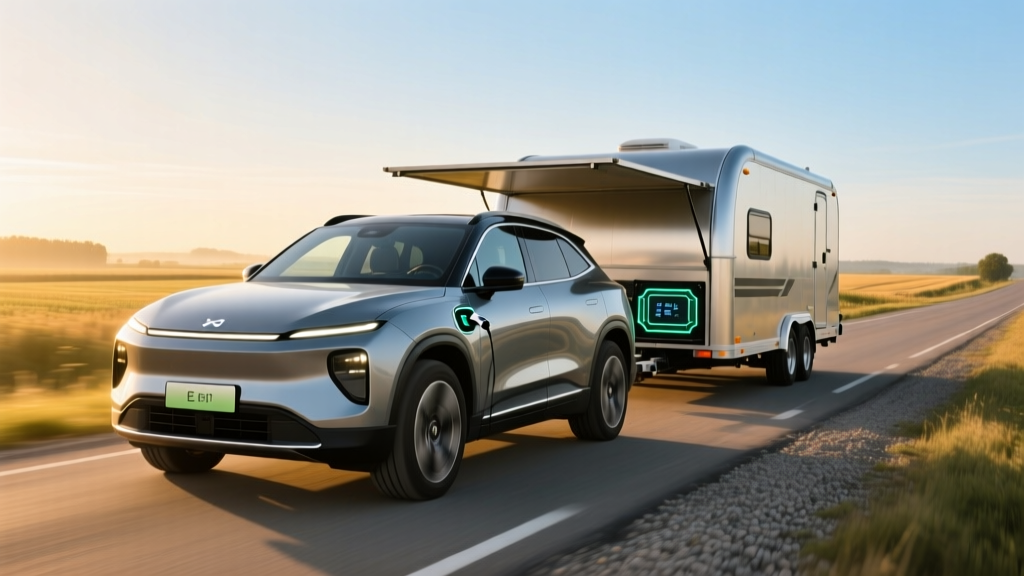
- Battery-electric trailers (e-RVs): These are travel trailers with their own battery pack and electric motors on the axle. The Lightship L1 (announced for late 2025/2026 delivery) carries a ~140 kWh battery pack and dual electric motors that self-propel the trailer, reducing tow-vehicle energy consumption. The Pebble Flow takes a similar approach with a smaller ~45 kWh pack and a single motor, plus solar panels on the roof. Both are designed to be aerodynamic and lightweight.
- Conventional trailers towed by EVs: This is simply pulling a standard travel trailer, boat, or utility trailer behind an electric truck or SUV. The EV does all the work, and range takes a significant hit.
For this guide, we'll cover both scenarios because the ownership math, charging logistics, and vehicle requirements differ substantially.
The Range Reality: EV Towing Numbers That Matter
Here's where marketing brochures go silent and physics takes over. Towing any trailer increases aerodynamic drag and rolling resistance dramatically. The bigger and boxier the trailer, the worse the penalty.
| Vehicle | Unloaded Range (EPA) | Trailer Weight | Est. Towing Range | Range Loss | Fuel/Energy Cost (300 mi trip) |
|---|---|---|---|---|---|
| Ford F-150 Lightning (Ext. Range) | 320 mi | 5,000 lb travel trailer | ~175 mi | ~45% | ~$85 (DC fast charging) |
| Ford F-150 (3.5L EcoBoost, gas) | ~450 mi (18 gal tank, 25 mpg hwy) | 5,000 lb travel trailer | ~270 mi (~12 mpg) | ~40% | ~$75 (at $3.00/gal) |
| Rivian R1T (Dual Max) | 410 mi | 5,000 lb travel trailer | ~225 mi | ~45% | ~$110 (DC fast charging) |
| Chevy Silverado 1500 (2.7L Turbo, gas) | ~440 mi (24 gal, ~22 mpg hwy) | 5,000 lb travel trailer | ~265 mi (~11 mpg) | ~40% | ~$80 (at $3.00/gal) |
| F-150 Lightning + Lightship L1 (e-trailer) | 320 mi | 7,500 lb (self-propelled) | ~280–310 mi (est.) | ~3–12% | ~$85 (DC fast charging) |
Real-world caveat: These towing ranges assume 65–70 mph highway speeds on flat terrain at 65–75°F. Add 15–25% additional loss for mountain passes, headwinds, or cold weather below 40°F. In winter towing conditions, an F-150 Lightning with a conventional trailer might only achieve 130–150 miles before needing a charge.
Electric Trailers with Propulsion: How e-RVs Change the Math
The emerging category of self-propelled electric trailers aims to solve the range-penalty problem by having the trailer contribute its own energy. Here's how the leading options stack up as of early 2026:
| Spec | Lightship L1 | Pebble Flow |
|---|---|---|
| Trailer Battery | ~140 kWh (NMC) | ~45 kWh (LFP) |
| Propulsion Motors | Dual electric axle motors | Single electric axle motor |
| GVWR | ~7,500 lb | ~4,500 lb |
| Solar Capacity | Up to 3 kW roof solar | Up to 1.2 kW roof solar |
| Base MSRP (announced) | ~$125,000 | ~$75,000 |
| Delivery Status | First units expected 2026 | First units expected 2026 |
| Tow Vehicle Requirement | Any EV with 7,500+ lb tow rating | Any EV with 4,500+ lb tow rating |
The Lightship L1's 140 kWh pack is larger than most EV truck batteries. When the trailer's motors engage during highway driving, they share the propulsion load, meaning the tow vehicle's battery depletes far more slowly. Lightship claims near-zero range impact on the tow vehicle under ideal conditions. Independent real-world testing is still limited as these are pre-production units, so treat those claims with appropriate skepticism until third-party validation arrives.
The Pebble Flow, with its smaller 45 kWh LFP battery, won't fully offset towing drag on a heavy load, but it can meaningfully reduce range loss—potentially cutting the penalty from ~45% to ~20–25%. LFP chemistry is a smart choice here: it handles the frequent deep cycling and outdoor temperature swings better than NMC, and its longer cycle life (3,000+ cycles vs. ~1,500 for NMC) suits a trailer that may sit unused for months.
Which EVs Can Actually Tow? 2026 Tow Ratings
Not every EV is rated for trailer duty. Here are the current leaders with their maximum tow ratings and relevant specs:
| Vehicle | Max Tow Rating | Battery (kWh) | EPA Range | Starting MSRP | §30D Credit Eligible? |
|---|---|---|---|---|---|
| Ford F-150 Lightning (Ext. Range) | 10,000 lb | 131 kWh (NMC) | 320 mi | $69,995 | Yes (varies by sourcing) |
| Rivian R1T (Dual Max Pack) | 11,000 lb | 149 kWh (NMC) | 410 mi | $87,900 | No (MSRP exceeds $80K cap) |
| Chevrolet Silverado EV (4WT) | 10,000 lb | 200 kWh (NMC) | 440 mi | $74,800 | Yes (varies by sourcing) |
| Tesla Cybertruck (AWD) | 11,000 lb | 123 kWh (NMC est.) | 340 mi | $79,990 | Borderline (MSRP near cap) |
| Hyundai Ioniq 5 (AWD, w/ tow pkg) | 2,700 lb | 84 kWh (NMC) | 290 mi | $52,200 | Yes (if income/sourcing qualify) |
For the §30D federal tax credit, remember that trucks and SUVs face an $80,000 MSRP cap (vans and trucks use this threshold). Buyer income limits apply: $150,000 single / $300,000 joint AGI. Battery critical-mineral and component sourcing requirements further restrict eligibility. Always verify current rules at IRS.gov before relying on the credit in your purchase math.
Towing Charging Logistics: What Road Trips Actually Look Like
Charging an EV while hooked to a conventional trailer introduces real friction that most buyers underestimate:
The Pull-Through Problem
Most DC fast-charging stations are designed for pull-in/pull-out parking. A truck with a 25-foot trailer cannot fit in a standard charging stall. You'll need pull-through sites—still rare in 2026, though networks like Electrify America and Tesla Superchargers are gradually adding them at travel plazas. Plan routes using A Better Route Planner (ABRP) or PlugShare, filtering for trailer-accessible chargers.
Charging Speed and Cost While Towing
When you arrive at a DC fast charger with a depleted battery from towing, expect slower effective charging because you'll likely need to charge to a higher state of charge (90–100%) to reach the next station. The charge curve tapers sharply above 80%, so those last 20% can take as long as the first 80%.
| Charging Scenario | Energy Used (est.) | Rate | Cost |
|---|---|---|---|
| Home Level 2 (pre-trip top-off) | 100 kWh | $0.14/kWh (avg. US residential) | $14.00 |
| DC Fast Charger (on-road, 1 stop) | 120 kWh | $0.35–$0.48/kWh | $42–$58 |
| DC Fast Charger (on-road, 2 stops) | 180 kWh total | $0.35–$0.48/kWh | $63–$86 |
| Gas truck equivalent (300 mi towing) | ~25 gallons | $3.00/gal | $75.00 |
The EV towing cost advantage depends heavily on home charging. If you can start each trip with a full battery charged overnight at $0.14/kWh, your per-mile energy cost is roughly $0.05–$0.07. On the road at DC fast-charger rates, it climbs to $0.12–$0.18 per mile—narrowing the gap with gas or even exceeding it in some regions.
Cost of Ownership: EV Truck + Trailer vs. Gas Truck + Trailer
| Cost Category | F-150 Lightning (Ext. Range) | F-150 EcoBoost (gas) |
|---|---|---|
| Purchase Price (MSRP) | $69,995 | $55,490 |
| §30D Federal Tax Credit | -$3,750 to -$7,500 (varies) | $0 |
| 5-Year Energy/Fuel (5K towing mi/yr + 10K normal mi/yr) | ~$8,500 (mixed home/DCFC) | ~$16,200 (gas at $3.00/gal) |
| 5-Year Maintenance | ~$2,100 | ~$4,800 |
| Insurance (5-year est.) | ~$12,500 | ~$9,800 |
| Estimated 5-Year Total | ~$86,345 (after credit) | ~$86,290 |
The totals are remarkably close. The EV wins on fuel and maintenance but loses on purchase price and insurance (EV truck premiums run 15–25% higher per IIHS data). The break-even point shifts in the EV's favor if gas prices rise above $3.50/gal or if you drive more than 15,000 total miles per year.
Common Electric Trailer Misconceptions
| Myth | Fact |
|---|---|
| "EVs can't tow anything heavy." | The F-150 Lightning tows 10,000 lb; Rivian R1T tows 11,000 lb. These match or exceed many gas half-ton trucks. The issue is range, not capability. |
| "Electric trailers are available everywhere now." | As of early 2026, the Lightship L1 and Pebble Flow are still in early delivery phases to reservation holders. Production volumes are limited. Expect broader availability in 2027+. |
| "I'll save a ton of money towing with an EV." | Home charging saves significantly. But DC fast-charging on road trips at $0.35–$0.48/kWh can cost as much as gas per mile when towing. Your savings depend on charging habits. |
| "Any EV with a tow hitch can pull a trailer." | Only vehicles with a manufacturer-rated tow capacity should tow. Aftermarket hitches on unrated EVs void warranties and may create safety/liability issues. Check your owner's manual. |
| "Electric trailers don't need their own charging." | e-RVs like the Lightship L1 must be charged independently or via the tow vehicle's connection. A depleted 140 kWh trailer battery won't provide propulsion assistance, defeating the purpose. |
Decision Framework: Should You Tow with an EV?
Choose an EV for towing if:
- You have reliable home Level 2 charging (240V, 40–80A circuit) to start trips with a full battery
- Your towing trips are under 200 miles one-way, or you've mapped DC fast-charger pull-through stops along your route
- You tow fewer than 10 times per year and daily-drive the truck (maximizing the EV's daily fuel savings)
- You're interested in an e-trailer like the Lightship L1 or Pebble Flow and are willing to pay the premium for range preservation
- You live in a moderate climate or accept 20–30% additional range loss in winter towing conditions
Stick with a gas/diesel truck for towing if:
- You regularly tow 300+ miles one-way through areas with sparse charging infrastructure
- You need maximum towing frequency without route-planning overhead
- Your trailer exceeds 8,000 lb and you need a heavy-duty platform (no electric 3/4-ton trucks exist yet in 2026)
- You lack home charging access and would rely entirely on public DC fast chargers
- Upfront budget is tight—gas trucks still carry a $10,000–$20,000 purchase price advantage
Frequently Asked Questions
Can I charge an electric trailer at a regular EV charging station?
It depends on the trailer's connector. The Lightship L1 is expected to use a standard NACS or CCS connector, meaning you could plug it into a DC fast charger—but you'll need a stall that physically accommodates a detached trailer, and you'll be paying for 140 kWh at public rates ($49–$67 per full charge). The Pebble Flow uses a smaller pack and can also charge from standard EV infrastructure. Always check connector compatibility before your trip.
How does towing affect my EV's battery warranty?
Manufacturer battery warranties (typically 8 years/100,000 miles with a 70% capacity retention threshold per fueleconomy.gov standards) cover defects and excessive degradation regardless of towing use, as long as you stay within the rated tow capacity. Exceeding the rated tow limit could void warranty coverage if damage is traced to overloading.
Is it safe to tow a trailer in cold weather with an EV?
It's safe, but plan conservatively. Cold weather alone reduces EV range by 15–30% (per AAA and real-world testing). Combined with towing drag, you could see total range loss of 55–65% vs. the EPA sticker. Preconditioning your battery before fast charging (most EVs do this automatically when a charger is navigated to) helps maintain charge speed. Pack extra margin: if the math says you need 150 miles of range, plan for 200.
Do I need a special license or endorsement to tow with an EV?
No. Standard driver's license requirements for trailer towing are the same whether your tow vehicle is electric or gas. Weight thresholds for commercial endorsements (typically 26,001+ lb combined GVWR) apply equally. Check your state's DMV for specific trailer-brake requirements—most states require electric brakes on trailers over 3,000 lb.
Can I use my EV's battery to power my trailer's appliances while camping?
Yes, if your EV has a Vehicle-to-Load (V2L) or Pro Power Onboard feature. The F-150 Lightning offers up to 9.6 kW of onboard power through its Pro Power Onboard system—enough to run a trailer's air conditioner, microwave, lights, and refrigerator simultaneously for days. This eliminates the need for a gas generator at the campsite, which is one of the most compelling EV-towing advantages beyond fuel cost.