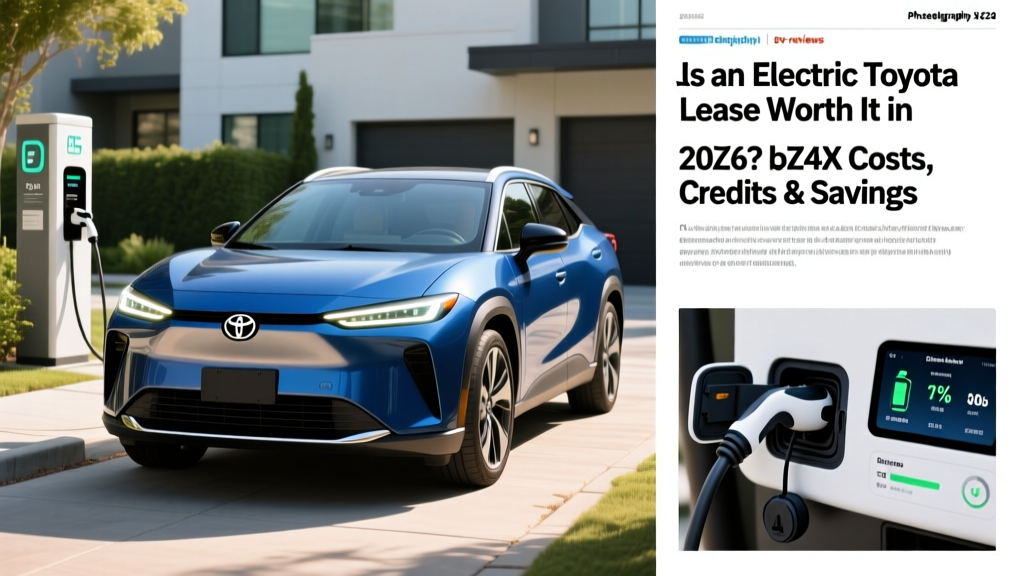
If you are shopping for an electrified vehicle, you have likely considered an electric Toyota lease. Toyota's primary battery-electric offering, the bZ4X, has evolved significantly since its rocky launch. For 2026, it remains a compelling option for buyers who want Toyota's legendary reliability but aren't ready to commit to a full EV purchase.
Leasing an EV offers a unique financial advantage: it can bypass the strict income and battery-sourcing requirements of the federal tax credit. However, the math only works if you understand the total cost of ownership (TCO). Below, we analyze the 2026 Toyota bZ4X (XLE FWD trim) to see if the numbers add up.
2026 Toyota bZ4X: Core Specifications
Before running the financial models, we must establish the baseline performance and efficiency data for the 2026 bZ4X. Note that while the EPA range is respectable, real-world highway driving at 70+ mph will typically yield 10-15% less range than the sticker suggests.
| Spec Category | 2026 bZ4X (XLE FWD) |
|---|---|
| EPA Range | 252 miles (Real-world hwy: ~220 mi) |
| Battery Capacity | 71.4 kWh (usable), NMC Chemistry |
| Efficiency | 119 MPGe combined / 28 kWh/100mi |
| DC Fast Charging | 150 kW peak (10-80% in ~30 min) |
| Level 2 Charging | 7.2 kW onboard charger |
| 0-60 mph | 7.1 seconds |
| MSRP (XLE FWD) | ~$38,465 (est. incl. destination) |
The Lease Loophole: Federal Tax Credit Rules
The most significant factor in an electric Toyota lease is the "lease loophole." Under current IRS rules for the §30D Clean Vehicle Credit, if you purchase an EV, you must meet strict MSRP caps, income limits, and battery-sourcing requirements. However, if you lease, the credit (up to $7,500) is technically awarded to the lessor (the leasing company).
Most manufacturers, including Toyota, pass this $7,500 directly to the consumer as a "lease cash" incentive or capitalized cost reduction. This means even if you earn too much to qualify for the purchase credit, or if the car's battery components fail the sourcing rules, you can often still get the $7,500 discount via a lease.
- Income Caps: AGI ≤ $150k (single) or $300k (joint).
- MSRP Caps: ≤ $80k (SUVs/Pickups) or $55k (Sedans).
- Sourcing: Battery minerals/components must meet US-trade-partner thresholds.
- Transfer: Purchase credits can be transferred to the dealer for a point-of-sale discount.
Always consult a tax professional and the official IRS guidance before signing, as these rules are subject to legislative changes.
5-Year Total Cost of Ownership Breakdown
How much does it really cost to own an EV over 5 years? To answer this, we compare a 2026 bZ4X lease/purchase scenario against a similarly priced gas SUV (e.g., Toyota RAV4 AWD). We assume 15,000 miles driven annually.
| Cost Factor (5 Years) | bZ4X (EV) | RAV4 (Gas AWD) |
|---|---|---|
| Purchase/Lease Net (after credits) | $32,500 (est.) | $36,000 |
| Energy/Fuel (15k mi/yr) | $3,900 (Home charging) | $11,250 (28 MPG @ $3.50/gal) |
| Maintenance | $1,200 | $3,500 |
| Insurance (Avg) | $9,500 | $7,500 |
| Estimated Depreciation | $16,000 | $12,000 |
| Total 5-Year Cost | $63,100 | $70,250 |
Charging vs Gas: The Per-Mile Reality
The primary savings driver in an electric Toyota lease is energy cost. However, this depends entirely on your access to home charging. If you rely on public DC fast charging (averaging $0.40–$0.50/kWh), your costs will rival or exceed those of a gas car.
| Scenario | Cost per Mile | Annual Cost (15k mi) |
|---|---|---|
| Home Level 2 ($0.14/kWh) | $0.039 | $585 |
| Public DC Fast ($0.48/kWh) | $0.134 | $2,010 |
| Gas SUV (28 MPG @ $3.50) | $0.125 | $1,875 |
Maintenance Savings and Insurance Reality
EVs have fewer moving parts, which translates to significant maintenance savings. You will never pay for an oil change, spark plugs, or a transmission flush. Additionally, regenerative braking can extend brake pad life to over 100,000 miles in many cases.
However, insurance is typically 15–25% higher for EVs. This is due to higher repair costs for battery packs and specialized aluminum body panels. For the bZ4X, expect to pay roughly $150–$200 more per year in premiums compared to a gas RAV4.
Depreciation and Resale Value Trends
How well do EVs hold their value? Historically, EVs have suffered steeper depreciation than gas cars due to rapid tech advancements and battery health concerns. However, leasing transfers this risk to the leasing company. If the bZ4X depreciates faster than expected, it is the lessor's problem, not yours. This makes leasing a safer bet for the current generation of EVs.
Frequently Asked Questions
Does Toyota offer a plug-in hybrid (PHEV) alternative?
Yes, the Toyota RAV4 Prime is a PHEV with 42 miles of electric-only range. It is an excellent choice if you cannot charge at home daily or frequently drive long distances where the 252-mile range of the bZ4X might be limiting.
What happens if the battery fails after the lease?
Toyota provides a 10-year/150,000-mile warranty on the hybrid/EV battery. If you lease for 36 months, the battery will be under warranty for the entire term and long after you return the car.
Can I buy the bZ4X at the end of the lease?
Most Toyota Financial Services leases include a purchase option at a predetermined "residual value." However, if EV prices drop significantly, the buyout price might be higher than the car's market value. Always check the current market before exercising a lease buyout.