Is There an Electric Toyota 4Runner in 2026?
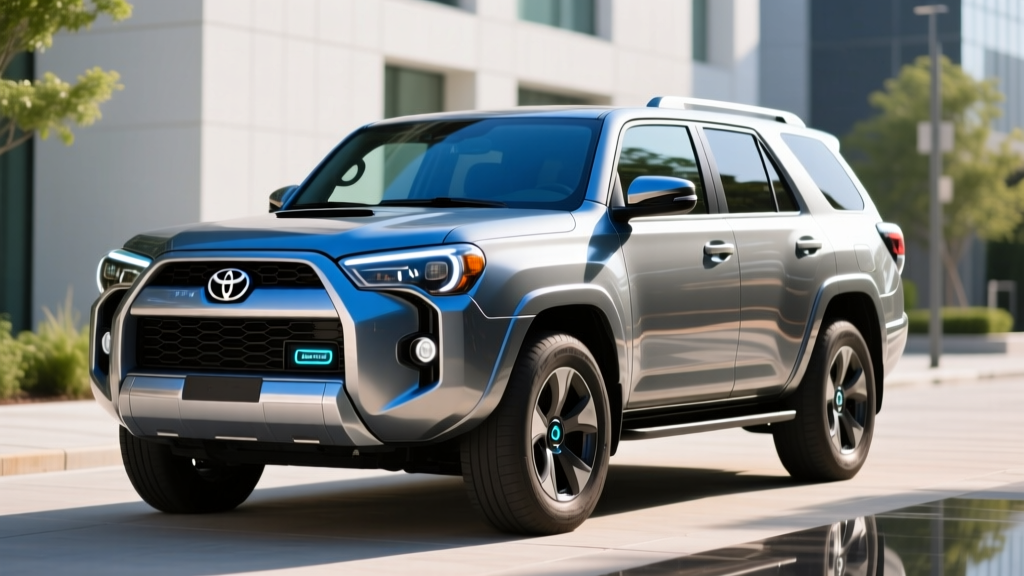
No. As of the 2026 model year, Toyota does not offer a fully electric (BEV) 4Runner. What Toyota does offer is the i-Force MAX hybrid powertrain, a gasoline-electric hybrid that pairs a 2.4-liter turbocharged four-cylinder with a 48-horsepower electric motor integrated into the transmission. The result: 326 horsepower, 465 lb-ft of torque, and an EPA-estimated 23–24 MPG combined depending on trim and drivetrain.
If you specifically want a zero-tailpipe-emissions electric SUV with 4Runner-like off-road capability, you'll need to look at alternatives like the Rivian R1S, the upcoming electric Jeep Recon, or the GMC Hummer EV SUV. But if your goal is better fuel economy without sacrificing the 4Runner's legendary off-road chops, the i-Force MAX hybrid is the most electrified 4Runner you can buy today.
2026 Toyota 4Runner i-Force MAX: Complete Spec Breakdown
| Specification | 2026 4Runner i-Force MAX |
|---|---|
| Powertrain | 2.4L turbo I-4 + electric motor (hybrid) |
| Combined Output | 326 hp / 465 lb-ft torque |
| Transmission | 8-speed automatic |
| Drivetrain | 4WD (part-time or full-time depending on trim) |
| EPA Fuel Economy (Combined) | 23–24 MPG (varies by trim) |
| EPA City / Highway | ~22 city / ~25 highway (TRD Off-Road) |
| Hybrid Battery | 1.87 kWh nickel-metal hydride (NiMH) |
| Towing Capacity | 6,000 lbs |
| 0–60 mph | ~6.5 seconds (estimated) |
| Starting MSRP (TRD Off-Road Hybrid) | ~$52,990 |
| Federal Tax Credit (§30D) | Not eligible (not a PHEV or BEV) |
| Hybrid System Warranty | 10 years / 150,000 miles |
The 1.87 kWh battery is small by EV standards—it's not designed to drive on electricity alone for meaningful distances. Instead, the electric motor provides torque fill at low RPMs, smooths stop-start driving, and enables modest regenerative braking. Think of it as a torque-boost system, not an electric range extender.
4Runner Hybrid vs. Gas vs. Electric SUV: The Real Cost Comparison
Let's put the 4Runner i-Force MAX in context. We'll compare it against the standard gas-only 4Runner, and two fully electric SUV alternatives that buyers cross-shop: the Rivian R1S Dual-Motor and the Kia EV9 GT-Line AWD.
| Metric | 4Runner Hybrid (2026) | 4Runner Gas (2026) | Rivian R1S Dual-Motor | Kia EV9 GT-Line AWD |
|---|---|---|---|---|
| Powertrain | HEV (hybrid) | Gas (i-Force turbo) | BEV (electric) | BEV (electric) |
| Horsepower | 326 hp | 278 hp | 533 hp | 379 hp |
| EPA Efficiency | 23 MPG combined | 20–21 MPG combined | 73 MPGe combined | 83 MPGe combined |
| EPA Range | ~460 miles (21-gal tank) | ~400 miles | 352 miles | 279 miles |
| Fuel/Energy Cost (5 yrs, 75k mi) | ~$10,870 | ~$12,500 | ~$4,500 (home charging) | ~$3,960 (home charging) |
| Starting MSRP | ~$52,990 | ~$42,490 | ~$79,900 | ~$64,900 |
| Federal Tax Credit | None | None | Up to $7,500* | Up to $7,500* |
| Off-Road Capability | Excellent | Excellent | Very Good | Moderate |
* §30D credit eligibility depends on buyer income caps ($150k single / $300k joint), MSRP caps ($80k for SUVs), and battery critical-mineral sourcing. Verify at IRS.gov before purchasing.
The takeaway: The 4Runner hybrid saves you roughly $1,600–$1,800 in fuel over five years compared to the gas-only model, but carries a $10,500 price premium at the entry point. The math doesn't pencil out purely on fuel savings—you're buying the hybrid for the extra torque, smoother drivetrain, and slightly lower emissions, not as a cost-saving measure. Meanwhile, the EV alternatives cost significantly more upfront but offer dramatically lower per-mile energy costs and instant torque.
Real-World Ownership: What 4Runner Hybrid Buyers Must Consider
Home Charging Is Irrelevant (and That's the Point)
The i-Force MAX is a conventional hybrid (HEV), not a plug-in hybrid (PHEV). You never plug it in. The small battery recharges through regenerative braking and the gasoline engine. For buyers who lack access to home or workplace charging—apartment dwellers, street parkers, or those in condos with no EV infrastructure—this is a major advantage. You get hybrid efficiency gains without any charging dependency.
Cold-Weather Performance
Unlike full EVs, which can lose 20–30% of EPA range in sub-freezing temperatures due to battery chemistry limitations and cabin heating demands, the 4Runner hybrid's fuel economy is only marginally affected by cold weather. Expect a 1–2 MPG drop in winter—consistent with any gasoline vehicle. The hybrid battery's NiMH chemistry is robust in temperature extremes, and Toyota has decades of cold-climate hybrid data from the Prius and Highlander Hybrid lineages.
Off-Road Integrity
Toyota engineers placed the hybrid battery under the rear cargo area, preserving ground clearance and approach/departure angles. The TRD Off-Road and TRD Pro trims retain Crawl Control, Multi-Terrain Select, and a locking rear differential. According to Toyota's official specifications, the hybrid system adds roughly 150 lbs over the gas powertrain—negligible for trail work.
Maintenance Expectations
Toyota's hybrid systems have proven extraordinarily durable. The Prius and Camry Hybrid have demonstrated battery longevity well past 200,000 miles in fleet and taxi service. The 4Runner's hybrid system carries a 10-year/150,000-mile warranty on hybrid-specific components. Oil changes remain on a standard gasoline schedule (every 10,000 miles with synthetic), and the regenerative braking system actually extends brake pad life by reducing friction-brake usage.
Cost Breakdown: 5-Year Ownership of the 4Runner Hybrid
| Cost Category | 4Runner Hybrid (5 yrs) | 4Runner Gas (5 yrs) | Rivian R1S (5 yrs) |
|---|---|---|---|
| Purchase Price (base) | $52,990 | $42,490 | $79,900 |
| Federal Tax Credit | $0 | $0 | –$7,500 (if eligible) |
| Fuel / Energy (75k miles) | $10,870 | $12,500 | $4,500 |
| Maintenance (est.) | $3,200 | $3,500 | $1,800 |
| Insurance (est. avg) | $9,500 | $9,000 | $12,000 |
| Depreciation (est. 5-yr) | ~$22,000 | ~$18,000 | ~$32,000 |
| Estimated 5-Yr Total Cost | ~$76,560 | ~$67,490 | ~$90,700 |
Estimates based on 15,000 miles/year, $3.50/gal regular unleaded, $0.14/kWh home electricity. Depreciation estimates based on historical Toyota 4Runner resale data (among the strongest in the industry per fueleconomy.gov). Actual costs vary by region, driving habits, and market conditions.
The 4Runner hybrid costs roughly $9,000 more over five years than the gas model, driven primarily by the higher purchase price that fuel savings can't offset. However, the 4Runner in any form holds its value exceptionally well—Toyota's resale value retention is among the best in the industry, which cushions the depreciation hit. The Rivian R1S, despite its fuel savings and tax credit, carries a much higher total cost due to its premium purchase price and steeper depreciation curve typical of newer EV brands.
Common Misconceptions About the 4Runner and Electrification
| Myth | Fact |
|---|---|
| "The 4Runner hybrid can drive on electric power alone." | The 1.87 kWh battery is too small for meaningful EV-only driving. The electric motor assists the gas engine—it does not replace it. Expect brief electric-only movement at very low speeds (parking lots, stop-and-go), not highway-capable electric range. |
| "You can plug it in to charge." | No. The i-Force MAX is a self-charging HEV, not a PHEV. There is no charge port. If you want a plug-in Toyota SUV, the RAV4 Prime (42 miles EV range) is the closest option in Toyota's lineup. |
| "The hybrid battery will need expensive replacement." | Toyota's hybrid batteries are warranted for 10 years/150,000 miles, and real-world data from millions of Toyota hybrids shows most last the vehicle's lifetime. If replacement is ever needed, expect $2,000–$4,000 for a refurbished unit—far less than an EV battery replacement. |
| "Toyota is behind on EVs, so the hybrid must be outdated tech." | Toyota's hybrid system is among the most refined and reliable in the world. While Toyota has been slower to adopt full BEVs, their hybrid technology represents decades of R&D. For buyers who need range certainty, off-road durability, and towing capacity, a proven hybrid can be more practical than a current-generation EV. |
| "An electric 4Runner is coming soon." | Toyota has not announced a fully electric 4Runner. Toyota's EV roadmap includes a three-row electric SUV (previewed by the bZ5X concept) and expanded bZ lineup, but no electrified 4Runner BEV has been confirmed. If it arrives, expect it no earlier than the 2028 model year based on Toyota's current product cadence. |
Decision Framework: Should You Buy the 4Runner Hybrid, Gas, or Go Electric?
Choose the 4Runner i-Force MAX Hybrid If:
- You need serious off-road capability and 6,000-lb towing but want the smoothest, most torque-rich 4Runner available
- You don't have access to home or workplace charging and don't want to depend on public DC fast-charging networks
- You regularly drive in remote areas (national forests, rural trails) where charging infrastructure is sparse or nonexistent
- You value Toyota's long-term reliability and resale value and plan to own the vehicle 8–10+ years
- The ~$10,500 hybrid premium fits your budget and you view the extra torque (465 lb-ft vs. 317 lb-ft gas) as worth the cost
Choose the Standard Gas 4Runner If:
- Budget is the primary concern—the gas model starts roughly $10,500 lower than the hybrid
- You drive fewer than 10,000 miles per year, making the fuel savings of the hybrid negligible
- You prefer the simplest possible powertrain with fewer components that could require service
Choose a Fully Electric SUV (Rivian R1S, Kia EV9, etc.) If:
- You have reliable home Level 2 charging (240V, 32A+ circuit) and want the lowest per-mile energy cost
- Your daily driving is under 250 miles and you road-trip infrequently (or are comfortable planning DC fast-charge stops)
- You qualify for the §30D federal tax credit (income under $150k single/$300k joint, vehicle MSRP under $80k for SUVs) and your chosen model meets critical-mineral sourcing requirements
- You prioritize instant torque, quiet operation, and zero tailpipe emissions
- Off-road use is light to moderate—the R1S handles trails competently, but the 4Runner remains the dedicated off-road tool
What First-Time Electrified Vehicle Buyers Should Know
If the 4Runner hybrid is your first step into an electrified powertrain, here's what to expect:
The transition is seamless. Unlike a full EV, the hybrid requires zero behavior change. You fuel it at gas stations as normal. The hybrid system operates transparently—you'll notice the engine shutting off at stops and a subtle electric assist during acceleration, but the driving experience is fundamentally that of a conventional SUV.
Regenerative braking feels different. The 4Runner hybrid uses mild regen to recharge its battery during deceleration. It's far less aggressive than the one-pedal driving you'd experience in a BEV. Brake pedal feel is normal and progressive—Toyota has tuned this system across millions of vehicles.
The hybrid battery is not a ticking time bomb. This is the single biggest misconception first-time hybrid buyers carry. Toyota's NiMH hybrid batteries have a demonstrated service life that routinely exceeds 200,000 miles. The 10-year/150,000-mile warranty provides substantial coverage, and replacement costs (if ever needed) are manageable compared to EV traction battery replacements, which can exceed $10,000–$20,000.
No tax credit applies. The §30D federal clean vehicle credit applies only to BEVs and PHEVs with sufficient battery capacity (at least 7 kWh for PHEVs). The 4Runner hybrid's 1.87 kWh battery doesn't qualify. Don't let a dealer tell you otherwise—verify credit rules directly at IRS.gov.
Frequently Asked Questions
What is the real-world fuel economy of the 2026 4Runner hybrid?
The EPA rates the TRD Off-Road i-Force MAX at approximately 23–24 MPG combined. In real-world mixed driving, owners typically report 21–23 MPG. Highway-only driving at 75+ mph will drop this to around 20–21 MPG, while city driving with frequent stops can push it toward 24–25 MPG thanks to regenerative braking. These figures represent a meaningful improvement over the gas-only 4Runner's 20–21 MPG combined.
Can the 4Runner hybrid tow as much as the gas version?
Yes. The i-Force MAX hybrid is rated for 6,000 lbs of towing capacity across applicable trims, matching the gas model. The hybrid's 465 lb-ft of torque actually makes it the more capable tow vehicle in practice, with stronger low-end pull for trailer launches and highway merging.
Is the 4Runner hybrid good for off-roading?
Absolutely. The hybrid system adds minimal weight (~150 lbs), and Toyota has preserved all key off-road hardware on TRD trims: locking rear differential, Crawl Control, Multi-Terrain Select, and ample ground clearance. The instant electric torque assist is actually beneficial on technical trails where precise low-speed control matters.
Will Toyota make a fully electric 4Runner?
Not in the current product cycle. Toyota has not announced a BEV 4Runner. Their near-term EV strategy focuses on the bZ series (bZ4X crossover, upcoming three-row bZ5X SUV). If an electric 4Runner arrives, industry analysts expect it no earlier than 2028–2029, likely on a dedicated EV platform rather than a converted version of the current body-on-frame architecture.
How does the 4Runner hybrid compare to the RAV4 Prime or Highlander Hybrid?
Different tools for different jobs. The RAV4 Prime is a PHEV with 42 miles of electric-only range and an EPA-estimated 94 MPGe—you can plug it in and drive on electricity for daily commutes. The Highlander Hybrid offers 35 MPG combined in a three-row family hauler. The 4Runner hybrid prioritizes off-road capability, body-on-frame durability, and towing at the cost of fuel economy. If you need a plug-in Toyota SUV, the RAV4 Prime is the answer; if you need a trail-capable rig, the 4Runner hybrid is the pick.
What happens if the hybrid battery fails out of warranty?
Toyota hybrid battery replacement costs range from approximately $2,000–$4,000 for a refurbished unit and $4,000–$6,000 for a new OEM battery, including labor. Independent hybrid specialists often offer refurbished batteries at lower cost. Given the demonstrated longevity of Toyota's hybrid systems, out-of-warranty failure is uncommon—but it's a known, manageable expense rather than a catastrophic one.