If you're researching electric supercars, the short answer is this: today's top-tier EV hypercars deliver 1,000+ horsepower, sub-2.0-second 0-60 times, and 200–300+ miles of EPA-rated range — but they cost $200,000 to $2.5 million+, are largely ineligible for the federal §30D tax credit due to MSRP caps, and demand careful planning around DC fast-charging access and battery thermal management during repeated hard launches. Unlike a gas supercar, you'll never pay for premium fuel or an oil change, but insurance, tire wear, and charging infrastructure logistics are very real ownership variables.
What Are Electric Supercars in 2026?
Electric supercars — sometimes called hypercar EVs — are low-volume, high-performance battery-electric vehicles that prioritize extreme acceleration, top speed, and track capability alongside the instant torque and low center of gravity that only a skateboard-style EV platform provides. Key players in 2026 include the Rimac Nevera, Lotus Evija, Pininfarina Battista, and the upcoming Tesla Roadster (announced, not yet in customer hands). These machines typically feature 80–120 kWh battery packs, all-wheel-drive tri- or quad-motor setups, and peak DC fast-charge rates of 250–350 kW.
Electric Supercar Specs: Range, Power, Charging, and Price
| Model | 0–60 mph | Top Speed | Battery (kWh) | EPA Range | Peak DC kW | 10–80% Time | Base MSRP |
|---|---|---|---|---|---|---|---|
| Rimac Nevera | 1.85 s | 258 mph | 120 kWh (NMC) | ~340 mi (WLTP; EPA est. ~300 mi) | 250 kW | ~19 min | $2,200,000 |
| Lotus Evija | <3.0 s | 200+ mph | 70 kWh (NMC) | ~260 mi (WLTP; EPA est. ~215 mi) | 350 kW | ~12 min | $2,300,000 |
| Pininfarina Battista | 1.89 s | 217 mph | 120 kWh (NMC) | ~300 mi (EPA est.) | 250 kW | ~20 min | $2,500,000 |
| Tesla Roadster (announced) | <1.9 s (claimed) | 250+ mph | ~200 kWh (claimed) | 620 mi (claimed, prelim.) | TBD | TBD | $200,000 (base, prelim.) |
Remember: kW is power (how fast you charge), kWh is energy (how much the battery holds). A 350 kW peak rate on the Evija means it can accept 350 kilowatts *at peak*, but like all EVs, the charge curve tapers sharply above ~80% state of charge to protect the battery. Real-world sustained averages are typically 60–75% of the peak number.
Electric Supercars vs. Gas Exotics: The Real-World Comparison
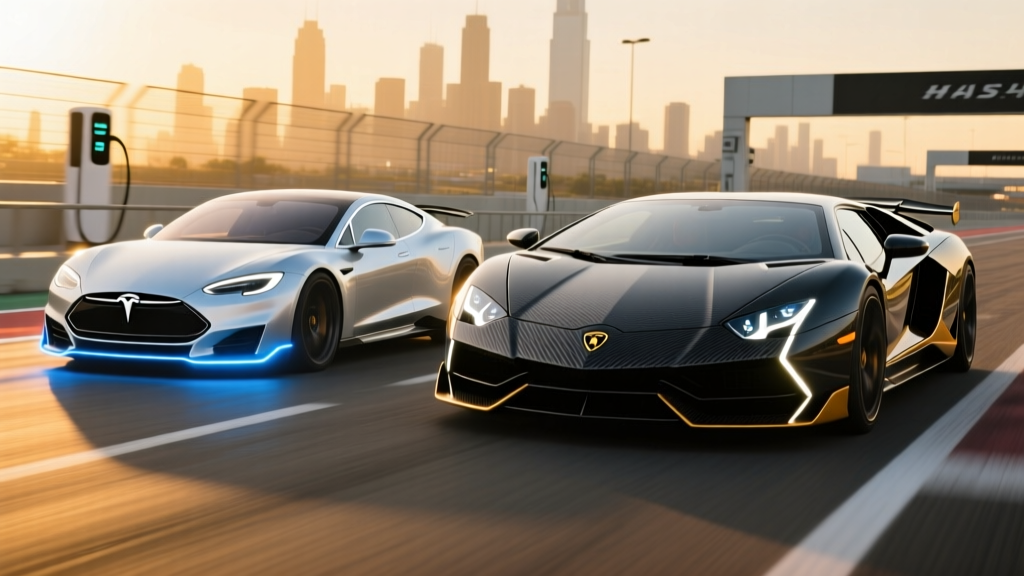
Stack a Rimac Nevera against a Lamborghini Revuelto or Ferrari SF90 Stradale, and the differences are structural, not just philosophical:
| Factor | Electric Supercar (e.g., Nevera) | Gas Exotic (e.g., Revuelto V12 hybrid) |
|---|---|---|
| Peak Torque Delivery | Instant, from 0 rpm | Ramp-up; peak above ~6,000 rpm |
| 0–60 mph | 1.85 s | ~2.5 s |
| Fuel/Energy Cost per Mile | ~$0.08–$0.14 (home L2) | ~$0.45–$0.70 (premium, 12 mpg) |
| Annual Maintenance | ~$500–$1,500 (tires, cabin filter, fluid top-offs) | $3,000–$8,000+ (valve, clutch, belts, fluids) |
| Service Network | Limited; fly-in technician or ship to factory | Established dealer network in major metros |
| Weight | ~4,700–5,000 lbs | ~3,700–4,100 lbs |
| Emissions (tailpipe) | Zero | High CO₂, NOx |
The EV wins on torque delivery, acceleration, per-mile energy cost, and tailpipe emissions. The gas exotic still wins on weight, top-end track stamina (EV batteries thermal-throttle after repeated hard laps), and service infrastructure. For street use and occasional drag-strip heroics, the EV is arguably the more usable exotic.
Real Ownership Costs: What a Supercar EV Actually Costs to Run
Purchase price is only the entry fee. Here's a realistic 5-year ownership cost sketch for a $2.2M electric supercar driven 3,000 miles/year (typical for the segment):
- Purchase: $2,200,000 (no §30D tax credit — the IRS caps eligible MSRP at $55,000 for sedans and $80,000 for SUVs/pickups/vans, and buyer income caps apply; see IRS §30D rules).
- Energy (5 yrs, 15,000 mi total): ~$1,200–$2,100 at $0.12/kWh home charging, assuming 3.0 mi/kWh.
- Gas exotic equivalent (15,000 mi at 13 mpg, $5.50/gal premium): ~$6,350.
- Insurance: $15,000–$35,000/year depending on driver profile, location, and agreed-value policy. Hagerty and similar specialty insurers are the norm.
- Tires: Michelin Pilot Sport Cup 2 or Pirelli P Zero Trofeo R sets run $2,500–$4,500 and may last 3,000–6,000 miles under hard use.
- Scheduled service: Minimal — cabin air filter, brake fluid check, coolant loop inspection. Budget $500–$1,500/year.
- Battery warranty: Typically 8 years/100,000 miles at 70% capacity retention threshold. Out-of-warranty pack replacement on a 120 kWh NMC pack: $40,000–$80,000.
Net energy savings vs. a gas exotic over 5 years: roughly $4,000–$5,000. That's real money, but it's a rounding error on a $2M+ purchase. Buyers in this segment are optimizing for performance and experience, not TCO.
Charging Logistics: The Hidden Ownership Variable
Home Level 2 charging at 11–19 kW (48–80A on a 240V circuit) is the baseline. A full 0–100% charge on a 120 kWh pack takes 7–11 hours overnight — perfectly practical for a garage-kept exotic. Installation of a hardwired Level 2 station (ChargePoint Home Flex, Tesla Wall Connector, or Emporia) typically runs $800–$2,500 including electrician labor and permits, assuming your panel has capacity. Older homes may need a $2,000–$5,000 panel upgrade to 200A service.
For road trips, plan around 250–350 kW DC fast chargers (Electrify America, EVgo, Ionity in Europe). At 250 kW peak, a 120 kWh pack adds roughly 150 miles in 15 minutes — but only if the battery is preconditioned (warmed to optimal temperature via the car's thermal management system) and you start below 20% SoC. Above 80%, charge rate drops steeply to protect cell longevity. Cold weather can cut effective range 20–35% and slow charging materially until the pack warms.
Charging deserts remain a real concern outside major corridors. If you live in rural Montana or the Dakotas, plan your grand-tour routes carefully — a dead Rimac in a town with only a 50 kW charger is a $5,000 flatbed ride.
Common Misconceptions About Electric Supercars
| Myth | Fact |
|---|---|
| "They'll get the $7,500 federal tax credit." | No. §30D has MSRP caps ($55k sedans, $80k SUVs/trucks), income caps ($150k single / $300k joint), and battery-sourcing rules. A $2M supercar is ineligible on price alone. |
| "EVs are maintenance-free." | There's no oil or spark plugs, but tires, brakes (fluid), cabin filters, coolant loops, and 12V batteries still need service. High-torque EVs burn tires faster than comparable gas cars. |
| "EPA range is what you'll actually get." | EPA is a standardized lab cycle. Expect 75–85% of EPA at sustained 75+ mph highway speeds, and 65–75% in sub-freezing weather. |
| "They're self-driving." | None of these cars offer anything beyond SAE Level 1 or basic Level 2 driver assist. You are the driver, always. |
| "Battery replacement is inevitable and catastrophic." | NMC packs in low-mileage exotics will likely outlast the car's useful life. Degradation is typically 8–15% over 8 years in mild climates. Warranty covers below-70% capacity. |
Decision Framework: Is an Electric Supercar Right for You?
Choose an electric supercar if:
- You want unmatched straight-line acceleration and instant torque response.
- You have a climate-controlled garage with a dedicated 60–80A Level 2 circuit.
- Your driving is primarily street, canyon, and occasional drag/roll-racing — not repeated hot-lap track days.
- You're comfortable with a small, specialized service network and potential fly-in technician visits.
- You accept the $2M+ price and $15k–$35k/year insurance as the cost of entry.
Stick with a gas or hybrid exotic if:
- You plan frequent track days where thermal stamina and lower weight matter.
- You live in a region with sparse DC fast-charging infrastructure.
- You want an established dealer/service network within 100 miles.
- Sound, emotion, and mechanical theater (V12, flat-plane V8) are central to the experience.
- You intend to drive 8,000+ miles/year and need quick refueling flexibility.
Frequently Asked Questions
Can I daily-drive an electric supercar?
Yes, with caveats. Range is sufficient for most commutes, and the instant torque makes city driving effortless. But ground clearance, wide tires, 20-foot doors, and a lack of frunk space (in most models) limit practicality. Most owners treat them as weekend/occasion cars.
How fast do electric supercars charge on a road trip?
At a 250–350 kW DC fast charger with a preconditioned battery, expect 10–80% in roughly 12–20 minutes, adding 150–220 miles per stop. Plan 20–30 minute breaks every 2–2.5 hours of driving.
Do electric supercars hold their value?
Low-production hypercars like the Nevera and Battista tend to hold or appreciate modestly, similar to limited-run gas hypercars. Depreciation data is still thin given the segment's youth. Broader-production EVs (Tesla, Porsche Taycan) have shown steep depreciation in the 2023–2025 window.
What happens if the battery fails out of warranty?
Replacement of a 120 kWh NMC pack is $40,000–$80,000 including labor. Most manufacturers offer module-level repair (replacing individual failed modules rather than the whole pack), which is significantly cheaper. Real-world failure rates are low — under 1% in mainstream EVs, per Consumer Reports data.
Are electric supercars safer than gas exotics?
Structurally, EVs have a low center of gravity (reducing rollover risk) and large front crumple zones (no engine block). However, these are low-volume cars that often aren't crash-tested by NHTSA or IIHS. High-voltage safety systems automatically isolate the battery pack in a collision. Treat them as equal to, not safer than, modern gas exotics until formal ratings exist.